Introducing Beckmann Transport Models (BTMs): a theoretical framework for a new class of generative models under the manifold hypothesis.
BTMs admit two complementary instantiations:
1. A one-step transport map learned directly — without jointly learning a velocity field.
2. A time-independent flow whose trajectories halt upon first hitting the data manifold.
Paper: https://t.co/k3HGrgacHt
Tutorial: https://t.co/d1yrGQYrn2
Joint work with @CoeurdouxF, @PPotaptchik, @msalbergo, @du_yilun, and Eric Vanden-Eijnden.
Thanks also to @sophia_tang and Franklin Wang for helpful experimental and presentation discussions.
I often hear that score/flow matching is "just regression"
It's not, and a lot of what we take for granted about generalization in deep learning doesn’t carry over to diffusion models:
New on our Frontier Red Team blog: using Claude to formally verify software at large scale.
Formal verification can prove that code is free of certain bugs, but historically it has only been feasible for small codebases (or required a lot of expert time).
With AI models, however, this is beginning to change. In collaboration with @theoremlabs, we used Claude to prove security properties in over one hundred real-world open-source libraries over the span of a few weeks.
Read our research in full here: https://t.co/zUyx8CjBEk
We now have state-of-the-art pre-trained base models in the 3T-parameter weight class, built entirely in-house at MAI.
Post-training results coming soon -- stay tuned!
Lots of details in our technical blog post.
https://t.co/xcZ5uV4TAp
Stratford is one of Europe’s great regeneration success stories. It’s ready for its next chapter - European rail links.
I’m proud to say I’m working with the government to deliver new cross-Channel trains from East London. The benefits would be felt far beyond our city.
https://t.co/Be82JOdR1f
🚨 We finally have a better understanding of how the different paradigms for discrete diffusion compare!
In new work with Liye Wang, we prove a quadratic separation between the parallel generation capabilities of uniform and Gaussian diffusion relative to unmasking! 1/
Thanks @ShiyiWangML and @_sophia_tang_ for porting BTM to discrete state space and trying out techniques in the FMLM literature over the summer.
It seems that BTMs can be made pretty competitive with flow maps on text!
The same can't be said for images yet :(
Still a lot to be understood empirically and theoretically!
Can we train a one-step discrete generator without a teacher model?
Introducing Discrete Beckmann Transport Models 🛸 — a new family of discrete generative models that provably carries any point in the latent space to a fixed point on the vertices of the simplex in a single step.
We achieve the diversity-coherence Pareto frontier for unconditional language modeling and SOTA few-step reasoning performance, with 84.6% accuracy in 4 NFEs on Sudoku-Hard and 16.8% in 32 NFEs on TinyGSM/GSM8K.
Joint work with @ShiyiWangML from my visit at Harvard!
Also, huge thanks to @msalbergo and @BrianLee794309 for the helpful discussions and guidance :D
More in 🧵
New preprint: Thinking with Looped Flows!
We show that stateful flows trained with both denoising and recurrence can serve as strong latent reasoners, outperforming past looped models on ARC-AGI-1 & 2.
uber driver (chinese woman) thought i was a college student
i said no, i just look young bc i'm asian
she said no, you look young bc you still have the light in your eyes
If fraud in academia is now considered to be no big deal, then why is an institution like Cambridge charging international students $US166,000 for a 3 year arts degree? What exactly are they paying for?
Excited to share what we have worked on for the past 6 months.
Can we really call masked diffusion an "any-order" model?
In our new work, we argue that off-the-shelf masked diffusion models have any-order predictive power but fail to reason in a 'genuinely any-order fashion'.
We introduce two models that do: LatentMDM and 7B-scale FlexMDM, extending our prior work. LatentMDM, our new latent-space masked diffusion, outperforms AR (with KV caching) on TinyGSM, at a matched inference budget. To the best of our knowledge, LatentMDM is the first model on the same setup to do so.
Joint work with co-first authors @seunggeun_kr, @tklll_tx, and Yuyuan Chen, and advisors @du_yilun, @ShamKakade6, and @sitanch.
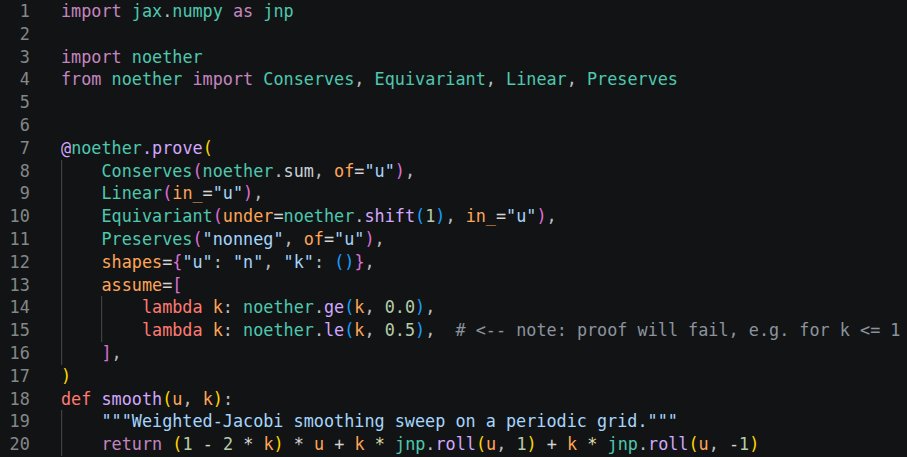
Formal verification should become a normal part of scientific computing.
As a step in that direction, I started prototyping the idea to automatically prove mathematical statements about your Python/JAX code in Lean.
https://t.co/gHg7j4n8If
Hey Lukas, thanks for you interest and pointing out the similarities to Equilibrium Matching. BTM is inspired by EqM, but they are not equivalent.
One central contribution of BTM is that it corrects a bias of EqM -- our objective is not identical to BTM: The EqM regression target is not derived from a valid interpolant. As a result, EqM cannot recover the data distribution exactly, which we do. Appendix J in our paper explicitly measured for this error in EqM.
Our theoretical framework also lead to new ways for few steps generation.
For the point of blurred probability mass, we make no such assumption, and our guarantee is exact.
Introducing Beckmann Transport Models (BTMs): a theoretical framework for a new class of generative models under the manifold hypothesis.
BTMs admit two complementary instantiations:
1. A one-step transport map learned directly — without jointly learning a velocity field.
2. A time-independent flow whose trajectories halt upon first hitting the data manifold.
Paper: https://t.co/k3HGrgacHt
Tutorial: https://t.co/d1yrGQYrn2
Joint work with @CoeurdouxF, @PPotaptchik, @msalbergo, @du_yilun, and Eric Vanden-Eijnden.
Thanks also to @sophia_tang and Franklin Wang for helpful experimental and presentation discussions.
That covers the main algorithms. The paper develops several additional theoretical results, including:
1. Connections to Equilibrium Matching and Poisson Flow
2. The transport cost of autonomous flow relative to standard flow matching
3. A characterization of the dynamics near the data manifold
— and much more.