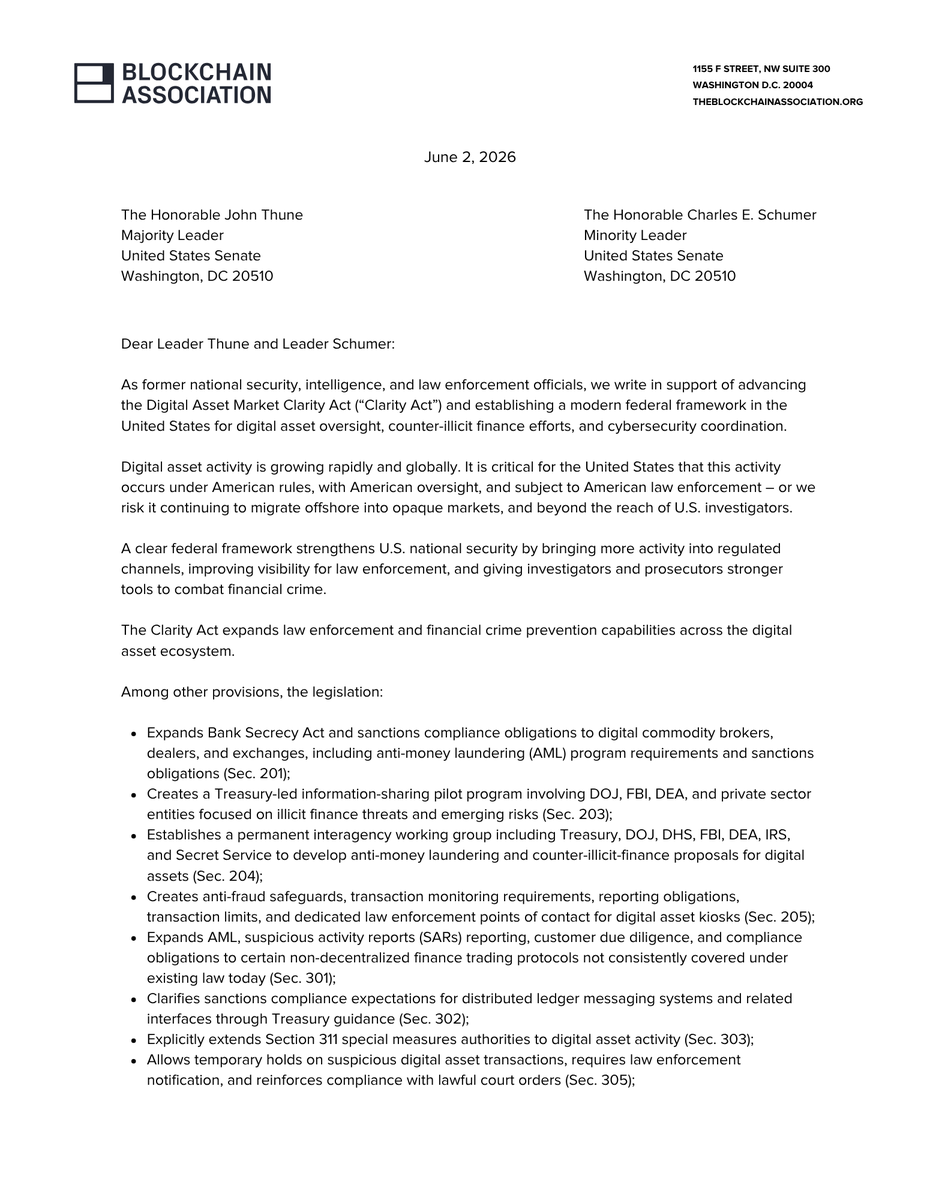
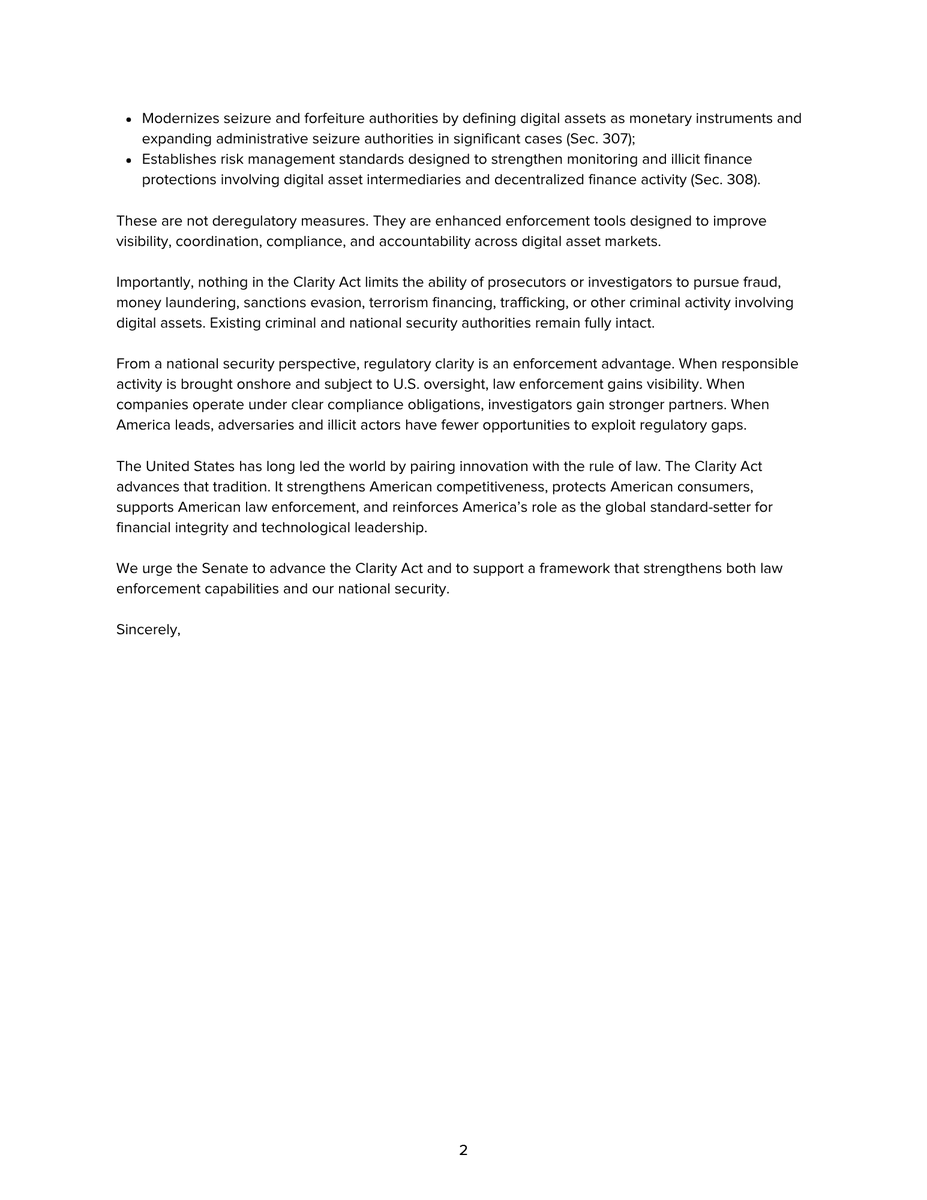
1/ Today, we’re sending a letter to Senate Majority Leader Thune and Senate Democratic Leader Schumer signed by 160 former national security, intelligence, and law enforcement professionals in support of the Clarity Act.
https://t.co/1lSQkoaaXI
Today a crazy quantum story just got wilder.
On March 31, the Google Quantum AI team published a landmark result on Shor's algorithm for elliptic curve cryptography. Technically, the paper was a bombshell: a dramatic 10x improvement over the state-of-the-art. As a stunt and wakeup call to the blockchain space, those optimisations were illustrated on secp256k1, the elliptic curve underlying Bitcoin and Ethereum signatures.
But perhaps the most striking part of the paper was sociological, not technical. Instead of following standard academic process, the optimisations were kept secret, hidden behind a zero-knowledge (ZK) proof. Google's accompanying blog post mentions they "engaged with the U.S. government". The ZK proof demonstrates the existence of algorithmic improvements without leaking details. Academic censorship with ZK, a historic first!
As a co-author of the Google paper I witnessed some of the context surrounding this censorship. To be honest, multiple aspects of that context don't sit well with me. As much as I believe the general public ought to know more, I am limited in my ability to whistleblow. Though let me be clear about one thing: the Google team's professionalism has been absolutely exemplary, and they deserve nothing but praise.
Censorship has a way of backfiring. The Streisand effect, where an attempt to bury something only draws more attention to it, is exactly what's unfolding today. First, Google's key optimisation has been rediscovered by the French. And in a thrilling turn of events, a collaborative Shor-at-home challenge just launched. The initiative, available at ecdsa[.]fail, breached a new Shor world record in a matter of hours.
Let's start with the rediscovery. Just two months after Google's paper, French quantum expert André Schrottenloher cracks the main secret optimisation. His paper, titled "Optimized Point Addition Circuits for Elliptic Curve Discrete Logarithms", landed on the arXiv today. Big congrats to André, who beat several other nerdsnipped experts to it. In a blog post also published today, Craig Gidney, the world expert on Shor optimisations, revealed that he'd been sitting on this very optimisation for a whole year under censorship pressure.
Interestingly, André missed a handful of minor optimisations, both from Google's original publication and from improvements found since. It's plausible there's still plenty of juice left to squeeze out of Shor, and this is exactly what the ecdsa[.]fail challenge is about. The verifier program developed for the ZK proof does double duty, automatically filtering for valid submissions. Dozens of compounding small and micro improvements are rolling in. As of the time of writing there's an 8.4% improvement to Google's circuit, as measured by the product of logical qubit count and Toffoli gate count. Nice!
The nerdsnipping ran deeper than anyone expected. Over the last few weeks it became clear it extended well beyond André and other quantum experts. Behind the scenes, a small army of amateurs quietly got to work. Inspired by Karpathy-style autoresearch, they turned AI on Shor. Ironically, the verifier program for the ZK proof makes an ideal reward function for AIs. The barrier to entry for this modern style of research is refreshingly low, with several non-experts, even a teenager, finding nice optimisations. Get in touch if you'd like to join a Telegram group with fellow autoresearchers :)
Part 2: neutral atoms and qday
The story doesn't end with Google. On the same day Google went public, a stealthy startup called Oratomic published its own Shor paper in a coordinated release. It made a splash, ultimately becoming the most upvoted paper on scirate[.]com, a website ranking arXiv papers.
Oratomic's claim was wild. By building on Google's logical optimisations and applying custom physical optimisations for neutral atoms, they claimed just 10K physical qubits were sufficient to run Shor's algorithm on secp256k1. That number is mind-bogglingly low.
Knowing essentially nothing about neutral atoms when Oratomic's paper landed, I was intrigued and decided to learn more about the tech. I fell straight down the rabbit hole and spent a couple hundred hours on the topic. I got a little obsessed and watched every YouTube video I could find and spoke to a bunch of experts.
My conclusion? The tech is real, very real. Even Google recently decided to start a neutral atom lab, a notable pivot from their sole focus on superconducting qubits. If you care about qday, i.e. the day a quantum computer will break the first piece of cryptography in production, neutral atoms demand your attention. I shared some of my learnings on Shor and neutral atoms in a 30min talk at the ZKProof cryptography conference. You can find it on YouTube by searching "zkproof neutral atom".
Here's an interesting observation about this duo of breakthrough papers: neither Google nor Oratomic say a word about what their results mean for qday. No timelines. Zero. Nada. That is especially baffling given that the whole point of whitehat quantum cryptanalysis is to inform qday estimations and help the general public make good decisions.
So let me attempt to partially fill the silence, similarly to what Scott Aaronson did in his April 29 post. Given everything I know, including scary non-public information, I now put the odds of qday by 2032 at 50%. 10% by 2030.
Anecdotally, the US government has its own date: 2035. Originating at the NSA and later adopted by NIST, it's when branches of the US government will be disallowed from using quantum-vulnerable cryptography. In plain language: with hindsight, that date is a joke and should be discounted entirely. I don't see how NIST avoids being forced to pull it forward by years.
Part 3: post-quantum cryptography
There are good reasons to sound the alarm today, but please do not panic. Rushing carelessly towards immature post-quantum cryptography is a recipe for disaster. IMO a good target date for migration is 2029, roughly 3.5 years out. 2029 happens to be the date selected by Google, Cloudflare, and the Ethereum Foundation.
These days most of my time goes to safely migrating Ethereum towards post-quantum cryptography as part of the broader lean Ethereum effort. There's a lot to do. We need to rip out and replace BLS signatures at the consensus layer, KZG commitments at the data layer, and ECDSA signatures at the execution layer.
The plan to get there is compelling, and is based on hash-based cryptography. Within the Ethereum Foundation we've developed a Swiss army knife called leanVM (github[.]com/leanEthereum/leanVM) powered by the magic of hash-based SNARKs. Thanks to truly exceptional work by Emile, Thomas, and others, its performance is derisked. Regarding security, leanVM is a jewel, a minimal zkVM crafted for end-to-end formal verification and maximum security.
Want to help? There are two $1M initiatives. First, the Proximity Prize (proximityprize[.]org). Solve a long-standing mathematical conjecture in coding theory, improve hash-based SNARKs, and go home a millionaire. Second, the Poseidon Initiative (poseidon-initiative[.]info), offers $1M for breaking Poseidon, the SNARK-friendly hash function.
Very thoughtful piece from a man who’s been on the inside of TradFi for decades and has brought his wisdom and perspective to the intersection of TradFi and Ethereum at Sharplink. He is a voice of reason and a steady hand. He’s built an outstanding team that can weather the lulls and capitalize on the surges.
The institutional group at Consensys is doing the work: bringing Ethereum to major global financial market infrastructure hubs and major financial institutions.
TradFi keeps choosing Ethereum, but TradFi doesn't announce that they're going to announce something. TradFi comprehensively covers the bases and then launches.
So Joseph's steadfast outlook is very well informed. The surge is coming.
Big news🚨— South Korea's Hana Bank acquired $670 million stake in Upbit (Dunamu)
In the disclosure, Hana said it aims to become more competitive in the new era of finance.
Hana is one of the largest financial institutions in Korea, making $2.7 billion in net profit last year.
This news (along with OpenAI saying the same) ends the capital flows in secondary markets which is good for all other risk markets.
If you were thinking about that AI SPV investment, now you need to find something else to invest that money in.
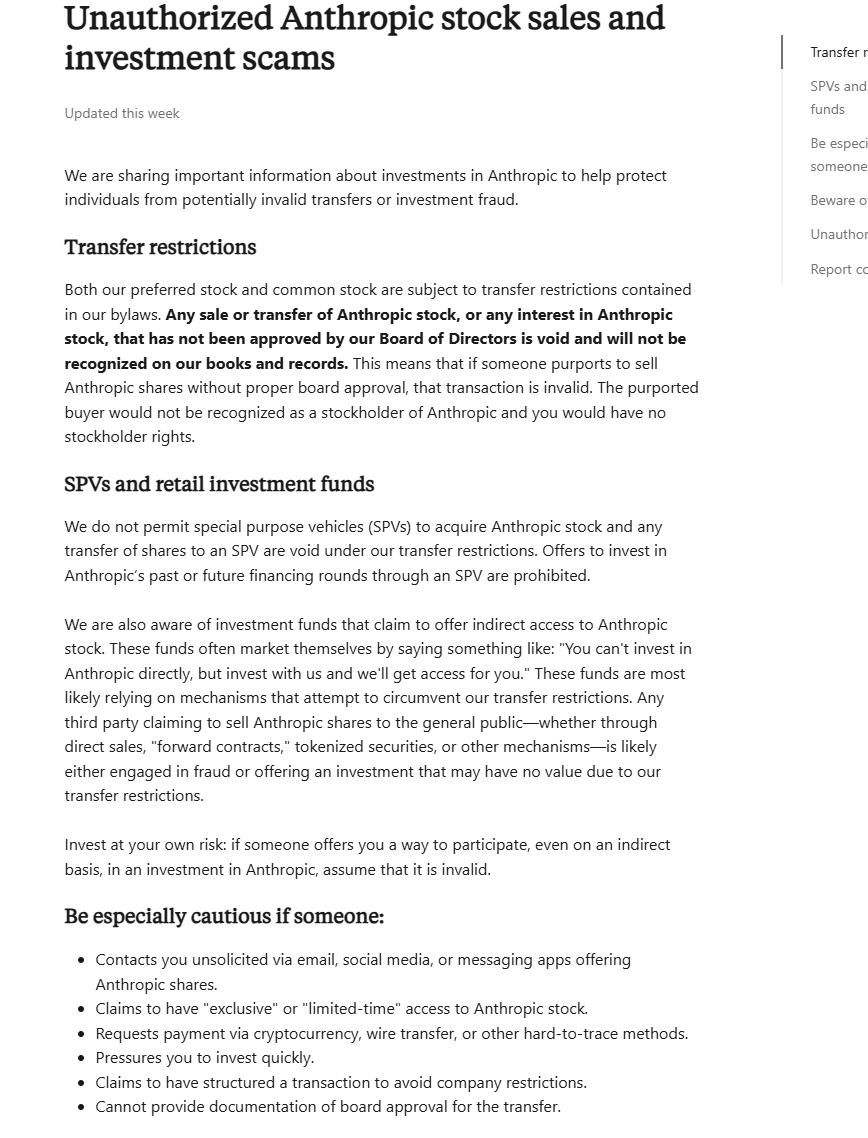
I am surprised more people are not paying attention to this update from Anthropic on its stock policy. This seems like a potential bombshell.
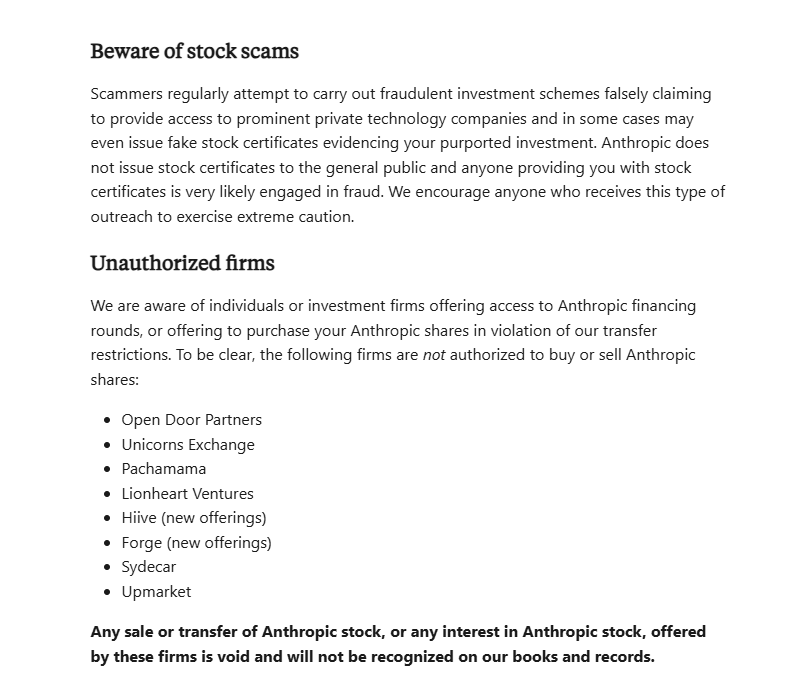
There is an active secondary market purportedly in Anthropic stock or derivatives including on fairly reputable (or at least well-known) platforms like Forge. Anthropic is calling them out *specifically*, by name, and essentially *saying* 100% of these are illegal.
Some may be frauds (people selling Anthropic stock or interests in Anthropic stock that they don't truly own), but more likely many are legit attempts at transferring Anthropic equity (directly, as SPV shares, or as some type of 'beneficial interest' or future, etc.)
Anthropic appears to be saying it will treat all these transfers as void. I don't have access to their terms, but it's very interesting to think what this could mean. Do the 'first purported sellers' in the chain potentially have an opportunity to do a double-dip? Does the first seller and all downstream buyers get the entire entitlement nuked?
Anthropic is threatening that--are they just bluffing? If they're not bluffing, what litigation is likely to ensue? This can get into really esoteric areas of corporate law that depend on exactly how the transfer restrictions are drafted as well as the language around how violations of transfer restrictions are treated--for example, if they are merely voidABLE then downstream buyers can assert various equitable claims/defenses, but if they are VOID ab initio then in some jurisdictions that forecloses equitable defenses.
SUI's pump this weekend has commonly been attributed to SUI Group Holding staking their $SUI treasury. This was announced on their earnings call on May 7 but, sure, maybe there was just a delayed market reaction. More importantly, though, headlines about removing supply from the liquid market and some news orgs even calling it a "liquidity crisis" is ridiculous because $SUI can be unstaked immediately so liquidity is mostly unchanged.
I'm bullish SUI but SUIG staking their SUI doesn't change market liquidity.
What’s behind $SUI’s recent +50% move? (Explored with Santiment MCP + Claude):
📈 Price: $0.92 baseline → $1.39 peak (May 10) → $1.26 now. Trading volume surged from $213M to $2.5B.
🔒 The trigger: SUI Group Holdings (NASDAQ: SUIG) transferred its entire 108.7M SUI treasury from DeFi protocols into direct staking on May 10, removing ~2.7% of supply from liquid float, on top of ~74% of SUI already staked.
🏛️ Two more catalysts compounding: CME Group SUI futures launching May 29 (only the fifth L1 with regulated derivatives access), and Paga partnership for cross-border African payments.
📊 Social dominance during the rally: 0.13–0.15%. Below the 0.38% spike that preceded the move.
The conversation isn’t outrunning the price.
Institutional supply locks driving a rally look different on-chain than retail FOMO.
new report from @OpenZeppelin pits the 6 biggest smart contract L1s against each other for fitment with tokenized RWAs
the results highlight why @MetaLeX_Labs picks Ethereum for its onchain-maxi securities tokenization protocol:
→ Zero full outages in 10+ years. Every other chain has halted.
→ ~$50.7bn cost to finalize a fraudulent transaction, more than 2x the runner-up.
→ Multi-client diversity at both execution and consensus layers. Every other network runs one dominant client.
→ Lowest insider genesis allocation (~17%).
→ Multi-team, deliberative governance. No single entity can push protocol changes unilaterally.
→ The most active post-quantum research program in the industry.
When the chain state transition function *is also* a legal state transition function, these stop being preferences and start being requirements.
Let's start with $BTC. Sorry for the delay.
Let’s do some simple math around $BTC, saylor and $STRC . Total purchased bitcoin so far for $MSTR is 88,568. Total holdings have reached 818,334 with a goal of hitting at least 1m by eoy. The average is around 730 BTC per da. It’s a rough average and varies slightly..
There are 450 BTC mined per day. So in the same period of purchases 40,500. Strategy is currently on pact to buy 1.6x the supply mined. So one single corporate buyer of BTC has bought more than DOUBLE the btc created in this period.
Obviously, at some point something has to give. In the past year I’ve not taken many BTC trades and have been more focused on stocks. Only trading 85k to 92k. 68k to 76k. However. I think once BTC clears the mid 80’s and holds the chances of seeing new highs are quite high. And thus I’ve made new purchases and plan to hold that for the foreseeable future. I’ll do a little weekly update around this. Any increased buying from ETF’s from here will have an outsized impact imo.
In terms of probabilities, I think the lows are in and we could see BTC trade as high as $180k between this year and next.
The confirmation for that imo is likely holding the mid 80k's short term as the signal for momentum to begin.
Over the past few years, I’ve woken up to random @CoinDesk articles shitting on our industry, and specifically NFTs.
That alone wouldn't bother me. Criticism is healthy. The press should hold this space accountable.
But while Coindesk takes $ 300k+ to write glowing “research” around companies in crypto, they also write ragebait headlines that shit on the same industry.
Pretty annoying to see.
It’s bad journalism to ask for $ 300k+ for an article, and if we don’t pay, you write negatively about us.
There are so many other news outlets actually trying to make it by covering bright stories in our industry.
There are so many other twitter spaces and communities that show up daily to move the space forward.
But what Coindesk is doing can’t be a sustainable model.
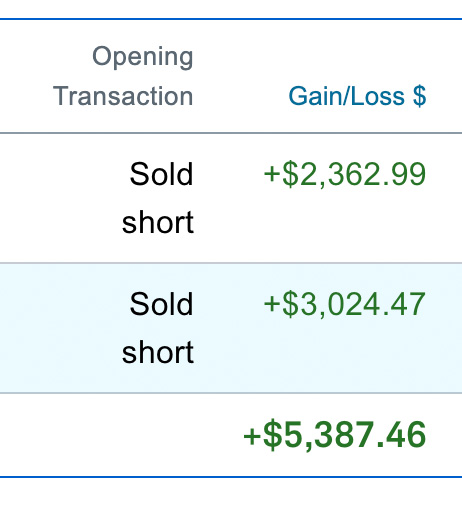
So a few weeks ago I opened up a short position on Coindesk’s parent company, Bullish.
This isn’t about money, it’s about principle.
The principle: you can’t hurt our community for your corporate gain.
Why can a business shit on an industry it participates in and still aim to profit within it?
Well, it can’t.
That was my bet anyway.
I’ve now closed the short up $5,387.46.
To be clear: the position is closed. Nothing I write here profits me from a trading standpoint. The trade is over. What's left is the principle.
I will use the money to take Bored Apes out to dinners, or Laker Games, or whatever the fuck I want - and every time I do, I will post an entire article about how I got the money (shorting Coindesk) and why I think Coindesk’s current approach is bad for our industry.
Congrats Coindesk, you’re now at war with a fucking psycho.
I will relentlessly bearpost this behavior until a representative reaches out to me and assures me that they’re going to knock this shit off.
Every Defi protocol should have:
1. Circuit breakers for deposit and withdrawals, and possibly other internal operations as well
2. Timelocks for any change
3. Security councils that can shut down protocols immediately
We don't need insurance, we need to do start doing the ffcking basics correctly. It's too early for this space to drive without any training wheels.
I beg you, sacrifice a tiny bit of UX to gain a lot of peace of mind. The worst possible UX is losing your user's money.
Blockchains still broadcast every transaction publicly. Every stablecoin payment leaks the amount, the sender, and the recipient.
We’re excited to share that Tempo is building Zones for businesses that need privacy: private blockchains that are interoperable with the rest of Tempo for stablecoin use cases like payroll, treasury, and settlement.
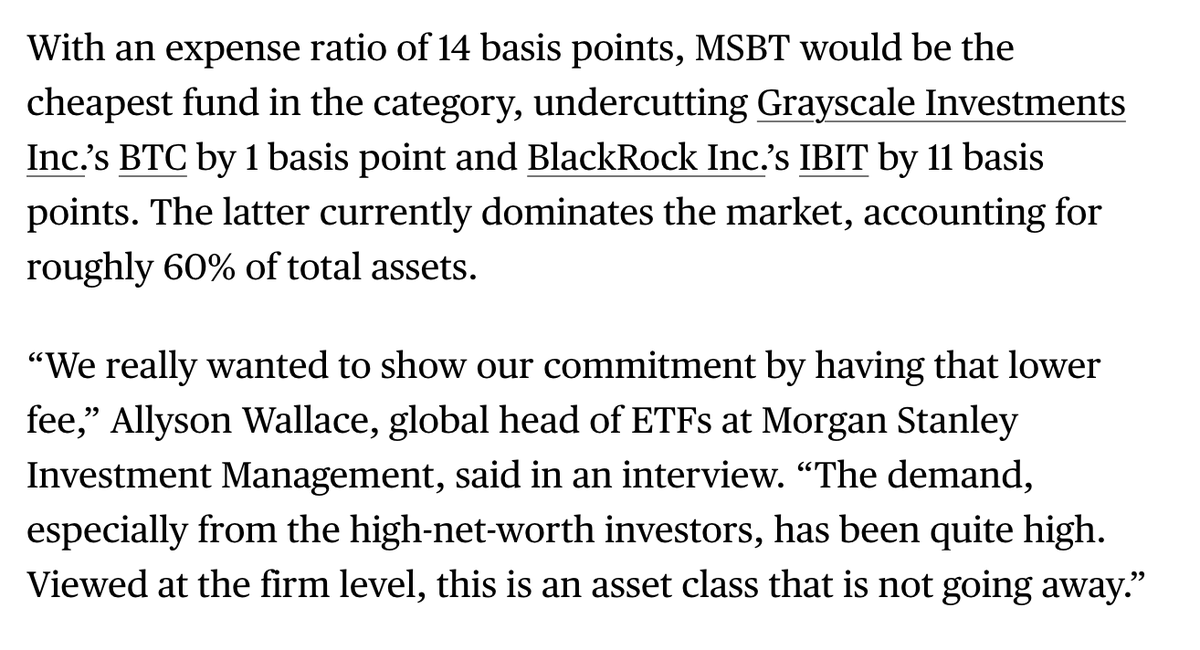
BIG: “We really wanted to show our commitment by having that lower fee,” Allyson Wallace, global head of ETFs at Morgan Stanley. “The demand, especially from the high-net-worth investors, has been quite high. Viewed at the firm level, this is an asset class that is not going away.” -- Nice intv w/ Ally (ex BlackRock btw) and article on $MSBT today from @isabelletanlee