There's a lot of confusion about the recently patched Zcash bug. Here's how to actually understand it.
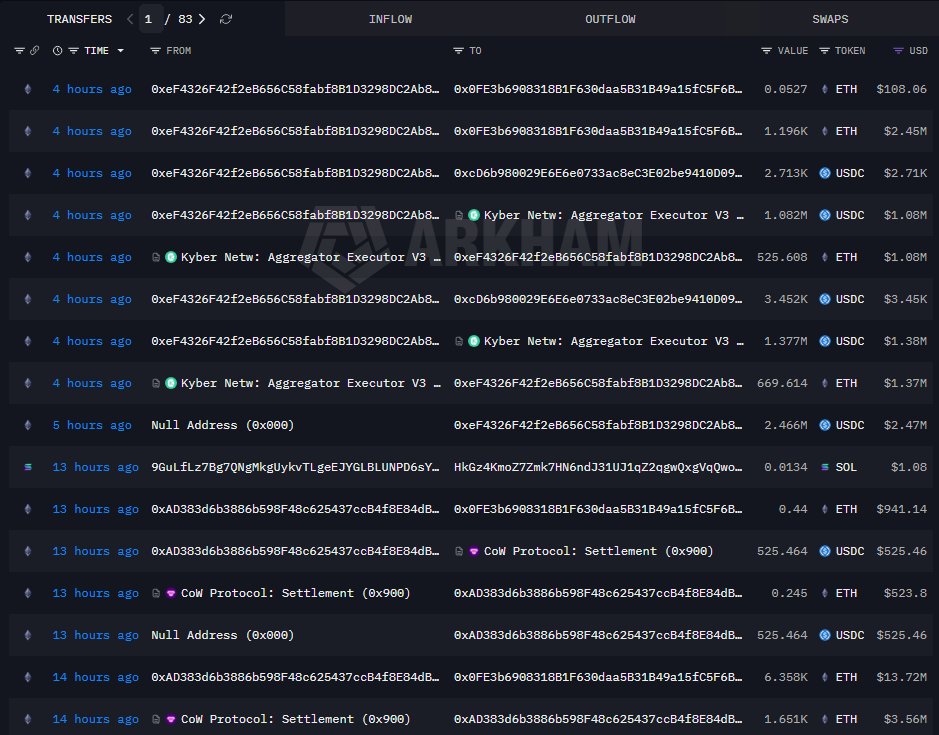
If the bug had been exploited before the patch (very unlikely it was), it would have looked like the shielded pool getting drained. Whoever minted the counterfeit shielded ZEC would want to sell fast, before anyone else found the same bug. And remember, the market for ZEC is almost entirely transparent ZEC, not shielded. You can't dump freshly minted shielded ZEC on Binance or Coinbase without unshielding it first.
The losers in that scenario are shielded holders who sit still. The transparent portion of Zcash is fully visible, so it's trivial to enforce that transparent ZEC never exceeds max supply. If you try to unshield more than the cap, you'll get stopped at the door.
So if you hold transparent ZEC (anyone trading, on an exchange, or doing price discovery on ZEC) there's no marginal effect on you. The loss falls entirely on shielded holders.
The team's next step is a new turnstile and a fresh shielded pool in the coming upgrade, which will confirm the shielded pool was not inflated. Think of it as taking headcount at the end of the field trip--that will make sure no extra kids snuck onto the bus.
But while AI found this bug, AI will also deliver the fix for the whole category: formal verification. I'm very bullish on this as the path to harden all software across the industry. Formally verified cryptography can't have implementation bugs by construction.
Right now AI is surfacing vulnerabilities across all our software--browsers, OSes, and blockchains are no exception. We're in the awkward adolescence where every wart is getting magnified and put on full display. But formally verified software is the only path forward for mission-critical software, and Zcash has put it front and center on their roadmap to deliver.
Privacy is too important not to.
(Dragonfly holds $ZEC and continues to. I'm personally an investor in ZODL.)
We've raised $65 billion in Series H funding at a $965 billion post-money valuation, led by @AltimeterCap, Dragoneer, @Greenoaks, and @sequoia.
This investment will help us advance our research and expand our capacity to meet growing demand for Claude.
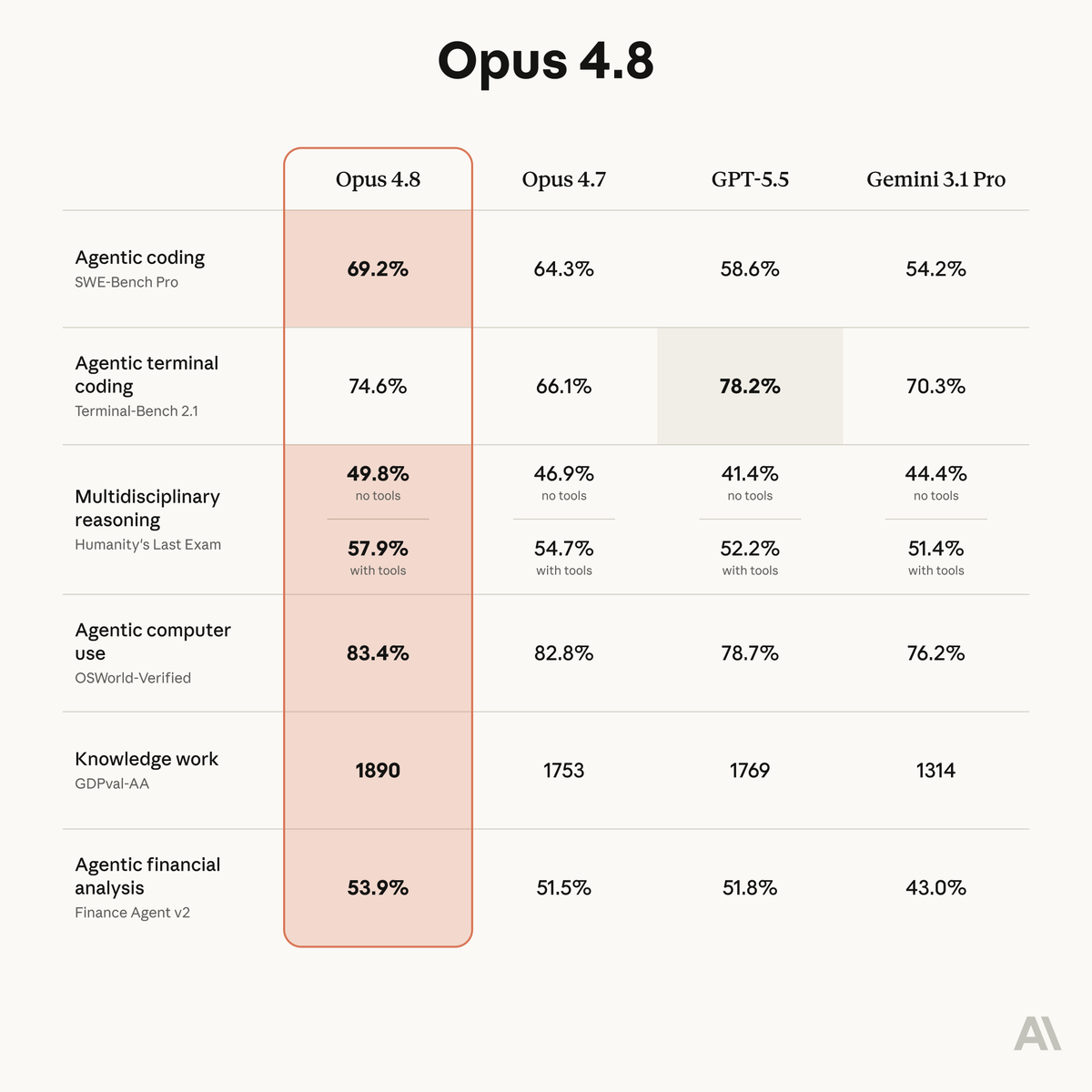
Introducing Claude Opus 4.8: it builds on Opus 4.7 with sharper judgment, more honesty about its own progress, and the ability to work independently for longer than its predecessors.
Available today at the same price.
I just got back from SF and I FEEL INSPIRED.
I spent 5 days with frontier AI model teams, AI startup founders, and 3 billionaires.
My takeaways:
1. I had lunch with 3 billionaires. All of them are buying SaaS companies and rebuilding them agent-first. They were deeply inspired by Bending Spoons and Ryan Cohen's eBay deal. Buy the company, cut the headcount, rebuild the tech, add agents, add features, make more valuable experience, raise prices.
2. The frontier model companies are hungry for usage data from the field. They can see API calls and token counts. They can't see the actual workflows. If you're deep in a niche using these models in ways the model companies haven't seen, that understanding is incredibly valuable. Usage intelligence is the new alpha.
3. Consumer AI is massively underbuilt. Every billboard in SF is either B2B inference infrastructure or vertical agent companies. The entire city is optimized for enterprise. Meanwhile you have companies like Cal AI doing $50M ARR in 18 months as a consumer app. I met with a cool few teams doing consumer AI (@paulscherer / @ekuyda)
4. MCP came up in literally every conversation. The companies exposing their product as MCP endpoints are getting pulled into deals they never pitched for. The ones that aren't are becoming invisible to agents. This is the new SEO. If agents can't find you, you don't exist. Building products for agents is the new zeitgeist in general.
5. Not uncommon for hot seed rounds to be $25-50 million valuations. I saw a Series A at $450 million
6. If I had a dollar every time someone mentioned "forward-deployed engineer" this trip I could have funded a seed round. It's the hottest role in SF right now. The person who sits between the agent and the customer, making sure everything actually works.
7. The mood around open source shifted. A year ago it felt like open source was chasing the frontier models. Now founders are telling me Gemma and DeepSeek are good enough for 80% of what they need at a fraction of the cost. The "which model do you use" conversation is being replaced by "which model for which task." Model loyalty kinda feels dead.
8. Voice agents came up more than I expected. Multiple founders told me voice is the interface for the next billion users. The billion people who will never type a prompt will absolutely talk to one.
9. The Obsidian community in SF is weirdly intense. Multiple founders showed me their vaults unprompted. Like showing someone your home gym. It's a flex now. The quality of your knowledge base (second brain?) is becoming a status symbol among builders.
10. Maybe it was just the people I met but the age of the founders is shifting. I met more founders over 40 this trip than any trip before and more founders under age 21 than ever before. Founders getting older and younger at the same time.
11. I spoke to a lot of fast-growing startups, VCs and frontier models who are hiring content creators right now.
12. The restaurant scene in SF is actually better than it's been in years. Founders are going out more. Alcohol is out, not surprisingly.
13. SF doesn't feel like the only place anymore. We all have access to the same frontier models. We all read the same X feed. A founder in NYC or Lagos is calling the same APIs as a founder in SoMa. So in the past it felt like SF was always lightyears ahead, doesn't feel that way anymore. It's okay not to live in SF and have BIG DREAMS.
14. The coworking spaces in SF are half empty but the coffee shops are packed. People want to be around people. I had a few startup ideas here....
15. Walking around the Mission I noticed something: the street-level businesses, the taquerias, the barbershops, the laundromats, none of them use any AI at all.
16. I heard the phrase "agent debt" for the first time. Like technical debt but for agents. When you hack together an agent workflow fast and never clean it up, the system prompts conflict, the memory gets polluted, the tools overlap. 6 months later the agent is doing weird things and nobody knows why lol.
17. Met a few people who carry two phones now. One for personal. One that's basically an agent terminal running Telegram or iMessage connections to their agent fleet.
It's always amazing to get that dose of inspiration in SF. I FEEL INSPIRED.
But I'm so happy to be back home, locked in and building.
We're 12-18 months into a shift that will take 15 years to play out. The urgency in every conversation was real.
What an incredible time to be building.
This is crazy. The hacker installed a dead-man's switch that will wipe your computer if you revoke the GitHub token they stole from you. Revoking the token is what triggers the wipe.
Coinbase fired 14% of their employees because of AI
Reducing management layers
No pure managers, only player-coaches - getting hands dirty together
Lean teams, AI native people only
Non-tech people are writing code (this is a scary part from security perspective)
If your company doesn't have an AI mandate and getting everyone to vibe coding level by EOY, you're late
This is an email I sent earlier today to all employees at Coinbase:
Team,
Today I’ve made the difficult decision to reduce the size of Coinbase by ~14%. I want to walk you through why we're doing this now, what it means for those affected, and how this positions us for the future.
Why now
Two forces are converging at the same time. We need to be front footed to respond to both.
First, the market. Coinbase is well-capitalized, has diversified revenue streams, and is well-positioned to weather any storm. Crypto is also on the verge of the next wave of adoption, with stablecoins, prediction markets, tokenization, and more taking off. However, our business is still volatile from quarter to quarter. While we've managed through that cyclicality many times before and come out stronger on the other side, we’re currently in a down market and need to adjust our cost structure now so that we emerge from this period leaner, faster, and more efficient for our next phase of growth.
Second, AI is changing how we work. Over the past year, I’ve watched engineers use AI to ship in days what used to take a team weeks. Non-technical teams are now shipping production code and many of our workflows are being automated. The pace of what's possible with a small, focused team has changed dramatically, and it's accelerating every day.
All of this has led us to an inflection point, not just for Coinbase, but for every company. The biggest risk now is not taking action. We are adjusting early and deliberately to rebuild Coinbase to be lean, fast, and AI-native. We need to return to the speed and focus of our startup founding, with AI at our core.
What this means
To get there, we are not just reducing headcount and cutting costs, we’re fundamentally changing how we operate: rebuilding Coinbase as an intelligence, with humans around the edge aligning it. What does this mean in practice?
- Fewer layers, faster decisions: We are flattening our org structure to 5 layers max below CEO/COO. Layers slow things down and create coordination tax. The future is small, high context teams that can move quickly. Leaders will own much more, with as many as 15+ direct reports. Fewer layers also means a leaner cost structure that is built to perform through all market cycles.
- No pure managers: Every leader at Coinbase must also be a strong and active individual contributor. Managers should be like player-coaches, getting their hands dirty alongside their teams.
- AI-native pods: We’ll be concentrating around AI-native talent who can manage fleets of agents to drive outsized impact. We’ll also be experimenting with reduced pod sizes, including “one person teams” with engineers, designers, and product managers all in one role.
In short: AI is bringing a profound shift in how companies operate, and we’re reshaping Coinbase to lead in this new era. This is a new way of working, and we need to leverage AI across every facet of our jobs.
To those who are affected
I know there are real people behind these decisions — talented colleagues who have poured themselves into this company and our mission. To those of you who will be leaving: thank you. You’ve helped build Coinbase into what it is today, and I am sincerely grateful for everything you've done.
All impacted team members will receive an email to their personal account in the next hour with more information, and an invitation to meet with an HRBP and a senior leader in your organization. Coinbase system access has been removed today. I know this feels sudden and harsh, but it is the only responsible choice given our duty to protect customer information.
To those affected, we will be providing a comprehensive package to support you through this transition. US employees will receive a minimum of 16 weeks base pay (plus 2 weeks per year worked), their next equity vest, and 6 months of COBRA. Employees on a work visa will get extra transition support. Those outside of the US will receive similar support, based on local factors and subject to any consultation requirements.
Coinbase prides itself on talent density. Our employees are among the most talented people in the world, and I have no doubt that your skills and experience will be highly sought after as you pursue your next chapters.
How we move forward
To the team that is staying, I know this is a difficult day. We’re saying goodbye to colleagues and friends you've been in the trenches with. But here’s what I want you to know as we move forward together:
Over the past 13 years, we have weathered four crypto winters, gone public, and built the most trusted platform in our industry. We’ve made it this far by making hard decisions and by always staying focused on our mission. This time will be no different – nothing has changed about the long term outlook of our company or industry. And most importantly, our mission has never been more important for the world. Increasing economic freedom requires a new financial system, and we’re building it.
The Coinbase that emerges from this will be more capable than ever to achieve our mission.
Brian
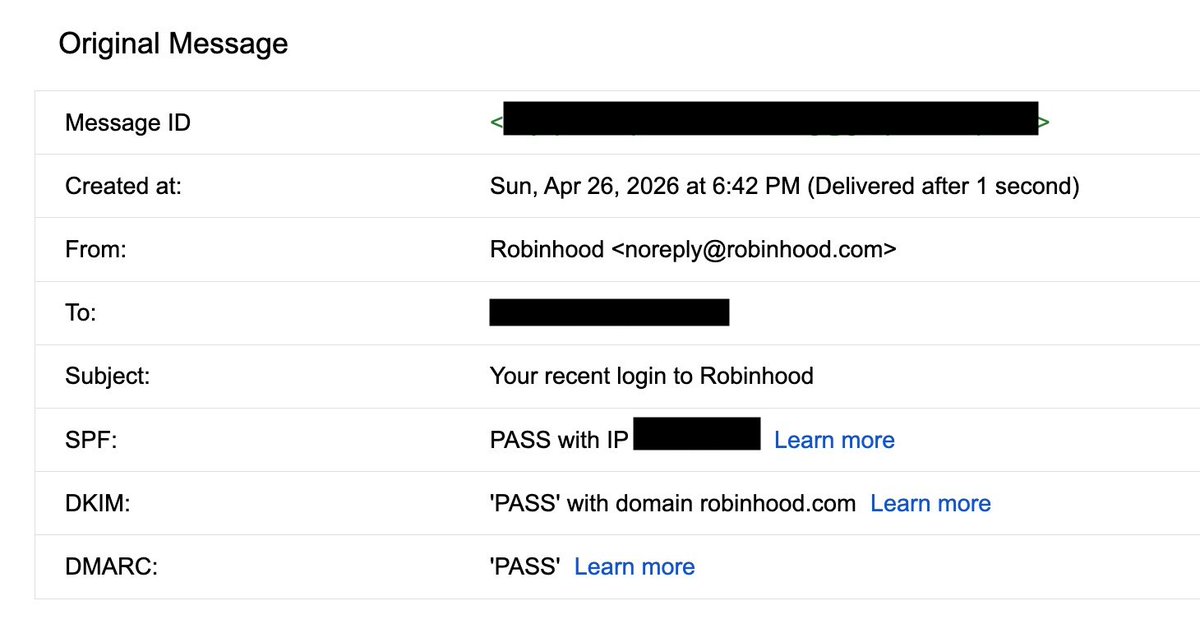
New Robinhood phishing chain that's kinda beautiful:
1. Attacker creates an RH account using the Gmail dot trick of your email (same inbox, different address)
2. Sets device name to HTML
3. RH's "unrecognized activity" email renders the device name unsanitized (html injection)
The result is a real email from [email protected], DKIM pass, SPF pass, DMARC pass, with a phishing CTA
Just because it's real, doesn't mean it's safe... $HOOD
"so you staked your ETH on the Ethereum blockchain to earn yield?"
"yes, Dave"
"except you didn't want your capital to be locked up so you actually staked it with a liquid staking protocol called Lido?"
"that's correct, Dave"
"and Lido gave you a liquid staking receipt token called stETH in return?"
"yes, Dave"
"and then you didn't think that was enough, so you juiced the yield even further by depositing your stETH receipt tokens into a restaking protocol called Eigenlayer?"
"you are correct, Dave"
"and now you didn't want to lock up your capital, so you actually restaked with a liquid restaking protocol called KelpDAO who provided you with a liquid restaking receipt token called rsETH?"
"you got it, Dave"
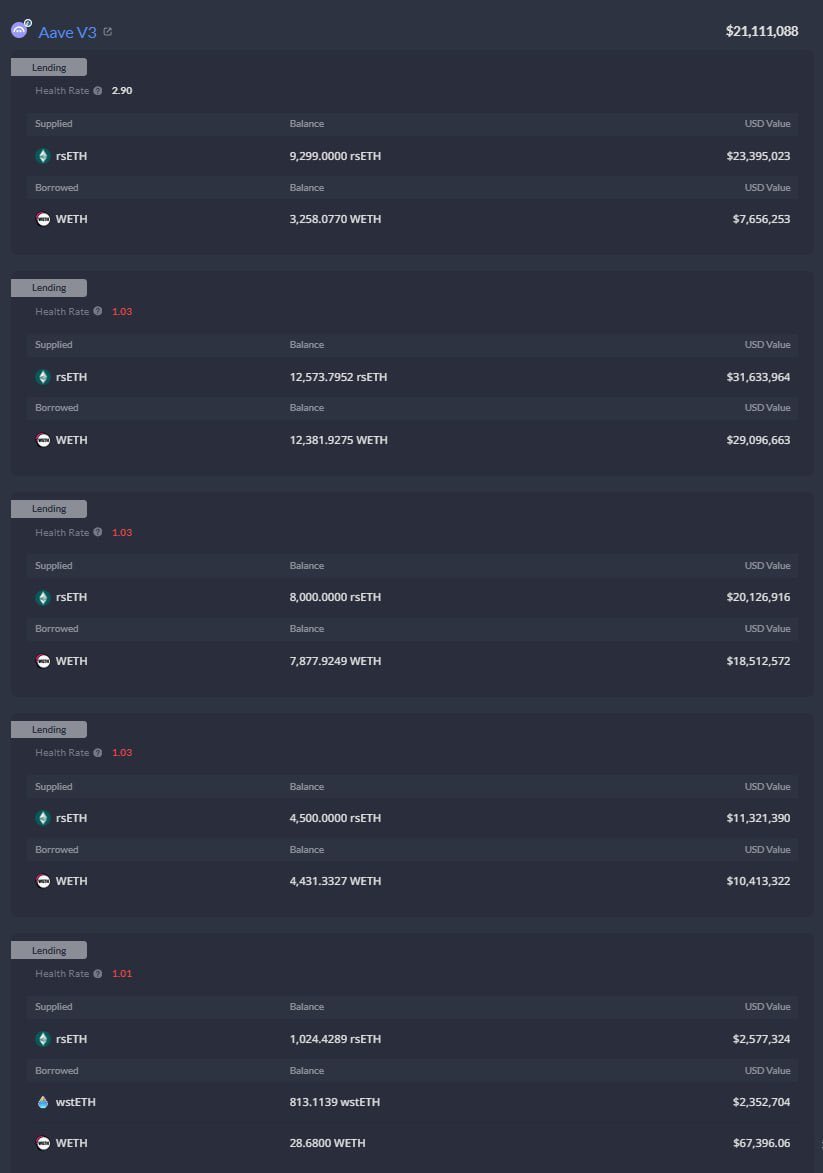
"and then that was surely not enough juice, so you then deposited your rsETH tokens into a lending protocol called AAVE so that you could open a leveraged looping position that borrows ETH against the rsETH collateral and restakes the ETH into rsETH which is then deposited as collateral, except it turns out rsETH used a cross-chain bridge called LayerZero whose security is held together by a 1/1 toothpick, which was obviously hacked by north koreans causing rsETH to become undercollateralized and now these looping positions are stuck and unprofitable, and everyone is pointing fingers at each other, and also DeFi is a very serious industry"
"you are 100% correct, dave"
jfc.
In crypto and defi (ie in honest markets), when a component fails, those closest to the component—whether wildly negligent or innocent victim—suffer the loss, and are burdened with that responsibility. Unequal, but proper.
In tradfi and banking (ie in coercively manipulated markets), when a component fails, the entire society is forced under the burden of its resolution. Costs are socialized. Equal, but improper.
The former, with time, becomes self-correcting, self-improving, and crucially, retains vitality. The latter, regardless of time, becomes stagnant and soulless, and here everyone can wallow in an equivalent grey.
Any man of agency should prefer the former, taking care over that to which he is proximate. It is from this that the virtue of markets emerges.
The Arbitrum Security Council has taken emergency action to freeze the 30,766 ETH being held in the address on Arbitrum One that is connected to the KelpDAO exploit. The Security Council acted with input from law enforcement as to the exploiter’s identity, and, at all times, weighed its commitment to the security and integrity of the Arbitrum community without impacting any Arbitrum users or applications.
After significant technical diligence and deliberation, the Security Council identified and executed a technical approach to move funds to safety without affecting any other chain state or Arbitrum users.
As of April 20 11:26pm ET the funds have been successfully transferred to an intermediary frozen wallet. They are no longer accessible to the address that originally held the funds, and can only be moved by further action by Arbitrum governance, which will be coordinated with relevant parties.
Wow, KelpDAO comes out and says:
> 2 of LayerZero’s RPCs were hacked
> it was LayerZero internal compromise that led to the exploit
> they took fast action to prevent another $75m vulnerability
> the 1/1 DVN was the suggested setup from LayerZero & even after they asked further about it during the transition to L2s, it was kept the same
> blames LZ for the setup
My goodness. Absolutely no one taking any responsibility and no real detail on the loss socialization for Aave users still.
I think we are all underestimating how long the WETH & stablecoin pools may be frozen.
VERCEL GOT HACKED
ShinyHunters - the group behind the Ticketmaster breach - is selling Vercel's internal database for $2M on BreachForums
here's why every developer should care:
- they have NPM tokens and GitHub tokens
- Vercel owns Next.js - 6 million weekly downloads
- one malicious push = global supply chain attack
- Vercel confirmed the breach today, April 19
- they literally DMed the hackers on Telegram asking them to stop
rotate your env variables RIGHT NOW
Kelp DAO appears to have been exploited for $293 MILLION in the last hour, making it the biggest DeFi hack of 2026.
And it's far from being the only one this month.
Over $600M stolen from DeFi in the last 2 weeks across over 10 different protocols, and AI is only making it easier for hackers.
> Kelp DAO: attacker exploited the LayerZero bridge to drain 116,500 rsETH ($293M), then used it as collateral on Aave to borrow ETH, leaving Aave with bad debt as $AAVE dumps.
> Drift Protocol: $285M drained by North Korean hackers using AI powered social engineering, they spent months building trust with insiders before executing in 12 minutes.
> Rhea Finance: $18M stolen through fake token pools that tricked the protocol's oracle into approving withdrawals.
> Grinex: $15M stolen, sanctioned Russian exchange suspended all operations and blamed "Western intelligence".
> Hyperbridge: attacker minted 1 billion fake bridged DOT with a notional value over $1B, but only extracted about $237K because liquidity was thin.
> BSC TMM pool: $1.67M drained through reserve manipulation.
> Aethir: $423K lost in an access control exploit on their GPU network.
> Dango: $410K stolen through a smart contract bug in their bridge aggregator.
> Silo Finance: $392K gone from a misconfigured oracle.
> CoW Swap: frontend hijacked through DNS attack, site redirected to a phishing page.
> Zerion: hit by North Korean social engineering, credentials stolen.
The attack surface is expanding faster than the defenses.
This is only going to get worse.