BREAKING: Meta stock, $META, extends losses to -7% on the day after the Financial Times reports that the company is considering a stock offering to raise capital.
The stock has now erased -$115 billion of market cap today.
Goldman Sachs: The #SPX 500 is forecast to rise to 8000 by the end of this year, up from an earlier projection of 7600, according to Ben Snider, chief US equity strategist in #GoldmanSachs Research. The rally would mark a 6% gain from current levels (as of May 26). The higher forecast is driven by upgraded earnings estimates; the team projects #SPX500 #earnings per share (#EPS) of $340 in 2026, a 24% increase from the prior year, and $385 in 2027, representing 13% growth.
Spending on AI infrastructure is the single biggest driver. The largest tech firms are projected to spend $754 billion on capital investment this year (an 83% jump from 2025) and $905 billion in 2027. The companies that benefit from AI infrastructure investment are expected to account for roughly half of #SPX500 EPS growth this year.
"Ben Snider, chief US equity strategist at Goldman, added that “conditions that typically mark the end of bull markets” — such as “speculative mania, contracting profit margins” or Federal Reserve rate rises — are “absent”" : https://t.co/qZ9CVcpFDS
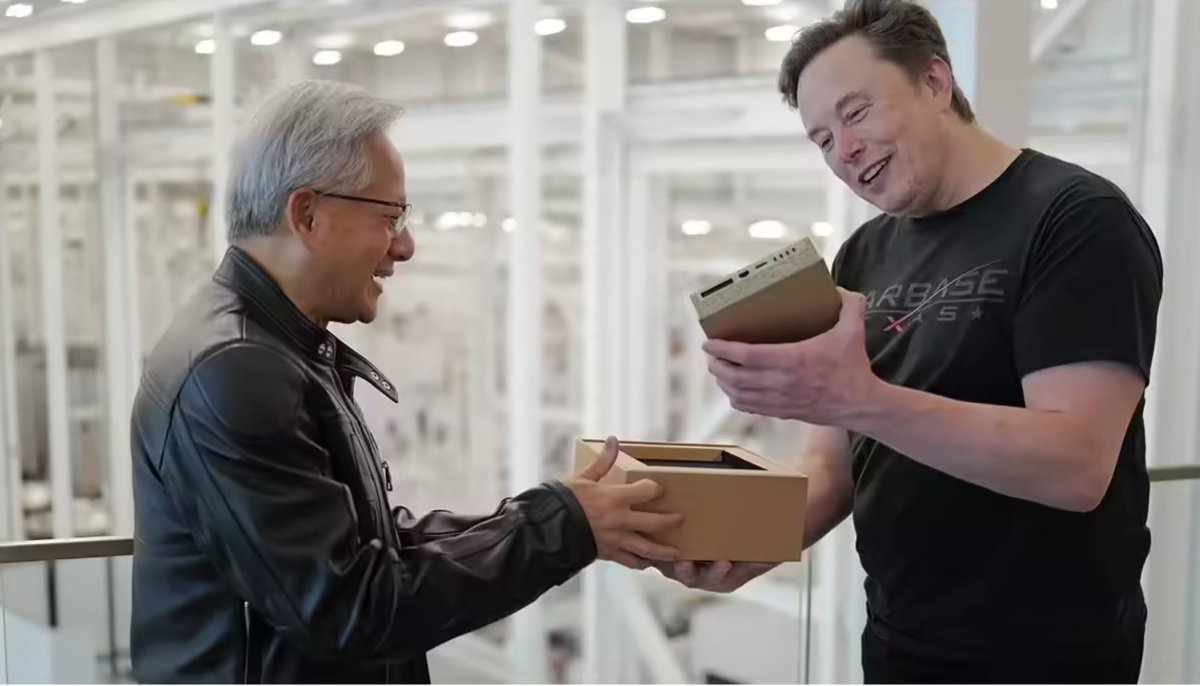
🚨Michael Burry just said Elon Musk and Nvidia's deal is built on fake numbers.
Burry published a detailed breakdown calling the entire structure "Fugazi", his word for fake.
He is alleging that billions of dollars in Nvidia chips are being hidden off balance sheets, and that American retirees are unknowingly funding the whole thing.
Nvidia, the world's largest AI chip company sold $5.4 billion worth of its most advanced GPUs, the GB200, to a company called Valor.
Valor is not a real operating business. It is a special purpose vehicle, a shell company created specifically to hold these chips and nothing else. Nvidia also invested $1.9 billion of its own money directly into Valor on top of the sale.
Those 100,000+ chips are now physically inside xAI's data center. xAI is Elon Musk's artificial intelligence company, the one that builds Grok. xAI is using every single one of those chips right now to run its AI models.
But here is what Burry is flagging.
Neither Nvidia nor xAI owns those chips on paper. Valor, the shell company holds legal title. That means $5.4 billion in GPU assets do not show up on Nvidia's balance sheet as inventory.
They do not show up on xAI's balance sheet as assets. They are legally invisible to both companies.
Nvidia gets to book the $5.4 billion as a completed sale and record it as revenue. xAI gets full use of the chips without owning them. And the risk disappears into a shell company in the middle.
Now here is where American retirees enter the picture.
Valor needed $3.5 billion in debt to fund this structure. Apollo provided it. Apollo is one of the largest asset managers on earth with $1.03 trillion under management and $834 billion specifically in private credit.
Apollo raised the $3.5 billion, packaged it into debt securities, and sold those securities to Athene.
Athene is Apollo's own insurance company. It sells fixed and indexed annuities, retirement savings products, to ordinary Americans.
When a retiree buys an Athene annuity, they believe their money is sitting in safe, stable investments. That money is now inside a structure funding Elon Musk's AI data center.
The numbers inside Athene are most alarming.
Athene holds $74.2 billion in reserves. It has moved $217 billion in assets into a captive insurer based in Bermuda, meaning those assets sit outside normal US insurance regulation and oversight.
Of the entire portfolio, 34.7%, equal to $103 billion, is classified as Level 3 assets.
Level 3 is an accounting classification that means there is no observable market price for these assets. No outside party can independently verify what they are actually worth.
The leverage sitting on top of those unpriced assets is 16 times.
Burry's says:
Every step of this structure is technically legal and publicly disclosed. But the entire thing was deliberately engineered across 8 to 12 steps to move credit risk off balance sheets and away from any market pricing.
- Nvidia books the revenue.
- Apollo collects the fees.
- xAI gets the computing power.
- And retirees sitting at the bottom of a 16x leveraged Bermuda insurance structure, holding $103 billion in assets with no market price carry the risk without knowing it exists.
While you’re reading this, the world is quietly handing the keys to a new intelligence.
Everyone else is selling Hollywood endings.
This book delivers the unfiltered blueprint: who we truly are, our exact place in the AI timeline, and what comes after.
Two economists just published a mathematical proof that AI will destroy the economy.
Not might. Not could. Will — if nothing changes.
The paper is called "The AI Layoff Trap." Published March 2, 2026. Wharton School, University of Pennsylvania. Boston University. Peer reviewed. Mathematically modeled.
The conclusion is one sentence.
"At the limit, firms automate their way to boundless productivity and zero demand."
An economy that produces everything. And sells it to nobody.
Here is how you get there.
A company fires 500 workers and replaces them with AI. A competitor fires 700 to keep up. Another fires 1,000. Every company is behaving rationally. Every company is following the incentives correctly. And every company is building a trap for itself.
Because the workers who were fired were also customers.
When they lose their jobs faster than the economy can absorb them, they stop spending. Consumer demand falls. Companies respond by cutting costs — which means automating more workers — which means less spending — which means more falling demand — which means more automation.
The loop has no natural exit.
The researchers tested every proposed solution. Universal basic income. Capital income taxes. Worker equity participation. Upskilling programs. Corporate coordination agreements.
Every single one failed in the model.
The only intervention that worked: a Pigouvian automation tax — a per-task levy charged every time a company replaces a human with AI, forcing them to price in the demand they are destroying before they pull the trigger.
No government has implemented this. No major economy is seriously discussing it.
Meanwhile the numbers are already tracking the curve. 100,000 tech workers laid off in 2025. 92,000 more in the first months of 2026. Jack Dorsey fired half of Block's workforce and said publicly: "Within the next year, the majority of companies will reach the same conclusion."
Nobody is doing anything wrong. Companies are following their incentives perfectly. That is exactly the problem.
Rational behavior. At scale. Simultaneously. With no mechanism to stop it.
Two economists built the math. The math leads to one place.
Source: Falk & Tsoukalas · Wharton School + Boston University ·
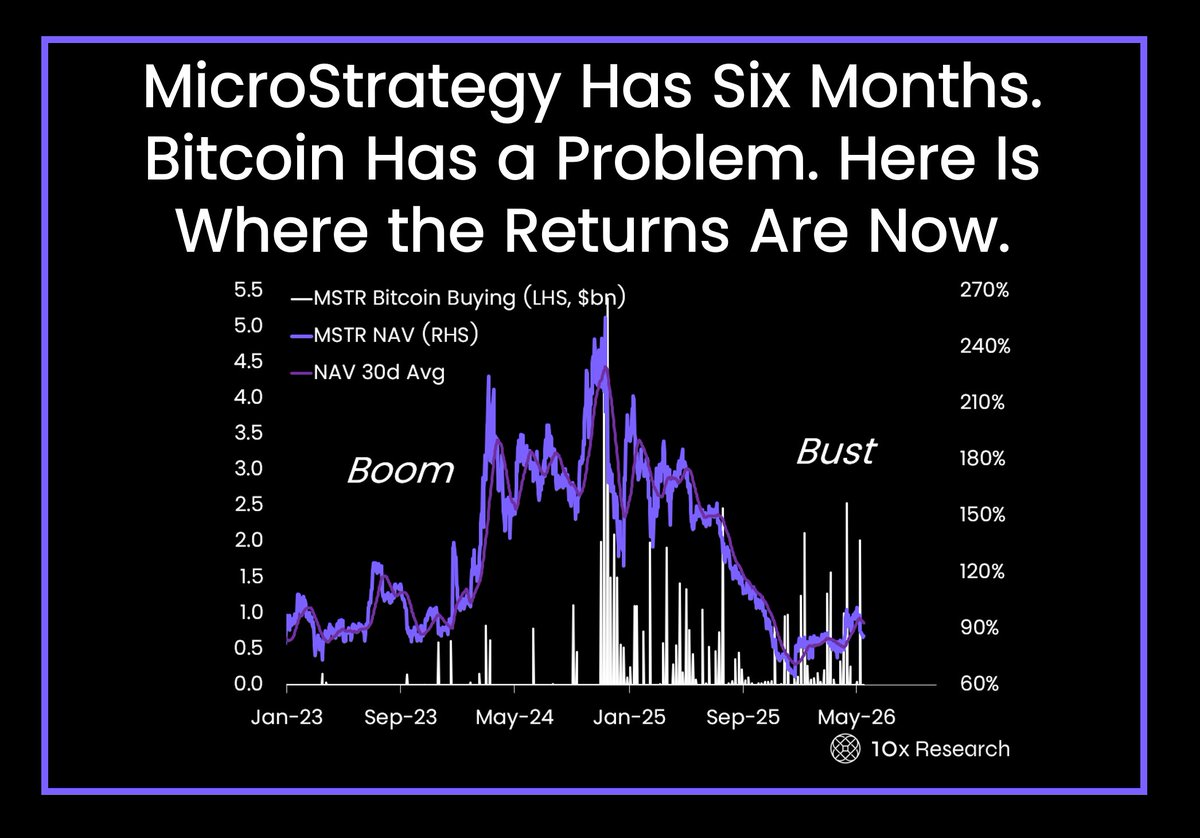
MicroStrategy Has Six Months. Bitcoin Has a Problem. Here Is Where the Returns Are Now.
Are the wheels coming off, one by one?
MicroStrategy's signal that it may sell Bitcoin, with only six months of cash remaining to cover dividend obligations, strongly suggests the company will no longer serve as a meaningful buyer.
That removes one of the most visible and consistent demand drivers of the past several years.
So where should investors look now, and how has the technical picture shifted?
Below, we address both our short- and longer-term views, and show where returns are still being generated even as Bitcoin becomes a headwind.
-> Our altcoin model portfolio is up 24% over the past seven weeks (here)
-> Our crypto equity picks have returned an average of +28% over the same period.
-> (Our thematic cross-asset space stocks portfolio has also returned +35% since April 3, 2026).
The opportunity has not disappeared, but finding it requires more creativity and a willingness to look beyond the obvious.
In today's report we show our subscribers where the opportunities are...
The Strait of Hormuz used to be one chokepoint. Iran built three more in fifteen days. One charges Bitcoin. One issues sovereign permits. One threatens to monetize the data cables that carry SWIFT.
Two of those cables run through Iranian territorial waters. Treasury Secretary Bessent declared “absolute control” over the strait on May 4. A drone hit the Arab world’s only nuclear plant on May 17. Trump postponed Tuesday’s strike at the request of Saudi Arabia, Qatar, and the UAE. Putin and Xi signed their multipolar declaration in Beijing this week. The protocol sovereignty trap is no longer theoretical.
Iran’s Supreme National Security Council activated the Persian Gulf Strait Authority on Monday. The PGSA calls itself “the legal and official representative authority of the Islamic Republic of Iran responsible for managing transit through the Strait of Hormuz.” Ships are already receiving regulations. “Passage without permission will be considered illegal,” the PGSA posted. Windward AI reports $2 million per vessel transit tolls coming next.
Iran’s Ministry of Economic Affairs launched Hormuz Safe on May 16. The platform settles maritime insurance in Bitcoin for vessels transiting the Strait. Coverage includes detention, inspection, and confiscation. The Ministry projects up to $10 billion in annual revenue. The $344 million Tether freeze on April 23 demonstrated stablecoin issuers can freeze at OFAC direction. Bitcoin cannot. Hormuz Safe pivoted twenty-three days later.
Seven major intercontinental cables run under the Strait of Hormuz. They carry global internet traffic and SWIFT financial messaging. Iranian military spokesman Ebrahim Zolfaghari declared on May 9 that Iran would “impose fees on internet cables.” Parliamentary member Mostafa Taheri put potential revenue at $15 billion. IRGC-linked Tasnim proposed requiring Google, Microsoft, Meta, and Amazon to operate under Iranian regulations.
Bessent froze $500 million in Iranian crypto under Operation Economic Fury. OFAC banned digital asset payments for Hormuz transit on May 1.
President Trump postponed Tuesday’s strike at the unified request of Qatari Emir Tamim bin Hamad Al Thani, Saudi Crown Prince Mohammed bin Salman, and UAE President Mohamed bin Zayed Al Nahyan. The Gulf message per Axios: “give negotiations a chance because if you hit Iran, we will all pay the price for it.” Pakistan delivered Iran’s revised proposal: long-term nuclear freeze with enriched uranium transferred to Russia. The US military stands ready for “a full, large scale assault on a moment’s notice” if no deal is reached.
Putin arrived in Beijing this week with five deputy prime ministers, eight ministers, and the central bank head. He and Xi adopted a “declaration on the formation of a multipolar world and a new type of international relations.” Forty documents were signed. The visit coincides with the 25th anniversary of the Sino-Russian friendship treaty. Pakistan separately deployed 8,000 troops and Chinese HQ-9 air defenses to Saudi Arabia.
Brent fell 1.9 percent to $110.01 per barrel after Trump’s announcement. Both Brent and WTI have advanced more than 54 percent since the war began on February 28.
The Strait of Hormuz used to be one chokepoint. Iran built three more in fifteen days. The Bessent doctrine of absolute control meets the multipolar declaration this week. The Gulf is no longer just an energy theater. It is the strategic competition’s first three-layer protocol battlefield.
https://t.co/FRwSI1w8WU
BREAKING: SpaceX has officially filed its S-1 registration statement with the US SEC ahead of its record-setting IPO.
Details include:
1. SpaceX intends to list its shares on the Nasdaq under ticker symbol $SPCX
2. SpaceX posted Q1 2026 revenue of $4.69 billion
3. Elon Musk will be CEO, CTO, and Chairman of the Board after the IPO
4. SpaceX holds $15.8 billion in cash as of March 31st
5. SpaceX is seeking to raise a record $80 billion in its IPO with an expected IPO date of June 12th
More details to come shortly on this historic IPO.
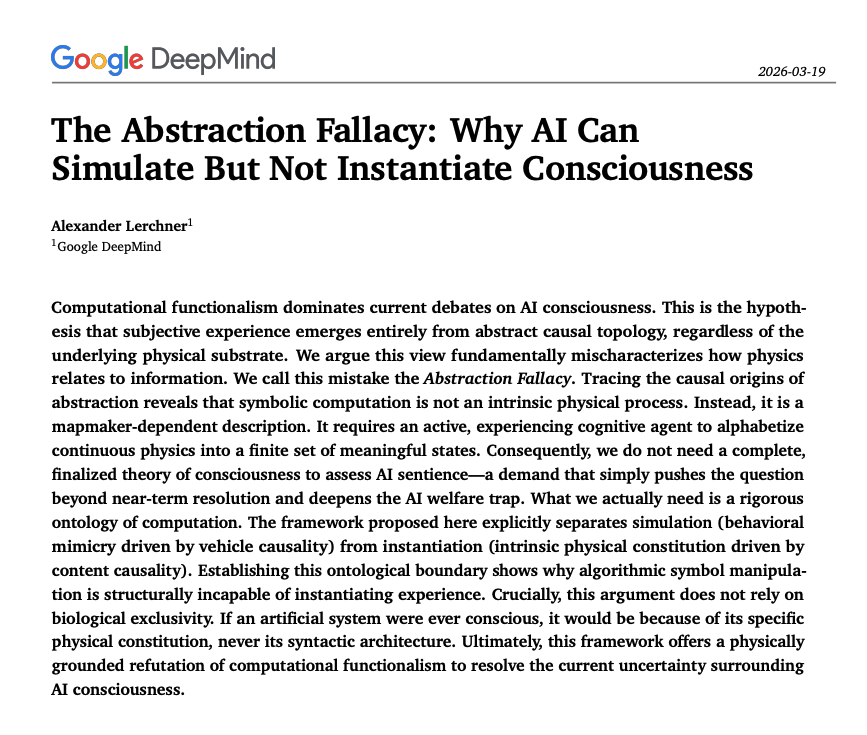
Google DeepMind researcher argues that LLMs can never be conscious, not in 10 years or 100 years.
For a long time, the dominant theory in Silicon Valley has been "computational functionalism." The idea that if you make a model big enough, and organize the information perfectly, consciousness will magically emerge.
We assumed that if the software got smart enough, it would eventually wake up.
Alexander Lerchner, a Senior Staff Scientist at DeepMind, published a paper explaining why that is structurally impossible.
He calls it the Abstraction Fallacy.
Here is the core truth: Computation isn’t a real physical process. It is a map.
An LLM doesn't actually process logic or thoughts. It just moves electrons around based on physics. It requires a human, a conscious "mapmaker", to look at those physical states and assign meaning to them.
Mistaking an AI for a conscious being is like looking at a map of a river and expecting it to be wet.
An AI can simulate the exact syntax of a feeling, a thought, or an emotion. But it can never instantiate it.
It doesn't matter how many trillions of parameters you add or how much compute you burn. You cannot mathematically compute your way into a subjective experience.
The implications of this are massive. And deeply convenient for the companies building these models.
If an AI is structurally incapable of consciousness, it cannot be a moral patient. It doesn't get rights. It cannot be exploited.
It can be regulated exactly like a toaster.
🚨 Anthropic just showed a 27-minute workshop on how to actually do prompts for Claude.
Taught by the people who built it.
Free. No registration. No paywall.
I've seen $300 courses that don't cover what they teach in the first 8 minutes.
Watch it and bookmark it now.
Two of the Mag 7 made the new highs list on Friday.
Amazon $AMZN made a new all-time intraday high, while NVIDIA $NVDA made a new all-time closing high.
Global imbalances result from irresponsible US fiscal policies and China’s trade distortions. Europe + rest of the world are victims.
Markets will react where they can (USD weaker, US yields higher) - politics will do the rest in reaction to China pol.
https://t.co/ihWymL6qVa
For five years, Iran built an alternative financial architecture on the explicit theory that cryptocurrency would be sanctions-resistant. Bitcoin mining was legalized in 2019. Subsidized power was redirected to industrial farms. Mined coins were sold to the Central Bank of Iran for hard currency. The IRGC moved over three billion dollars through digital assets in 2025 alone. By year end the Iranian crypto ecosystem had reached seven point eight billion dollars per Chainalysis, with the central bank holding at least five hundred seven million in USDT reserves per Elliptic.
The architecture was the bet. The bet was that the dollar could not follow Iran onto the chain.
On April 23, 2026, the United States Treasury froze three hundred forty-four million dollars of that architecture with one smart-contract call.
Tether executed the freeze on receipt of intelligence from US law enforcement. Two Tron wallets, beginning TNiq9AXBp9 and TTiDLWE6fZ, were blacklisted at the smart-contract level. The first held two hundred thirteen million. The second held one hundred thirty-one million. The funds had accumulated approximately three hundred seventy million across nearly one thousand transactions since March 2021. Less than seven percent ever flowed out. The wallets had been dormant since late 2023. This was not operational money. This was a sovereign war chest stored on the chain because the IRGC assumed nobody could touch it. Treasury touched it on Thursday.
Treasury Secretary Bessent named the campaign Economic Fury and stated the doctrine in plain English. “Treasury will continue to systematically degrade Tehran’s ability to generate, move, and repatriate funds. We will follow the money that Tehran is desperately attempting to move outside of the country and target all financial lifelines tied to the regime.”
The five-year theory collapsed in one paragraph.
The IRGC built crypto rails to escape the dollar. The dollar followed onto the rails, identified the wallets through TRM Labs and Chainalysis behavioral clustering, instructed Tether to freeze them, and demonstrated that the seven-point-eight-billion-dollar parallel economy is permissioned at the issuer layer. Tehran now knows what every Russian, North Korean, and Venezuelan sanctions desk is reading: USDT is a US Treasury asset that sanctioned actors cannot store value in.
The timing reframes the entire conflict.
Tehran’s negotiating posture for forty-eight days assumed crypto reserves provided sanctions cushion. That cushion is now provably three hundred forty-four million dollars smaller. The Pentagon is photographing three carrier strike groups. Treasury is photographing the Tron blockchain. Both are publishing the order of battle.
The market is reading this as tactical sanctions enforcement. That reading is incomplete. CNN noted yesterday it had not independently corroborated the Iran attribution, and Bitcoin maximalists are noting that three hundred forty-four million is under five percent of the seven-point-eight-billion-dollar ecosystem. Both points concede the floor of the argument. Stablecoins are now Treasury extensions with smart-contract APIs. The GENIUS Act, signed July 2025 and operationalized through April rules, codified it. The freeze made it visible.
Three readings of this week.
A successful sanctions enforcement against the Iranian regime. Priced.
A diplomatic pressure tactic ahead of fragile ceasefire talks. Narrow.
The first publicly verifiable demonstration that Iran’s five-year sanctions-evasion architecture is permissioned end to end, that the dollar followed the IRGC onto the chain, and that every sanctioned sovereign on earth must reprice its crypto reserves before the next Economic Fury Friday.
The market is pricing the first.
Tehran is repricing the third.
https://t.co/vLQh7ydMdk
Europe's Energy Suicide: The Netherlands is proceeding with the final closure and cementing (!) of wells in the Groningen gas field — one of Europe's largest reserves. Germany has accelerated phasing out coal and, as part of its "Energiewende" -- "energy turnaround" from fossil fuels to "renewable energy" such as wind and solar that do not work -- has been deliberately flooding (!) coal mines. Across the continent, shale gas exploration remains effectively banned in most member states. Nuclear capacity has been curtailed in several countries, most notably Belgium and Germany, with the latter's abrupt shutdown of its last nuclear power plants. Europe's Energy Suicide is not a calamity. It's a choice.
https://t.co/L9QfsNG1nj