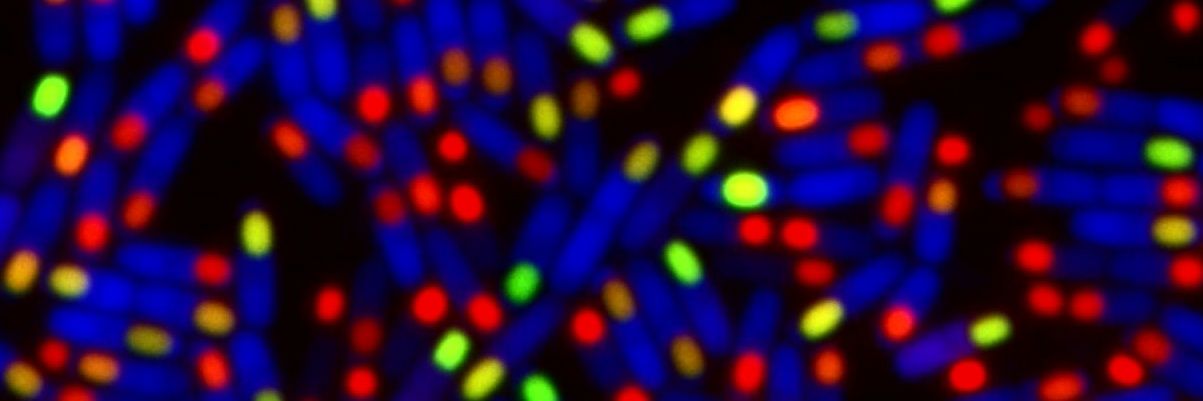
Check out the latest paper from our lab in PLOS Genetics, where we examine the role of a small protein in cell-cell signalling during sporulation.
Thanks to our collaborators @SGribaldo@CavaLab_MIMS
Per Bullough and Cecile Morlot
https://t.co/tnRY7bdrEG
I have spent my entire life working on this and thinking about this for the past 4 years. I don't know what will happen in 20 years, but I can promise you that on the 5-10 year timescale, scientists are not out of their jobs. AI is going to massively accelerate the pace of science, increase productivity, let individual scientists make way more discoveries way faster, and is going to make science overall more fun. But the model is going to be collaboration between humans and AI, not replacement.
The key difference here between science and e.g. software engineering is that science is not verifiable in any rapid/convenient way (unlike software), unlike programming. We still need humans for their scientific taste.
Today we all lost our jobs.....
Three Nature papers showing that scientists in the conventional sense are obsolete
At least read the first one.... the AI replaced all things that the scientist does ....
https://t.co/zMsRLaaRDU
We have developed a cysteine-free, highly thermostable tagging system, UTag, that enables single-mRNA translation tracking in live cells. You may wonder how different tagging systems affect translation kinetics—we addressed this by performing a systematic comparison.
Scientists may have just solved one of biology’s biggest mysteries: why life overwhelmingly uses only one “handed” (chiral) version of molecules, and what that means for alien life.
A new study shows that electron spin — a fundamental quantum property — interacts differently with mirror image molecules (enantiomers). When electrons move through chiral structures, their spin creates measurable asymmetries in dynamic processes like electron transport and chemical reactions. Over time, even tiny biases can amplify into the strong preference we see in biology (left-handed amino acids, right-handed sugars).
This quantum effect, known as chirality-induced spin selectivity (CISS), provides a physical mechanism, not just a chemical accident, for homochirality, the universal “one-handedness” of life on Earth.
Implications for alien life: If this spin driven bias is proved, then it's highly likely extraterrestrial life would also converge on the same handedness.
When we do find alien life, it's biochemistry might not be so different from ours after all.
📸 Wikimedia commons
Source: https://t.co/0qSWo2BCxh
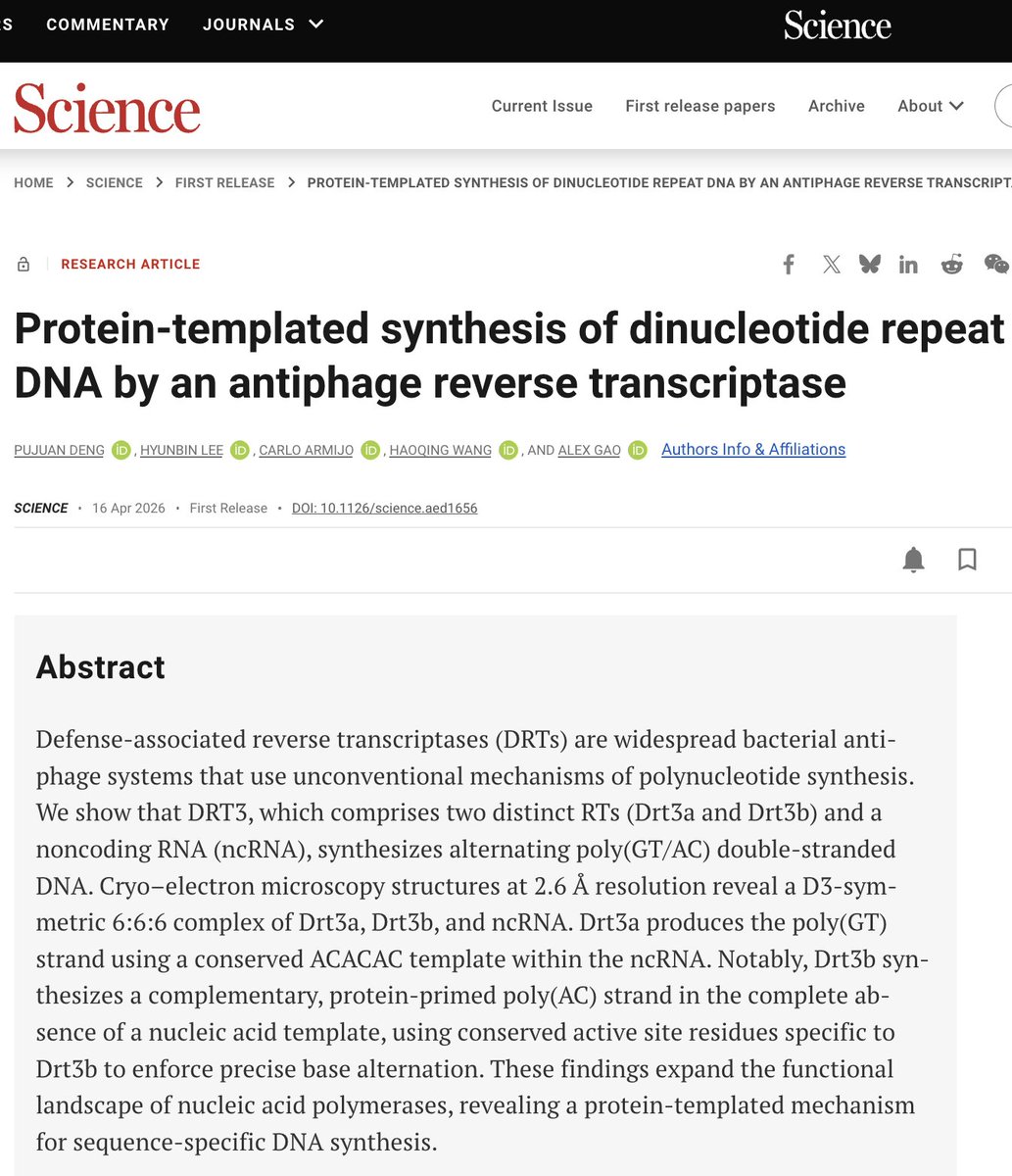
Bacteria are full of diverse molecular tricks. This Science article reports an interesting one that is being misrepresented by news coverage, including the coverage in Science.
The study describes an enzyme complex that synthesizes alternating dinucleotide repeat DNA as part of an immune response. Protein templating DNA is a cool observation, even if the sequence is only a repeating dinucleotide.
The headline-grabbing takeaway is the mechanism of the Drt3b subunit. While its partner, Drt3a, uses a canonical RNA template (reverse transcription), Drt3b synthesizes the complementary strand in the absence of a nucleic acid template. Instead, it uses specific amino acid residues (a glutamate and an arginine) to stabilize and "select" the incoming dNTPs.
It is tempting to view this as a radical shift in our understanding of information transfer, a "protein-templated" genetic sequence. However, we should be cautious with the "paradigm shift" narrative.
Why this isn't "rewriting" the Genetic Code:
Despite claims in the news coverage, this finding does not represent a new form of hereditary information transfer. This is not a protein "reading" itself to create a complex message; rather, it is a highly specialized structural constraint. The protein is essentially a "stuttering" machine, physically keyed to produce a simple, repetitive sequence. The "information" is hard-coded into the protein's fold to perform a single, specific defensive task, rather than acting as a general-purpose template for diverse genetic messages.
The Parallel to tmRNA:
This observation is not entirely unprecedented when we look at how bacteria handle biochemical "dead ends." It reminds me of transfer-messenger RNA (tmRNA). In trans-translation, when a ribosome stalls on a broken mRNA, the tmRNA molecule steps in to provide both the tRNA component and a short mRNA "tag" to rescue the ribosome:
- The "Non-Standard" Template: Much like tmRNA provides an external sequence to fix a stalled process, the DRT3 ncRNA and the Drt3b protein provide "internal" instructions to create DNA where no genomic template exists.
- Specialized Rescue: Both mechanisms are niche "emergency" responses, one for proteostasis (tmRNA) and one for viral defense (DRT3).
In the end, this discovery doesn't replace our understanding of the genetic code; it expands the "toolbox" of how cells can synthesize polynucleotides when the standard rules don't apply. It is a beautiful reminder that in the microbial world, if a chemical shortcut is possible, evolution has likely found it.
ok actually insane paper published yesterday
a research group in Korea built a gene switch you can control wirelessly using electromagnetic fields
they exposed mice to 60 hz EMF (same frequency as your wall outlet) using a pair of large coils that generate a uniform magnetic field around the animal, for cyclic 3-day on / 4-day off pulses
they showed this could:
- activate OSK to do epigenetic reprogramming in progeroid and aged mice, extending lifespan and reversing aging markers across multiple tissues
- conditionally switch on mutant amyloid genes only in aged mouse brains, letting them separate aging effects from amyloid effects to study AD biology in a way previous models couldn't
no drugs, no impacts, just a magnetic field from outside the body
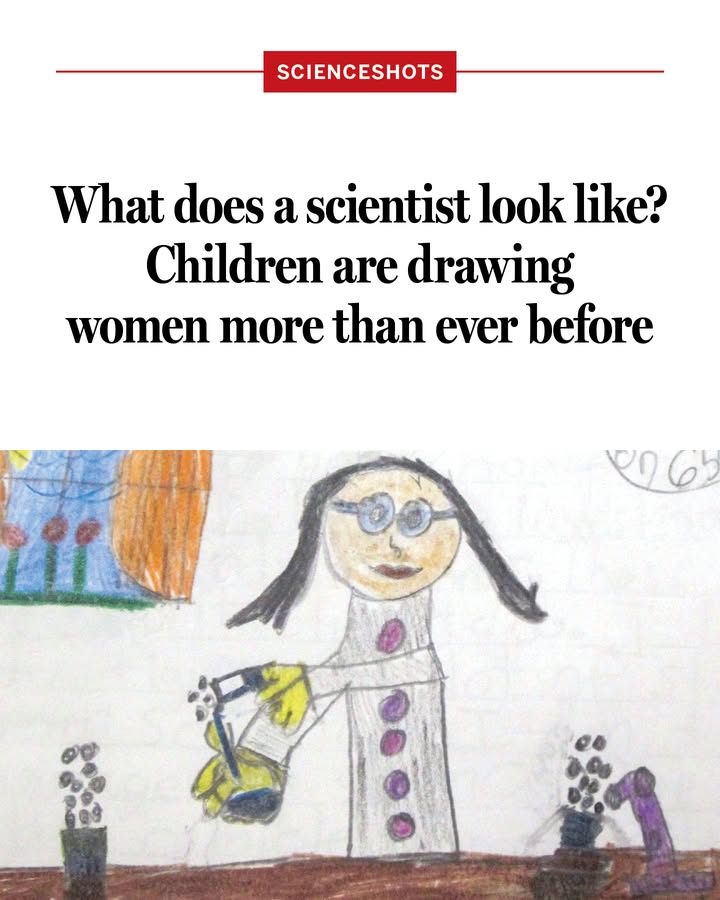
When asked to draw a scientist, school-age kids in the United States are increasingly sketching women, according to a study from 2018.
Read more on #WomenInScienceDay: https://t.co/1TZ0pwBtMJ
AI is cool and all... but a new paper in @ScienceMagazine kind of figured out the origin of life?
The paper reports the discovery of a simple 45-nucleotide RNA molecule that can perfectly copy itself.
We had a great time collaborating with Tong Zhang and Mike Laub and on our recent study, now published in @Nature, visualizing a bacterial innate immune mechanism that protects populations from phage infection.
https://t.co/tD4r9oGLNb
Calling prospective PhD students!
The NUBee lab @Newcastle University have an exciting fully funded opportunity to study Varroa, a major driver of honey bee colony losses.
The PhD complements ongoing work.
For more info (https://t.co/YIVFIlIUIJ) or contact Prof. Giles Budge.
Check out these tools to detect co-evolution in protein-protein interactions developed by postdoc @ChrisLBGraham
Very useful as a hypothesis generator, complementing protein interaction prediction from Alphafold.
https://t.co/ddKIaoD2dt
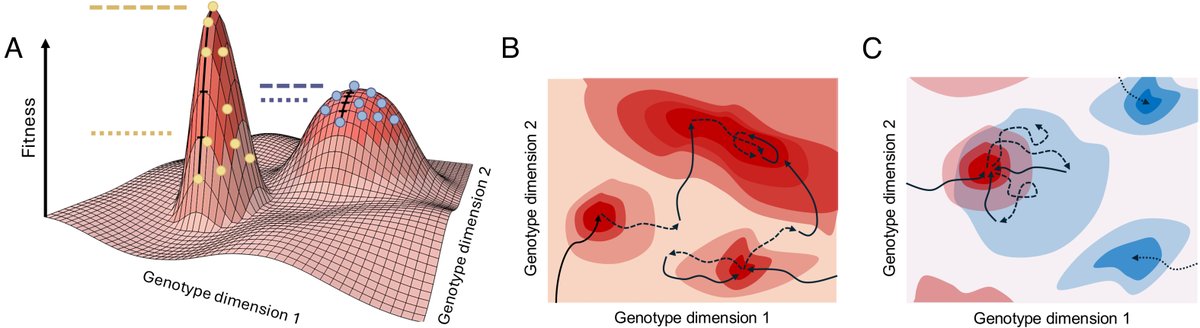
One of the most-viewed PNAS articles in the last week is “The variability of evolvability: Properties of dynamic fitness landscapes determine how phenotypic variability evolves.” Explore now: https://t.co/nFlVYHKT8O
For more trending articles, visit https://t.co/wtpRNANr6a.
Using precise spatial and temporal analysis, researchers in Science provide insight into how bacteria around the root interact both with the plant and with each other.
Learn more in this week's issue: https://t.co/wXSBg9t3gY
🔬 🧫 The Collier lab is hiring a new Postdoc! 🧬 🧪
We are looking for a motivated candidate to study mechanisms controlling DNA replication in Alphaproteobacteria with complex genomes.
--> Apply by 30th August 2025 using this link:
https://t.co/wGEcSEQsf5
The mantra “location, location, location” isn’t just about real estate.
For life scientists, more than 50% of their productivity can be attributed to the institution where they work, according to a new study. @ScienceCareers https://t.co/6a82aHRl9G
Finally out! 🎉 Our first work at @humantechnopole is published in @NatureComms:
"Translating microbial kinetics into quantitative responses and testable hypotheses using Kinbiont"
📄 https://t.co/ojWhoVr5oH
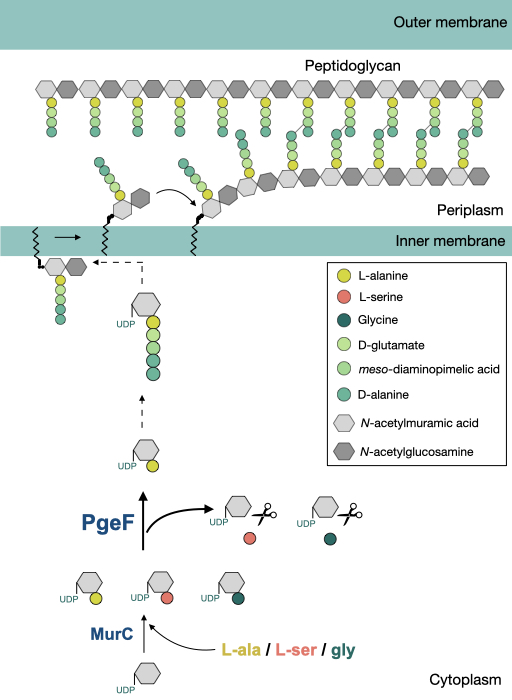
#Newpaper Bacterial cell walls are polymers made of sugar backbones cross-linked with amino acid peptides. Recent work from Manjula Reddy's lab led by @shambhavi_garde highlights how the identity of the amino acid most proximal to the sugar backbone is crucial for bacteria. 1/2
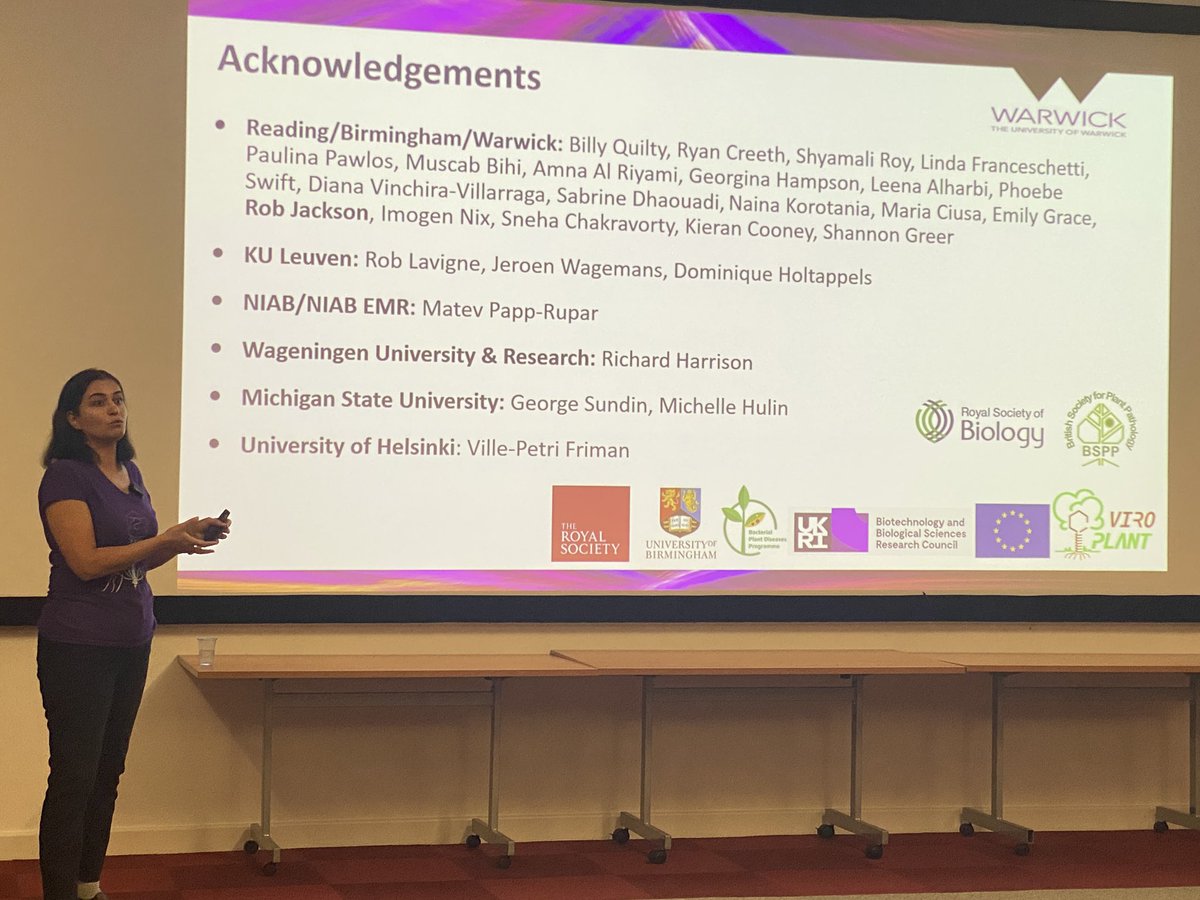
Excellent talk from @MojganRabiey@warwickuni using phage to control bacterial pathogens in crops. Lots of tutorial questions from enthusiastic plant-curious (and future plant sci leaders ‘n shaker) students at @GatsbyPlantScEd#GPSSS