"I don't get the sense the Fed is cutting," says Fedwatch Advisors founder @Marcomadness2
He explains what he thinks the Fed may be getting wrong when it comes to the Fed and rates. https://t.co/Nw7SbHv1Yy
Look what happens when the Fed takes the stress out of their stress tests for big banks👇👇
“JPMorgan Chase , Bank of America and a collection of their peers all passed the Federal Reserve’s annual stress tests, a widely expected outcome after regulators last year began disclosing the exam’s scenarios and models in advance…
…Critics of the move have accused the Fed of giving away the answers to its own test before it happens….”
Oct 2025
The FED created new reporting rules this summer that make it easier for U.S. banks to hide troubled loans
https://t.co/GrkLEO1wCg
June 2025
So The Bank Stress Tests Made Sure Not To Test Anything That Creates Stress?
https://t.co/UgmnMAkrKH
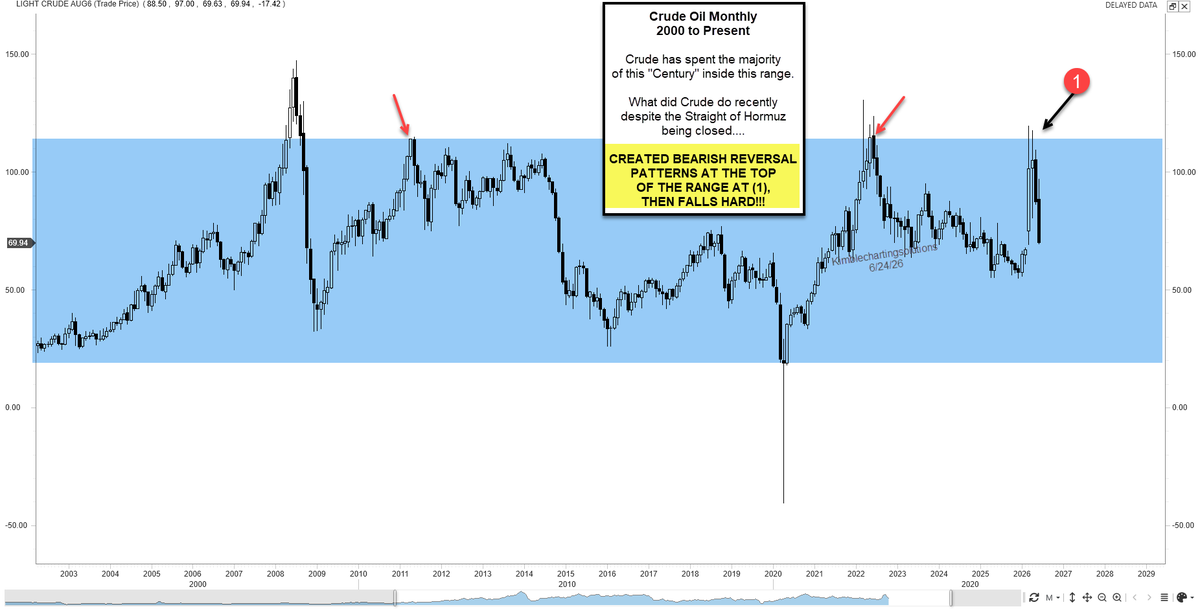
Crude has spent 98% of this century in this sideways trading range.
Despite the Straight being closed, all Crude could do the past 3 months is create "monster bearish reversal patterns" at the top of the range at (1).
While many are worried about inflation.....should they be???
$CL_F $USO
The vision: connect 55 countries across Africa through a single digital trade network.
Increase cross-border trade.
Decrease costs.
Decrease payment times.
It started with a pilot in Kenya five years ago.
It's scaling now.
Manufacturing output just printed a 59-month high — and factories are gutting payrolls at the sharpest pace since 2009 ex-pandemic to do it. Firms that trust their order books don't fire into a surge — they front-ran the war, stacking input inventories at the fastest rate in the survey's near-two-decade history, bar only the 2025 tariff scramble. That isn't end-demand; it's a hedge with an expiry date, output borrowed against tomorrow's shortages. Which is why the divergence is the signal: manufacturing has broken above services to invert the cycle's usual order, but one line is borrowing tomorrow's orders while the other reports today's — services, two-thirds of the economy, crawling at 51.3 on price-weary push-back. Beneath both, the composite musters barely 1% annualized growth, leaving the Fed a sub-1% economy with selling-price inflation still climbing. The first-order hit already lands on households — in pink slips, not forecasts. Read the breakout not as factories leading a rebound, but as the sector quietly liquidating its own optimism. https://t.co/DUwUfSI431
"Experts" panicked and cried about deflation when annual M2 growth briefly turned negative, ignoring both the record increase that immediately preceded the short-lived decline and the quick return to growth; sadly, we're back on the rollercoaster: