Coding But Still Alive - that’s my passion. I am a Data Scientist & ML Engineer with a special interest in advanced AI and Deep Learning. PhD in Bioinformatics.
It's painfully obvious to me, after 12 years of shipping production code, that:
We are massively overestimating AI and massively underestimating it at the same time.
→ 96% of the code I write today is AI-generated
→ but I review every single line like my job depends on it
→ the developers who win won't be the ones who prompt the fastest but be the ones who know what "good" looks like
Here's what nobody wants to admit:
AI didn't make engineering easier.
It made judgment the entire job.
The bottleneck was never typing.
It was knowing what to build, what to throw away, and what will break at 3am six months from now.
Juniors are shipping 10x more code.
And introducing 10x more bugs they can't explain.
The skill isn't writing anymore.
It's reading. Reviewing. Saying no.
Taste is the new 10x.
The engineers who treated coding as typing are panicking.
The ones who treated it as thinking have never been more valuable.
Adapt accordingly.
@klobrille I remember a friend. He said you banned his account because he was criticizing all of that development. Obviously, he was right and you didn’t want to hear it. Interesting.
Google has quietly dropped what researchers are calling "Attention Is All You Need V2."
And it signals the end of the Transformer era as we know it.
In 2017, the original "Attention Is All You Need" paper changed the world by proving that AI doesn't need recurrence, it just needs to pay attention.
But today, even the most advanced models like GPT and Gemini suffer from a massive, structural flaw: Catastrophic Forgetting.
The moment an AI learns something new, it starts losing what it learned before. It’s why AI "hallucinates" or loses the thread in long conversations.
This paper, titled "Nested Learning: The Illusion of Deep Learning Architectures," completely replaces the way AI stores information.
The researchers have introduced a paradigm shift called Nested Learning (NL).
Here is why this is "V2":
For the last decade, we treated AI models as one giant, flat mathematical function. NL proves that a model is actually a set of thousands of smaller, "nested" optimization problems running in parallel.
Instead of one giant "memory," each layer has its own internal "context flow." This allows the model to learn new tasks at test-time without overwriting its core intelligence.
It moves us past the static Transformer. The new architecture (HOPE) demonstrated 100% stability in long-context memory and "post-training adaptation" that was previously impossible.
The technical takeaway is brutal for the competition:
Existing deep learning works by compressing information until it breaks. Nested Learning works by organizing information so it can grow forever.
We’ve spent 7 years trying to make Transformers bigger. Google figured out how to make them "Nested."
The Transformer replaced the RNN in 2017.
Nested Learning is here to replace the Transformer in 2026.
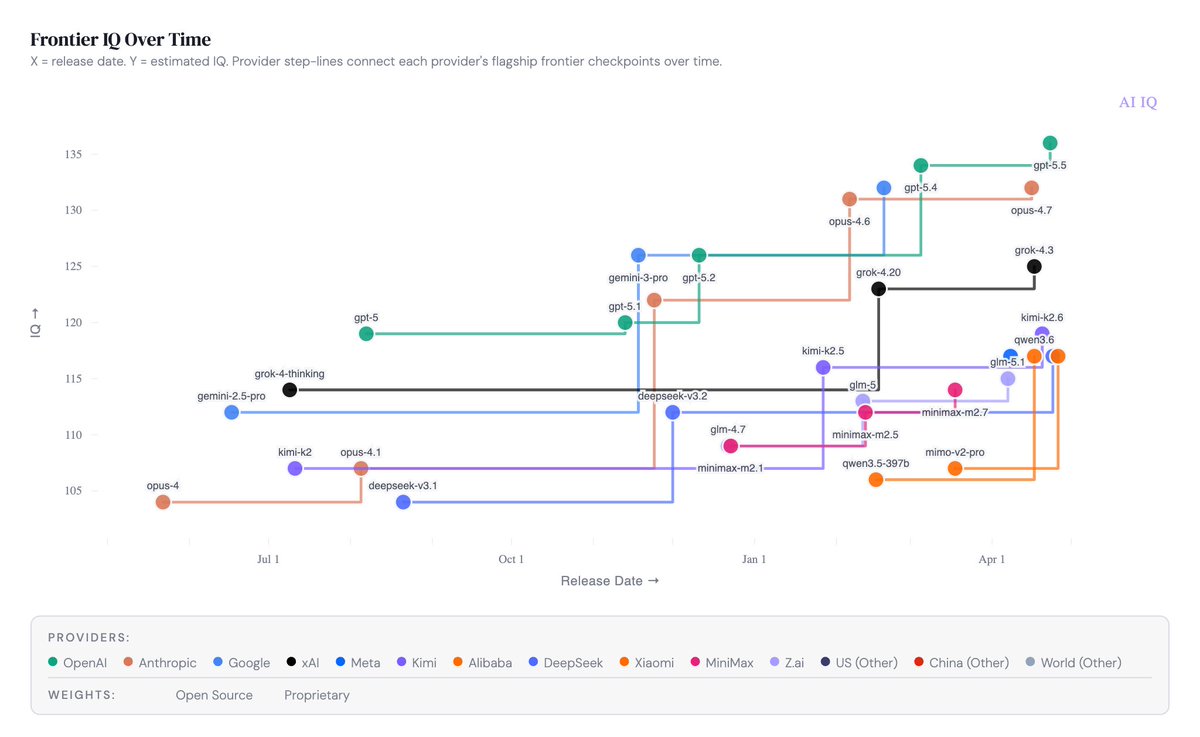
Today I’m launching AI IQ — frontier AI models, scored on the human IQ scale.
Instead of endless leaderboard tables, AI IQ shows:
• Where models land on the IQ bell curve
• How frontier IQ is changing over time
• How models compare on IQ and EQ
• What intelligence costs in practice
GPT-5.5, Claude Opus 4.7, Gemini 3.1, Grok 4.3, Kimi K2.6, Qwen3.6, DeepSeek V4, Muse Spark, and more.
Link in the first reply. Curious which chart surprises you most.
Excited to see my student’s work on Flux Matching out. It turns out you can learn a much broader class of vector fields with the data distribution as stationary (not just the score). This lets you enforce useful properties like fast mixing, and it already works on high-dimensional image datasets!
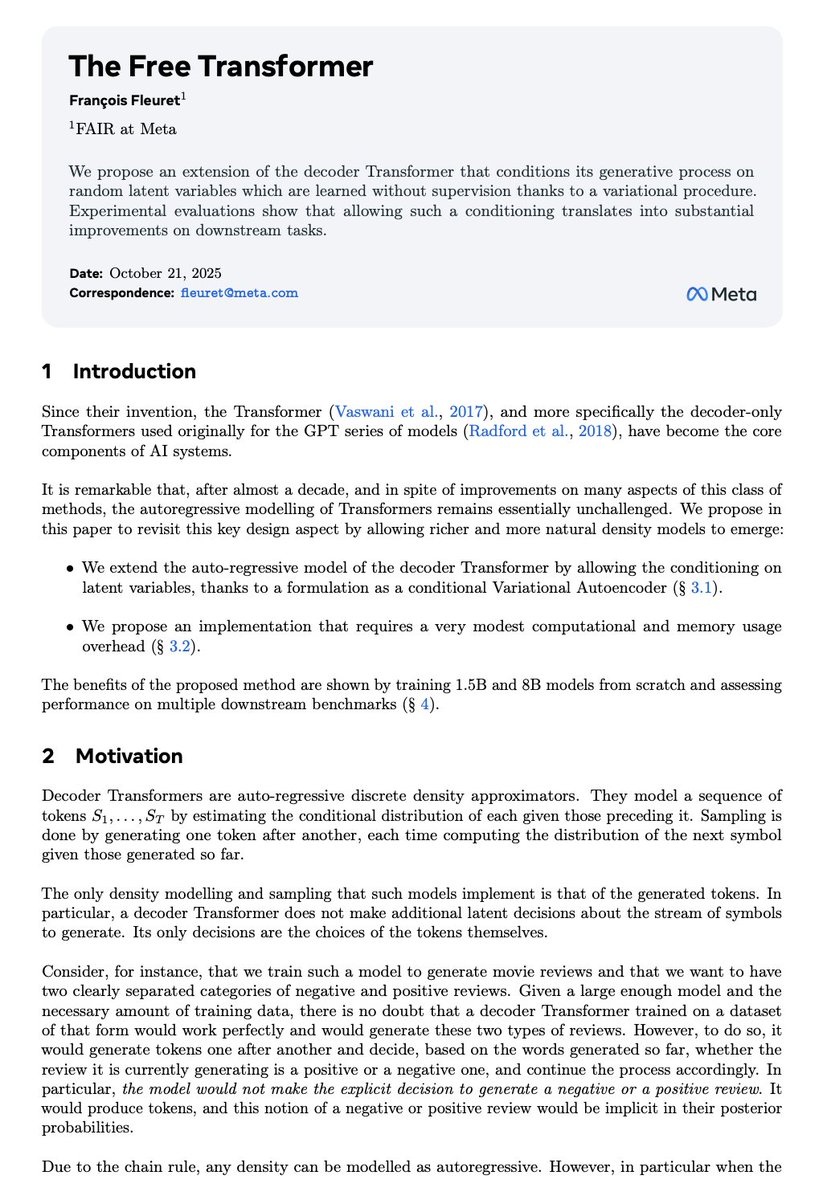
Meta has officially unlocked the "hidden brain" of the Transformer.
And it solves the biggest architectural flaw in AI since 2017.
Every AI you use today (ChatGPT, Claude, Gemini) is a prisoner of the next token. It doesn't "think" before it speaks, it just calculates the most likely next word, one by one.
It’s like trying to write a novel by only looking at the very last letter you typed.
The model doesn't decide to write a "positive" review; it just drifts into positive words and gets stuck there.
Meta FAIR published a paper that ends this era.
They call it The Free Transformer.
Instead of just predicting tokens, Meta added a "Latent Random Variable" to the decoder.
This gives the AI a private, hidden workspace, a latent state where it can make high-level decisions before a single word ever hits the screen.
It allows the model to "flip a coin" in its head and decide the intent, tone, or strategy of the entire response before it begins.
The results are staggering:
+30% on GSM8K (Math)
+35% on MBPP (Coding)
+40% on general reasoning benchmarks
All of this with only a 3% increase in compute overhead.
Meta essentially figured out how to give an AI a "Chain of Thought" that happens entirely in its hidden sub-conscious, rather than forcing it to type out its reasoning in text.
It’s the first major challenge to the "autoregressive" rule that has governed AI for a decade.
In this joint work by OpenAI, Anthropic, and Google scientists reveals an effective new method to extract alignment training data from open models.
Read the paper with an AI tutor: https://t.co/l6kPBWvXcK
PDF: https://t.co/n2NEgDPNCI
@williamfalcon I am a new user on Lightning AI Studio. Did this in any way affect your prebuild studio images? I mean, even if I did not install the respective lightning packages myself.
Jeremy's (@jeremyphoward) and Terence's (@the_antlr_guy) backprop guide is sooo well written that 3 years later as I'm reviewing the guide, everything is just coming back so fluidly.
11/10 would read again
https://t.co/9qB3RbJKVI
Mercury 2 is live 🚀🚀
The world’s first reasoning diffusion LLM, delivering 5x faster performance than leading speed-optimized LLMs.
Watching the team turn years of research into a real product never gets old, and I’m incredibly proud of what we’ve built.
We’re just getting started on what diffusion can do for language.
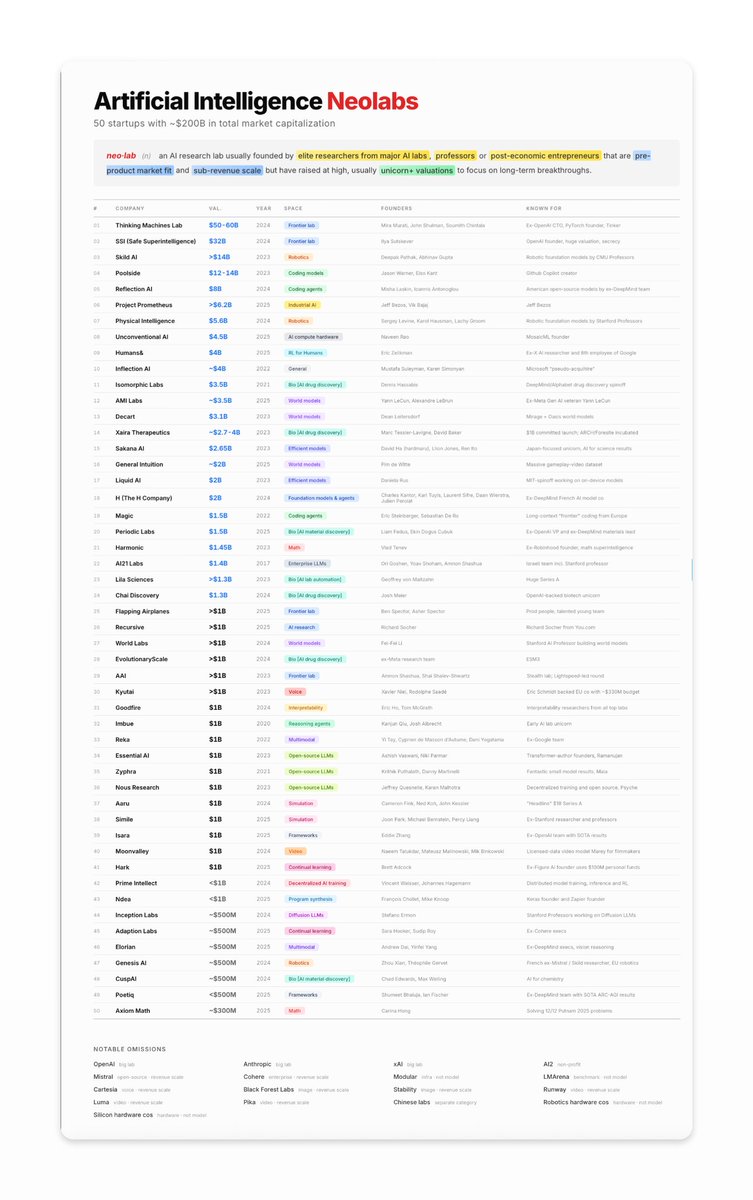
The Ultimate List of Artificial Intelligence "Neolabs".
A Neolab is a pre-revenue scale startup working on long-term AI breakthroughs.
Here's all 50 of them.
@XboxP3 I celebrate you are finally leaving!!!What a disastrous era for @Xbox under your regime. Let’s hope there will be something to revive after your time at all.
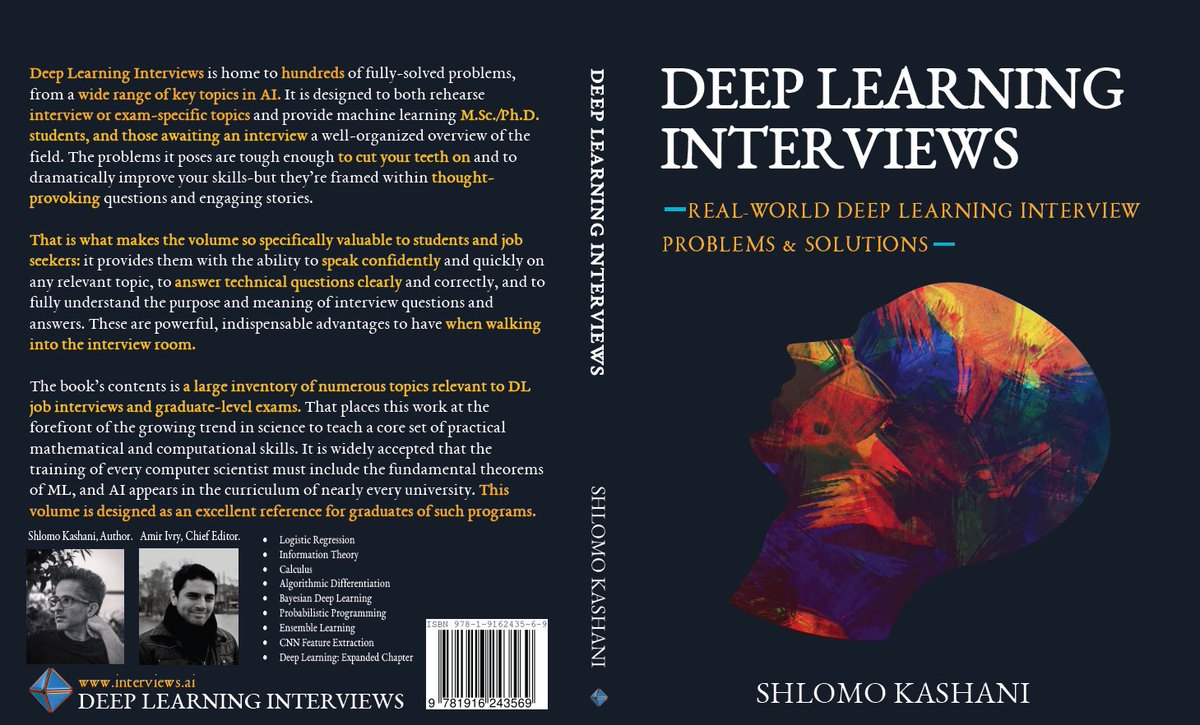
This book alone can change your ML interview game🙀
If you're serious about AI, ML, or landing top-tier roles... this book is DIFFERENT.
• Real-world deep learning interview problems
• Step-by-step solutions
• Covers ML math, probability, CNNs, Bayesian DL & more
• Designed for people who actually want to understand, not just memorize
This isn’t basic theory.
This is the kind of prep that makes you walk into interviews confident.
And I’m giving it FREE to first 4500
How to get it :
1️⃣ Follow me MUST (So i can dm you)
2️⃣ Like this post
3️⃣ Comment “DL”
4️⃣ RT to help others level up
If you’re preparing for ML interviews in 2026, this could literally change your trajectory.
No fluff. No gatekeeping.
Let’s build killers in AI. 🚀🔥