Charles Mugoya from #TargetMalariaUganda@UVRIug was the guest of Good Morning Uganda on @ubctvuganda to discuss the key results of World Malaria Report 2024 #WMR2024 and what it means for East Africa.
Thank you for having us @RobKirabo.
Watch the interview here: https://t.co/TIUJCHKByf
#UBCGMUEXTRA #ubctvUganda #genedrive
New study shows that the return of Africa's most notorious malaria vector, Anopheles gambiae, to eastern Rwanda was associated with significant resurgence of the diseases
~
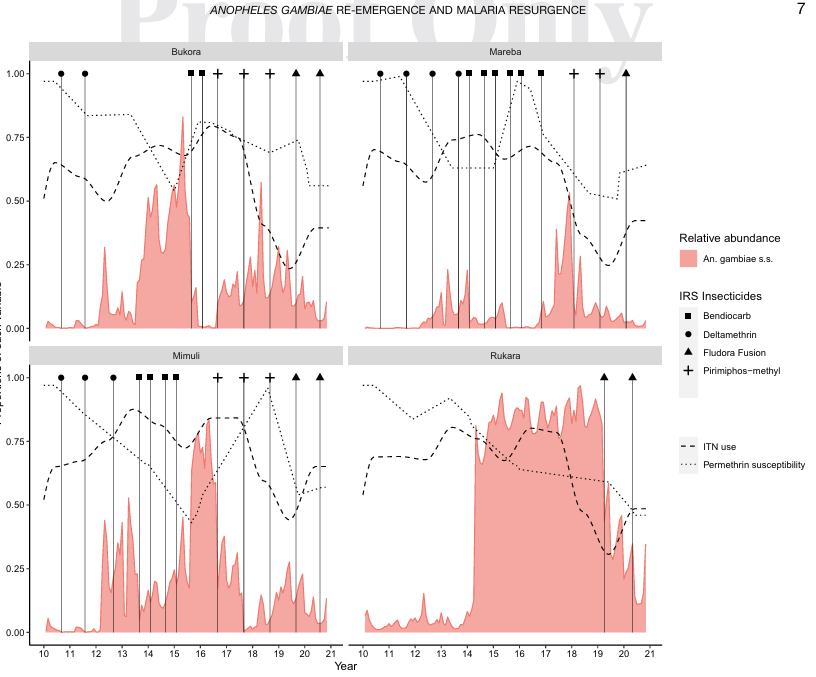
In many parts of east and southern Africa, populations of Africa's most notiorius malaria mosquito, Anopheles gambiae has been dwindling for the past 20 years, in part because of scale up of key interventions like insecticide treated bed nets and house spraying with insecticides. In a new study, researchers conducted a retrospective analysis of entomological and epidemiological data from 2010 to 2020, examining mosquito species composition, insecticide resistance, and temperature fluctuations. They found that rising pyrethroid resistance and warmer temperatures contributed to a re-emergence of An. gambiae, after it had declined significantly in the decade before that. They also observed that this vector resurgence was associated with an increase in malaria cases. Fortunatekly, non-pyrethroid IRS significantly reduced An. gambiae abundance and malaria incidence. By the way, in the abstract, they mention that Rwanda had achieved unprecedented malaria control gains from 2000 to 2010, but cases increased 20-fold between 2011 and 2017. I have to say this is really cool
~
Hennessee et al 2024: Anopheles gambiae Re-Emergence and Resurgent Malaria Transmission in Eastern Rwanda, 2010–2020 https://t.co/mCKqpNj0Of
@cobbo3 The potential to use genetic based vector control technologies in the fight against Malaria is the way to go. Scientists at UVRI in Uganda and Burkina Faso are pioneering this journey in Africa.
Scientists have discovered the first cases of the malaria vector, Anopheles funestus mosquitoes genetically mutating to develop a resistance to a type of insecticide called DDT
~
https://t.co/u1nVuxSi4V
Uganda has one of the highest global burden of #Malaria cases, with over 90% of the population at risk.
In 2022, there were an estimated 12,7 million malaria cases with 17,556 deaths recorded in Uganda, according to World Malaria Report 2023 published by @WHO.
For more information about our work: https://t.co/0JDTaW4q0X
Together we can #EndMalaria!
#UgandaIndependenceDay
By 2050, 500M more people could be exposed to malaria as climate variability drives mosquitoes into new regions and worsens conditions for displaced populations.
We must urgently integrate climate resilience into malaria strategies to stay ahead of this growing threat.
"It would be one of mankind's biggest achievements to finish off malaria" - Bill Gates
Netflix's new documentary series "What's Next? The Future with Bill Gates", produced by Tremelo Production, premieres today.
Episode 5, "Can we outsmart disease?", directed by Alex Braverman, focuses on new technological solutions to #EndMalaria once and for all in our lifetime.
Prof. Abdoulaye Diabaté, Principal Investigator for #TargetMalariaBurkinaFaso, is interviewed by @BillGates, highlighting efforts to use the genetic modification of mosquitoes, specifically #GeneDrive, as a complementary tool to fight #Malaria in Africa.
The episode also follows our stakeholders as they visit our lab and insectary at the @IrssDro (Institut de Recherche en Sciences de la Santé (Burkina Faso)).
Target Malaria is a consortium of research institutions in Africa, Europe and North America. @UVRIug, @UnivofGh, @UniofOxford, @PoloGGB, @imperialcollege, @CDCFound, @IrssDro.
We are grateful to be featured alongside malaria advocates:
Philip Welkhoff, Dr. Timothy Winegard, Michael Specter, Dr. Robert Seder, Laura Steinhardt, Titus Kwambai, Helen Jamet, Jennifer Gardy, Dr. Anthony S. Fauci, @gatesfoundation, @CDCgov, @KEMRI_Kenya, @NIH.
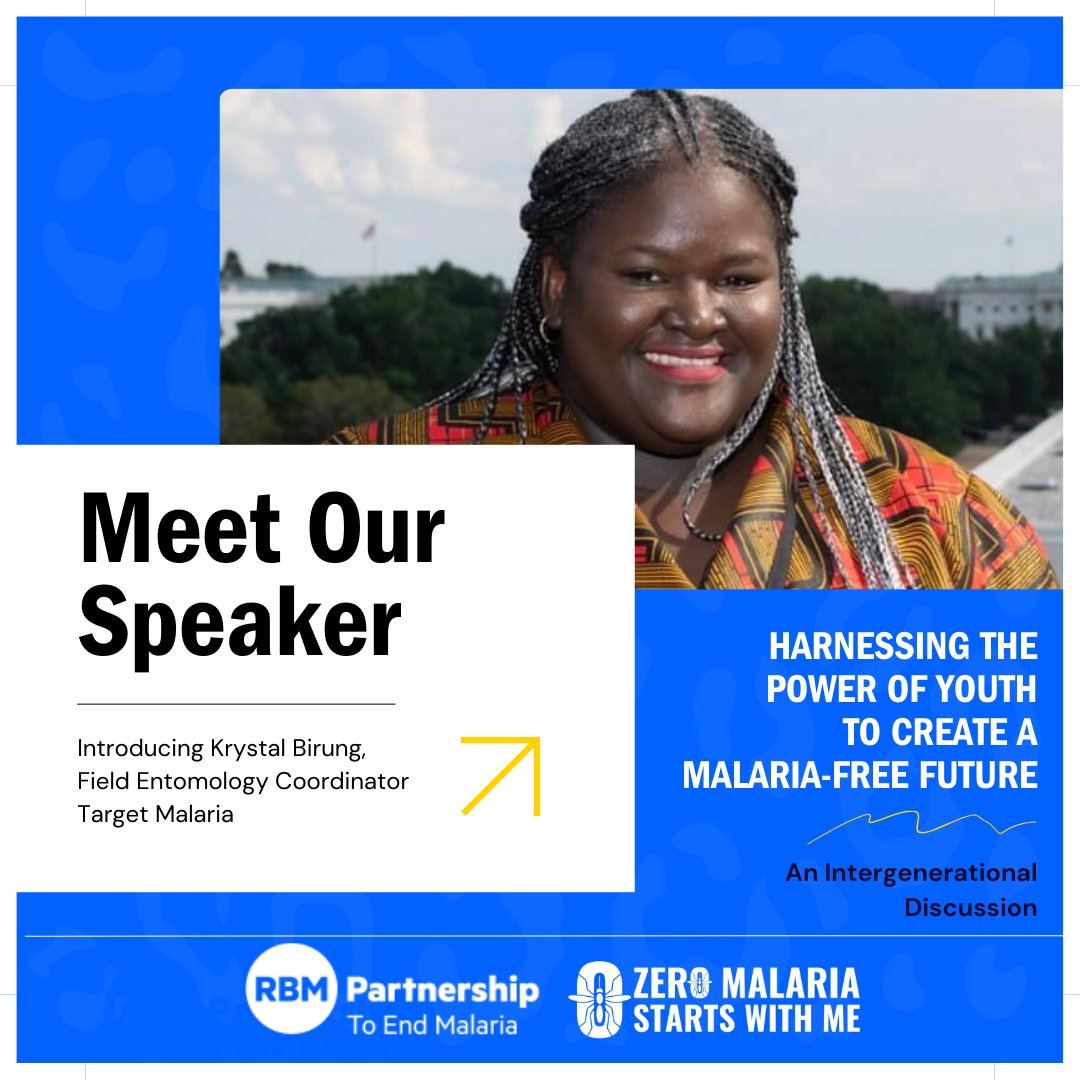
🔊Meet our speaker: Harnessing the Power of Youth to Create a Malaria-Free Future #GenZeroMalaria@TargetMalaria Field Entomologist, Krystal Birungi, will share her journey as a young scientist and the importance of creating more youth-inclusive malaria interventions.
#RBMatUNGA79 #YouthLead
🔗https://t.co/4yH9sMse3X
Today's high-level dialogue highlighted the remarkable progress Africa is making in harnessing emerging technologies in the health sector. From advancements in artificial intelligence to promising developments in genomic medicine, Africa stands on the brink of a new era that could transform its health landscape. However, a key message throughout the day was the importance of collaboration. Africa cannot rely on a single technology to drive progress—biological and digital innovations must complement each other to achieve the desired outcomes.
Additionally, there was a strong emphasis on fostering political will and increasing community engagement to ensure that these emerging technologies are not only introduced but embraced by societies across the continent. As Africa adopts advanced tools, the need for capacity building and the protection of data privacy remains essential to ensure that all populations benefit from these innovations.
------------------------------
Le dialogue de haut niveau d’aujourd’hui a souligné les progrès remarquables réalisés par l’Afrique dans l’exploitation des technologies émergentes dans le secteur de la santé. Des avancées en intelligence artificielle aux développements prometteurs en médecine génomique, l’Afrique est à l’aube d’une nouvelle ère qui pourrait transformer son paysage sanitaire. Cependant, un message clé tout au long de la journée a été l’importance de la collaboration. L’Afrique ne peut pas compter sur une seule technologie pour faire des progrès: les innovations biologiques et numériques doivent se compléter pour atteindre les résultats souhaités.
En outre, l’accent a été mis sur l’encouragement de la volonté politique et l’augmentation de l’engagement communautaire pour garantir que ces technologies émergentes soient non seulement introduites mais adoptées par les sociétés de tout le continent. Alors que l’Afrique adopte des outils avancés, le besoin de renforcement des capacités et de protection de la confidentialité des données reste essentiel pour garantir que toutes les populations bénéficient de ces innovations.
#EmergingTechnologies #HealthTechAfrica
@NEPAD_Agency@_AfricanUnion@roseoronje@EliyaZulu@sipuka_m@BhekaniMbuli@CharlesMugoya@BarbsGlover
Dengue is a viral infection transmitted to humans through the bites of infected female Aedes mosquitoes.
Watch the video below by @ViralFactsAfrica to find out what you need to know about dengue fever.
#EndMalaria#WorldMosquitoDay#MosquitoCountdown