And, as ever with advocacy material from the Green Blob, you need to look under the bonnet rather than trust the headline.
ECIU/CBI Economics claim the Net Zero economy is worth £105 billion in GVA and supports 1.1 million jobs.
But that is not the direct value of the sector. It combines direct activity with supply chain effects and induced effects from employee spending.
Indeed, the report’s own direct figure is £36.7 billion in GVA and 308,000 jobs. The rest comes from £51.2 billion through supply chains and £16.8 billion through wider induced activity.
Moreover, the definition is very broad.
As @RianCFFWhitton has previously noted, ECIU/CBI Economics do not use the Low Carbon and Renewable Energy Economy (LCREE) Survey definition, which is an official ONS survey category for direct low-carbon and renewable energy activity.
Instead, they use The Data City’s Net Zero RTIC, a broader private taxonomy designed to identify firms linked to Net Zero. LCREE is not perfect, but it is at least an official ONS statistical measure.
Now compare that with Whitton’s Foundational Industrial Economy (FIE), which covers energy intensive industries (as defined by the European Union) such as concrete, glass, steel, petrochemicals and fertilisers, plus mining, quarrying, oil and gas extraction.
Using 2023 data, Whitton found that the FIE generated £57 billion in GVA and employed 445,000 workers. It accounted for only 1.4% of employment, but 2.5% of national GVA.
The average FIE job generated £128,000 in GVA, compared with £72,000 across the economy.
That is the distinction Miliband ignores and the ECIU/CBI Economics headline obscures.
The FIE is a highly productive industrial base. It mines, refines, processes, manufactures and supplies the material foundations of national power.
Miliband’s Net Zero economy is different. It is a rent-seeking, mandate-driven ecosystem that depends heavily on subsidies, legislative support, compliance spending, imported technology and inflated multiplier effects.
One creates real value. The other survives because politicians force the economy to pay for it.
@BjornLomborg Correct that SoH issue is showing world how important FFs are to modern economies
But the fert problem is not that severe. Several fert are less $ now than they were EoY
Lots of alt transport for fert out of PG that is not available for crude/LNG
2008/2022 spikes far worse
Ethically and practically, it very much looks like reckless or intentional misrepresentation for financial gain.
The firms knew the scenario was highly questionable, yet they kept selling it as credible risk intelligence because it was profitable.
This is one of the ugliest parts of the entire RCP 8.5 saga: the science became corrupted, and then it was monetized.
The combination of ideological capture and financial incentives created a perfect storm.
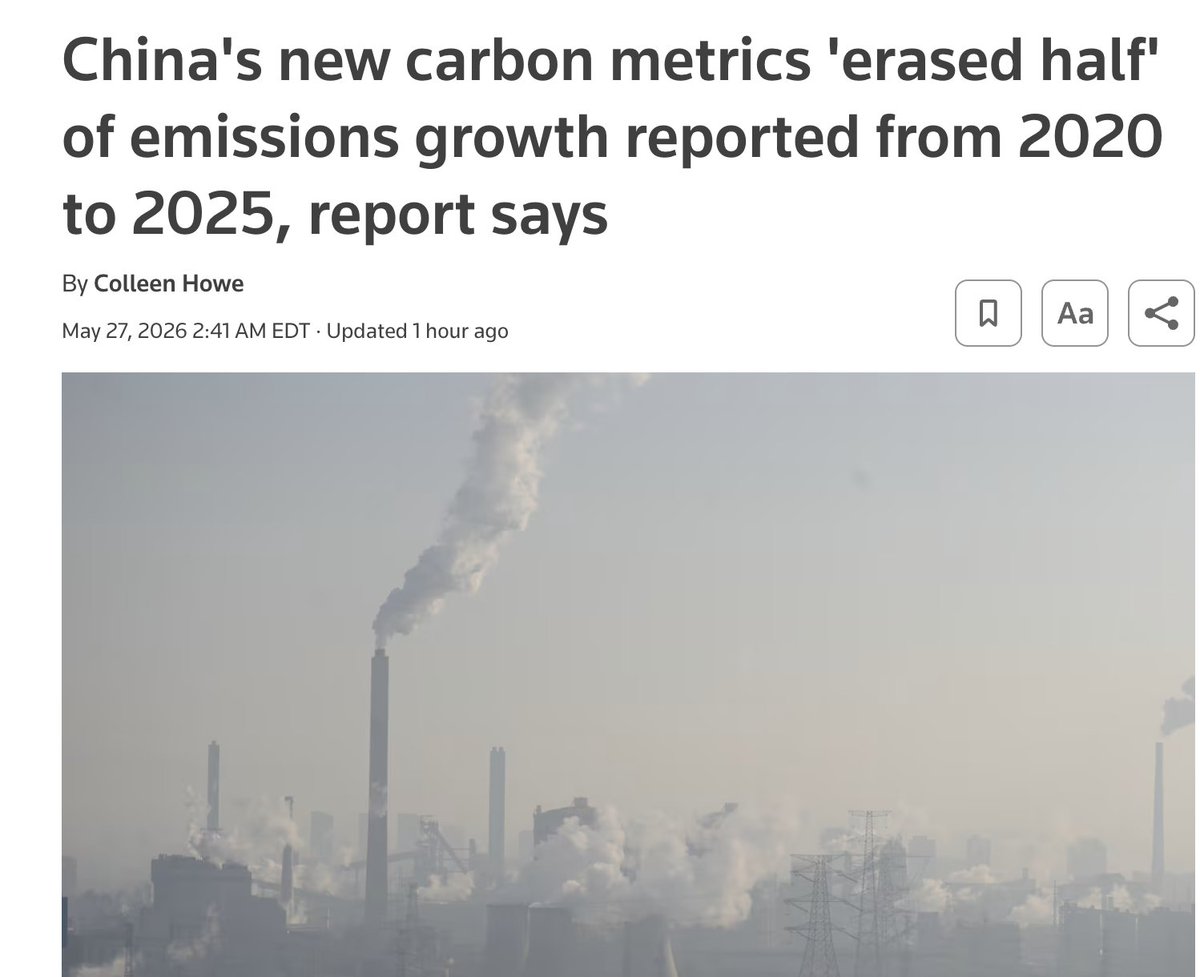
CHINA CHEATS: "China's new carbon metrics 'erased half' of emissions growth reported from 2020 to 2025"
"China's latest carbon data suggests it has changed the way it calculates carbon emissions, reducing by half the emissions growth the country previously reported from 2020 to 2025, climate researchers argue in a new report" https://t.co/yvmUdvyOEN
In the context of the current Sturm und Drang over the demise of RCP 8.5, lets consider that it was Al Gore and his 'Inconvenient Truth' which launched the climate alarmist movement
He made exaggeration mainstream
He made climate fear into a grift
He forced govt spigots to open
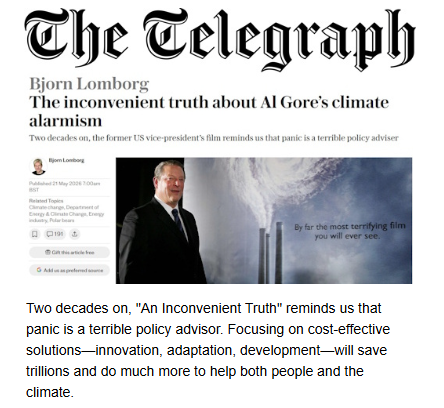
The depressing 20-year legacy of An Inconvenient Truth
Exactly two decades ago today, Al Gore's movie "An Inconvenient Truth" thrust climate change into the global spotlight. With dramatic imagery and dire warnings, it transformed a niche concern into a front-page crisis, influencing rich country leaders and elite jet-setters, and inspiring a generation of activists.
From my latest newsletter: https://t.co/8PmzChHQOl
Sign up: https://t.co/PIif2dDeWJ
The reality is that while many more might take climate science more seriously today, they probably would not have wasted literal trillions of dollars to prevent fantasy scenarios. We would all be in a better place.
But we aren’t.
Because of their scare tactics.
@SenWhitehouse “Surged globally”?
You mean going from 80.4% of global energy from fossil fuels 20 years ago to 80.1% of global energy from fossil fuels today is surging?
You know nothing about what you talk about, do you?
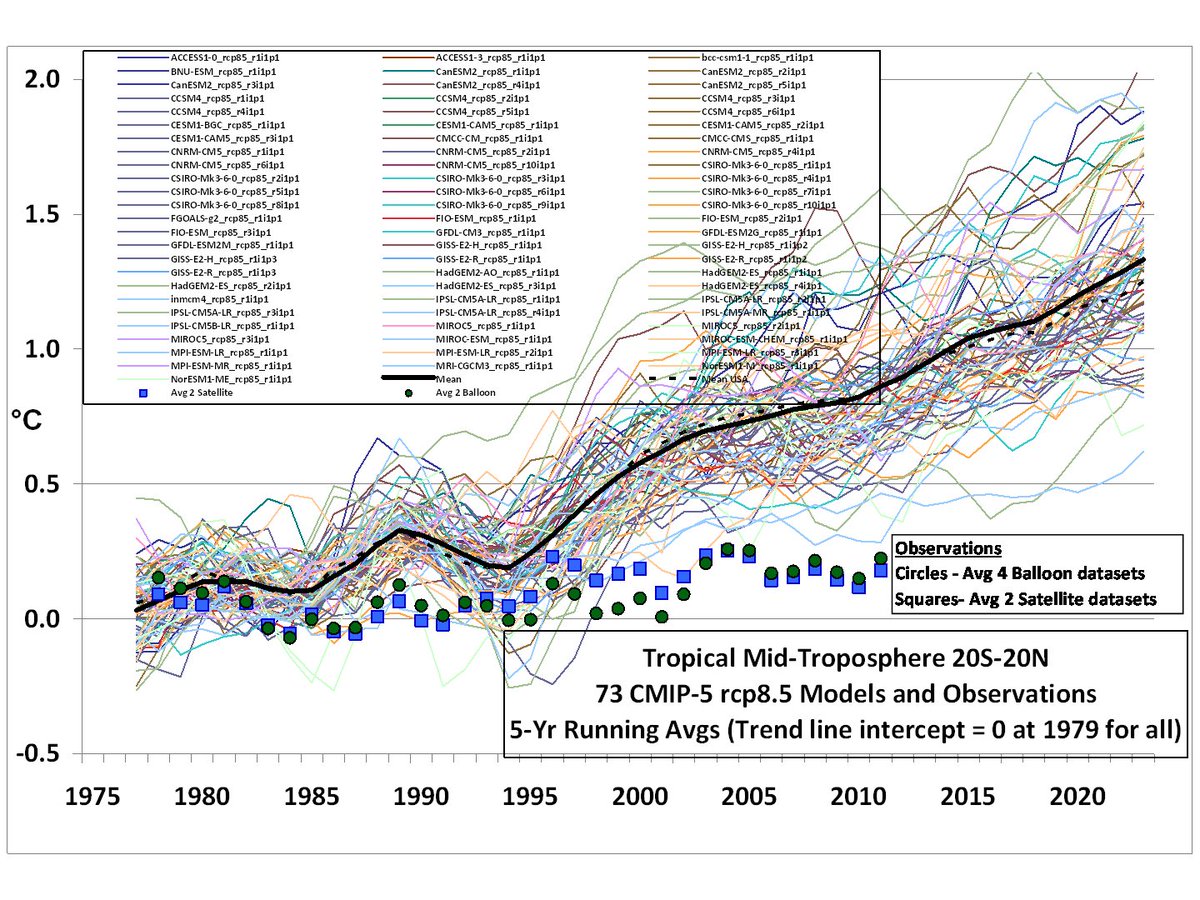
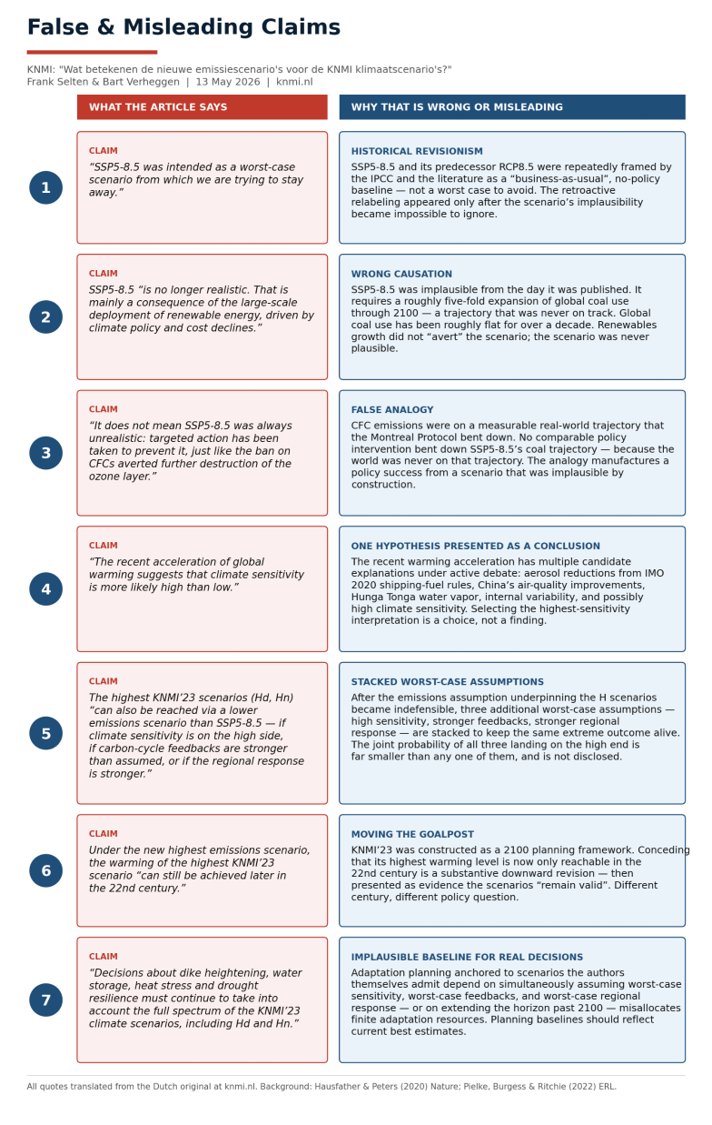
RCP8.5 was trashed because it’s garbage and everyone knows it
🚨Big post
Most people who work with or use climate scenarios, including most climate scientists, are unaware that in the early 2000s there was a big fight in the community over how to present scenarios to the world, explicitly about how to communicate their political implications
On one side were the scenario experts led by the IPCC SRES leadership who argued that it was scientifically inappropriate to assign scenarios a likelihood, notably by assigning one or a few scenarios to be official baseline or reference scenarios
The 2000 SRES report provided 40 different scenarios spanning a very wide range of plausible futures, and ALL of them were characterized as baseline scenarios, that is, plausible trajectories of where the world might go into the future
No scenario was give a likelihood or probability
On the other side of the debate were earth scientists, led by Steve Schneider who wanted scenarios to convey a particular political message, he explained "policy analysts needed probability estimates to assess the seriousness of the implied impacts"
Schneider's camp won the debate and by 2005 the community decided to scrap the SRES scenarios and develop a very small number to replace them and to assign a single scenario as the baseline or reference scenario, back then also called business as usual
That was the birth of the RCPs (4 scenarios, 1 baseline) and then SSPs (7 sceanrios, 2 baselines)
Under the RCPs/SSPs baseline scenarios have long been treated as where the world was headed. This was what the SRES community warned NOT to do.
We now know that the three baselines of the RCPs/SSPs were all fatally flawed. That is why they have been retired in 2026.
If you want to know how climate science got off track, understanding the early-2000s scenario debate is essential.
Another great @energy_said piece
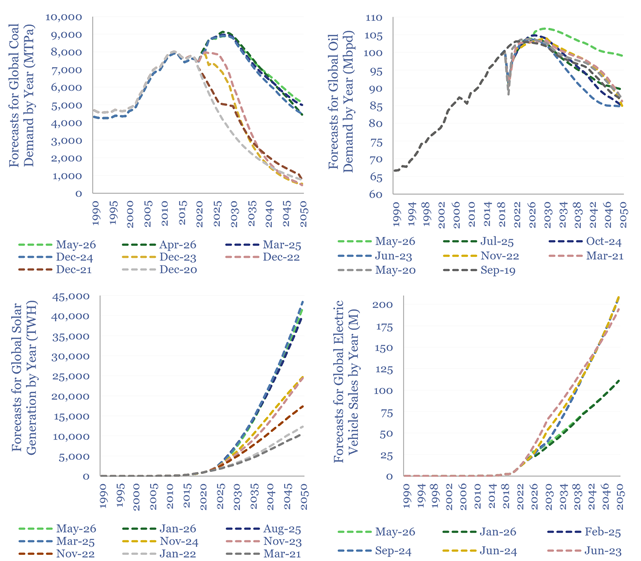
The "experts" forecasting energy seem to always get it wrong. Instead of peak coal, peak oil, and exploding EV demand, we get ... the opposite. And never mind those H2 forecasts🙄
Solar growth strong - but massive subsidies will do that
Activist academics are squealing that with RCP8.5 / SSP5-8.5 being dead, critics will argue that the tens of thousands of papers published that used the IPCC's worst-case scenario are invalid and cannot be used for regulations and litigation against coal, oil, and natural gas companies.
This is an admission that these hacks simply do not care about science and correcting the record; they care only about political activism.
They have shown their true colors. 🎨🖌️
@RogerPielkeJr RCP 8.5 is exposed as fantasy
Instead of acknowledging the problem and their complicity hyping extreme climate scenarios that aren’t realistic, they take a defensive posture and act as if they did nothing wrong
Is it any wonder why climate scientist credibility is approaching 0?
With respect, we’ve known for some time — certainly prior to AR6 — that RCP 8.5 was implausible, yet it was allowed to continue beyond AR6. Worse, the climate community was sheepishly quiet as it observed every traditional media outlet use it as the base scenario.
The community must not be surprised that it has lost the proverbial moral high ground — and the trust of the people. Nor should it be surprised, finding itself in the political crosshairs of Trump when it chose to behave politically rather than scientifically.
1/5 🧵In Massachusetts, the energy efficiency surcharge on electric bills has exploded, rising from 1.23 ¢/kWh in 2014 to 6.03 ¢/kWh in early 2025 — nearly 5× higher. For a typical 600 kWh/month household, that’s gone from $7.40 to $36 per month just for “EE.” @windaction