Gemini 4 Neon + Antigravity is most UNDERRATED AI setup right now...
I've never seen such quality so cheap, and 99% of people will ignore it
BUT if you put all Google models on one team AND connect Claude + GPT → your world changes
I'll show you how: https://t.co/1QidhQJpqu
Dear Community,
We’d like to share an update on the Sep 12 hack at the former @camelotdex, now @FrontierLaunch, which resulted in ~$131K in losses for the Equilibria community.
We believe you deserve to know what happened.
https://t.co/Lm4pcAP2Cs
. @arbitrum@RobinhoodApp
Our bet is that better AI will make films more personal.
So I made a film where hurting someone turns you into candy.
Would that make us civilised?
Created with @seedance 2.5.
Happy to collaborate with @BytePlusGlobal on this project.
#seedance25
So I tested DeepSeek V4.1 Flash on real tasks. 2 repos, 105 hidden bugs, find and fix what you can.
Opus 5 (max): 27
Grok 4.6 (max): 27
DeepSeek V4.1 Flash (max): 24
GPT-5.6 Luna (xhigh): 23
Opus 5 (high): 21
A really strong model for everyday tasks. And look at the cost:
Opus 5 (max): $51.33
Grok 4.6 (max): $16.96
DeepSeek V4.1 Flash (max): $1.80
GPT-5.6 Luna (xhigh): $2.50
Opus 5 (high): $38.77
It's at the Pareto frontier.
Other effort levels (high) and extra tests for DeepSeek V4 Pro dropping every hour in this thread 🧵
I had early access to GPT-6. This model will completely shatter your understanding of what's possible, and it will start a new era of creativity.
It's hard to explain how big of a jump this is, so I'll share my tests.
1/6 Made this 3D model and animation in code from an image.
You don’t need a bridge anymore.
Introducing Universal Deposit.
Send a token from any supported chain and receive USDC in your Solana wallet.
Universal Deposit handles the routing, bridging, and swapping automatically:
- Send funds from the wallet you already use
- Deposit from Ethereum, Base, Arbitrum and Sui
- No bridge apps, network switching and extra transactions
- Flat $0.30 fee, whether you send $100 or $10M
The most seamless cross-chain transfer experience is here.
All roads lead to Solana
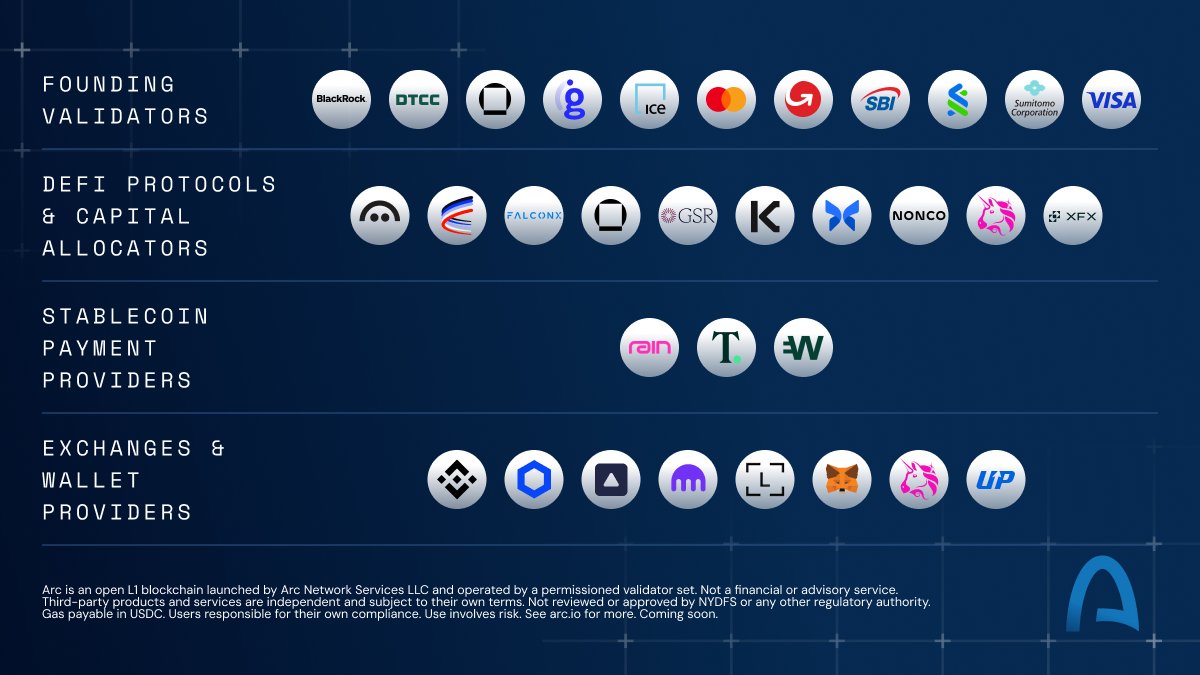
Arc Mainnet launches September 16.
Arc is an open blockchain network being built for the world’s financial markets, real-time money movement, and agentic economic activity.
Arc’s founding validator cohort includes @BlackRock, @The_DTCC, @galaxyhq, @GlobalPayInc, @Mastercard, @MoneyGram, @ICE_Markets, SBI, @StanChart, Sumitomo Corporation, and @Visa.
This is a different model for onchain infrastructure: a network secured by the institutions building on it.
Arc is already gaining traction across major institutions.
@BlackRock, @BNYglobal, @The_DTCC, and @StanChart are each exploring integrations spanning tokenized asset settlement, custody, stablecoin access, FX, and repo infrastructure.
Arc is also expected to launch with a broad ecosystem across liquidity, payments, access, and infrastructure with more to come.
Liquidity / DeFi: @aave, @aeroxyz, @FalconXGlobal, @galaxyhq, @GSR_io, @keyrock, @Morpho, @nonco_otc, @Uniswap, @OfficialXFX
Payments: @raincards, @ThunesPayments, @wirexapp
Major Exchanges and Wallet Providers: @BinanceWallet, @chainlink, @FireblocksHQ, @krakenfx, @Ledger, @MetaMask, @Official_Upbit, @Uniswap
Participants building on Arc experience an open platform powering the world's financial markets, real-time money movement, and agentic economic activity.
Whether you're launching a financial application, integrating stablecoin flows, or experimenting with new, AI-powered economic models, Arc gives you the tools to build what isn’t possible anywhere else.
Arc Mainnet launches September 16.
https://t.co/lUb8kJRp2o
Every year we get our consortium style initiative around a stablecoin, we have seen this with Diem, Global dollar and now Open USD. While the set of players here is obviously potent, I remain highly skeptical any of these initiatives can hit scale.
A few thoughts on OpenUSD:
1. Liquidity and the cold-start problem. USDC and USDT have massive network effects across exchanges, payment processors, and brokers. This is always repeated but it's true, there are no BTC/sofiUSD pairs to trade on any of these exchanges or markets. These are not stableocin market makers and participants are willing to hold in size, as you can’t really use them anywhere.
The fair counter is that crypto markets will be far smaller than remittances or equities/bonds. Probably true, I suspect in the medium term, but those markets are still converging on the same stablecoins. Hyperliquid just struck a massive deal with USDC/Coinbase. Every tokenization initiative so far is built around the incumbents too.
2. A consortium of 500 rivals has no precedent for working. The pace of decision-making across 500 competitors is going to be glacial. Not everyone gets a board seat at Open Standard I imagine, so what happens when decisions cut against some of the players? Circle and Tether ship whatever they want, whenever they want, with zero commitment to anyone.
3. Regulatory and antitrust risk at scale. Circle and Tether are willing to absorb enormous pressure, they have being doing so for years. They hold hundreds of licenses they can use to arbitrage markets, Yes GENIUS act gave a lot of breathing room and clarity, but oversees, this is not the same story. The moment this gets hard under regulatory pressure, I think a lot of these partners just walk away. And a bloc of the largest banks and card networks jointly issuing money is an obvious antitrust target.
4. The "socialist" economics starve the issuer. Passing reserve revenue back to partners sounds great in practice, but what does Open Standard actually operate on? Little to no retained capital. People forget Circle doesn't just have marketplace/exchange partnerships; it funds a whole web of rebates across on/off ramps, stablecoin settlement, OTC desks, and more, with each deal being somewhat bespoke depending not he partner. Who funds that at Open Standard? Who decides which deals, on what terms, especially when the counterparty is a rival of an existing member?
Circle GAAP Opex for 2025 were 900M USD, if you strip out one time cost and IPO related cost, its adjusted OPEX is closer to 500M annually. Let’s say open Standard gets 25 bips, which is what other consortium did, At 10B of supply, open standard is making 25M a year… You don’t fund much with that…. You need to become huge very quickly.
5. The announcement is basically a giant LOI. Read the quotes: BlackRock calls it "a constructive step," BNY "looks forward to exploring ways to support," others say it's "interesting." Meanwhile the partners are backing rivals: Stripe owns Bridge and has its own stack, Coinbase is wedded to USDC, banks are building their own deposit tokens, and the card networks support every token out there. They'll hedge across all of them. Distribution only matters if it's exclusive — and it clearly won't be.
6. The "mint/redeem fees are a problem" claim is wrong. In practice every large institution minting and redeeming through Circle and Tether already gets big rebates. The real cost of moving money is FX, not mint/redeem and there's no moat there, because anyone can just match free mint/redeem.
All in all: one to monitor, but I'm deeply skeptical that an organization that looks like a DAO of 500 companies can move fast enough to matter long term. Who decides go-to-market? Capital allocation? Anything?
Ultimately this reminds me of the DAO experiment. The pitch was identical: no single owner, "neutral" governance, aligned incentives, decisions made collectively for the good of the network. In practice DAOs almost universally failed at the thing that actually matters: shipping. Governance turned into endless forum debates and token-weighted voting where nothing decisive got done, capital sat idle because no one could agree how to deploy it, and the projects that won were the ones with a clear owner willing to move fast and take risk. "Owned by everyone" almost always means accountable to no one. Open Standard is a DAO of competitors that are not really committed to anything, and I'd bet on the two operators who can ship unilaterally over a committee that has to ask 500 rivals for permission.