We are excited that our SUMMIT paper has been published in Nature Communications. SUMMIT is a new method to improve gene expression prediction and can build expression prediction models for genes with low heritability. https://t.co/AHNQLAVuvG @NatureComms
AlphaFold: predicting the protein structure from amino acid sequence for >200 million proteins (awarded @NobelPrize)
Today
Alpha Genome Atlas: predicting the molecular impact of all 9 billion variants of the human genome
https://t.co/DkEtZofJ8s
Yes, this result cost millions of dollars.
But remember that when @OpenAI announced o3 it cost ~$500,000 to score 87.5% on ARC-AGI 1. Today, Astra scores higher for ~$20.
In 2025 it took us and GDM an enormous amount of compute to achieve IMO gold. For the 2026 IMO, anyone with a $20/month ChatGPT subscription could do it.
Massively scaling test-time compute gives us a glimpse of the future. I believe that a year from now everyone will have an AI at their fingertips capable of solving problems of this caliber.
We’re sharing a solution to the Navier-Stokes Millennium Prize Problem, one of the deepest problems at the frontier of mathematics.
The proof was produced by a group of agents, using an OpenAI next-generation model significantly more capable than GPT-6 Astra.
The problem concerns whether the description of smooth three-dimensional fluid motion modeled by the Navier-Stokes equations can break down. It has remained unresolved for roughly 90 years.
Pay attention to the RLM space.
I'm doing some digging and, on a technical level, RLM already solves some of the biggest problems in context windows and attention mechanisms.
But here's the thing: the raw AI intelligence is already equal to, or superior than, many problems we face today.
The problem has been, you guessed! Memory and context management.
But if we solve this, then that's a step change. This could be much bigger than RAG.
To break it down, there are two core insights of RLMs:
- Reasoning and retrieval are now orthogonal capacities: Until now, reasoning, retrieval, and attention were all bound up together.
- Problem tractability is a function of addressability, not complexity (anymore). The models have been smart enough for a while, but the bottleneck was total information.
I won't say "this is as big as reasoning or Chain of Thought" but it feels darn close, and I would not be surprised if this is ultimately bigger than RAG.
Repeating your prompt can make LLMs significantly more accurate.
Google just showed a trivial change that wins 47 of 70 tests.
No extra tokens. No added latency. Zero losses reported.
𝗣𝗿𝗼𝗺𝗽𝘁 𝗿𝗲𝗽𝗲𝘁𝗶𝘁𝗶𝗼𝗻 𝗶𝗺𝗽𝗿𝗼𝘃𝗲𝘀 𝗮𝗰𝗰𝘂𝗿𝗮𝗰𝘆
The method is simple. Send the exact same input twice, back to back.
Language models read tokens in order.
Early parts get processed without full context.
On the second pass, the full picture already exists.
Predictions become more stable and more accurate.
𝗜𝘁 𝘄𝗼𝗿𝗸𝘀 𝗮𝗰𝗿𝗼𝘀𝘀 𝗺𝗮𝗷𝗼𝗿 𝗺𝗼𝗱𝗲𝗹𝘀
The paper tests popular systems at scale.
Every evaluated model improves without reasoning enabled.
Key results:
> 47 wins out of 70 benchmarks
> Zero accuracy regressions
> No increase in output length
> No measurable latency cost
𝗜𝘁 𝗮𝗹𝗹𝗼𝘄𝘀 𝗱𝗿𝗼𝗽-𝗶𝗻 𝗱𝗲𝗽𝗹𝗼𝘆𝗺𝗲𝗻𝘁
Outputs keep the same format. Existing pipelines stay unchanged.
You get higher accuracy by copying and pasting once.
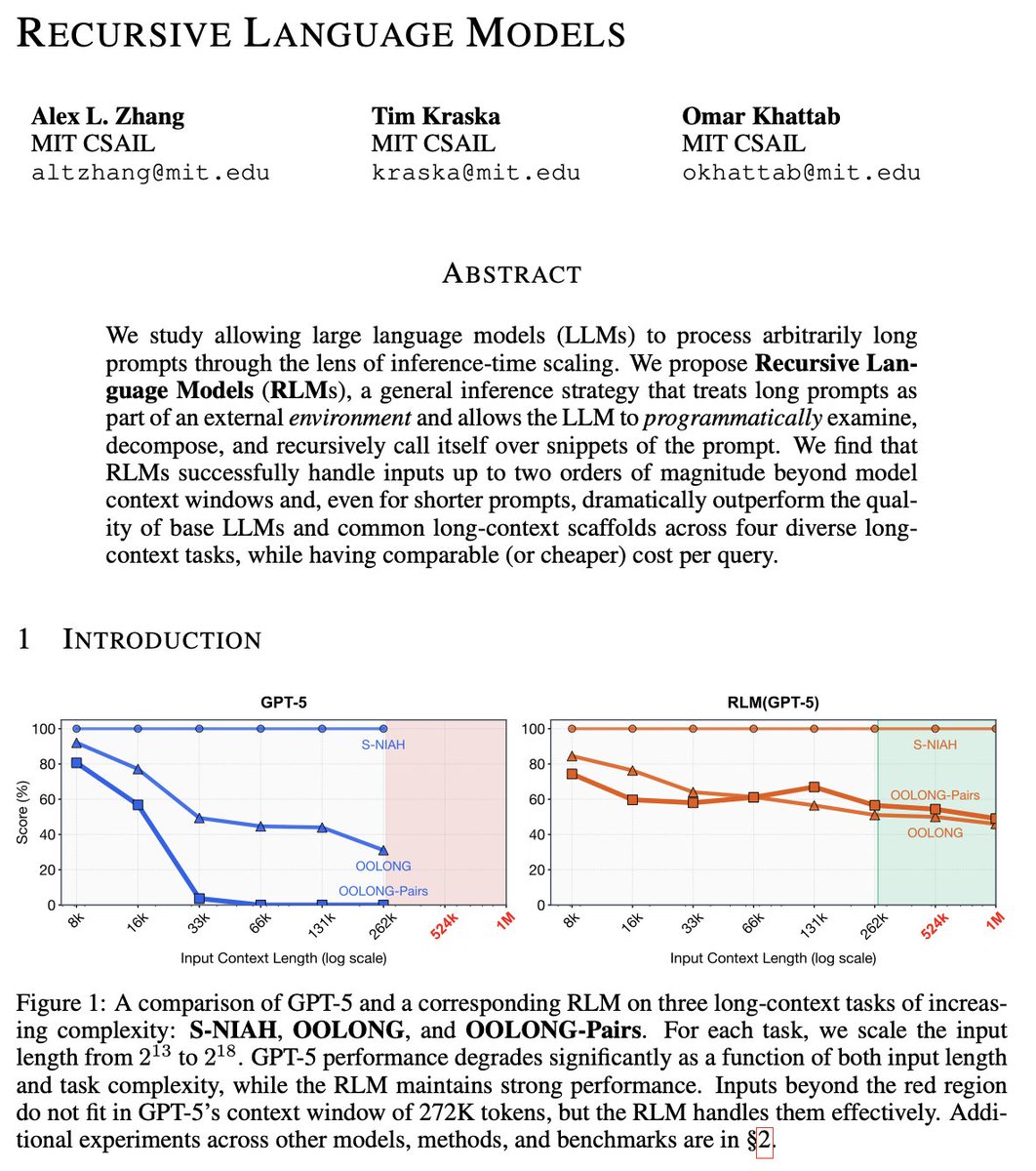
Much like the switch in 2025 from language models to reasoning models, we think 2026 will be all about the switch to Recursive Language Models (RLMs).
It turns out that models can be far more powerful if you allow them to treat *their own prompts* as an object in an external environment, which they understand and manipulate by writing code that invokes LLMs!
Our full paper on RLMs is now available—with much more expansive experiments compared to our initial blogpost from October 2025!
https://t.co/x47pIfIkTb
@MDAndersonNews@PengWeiPhD Thank you for featuring our study in DNA foundation models. Grateful to Haonan Feng for hard work and insights on this project.
Researchers at MD Anderson compared five AI models to see how well they performed DNA foundation language models.
How this study provides a framework for choosing optimal AI models for specific genomic tasks: https://t.co/PzITulGUhg @ChongWuBiostat@PengWeiPhD#EndCancer
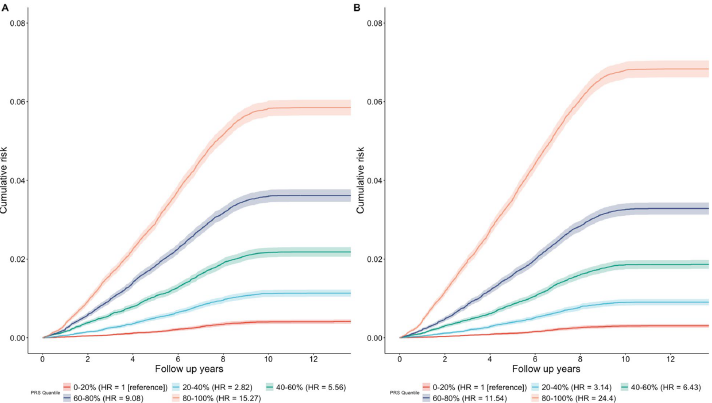
A #Polygenic risk score improves the accuracy of a clinical risk score for #CoronaryArteryDisease
Read more about improved predictive accuracy for incident CAD in the #UKBiobank at #BMCMedicine https://t.co/8T5RaacnTj
The key idea of SUMMIT is to use summary-level gene expression data to build gene expression prediction models. Thanks to the large sample size of the summary-level data, the built models are better than those based on individual-level data with a small sample size.
We are excited that our SUMMIT paper has been published in Nature Communications. SUMMIT is a new method to improve gene expression prediction and can build expression prediction models for genes with low heritability. https://t.co/AHNQLAVuvG @NatureComms
Genes with moderate-low expression heritability cannot be well captured with conventional TWAS. This study introduces the SUMMIT method to improve the expression prediction of TWAS by using eQTL summary-level data.
@ChongWuBiostat
https://t.co/Js1YaJOwWU
Very excited that our new integrative analysis method CMO has been applied to identifying novel risk genes for COVID-19 severity. https://t.co/NwP6FtiWrB
@pgbovine Big Congrats. I want to take this opportunity to thank your advice post in your website. It really helps me a lot to find a job in academia...
IGES highlight from the April 2018 issue of Genetic Epidemiology is "Integrating eQTL data with GWAS summary statistics in pathway-based analysis with application to schizophrenia" by Chong Wu & Wei Pan
https://t.co/qIk4UWb0F8
or
https://t.co/Lic7F4FSJw