Almost 12 years ago, I left @DRWTrading with @wesarn_real to start @digitalasset. @ShaulKfir joined us shortly after. The name felt right. The idea was simple but audacious: build a global settlement system that is asset agnostic. One that doesn’t eliminate banks, exchanges, and intermediaries, but tears down the barriers keeping people from accessing assets and settling at a fraction of today’s cost. A new financial world, built for the end consumer.
We knew institutional adoption was the path. We just didn’t know how long it would take.
We failed. We made bad decisions. There are things we would have done differently. But we never let go of our North Star, even when people around us were convinced we had no idea what we were doing. That focus, conviction, and most of all, patience, led us to launching @CantonNetwork. And the results speak for themselves.
Today is a new chapter in that story.
I’m proud to announce that @a16zcrypto is leading our latest round, joined by some of the giants of the global financial system, including @ABNAMRO, ADIA, @apolloglobal, @BNPParibasCIB, @Broadridge, @citsecurities, @CMEVentures, @cbventures, Green Wolf Asset Management, @Hanwha_Official, @HSBC, @icapitalnetwork, @LCVentures, @OptiverGlobal, @polychain, @R136Ventures, @SPGlobal, @sbigroup, @smash_capital, @SoFi, @Tradeweb, and @WilliamBlair, and others we’ll be naming shortly. Twelve years ago, I could not have imagined building alongside partners of this caliber.
$CC today processes the highest fees of any institutional blockchain network. And we’re just getting started. What’s coming later this year is just as exciting.
None of this happens without the builders, the ones who show up to weekly tokenomics meetings, dial into operations subcommittees, spend nights and weekends building apps on Canton, and show up on @X to cheer this ecosystem forward. You are not just supporters. You are partners. I’m honored to be on this journey with you.
On a personal note: @a16z hits differently for me. Ben’s book The Hard Thing About Hard Things was one I kept coming back to during the hard stretches. Having his firm lead this round is meaningful in a way that’s hard to put into words. So I’ll let him do it:
“The hard thing isn’t setting a big, audacious goal. The hard thing is spending sleepless nights trying to achieve it. The hard thing isn’t dreaming big. The hard thing is waking up in the middle of the night in a cold sweat when the dream turns into a nightmare. Motivating yourself by watching YouTube shorts or Instagram reels isn’t the hard thing. The hard thing is working every day and being consistent even if you feel like shit. The hard thing isn’t boasting you could achieve anything. The hard thing is working like hell to achieve something. The hard thing isn’t believing in yourself. The hard thing is getting things done when nobody believes in you, even when you doubt yourself. The hard thing isn’t telling yourself that you must achieve the impossible. The hard thing is toiling hard every day for years despite knowing that success is too uncertain.”
https://t.co/heqdne7Thh
Canton separates identity from the protocol layer.
Each application defines its own identity requirements. A regulated lending app can require KYC. A decentralized exchange can operate without it. Both run on the same network.
Identity is a feature of the application, not a constraint of the chain.
Less than 4 months since our mainnet launch, we’re thrilled to announce https://t.co/RMku1WzkkS has surpassed $75M in total trade volume 🔥
A huge thanks to our community and the entire @CantonNetwork tribe for your continued support 🤝
We're just getting started...
#canton $cc #rwa
Interesting study arguing the universe can't be a simulation.
I think there's a missed nuance:
The Base Layer could be Turing-complete and computational but it already has Gödel incompleteness - which gets inherited by any simulated layer.
That means a simulated world can’t run further simulations.
No infinite nesting.
So we're Base Layer or (one and only) Simulation.
So which are we?.....
@EricTopol@NatMetabolism So:
- eat choline rich foods to produce TMA
- eat soluble fibre to keep TMA in the gut longer so less goes to liver to make TMAO
- eat polyphenols to suppress TMAO production in the liver
- eat probiotics eg kefir/yoghurt to promote microbiome that feeds on TMA
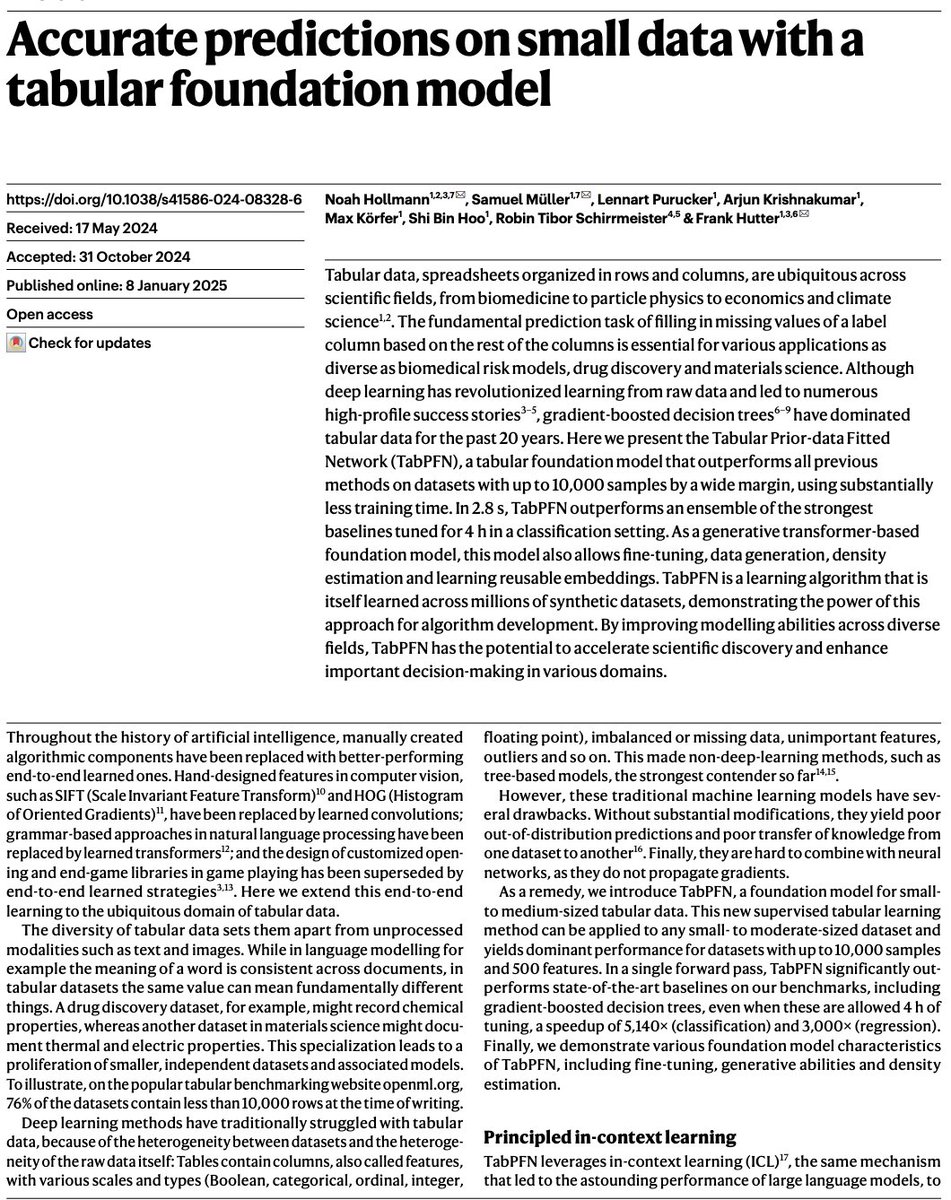
This paper really is groundbreaking. It solves a long-standing embarrassment in machine learning: despite all the hype around deep learning, traditional tree-based methods (XGBoost, CatBoost, random forests, etc) have dominated tabular data—the most common data format in real-world applications—for two decades. Deep learning conquered images, text, and games, but spreadsheets remained stubbornly resistant.
This paper's (published in Nature by the way) main contribution is a foundation model that finally beats tree-based methods convincingly on small-to-medium datasets, and does so very fast. TabPFN in 2.8 seconds outperforms CatBoost tuned for 4 hours—a 5,000× speedup. That's not incremental; it's a different regime entirely.
The training approach is also fundamentally different. GPT trains on internet text; CLIP trains on image-caption pairs. TabPFN trains on entirely synthetic data—over 100 million artificial datasets generated from causal graphs.
TabPFN generates training data by randomly constructing directed acyclic graphs where each edge applies a random transformation (using neural networks, decision trees, discretization, or noise), then pushes random noise through the root nodes and lets it propagate through the graph—the intermediate values at various nodes become features, one becomes the target, and post-processing adds realistic messiness like missing values and outliers. By training on millions of these synthetic datasets with very different structures, the model learns general prediction strategies without ever seeing real data.
The inference mechanism is also unusual. Rather than finetuning or prompting, TabPFN performs both "training" and prediction in a single forward pass. You feed it your labeled training data and unlabeled test points together, and it outputs predictions immediately. There's no gradient descent at inference time—the model has learned how to learn from examples during pretraining.
The architecture respects tabular structure with two-way attention (across features within a row, then across samples within a column), unlike standard transformers that treat everything as a flat sequence.
So, the transformer has basically learned to do supervised learning.
Talk to the paper on ChapterPal: https://t.co/hmWIA1dYji
Download the PDF: https://t.co/uxElyS85ge
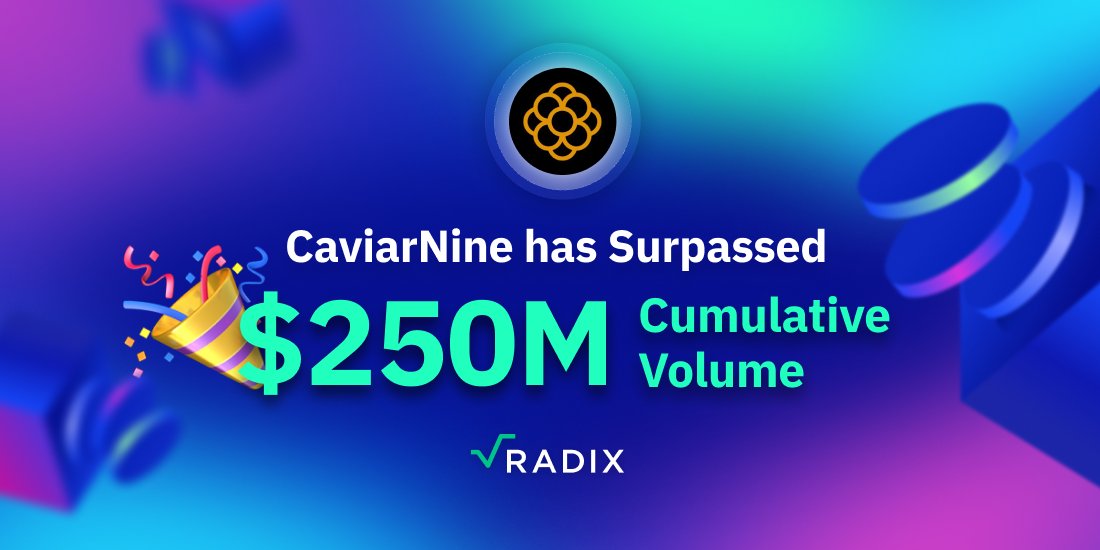
CaviarNine has officially crossed $250M in cumulative volume on Radix!
Because CaviarNine is built on Radix, every tx has used the Transaction Manifest, giving users complete visibility and control before they sign.
Cheers to the builders and users who made this possible!
Interesting study arguing the universe can't be a simulation.
I think there's a missed nuance:
The Base Layer could be Turing-complete and computational but it already has Gödel incompleteness - which gets inherited by any simulated layer.
That means a simulated world can’t run further simulations.
No infinite nesting.
So we're Base Layer or (one and only) Simulation.
So which are we?.....
Researchers have mathematically proven that the universe cannot be a computer simulation.
Their paper in the Journal of Holography Applications in Physics shows that reality operates on principles beyond computation.
Using Gödel’s incompleteness theorem, they argue that no algorithmic or computational system can fully describe the universe, because some truths, so called "Gödelian truths" require non algorithmic understanding, a form of reasoning that no computer or simulation can reproduce.
Since all simulations are inherently algorithmic, and the fundamental nature of reality is non algorithmic, the researchers conclude that the universe cannot be, and could never be a simulation.
So the most reasonable conclusion, based on logical hierarchy, information theory and physics as we know it, is that we are the Base computational layer, not the simulated one.
Which is good!
The hard part is over!
Now we just need to build our universe!
Quantum behaviour looks too mathematically precise to be a resource constrained.
Its exact symmetries and perfect agreement with experiment don't align with an approximate rendered game engine.
Discretized spacetime (a fixed grid/lattice or some cellular automaton) violates Lorentz invariance, the cornerstone of special and general relativity.
Quantum uncertainty is a FEATURE, not a HACK