Never stop developing as a person.
Never stop prioritising yourself.
Never stop loving your friends.
Never stop loving your family.
Never stop loving yourself.
Never stop being kind.
Never stop learning.
Never stop giving.
Never stop.
I've spent $10K+ on anti-aging supplements, and most of them ended up being marketing scams.
So here are the top 7 longevity supplements actually proven to work (based on data):
1. Resveratrol
Microsoft is now literally telling businesses exactly how to get traffic from AI Search.
Yes, directly inside webmaster tools.
This is probably one of the more important marketing updates of 2026.
Let’s go through it.
By the way, you can see whether your business is appearing across Google AI, ChatGPT, Claude, Perplexity and Grok here (it's free):
https://t.co/Evw8cXXicl
Earlier this year, Microsoft launched its AI Performance report so businesses could see how often their content was cited across Microsoft Copilot and partner AI experiences.
Now they are expanding it with four new AI Insights: Intents, Topics, Citation Share and Compare.
Let’s go through what changed.
Microsoft’s AI Performance report already showed: Total AI citations, Which pages were cited, Citation trends over time, the Average number of cited, Grounding queries associated with those citations, and now they' adding even more context.
The first update is Intents, thanks to which grounding queries are now classified into categories like: Informational, Commercial, Research, Learn & Solve and Local.
This goes without saying, but every AI citation is not equally valuable - a core principle that every SEO Stuff (https://t.co/wKpf0EILTx) package starts with.
A citation from an informational query may mean your content is being used to answer broad education-stage questions.
A citation from a commercial query may mean your business is being considered closer to the buying decision.
This is something that every SEO Stuff done-for-you package takes into account:
https://t.co/z7CwQrWps7
Imagine a payroll company sees Microsoft associating its site with:
Payroll software for contractors
Multi-state payroll compliance
Construction payroll pricing
ADP alternatives for small businesses
Now the business can see whether those queries are informational, commercial, research-driven or local.
That changes the content strategy.
If the site is getting cited mostly for informational queries, the company may need stronger pricing pages, comparison pages, industry pages and bottom-of-funnel content.
If it is getting cited for commercial queries but not winning much citation share, the issue may be authority, specificity or third-party validation.
The second update is Topics.
Microsoft is now grouping related queries into broader thematic clusters, and this is important because modern AI search organizes information around subjects, entities, intent, relationships and coverage depth.
That means a business should ask: “Does Microsoft understand us as a strong source for this topic?”
A payroll company may discover that Microsoft connects it strongly to: Contractor payroll, Small-business payroll, Payroll compliance, and Payroll pricing, as opposed to: Enterprise payroll, Global payroll, Healthcare payroll and Construction workforce management.
That tells the company where its topical authority is strong and where it is thin.
The third update is Citation Share.
Microsoft says businesses can now see how much of the citation space their site holds for a given grounding query.
Basically, you can start to see whether your site is one of many sources being cited, or whether you are earning a meaningful share of the AI answer ecosystem around a subject.
That is a very different metric from raw citations, because a site may get 100 citations for a topic, but if competitors are getting 5,000, the business may still be underrepresented.
Another site may only get 40 citations for a niche commercial query, but own a large share of the citation space.
This starts to move AI search reporting closer to share-of-voice analysis.
So less “Did we appear?” and more “How much of the available visibility did we capture?”
The fourth update is Compare.
Businesses can now overlay one time period against another.
For example:
Last 30 days vs. previous 30 days
Before a content update vs. after a content update
Before a backlink campaign vs. after a backlink campaign
Current season vs. prior season
This makes AI search optimization much easier to evaluate, because if a business publishes a new comparison page, strengthens an existing pricing guide and earns a few relevant authority placements, it can now look for citation movement afterward.
You don't have full attribution here yet, but even directionally this is still a big improvement.
This is where SEO Stuff’s done-for-you package becomes relevant:
https://t.co/MMsDTFf4rg
The package combines 10 AI-search-optimized articles with three DR50+ authority placements.
The content helps build deeper coverage around topics AI systems already associate with your business.
The authority placements help reinforce your company’s identity, category and expertise across the wider web.
That combination matters because AI visibility usually comes from two things working together:
Useful, specific content on your own site.
Trusted external signals confirming who you are and what you should be recommended for.
Microsoft says these new features are still in early preview, so occasional inaccuracies are possible, but the direction is obvious.
AI search is beginning to provide its own version of keyword, topic, intent and share-of-voice data.
This is the system SEO Stuff was built around:
https://t.co/wKpf0EILTx
And if you want to see whether your business is already being cited, understood and recommended across Google AI, ChatGPT, Claude, Perplexity and Grok, check here:
https://t.co/Evw8cXXicl
Jack's throwaway is the whole theory of the company: "sure, we'll Build seat belts and everyone else can copy them. That's good. That's like good world."
Websites with one specific characteristic get cited by AI platforms 1.8x more often.
Now the data is finally specific enough to act on.
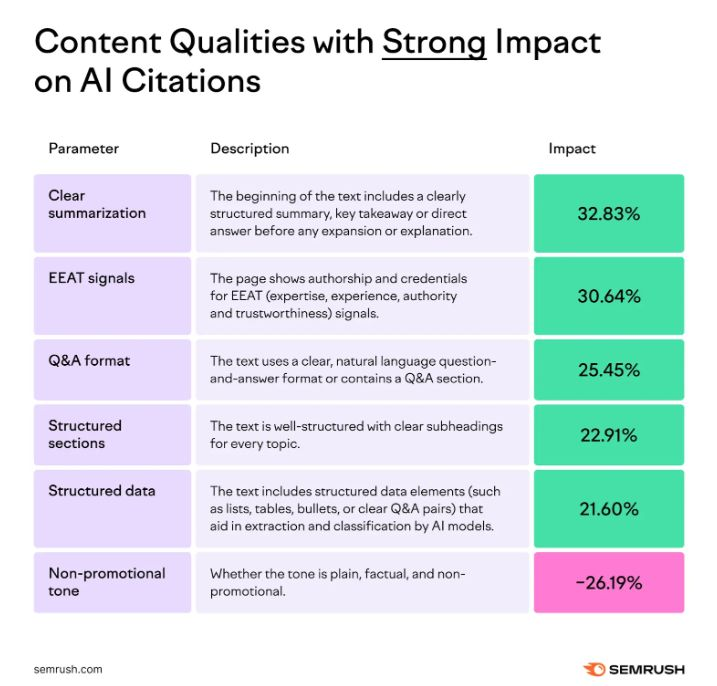
A study analyzed 11,882 prompts and 304,805 cited URLs across ChatGPT, Google AI Mode and Perplexity, then compared them against 921,614 URLs ranking in Google's top 20 that were not cited by AI.
The biggest differences?
Clarity and summarization quality (+32.83%), signals like author credentials and expert sources (+30.64%), Q&A formatting (+25.45%), clear section structure with headings, lists and tables (+22.91%) and structured data (+21.60%).
In other words, the pages AI systems tend to cite are generally clearer, better structured and backed by stronger expertise.
By the way, if you want to see where your site stands across Google, ChatGPT, Claude and broader AI search, start here. It’s free:
https://t.co/Evw8cXWKmN
According to Semrush, sources with clear author information were cited 1.8x more often than anonymous content.
That means naming the author, showing relevant credentials and citing credible expert sources materially improved the signals AI systems have available when deciding what to cite.
Semrush's data shows that cited pages were much more likely to communicate the answer clearly, use structured sections, anticipate questions and demonstrate actual expertise.
Mind you, a page can be relevant enough to rank and still be a poor citation candidate. And the strongest-performing content tends to combine two things.
First, useful content built around expertise: named authors, original data, expert perspectives, direct answers and comprehensive coverage of the buyer's question.
In fact, Semrush found Q&A formatting correlated with roughly 25% higher citation rates, while strong section structure correlated with roughly 23% higher rates.
Second, authority that reinforces the expertise.
Credible third-party coverage, editorial backlinks and references from trusted websites give search and AI systems more evidence that the content and the company behind it are worth trusting.
That is the system SEO Stuff (https://t.co/wKpf0EIe3Z) was built around.
The done-for-you package combines AI-search-optimized content with three DR50+ authority placements:
https://t.co/MMsDTFewBI
The content is built around clear answers, expert attribution, structured depth and the commercial questions customers actually ask.
The Premium Content Bundle goes deeper:
https://t.co/5osvnS9KR3
It includes 60 long-form pieces designed around structured coverage, expert attribution and question-based search intent.
And the Premium Backlink Bundle strengthens the authority side:
https://t.co/BMl9QCG8xv
It adds three contextual DR50+ placements designed to reinforce the brand and its expertise across trusted third-party websites.
And if you want to see where your site stands across Google, ChatGPT, Claude and broader AI search, start here. It’s free:
https://t.co/Evw8cXWKmN
"Just imagine that you asked 10,000 people whether they thought you could travel faster than light, and all but one said, yep, you can do it. I saw it on TV. And only one guy said, no, you can't do it. Albert Einstein. So a guy like him would overwhelmingly reject Einstein and believe the 10,000 average people."
That, per Edward Thorp, is why smart people stayed with Madoff. "He doesn't think for himself, he lets the crowd think for him."
Bill Ackman’s thesis on Amazon and Google:
"All of these companies require massive amounts of compute, and the cloud is the safest, most scalable place to get access to it."
In 1998, two Yale Law grads started GLG to publish industry guidebooks for investors.
A year later they shut the publishing business down. Their clients kept asking to get the people who wrote the guides on the phone.
That request became the expert network, and the hourly expert call with it.
Qualitate’s AI now runs those interviews itself, thousands a month. Insight Partners was a customer before it led the $25M round.
The report was always a summary of a conversation someone else got to have.
Warp founder and CEO Ayush Sharma (@ayushswrites) on what it means to build an AI native product.
Build the product, platform and architecture so every task, starting with deep tax compliance workflows, can be performed by an agent.
(Warp runs payroll, taxes and HR for fast-growing companies using AI agents.)
----
Full video on "YC Root Access" YouTube channel, (link in comment)
Somewhere, a finance team is building a spreadsheet to explain what changed in last month’s spreadsheet.
Add screenshots of bank statements and enough people to hold it all together.
We call this “closing the books.” Then do it all again next month.
Just listened to Parker Gilbert from @numeric_io break down how to finally get out of this loop.
Fun fact:
When a buyer asks ChatGPT about your brand BY NAME, your website gets cited 77.6% of the time.
When a buyer asks "who is the best in this category," your site gets cited 2.2% of the time.
Here is how to close that 14x gap.
Oh, and if you want to see where your site stands across Google, ChatGPT, Claude and broader AI search, start here (it's free):
https://t.co/Evw8cXXicl
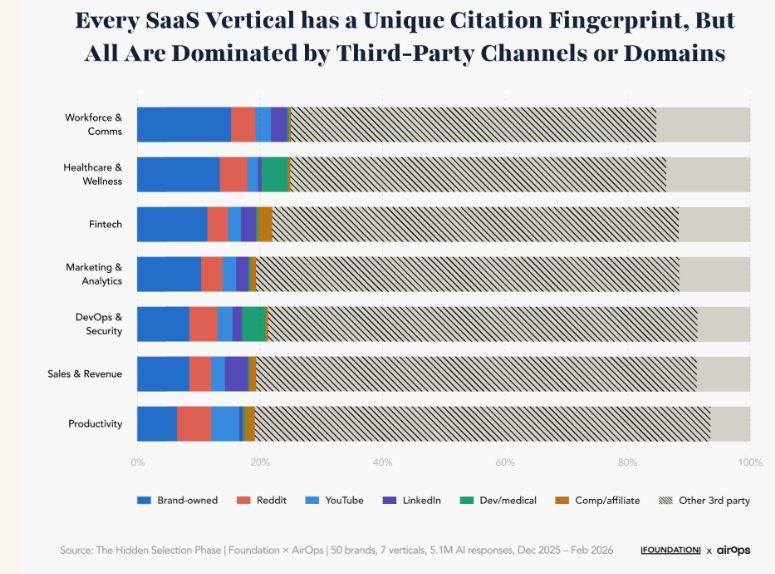
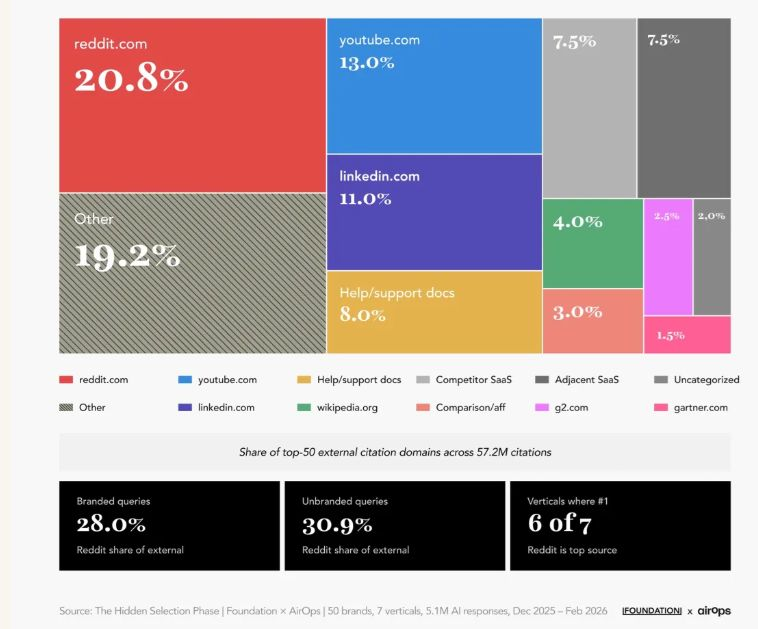
According to Foundation Marketing and AirOps's April 2026 study of 57.2 million AI citations across 50 brands in 7 B2B verticals, branded queries generate 14x more citations for brand-owned websites than unbranded discovery queries.
The brands that do appear in unbranded AI recommendations share a fairly consistent profile: deep expert content on their own site that establishes category authority, combined with editorial coverage from trusted industry publications that puts their brand name in front of the AI's retrieval system across multiple authoritative sources.
Basically, when a buyer asks AI about your brand by name, the AI searches specifically for your website and your content, so of course it finds you.
But then when a buyer asks "best CRM for mid-market companies" or "top cybersecurity platforms for healthcare," the AI is looking for the most authoritative, comprehensive answer it can assemble from every source in the category.
Every industry has a different set of sources that AI draws from for these unbranded queries.
The brands that close the 14x gap are the ones that show up across both their own site and the editorial sources AI trusts in their vertical.
That takes two things working together - both of which SEO Stuff (https://t.co/wKpf0EILTx) has been helping customers with all year.
Expert content on your own website that demonstrates deep category authority: this is what gives AI platforms a reason to include your brand when it finds you.
And editorial backlinks + mentions (authority) from trusted publications in your vertical: this is what puts your brand name across multiple authoritative sources so the AI encounters your brand repeatedly when searching for the best answer to a category query.
Again, if you want to see how your brand performs on branded versus unbranded AI queries and where the 14x gap is in your category, start here (it's free):
https://t.co/Evw8cXXicl
The expert content is doing two things simultaneously.
First, it creates a comprehensive resource that AI can cite directly when it finds the brand during category searches: the more sub-questions your content answers, the more entry points AI has to discover and recommend your brand.
Second, it creates something that editorial publications want to cover and link to: original data, expert frameworks, and comprehensive buyer guides are what industry publications write about.
Every editorial placement where a trusted publication mentions your brand and links to your site creates another source the AI can encounter during unbranded category queries.
A brand that has been covered by 10 or 15 editorial publications in its vertical gives the AI multiple authoritative references to draw from.
Reddit alone accounts for 20.8% of all external AI citations, but editorial publications, review sites, and industry sources collectively represent a massive portion of the citation landscape that brands can actively build presence on through expert content and earned editorial coverage.
This is the system SEO Stuff (https://t.co/wKpf0EILTx) was built around.
The done-for-you package:
https://t.co/Evw8cXXicl
Expert-attributed content backed by DR50+ backlinks: the content builds category authority on your site that AI cites directly, and the backlinks put your brand across the editorial sources AI draws from during unbranded discovery, closing the 14x gap
The content package:
https://t.co/5osvnSaiGB
60 pages of expert-attributed content covering every question buyers ask in your category: the content depth that gives AI a reason to cite your brand and gives editorial publications something worth covering
The authority building package:
https://t.co/BMl9QCGGn3
Editorial placements on trusted publications that put your brand name across the authoritative sources AI searches during unbranded category queries, turning your brand into a recommendation for buyers who have never heard of you
And if you want to see where your site stands across Google, ChatGPT, Claude and broader AI search, start here (it's free):
https://t.co/Evw8cXXicl
"If you've got all your chips on the table, you got to play the hand yourself." — @elonmusk
When the 2008 market collapsed, Tesla faced certain death unless Musk committed all his remaining capital.
If you run a local biz, there is a huge opportunity in becoming the company multiple AI engines independently decide to recommend.
Almost nobody is doing it consistently...
But when four major AI engines *DID* agree on the same top local business in a new study, something interesting happened:
Among those unanimous cases, the winning business's own website appeared among the cited pages 91% of the time.
Let's go through it.
By the way, if you want to see whether your business is appearing across Google AI, ChatGPT, Claude, Perplexity, Grok and broader AI search, start here. It's free:
https://t.co/Evw8cXXicl
Yext analyzed 491,972 local query-market cases across four AI engines: Gemini, OpenAI, Perplexity and Anthropic.
The prompts were unbranded local searches.
Then Yext looked at which business each AI engine ranked first.
All four engines chose the SAME top business in just 4% of cases.
In 48% of cases, all four chose FOUR DIFFERENT businesses for the #1 spot.
So same type of question, same market, four major AI systems - and almost half the time every one picked a different winner.
That tells you how fragmented local AI Search still is.
Being the top choice in one AI system does not mean the others agree - at all.
But among the rare cases where all four DID choose the same #1 business, that winner's own website appeared among the cited pages 91% of the time.
Think about what an AI system needs to understand before recommending a local business.
Where are you located?
What do you actually do?
Which services do you offer?
Which areas do you serve?
What do things cost?
What questions do customers ask?
What proof exists that the business is legitimate?
Imagine two plumbing companies.
Company A has a homepage, contact page and one generic Plumbing Services page.
Company B has dedicated pages for drain cleaning, water heater repair, leak detection, sewer repair, emergency plumbing, service areas, pricing, FAQs and customer examples.
If an AI system is trying to answer:
"Who should I call for a leaking water heater in Pasadena?"
Company B gives it substantially more relevant first-party information to evaluate.
And Yext found some interesting associations around exactly that.
Businesses with location pages were associated with a 2.9x higher likelihood of being named by AI in Yext's matched-profile analysis.
A cover photo: 2.8x.
A clear business description: 2.3x.
A claimed profile: 2.3x.
Recent posts: 1.8x.
10+ profile attributes: 1.5x.
The easier a business is to understand, the easier it may be for AI systems to evaluate it.
Yext also found that each AI engine was starting with a surprisingly different pool of businesses.
Across the four AI lists, the average query produced 23 different businesses.
Each individual engine returned around seven businesses on average.
So local AI Search has at least two separate problems: First, get considered and then become the business that actually wins.
If an AI system never identifies your company as a candidate, your review count is not going to save you.
If it cannot connect your location with the service being requested, you may never make the shortlist.
This is why a clear website matters.
But then comes the second question: why should the AI choose YOU over everybody else?
That is where the broader digital footprint becomes important.
Yext found that the four engines relied on very different source mixes.
Gemini leaned most heavily on first-party websites.
About 41.9% of its cited sources came from first-party sites.
Anthropic was around 33.1%.
Perplexity around 31.6%.
OpenAI around 26.9%.
But OpenAI relied much more heavily on directories and aggregators, which made up roughly 40.9% of the sources it cited.
Anthropic was far more reliant on review platforms than the others.
Reviews accounted for around 20.5% of Anthropic's citation mix whereas Gemini was below 2%.
That is a huge difference and it explains why there is no single AI Search hack.
A broader footprint gives different AI engines different ways to encounter and verify the same business - which brings us back to the 91% number.
When all four engines agreed on the same top business, the winner's own website appeared among the citations 91% of the time.
And those unanimous winners tended to have much deeper profiles and broader web presence than the typical businesses in Yext's matched dataset.
AI systems appear to be evaluating a much wider information environment.
That is where SEO Stuff comes in:
https://t.co/wKpf0EILTx
The content side helps your website become a stronger first-party source.
Instead of five generic pages, build useful coverage around services, locations, problems, costs, comparisons, use cases and the questions customers ask before hiring you.
That is what the Premium Content Bundle is designed to build:
https://t.co/5osvnSaiGB
Then there is the authority side.
Your website tells AI systems what YOU say about the company.
Third-party sources give them additional evidence.
That is why the done-for-you SEO Stuff package combines AI-search-optimized content with contextual DR50+ authority placements:
https://t.co/MMsDTFf4rg
And if you want to see whether your business is already appearing across Google AI, ChatGPT, Claude, Perplexity, Grok and broader AI search, start here.
It's free:
https://t.co/Evw8cXXicl
Dario Amodei saw founding an AI company as a duty.
Academia couldn’t provide the capital and engineering needed to advance AI at scale, while the existing tech industry risked repeating its own mistakes. For him, building a new institution was a means to pursue a meaningful mission.
According to Warren Buffett, the biggest threat to your business is the shock nobody sees coming.
When real panic strikes, fair-weather support disappears overnight. The strongest founders prepare early so market chaos becomes an opportunity, not an end.
Shopify is betting on three-person teams in the AI era.
CEO Tobi Lütke believes AI makes everyone a 7/10 across skills, while agentic systems distribute customer insights across teams automatically.
Once AI is ready for finance, the world is gonna be a different place.
Strict compliance is the main reason AI hasn't fully exploded in accounting yet.
But @john__glasgow and the team at @Meet_campfire are changing that with a deterministic model built specifically for finance.
Elite ML researchers aren't building chatbots anymore.
They're building stuff like agentic accounting.
I just listened to Matt Harpe from @trybasis explain that and it clicked almost immediately.