“Loop engineering” is a hot buzzphrase after mentions of it by Boris Cherny (Claude Code’s creator) and Peter Steinberger (OpenClaw's creator) went viral on social media. Loops are now a key part of how we get AI agents to iterate at length to build software. In this letter, I’d like to share my 3 key loops, shown in the image below, for building 0-to-1 products. These loops guide not just how I build software, but also how I decide what software to build.
Agentic coding loop: Given a product specification and optionally a set of evals (that is, a dataset against which to measure performance), we can have an AI agent write code, test its work, and keep iterating until the code is bug-free and meets its specification. This idea of closing the loop took off around the end of last year, and it has been a game changer in enabling coding agents to work longer productively without human intervention. For example, over the weekend, I was building an app for my daughter to practice typing, and my coding agent could easily work for around an hour, using a web browser to check what it had built multiple times before getting back to me, without needing my intervention.
The engineering loop executes quickly. Every few minutes, the coding agent might build and test a new version of the software. I hear frequently from developers who are finding new ways to engineer more effective engineering loops. This is an active area of invention!
Developer feedback loop: In this loop, a developer examines the current product and steers the coding agent to improve it. Last year, a lot of developers (including me) were acting as the QA (quality assurance) function for our coding agents, manually finding bugs and then asking the agent to fix them. But with coding agents much more able to test their own code, the amount of time we need to spend on this function has decreased significantly. This allows us to make higher-level product decisions, such as what key features to offer, where the UI needs improvement, and so on.
The developer-feedback loop operates over time intervals between tens of minutes and hours — that's how frequently a developer might review a product and give feedback. In the case of the typing app, I changed my mind a few times about the visual design, what cat costumes she can unlock as she learns (she loves cats), and the user flow for a grown-up to log in and steer the child's learning experience.
When a developer has a clear vision for what to build, it is still a lot of work to translate that vision into a specification for a coding agent to implement. Further, after the developer has seen an implementation, they might update (or perhaps clarify) the spec to steer it toward what they want. If you find that the system repeatedly runs into certain problems, building a set of evals for the agent becomes useful.
AI-native teams are increasingly using AI to help shape product direction, for example, automating the gathering and analysis of usage data, summarizing written and verbal customer feedback, or carrying out competitive analysis. However, for pretty much all the products I’m involved in, I see humans as having a significant context advantage over current AI systems — we know a lot more than the AI system about the users and the context the product has to operate in — and thus humans play a critical role. Many people describe this human contribution as “taste,” but I prefer to think of it as humans having a context advantage, since that gives us a clearer path to helping AI systems get better. This also speaks to why this step can’t be automated: So long as the human knows something the AI does not, human-in-the-loop is needed to to inject that knowledge into the system.
External feedback loop: This includes a wide range of tactics like asking a few friends for feedback, launching to alpha testers, or putting the code into production with A/B testing. These tactics are usually slow, rarely taking less than hours and sometimes taking days or even weeks. This data informs the developer vision, which in turn continues to drive the detailed product spec, which in turn drives the coding agent.
With coding agents speeding up software development, more engineers are starting to play a partial product management role. For many engineers who are growing into this role, the hardest part is shaping the product vision and striking a balance between building (bridging the gap between vision and spec) and getting user feedback to evolve the vision. It is important to do both!
I will write more about how to do this in future posts, but for now, I find it encouraging that engineers are playing an expanded role (just as product managers and designers now do more engineering).
[Original text: The Batch]
Agreed, but we'll need closer to $3..4b or $75-100m/yr though and whether we like it or not, we'll need to source talent/leadership from TradFi and here's why with a quick back-of-the-envelope...
A barrel of crude oil becomes more valuable once it’s refined into products like gasoline, jet fuel, and kerosene.
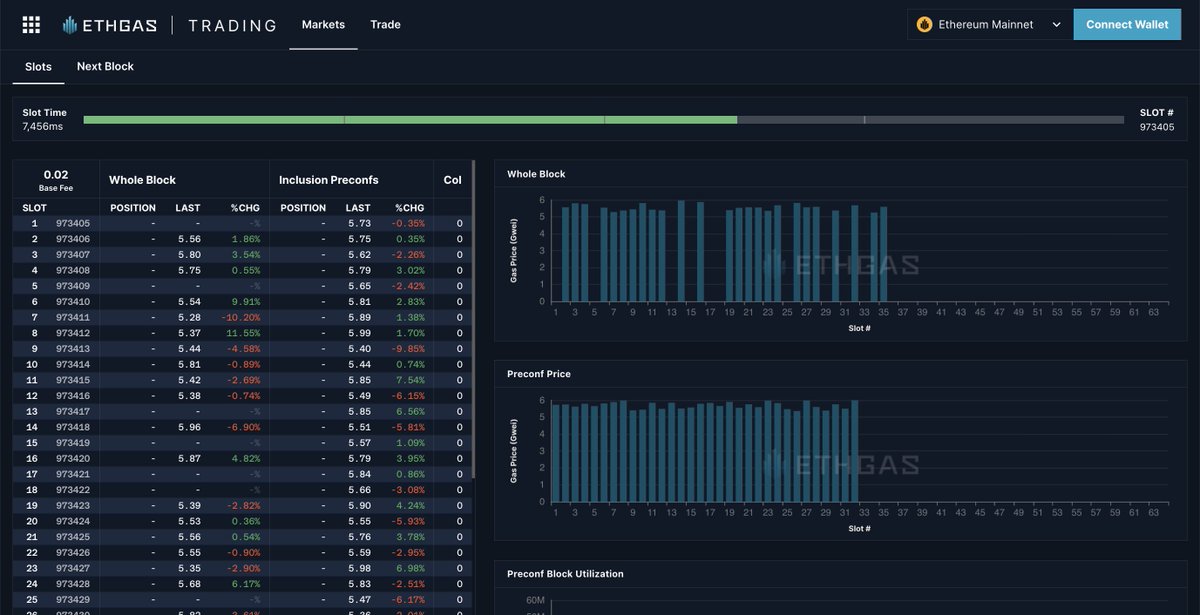
Ethereum blockspace works the same way. ETHGas breaks a block into ~100 sub-blocks, turning 12-second waits into 50ms updates. That’s how we make Ethereum 100x faster.⚡
Interview on Korea Economic TV (한국경제TV 글로벌)⬇️
I made a tiny Ethereum nerd project:
https://t.co/5dicKvNNjF
It visualises what happens during an Ethereum Sync Committee in real time:
- Sync Committee participation
- BLS signature aggregation
- RANDAO validator selection
- light client verification
Built for home stakers, node operators, researchers and protocol-curious devs.
Would love feedback.
#Ethereum #LightClients
@EtherealnewsHQ@ethStaker@ETH_Daily
Big thanks to @Delphi_Digital for the deep-dive on ETHGas.
The core idea is simple: Ethereum doesn’t just need more blockspace, it needs a better way to price and allocate it. This report lays out how preconfirmations and realtime sequencing can move Ethereum from adversarial auctions toward a more efficient, lower-latency market structure.
Realtime Ethereum isn’t just about speed, it’s about better execution, less extractive MEV, and a stronger foundation for traders, apps, LPs, and validators alike.
A shared vision builds a community.
While I'm seeing a bit of a shakeup at the EF, I'm so glad we've assembled this cohesive group of Marvel Superheroes looking out for the health, wealth and security of Ethereum.
The ticker is $ETH
🚀
Today, the Foundation’s Board released the EF Mandate.
This document, which was first intended for EF members, reaffirms the promise of Ethereum, and the role of EF within this ecosystem.
We've been long at work bringing multi-relay support to @ETHGasOfficial and we're proud to now push it out 'live'.
This means more seamless connectivity across the PBS pipeline, greater resiliency, and ultimately higher returns for Validators. 🔥 🔥
https://t.co/8KAMtZ1eGG
Today, we’re excited to announce that ETHGas has raised a $12M seed round, led by @Polychain, to build Ethereum’s blockspace futures market.
We’ve also received $800M in commitments from leading Ethereum builders to support ETHGas’ marketplace and product development.
Ethereum will power a trillion dollars of assets in 2026, and trillions more in the future.
How do we scale the block production pipeline in a way that's healthy, performant and future proof?
It's not as simple as it seems - see here for a "State of the Blockspace" exploration we put together alongside @kubimensah@drakefjustin@alextes , and a number of other contributors.
https://t.co/B0lKF0ydQX
@VitalikButerin Then I think @ETHGasOfficial is an excellent choice for this project. They are already doing this and have a very refined setup. A collaboration with them would be perfect.
@VitalikButerin I guess @ETHGasOfficial is good solution for this issue. I like the way they making gas as a tradable fuel that can be stored at current price to avoid high prices later on. You must check out brother
ETHGas: Making Ethereum Realtime with EigenLayer.
Validators that opt into ETHGas can make super fast confirmations (with penalty of slashability on EigenLayer).
For an ETH L1 app, any blocks which are built by validators that have opted in now have super fast confirmations. For example, if 50% of validators have this fast confirmation, then for half the blocks, the clock for the app will run at 2x the speed.
In order to get this benefit, all the app user needs to do is to use a different rpc, which supports this fast confirmation! For the users that use the standard RPC, they will just get the information slowly.
Can we build an L1 app which is real-time 100%?
I think it is possible. If an L1 app wants real-time confirmation 100% of the time, then it needs to modify its smart contract to accept only state changes from blocks of validators that opted into the superfast confirmation protocol. This allows the app to preserve composability with regular apps on Ethereum, while making the clock real-time.
We’ve split the atom(!) and enter a new era breaking Ethereum blocks down into synthetic 100ms sub-blocks on mainnet. These ‘Realtime Blocks’ were the result of many teams working tirelessly, and independently, to make Ethereum better. This new era, the realtime era, is a significant milestone for Ethereum and the ecosystem at large - let’s break this down 👇👇





![AndrewYNg's tweet photo. “Loop engineering” is a hot buzzphrase after mentions of it by Boris Cherny (Claude Code’s creator) and Peter Steinberger (OpenClaw's creator) went viral on social media. Loops are now a key part of how we get AI agents to iterate at length to build software. In this letter, I’d like to share my 3 key loops, shown in the image below, for building 0-to-1 products. These loops guide not just how I build software, but also how I decide what software to build.
Agentic coding loop: Given a product specification and optionally a set of evals (that is, a dataset against which to measure performance), we can have an AI agent write code, test its work, and keep iterating until the code is bug-free and meets its specification. This idea of closing the loop took off around the end of last year, and it has been a game changer in enabling coding agents to work longer productively without human intervention. For example, over the weekend, I was building an app for my daughter to practice typing, and my coding agent could easily work for around an hour, using a web browser to check what it had built multiple times before getting back to me, without needing my intervention.
The engineering loop executes quickly. Every few minutes, the coding agent might build and test a new version of the software. I hear frequently from developers who are finding new ways to engineer more effective engineering loops. This is an active area of invention!
Developer feedback loop: In this loop, a developer examines the current product and steers the coding agent to improve it. Last year, a lot of developers (including me) were acting as the QA (quality assurance) function for our coding agents, manually finding bugs and then asking the agent to fix them. But with coding agents much more able to test their own code, the amount of time we need to spend on this function has decreased significantly. This allows us to make higher-level product decisions, such as what key features to offer, where the UI needs improvement, and so on.
The developer-feedback loop operates over time intervals between tens of minutes and hours — that's how frequently a developer might review a product and give feedback. In the case of the typing app, I changed my mind a few times about the visual design, what cat costumes she can unlock as she learns (she loves cats), and the user flow for a grown-up to log in and steer the child's learning experience.
When a developer has a clear vision for what to build, it is still a lot of work to translate that vision into a specification for a coding agent to implement. Further, after the developer has seen an implementation, they might update (or perhaps clarify) the spec to steer it toward what they want. If you find that the system repeatedly runs into certain problems, building a set of evals for the agent becomes useful.
AI-native teams are increasingly using AI to help shape product direction, for example, automating the gathering and analysis of usage data, summarizing written and verbal customer feedback, or carrying out competitive analysis. However, for pretty much all the products I’m involved in, I see humans as having a significant context advantage over current AI systems — we know a lot more than the AI system about the users and the context the product has to operate in — and thus humans play a critical role. Many people describe this human contribution as “taste,” but I prefer to think of it as humans having a context advantage, since that gives us a clearer path to helping AI systems get better. This also speaks to why this step can’t be automated: So long as the human knows something the AI does not, human-in-the-loop is needed to to inject that knowledge into the system.
External feedback loop: This includes a wide range of tactics like asking a few friends for feedback, launching to alpha testers, or putting the code into production with A/B testing. These tactics are usually slow, rarely taking less than hours and sometimes taking days or even weeks. This data informs the developer vision, which in turn continues to drive the detailed product spec, which in turn drives the coding agent.
With coding agents speeding up software development, more engineers are starting to play a partial product management role. For many engineers who are growing into this role, the hardest part is shaping the product vision and striking a balance between building (bridging the gap between vision and spec) and getting user feedback to evolve the vision. It is important to do both!
I will write more about how to do this in future posts, but for now, I find it encouraging that engineers are playing an expanded role (just as product managers and designers now do more engineering).
[Original text: The Batch]](https://pbs.twimg.com/media/HMEtxp3bsAARJdi.jpg)