The Coolture Parva Darshini is back with the 2082 Vikram Samvat edition the Visvavasu Samvatsara calendar. From 2080 VS, Parva Darshini is a unique attempt to visualise the Vikram/Shaka samvat - calendar through the prism of the first principles of the calendar...
How might we not just conserve tradition but bring it into everyday life through the power of product design?
At the Aucitya Bengaluru Edition, meet Team @CooltureDesigns, who used civilization as a design framework drawing deeply from IKS and turning that into aesthetic calendars, games, merchandise, and everyday cultural utilities.
Join us to learn how tradition can be designed for use, beauty, learning, and scale: https://t.co/9PrXoTh8Sj
📢 Call for Internships
Passionate about India's history, culture, and love creating engaging content?
Join FIHCR and gain hands-on experience in research, content creation, and storytelling.
📅Last date: 15 June 2026
👉Apply here: https://t.co/3OrSnCHgbQ
@vikramsampath
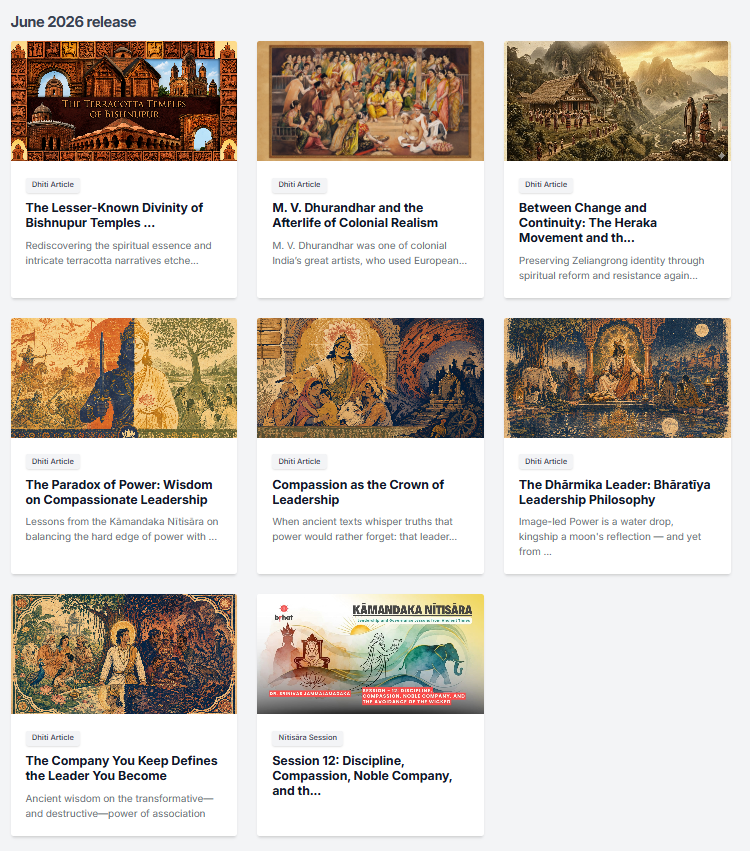
We are delighted to present our monthly subscribers' package for June 2026.
With featured reads, art essays and the Nītisāra series on Indic leadership, this month brings together the lesser known temples of Bishnupur, a forgotten artist and his rare works depicting our gods and rituals, and the civilizational Heraka movement of the north-east.
https://t.co/tBgfXH5IAo
How do we transform ancient civilisational intelligence into contemporary product experience?
At Aucitya Bangalore Edition, Charusmita Rao and Neelacantan B, the founders of @CooltureDesigns will take participants through the journey of designing the Pañcāṅga as a cultural product that translates Indian frameworks of time, rhythm, symbolism and ritual into a meaningful contemporary experience.
Their session explores what it means to build products rooted in Indic paradigms, lived aesthetics and cultural memory.
For creators, founders and designers working at the intersection of culture and creativity, this session offers a look into civilisational product thinking in practice.
Register now: https://t.co/OmhcQK2vFJ
One of the most powerful symbols of India’s unbroken civilizational continuity!
Discovered at Mohenjo-daro in undivided India this steatite seal, about 4,300-year-old, shows a seated figure in yogic posture (widely seen as Shiva-Pashupati) seated in Mulabandhasana, surrounded by animals.
While ancient sites may lie across modern borders, India remains the living custodian of this heritage. The yogic posture, Shaivite symbolism, and spiritual ethos seen in the Pashupati Seal continue to thrive in India’s temples, daily worship of Shiva, yogic traditions, and cultural life even today.
From the Vedic period to contemporary Bharat, this civilizational thread has remained alive and unbroken — deeply embedded in our philosophy, rituals, and collective consciousness.🇮🇳
#PashupatiSeal #IndusSaraswatiCivilization #LivingIndianHeritage
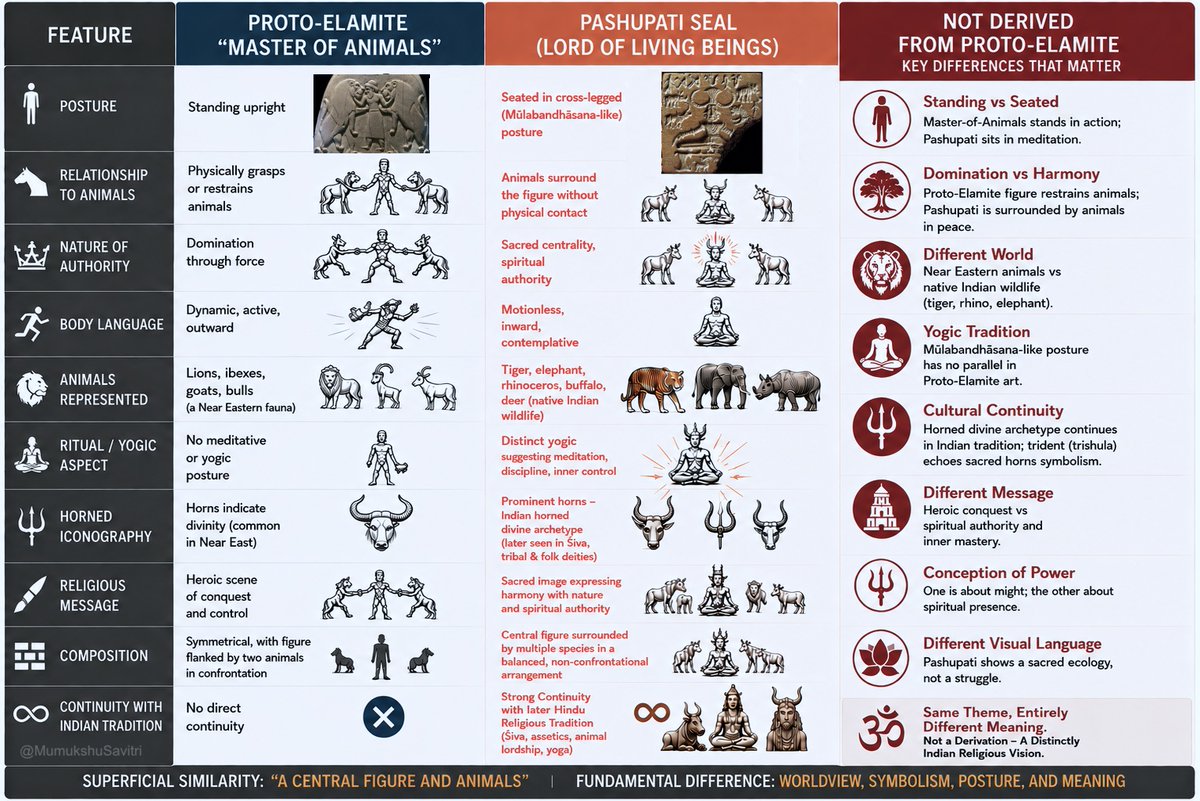
I created this poster to provide a clear explanation about why the IVC Pashupati Seal clearly cannot be derived from the Proto-Elamite "Master of Animals" motif.
Maiores descobertas da filosofia indiana:
Veda: existe uma ordem cósmica. Boa sorte entendendo ela.
Mīmāṃsā: os Vedas estão certos porque os Vedas dizem que estão certos.
Sāṃkhya: você não é a mente
Yoga: pare de pensar.
Nyāya: ?? source?? Prove isso.
Vaiśeṣika: prove isso categoricamente.
Vedānta: você é Brahman.
Advaita: você sempre foi Brahman.
Viśiṣṭādvaita: você é Brahman, mas não tanto assim.
Dvaita: você definitivamente não é Brahman.
Acintya-bhedabheda: você dois estão certos e errados ao mesmo tempo. Não eu não posso explicar lol
Śaiva: liberdade pra dentro da cabeça..
Śākta: todo dia é dia da Mulher
Kashmir Shaivism: tudo é consciência brincando de esconde-esconde consigo mesma.
Tantra: tudo pode levar à libertação. Sim, aquilo também.
Cārvāka: quando você morre, acabou. Agora vá beber, pois só existe matéria
Cārvaka quando fica doente: alguém conhece um bom sacerdote?
Jainismo: cuidado onde pisa
Budismo: tudo é sofrimento.
Theravāda: especialmente você (que não existe)
Madhyamaka: nada possui natureza própria
Madhyamaka: 27 tratados depois: aqui estão 400 páginas explicando pq nenhuma posição filosofica pode ser defendida
Yogācāra: meu pau na sua mente.
Tathāgatagarbha: na verdade você já tá iluminado e tal
Zen: calem a boca.
Ramana Maharshi: quem são vocês?
Gaudapāda: nothing ever happens
Śaṅkara: nada aconteceu e, se aconteceu, não aconteceu do jeito que você pensa.
Nāgārjuna: nem aconteceu, nem não aconteceu, nem ambos, nem nenhum dos dois.
Abhinavagupta: tudo isso é um espetáculo divino.
O estudante moderno: então qual dessas escolas está certa?
Filosofia indiana: sim.
This coin from Ujjain region dated to 200 BCE depicts polycephalic Shiva seated in the exact same posture as seen in the Indus seals.
Civilizational continuity indeed.
One of the most powerful symbols of India’s unbroken civilizational continuity!
Discovered at Mohenjo-daro in undivided India this steatite seal, about 4,300-year-old, shows a seated figure in yogic posture (widely seen as Shiva-Pashupati) seated in Mulabandhasana, surrounded by animals.
While ancient sites may lie across modern borders, India remains the living custodian of this heritage. The yogic posture, Shaivite symbolism, and spiritual ethos seen in the Pashupati Seal continue to thrive in India’s temples, daily worship of Shiva, yogic traditions, and cultural life even today.
From the Vedic period to contemporary Bharat, this civilizational thread has remained alive and unbroken — deeply embedded in our philosophy, rituals, and collective consciousness.🇮🇳
#PashupatiSeal #IndusSaraswatiCivilization #LivingIndianHeritage
There is absolutely no doubt that this is indeed ‘Pashupati’, a form of Shiva. There are several evidences visible in the seal itself.
- The yogic posture of the deity, seated in Mulabandhasana, closely matches the descriptions found in Hindu scriptures such as the Kalpa Sutra.
- The symbolism resembling a trident-like headgear is significant. Similar iconographic elements can also be seen in later-period Shaiva sculptures.
- A similar seal from the same civilisation depicts a similar deity along with the Saptamatrikas, providing further evidence for identifying the figure as Shiva. Comparable iconographic panels of Shiva with the Saptamatrikas appear in later Hindu temples across India.
- The deity is surrounded by animals, clearly aligning with the very meaning of the name Pashupati, “Lord of Animals.” Even in later Dakshinamurthy panels, Shiva is often depicted along with animals such as deer, tiger, and other creatures.
No matter how much certain Westerners attempted to deny or misinterpret it, this remains a powerful symbol of Bharat’s cultural continuity across thousands of years, exactly as observed by @MinOfCultureGoI
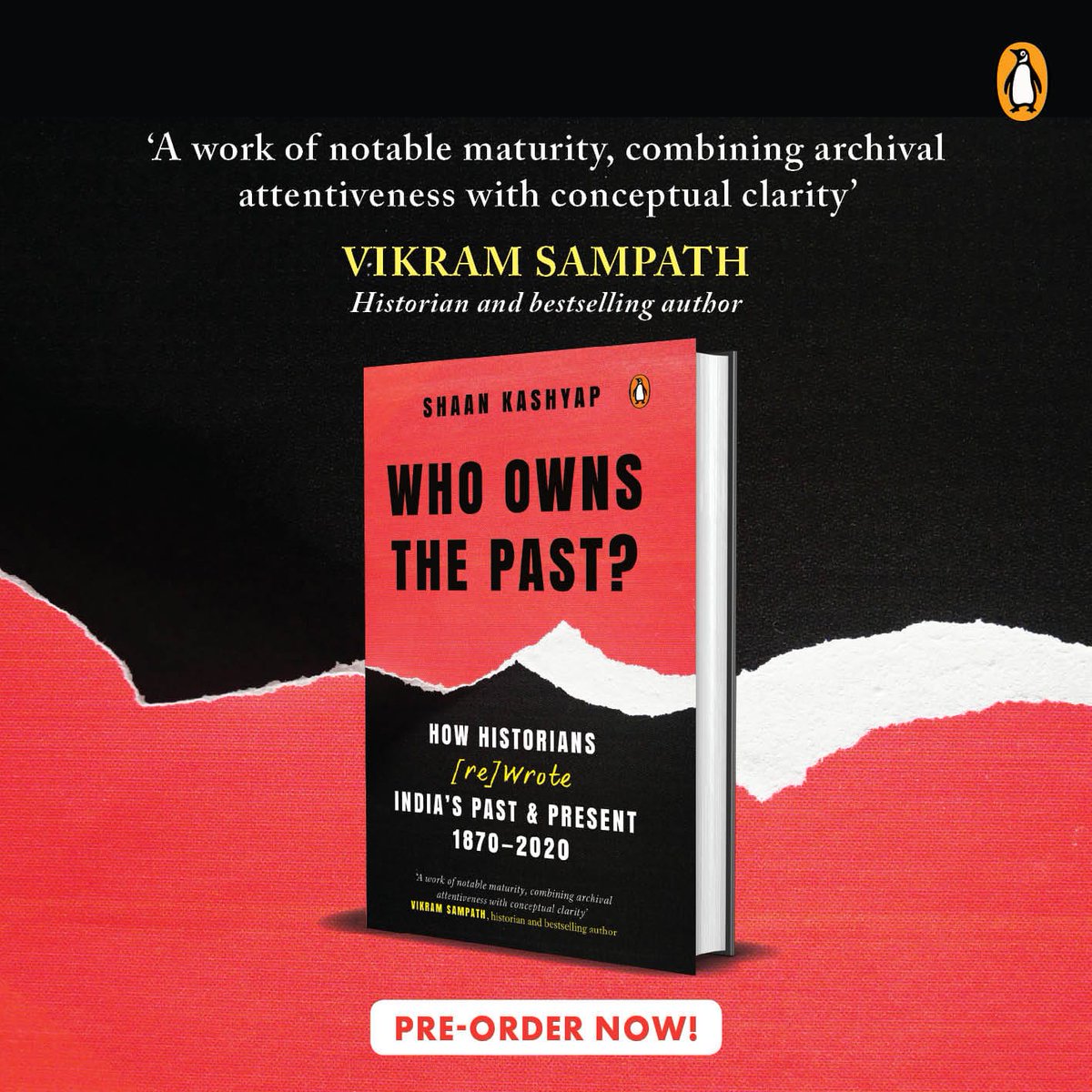
The 2nd book from @fihcr_info Sir Jadunath Sarkar Fellowship's Batch 1 is out now from @PenguinIndia.
"Who Owns the Past" by Shaan Kashyap is a deeply researched account of how India’s history has been written, rewritten, contested & politicized from the colonial era to the age of social media, with the accompanying power struggles that define the present where history is a live battle everyday.
Please order & read this important & timely book on link 👇
https://t.co/bCUzb0Y5QD
@premanka
Shatavadhani Dr. R. Ganesh, master of Avadhana, a classical art form unique to India, and credited with reviving the art form in Kannada, will be honoured with the Padma Bhushan for his exceptional contribution to literary aesthetics, prosody, and keeping this ancient art form alive.
Popularly known for his creative and scholarly achievements, he has performed more than 1,300 Ashatavadhanas and 5 Shatavadhanas till date, primarily in Kannada and Sanskrit. A prolific author having more than seventy books to his credit, he has written poems, plays, monographs, biographies, literary essays, analytical papers and scholarly treatises in Kannada, Sanskrit and English.
#PeoplesPadma #PadmaAwards2026 #PeoplesPadma2026
@HMOIndia@PadmaAwards@MinOfCultureGoI@PIBBengaluru@DDChandanaNews@airnews_kannada
#SadarPranam@patrollate ji!
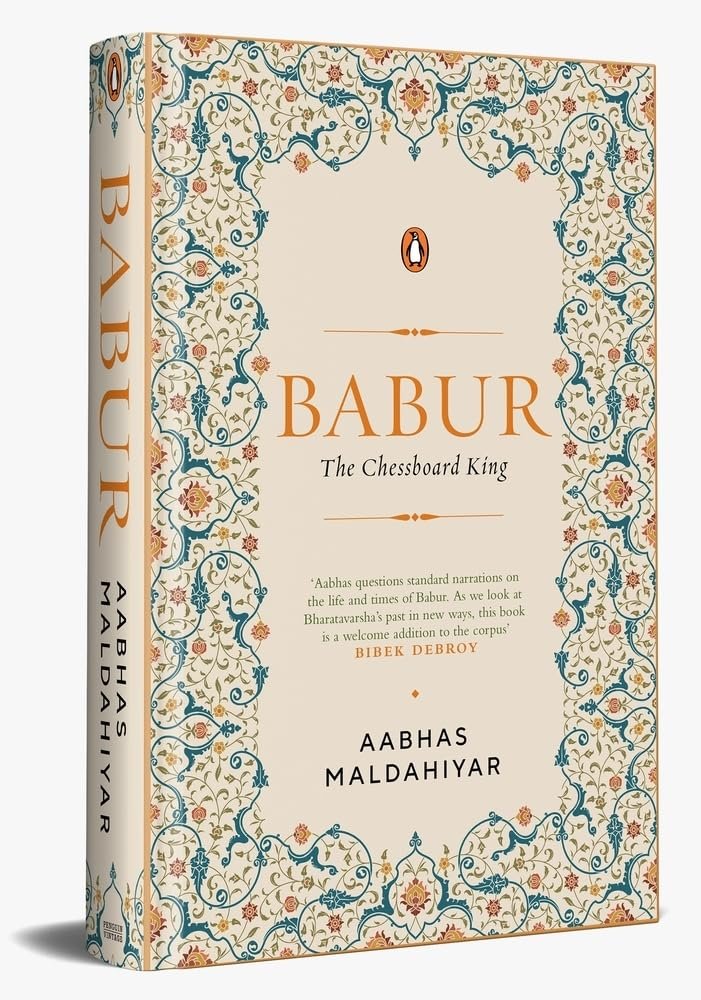
Read your piece in @timesofindia today glorifying Babur. As someone who has spent years studying Babur and writing his biography, I felt it deserved a rebuttal since your piece is highly uniformed.
So, here is a point-wise response to your piece.
1) You invoke the Battle of Panipat, yet conveniently omit Babur’s use of Panipat’s villages as human shields (see Baburnama, Persian folio 264). So yes, the Battle of Panipat is indeed a matter of anguish for me. It is difficult to romanticize a battlefield when the cries of ordinary people are buried beneath narratives of conquest; though that discomfort, it appears, does not seem to trouble you, or perhaps you did not even know about it.
2) You bring up the Taj and then drag in the familiar debate surrounding the so-called RW claim that it was a temple. The reality is simpler and more nuanced: neither was it a temple, nor was it necessarily a structure conjured entirely from nothing. I have already discussed this in detail in a podcast with @kushal_mehra.
Here, I will not enter into the debate on whether Shah Jahan built it entirely from scratch; I will address that separately through primary sources in my upcoming work on Shah Jahan in the years to come. Economically, however, the Taj commissioned in 1631 reportedly cost 41.8 million silver rupees, at a time when a farmer’s family survived on roughly one Dam a day and one rupee equaled forty Dams (Shireen Moosvi, The Economy of the Mughal Empire, C.1595: A Statistical Study, 301). This coincided with the devastating Deccan Famine of 1630–32, which claimed around 7.4 million lives (A famine in Surat in 1631 and Dodos on Mauritius: a long lost manuscript rediscovered. R. Winters, J. P. Hume, M. Leenstra. 1, s.l.: The Society for the History of Natural History, 2017, Archives of Natural History, Vol. 44, pp. 134–50), worsened by imperial campaigns that ravaged Malwa and the Deccan, leaving “scarcely a vestige of cultivation,” as chroniclers recorded.
I was shaken after reading the agony of the people and, surprisingly, court chronicler Abdul Hamid Lahori did not attempt to drape silk over suffering or bury horror beneath royal praise (Abdul Hamid Lahori, Badshahnama; Henry Miers Elliot (ed.), John Dowson, The History of India, as Told by Its Own Historians, London: Sh. Mubarak Ali, 1867–77, Vol. VII, p. 12):
"Inhabitants were reduced to the direst extremity. Life was offered for a loaf, but none would buy. Dog’s flesh was sold for goat flesh. The pounded bones of the dead were mixed in flour and sold. Men began to devour each other, and the flesh of a son was preferred to his love. The number of deaths caused obstructions in the roads. Those lands which had been famous for fertility and plenty of resources retain no traces of production."
Peter Mundy, the seventeenth-century British traveler and merchant who visited the region during the famine, wrote in his diary (Peter Mundy, The Travels of Peter Mundy in Europe and Asia, 1608–1667, Vol. II, pp. 40–48):
"Surat (Gujarat)- Great famine, highways unpassable, infested by thieves looking not for gold but grain; Kirka- Town empty. Half inhabitants fled. Another half dead; Children sold for 6 dams or given for free to any who could take them so they might be kept alive; Nandurbar (Maharashtra)-No space to pitch a tent, dead bodies everywhere. Noisome smell from a neighboring pit where 40 dead bodies were thrown. Survivors searching for grains in the excrement of men and animals. Highway stowed with dead bodies from Surat to Burhanpur."
He gives complete details of how the Timurid lords were treating people. He further wrote (Peter Mundy, The Travels of Peter Mundy in Europe and Asia, 1608–1667, Vol. II, pp. 40–48):
"In Bazar lay people dead and others breathing their last with the food almost near their mouths, yet dying for want of it, they not having wherewith to buy, nor the others so much pity to spare them any without money. There being no course taken in this Country to remedy this great evil, the rich and strong engrossing and taking perforce all to themselves."
While famine devoured the countryside, Shah Jahan’s imperial camp remained stocked, insulated, and abundant, with supplies flowing in from all directions. Even amid this devastation, taxes continued to be extracted. Timurid revenue demands were among the heaviest in the world, often taking more than half of peasant produce, compared to systems such as Vijayanagara that took roughly one-sixth. Records also suggest that nearly 62 percent of revenue was spent on merely 665 court elites (Irfan Habib, ‘Agrarian Relations and Land Revenue’, The Cambridge Economic History of India, p. 242).
Coupled with devastated cultivation, diversion of resources, and failed rains, the famine of 1630–32 claimed around eight million lives. Through this lens, the Taj, celebrated as a monument of imperial glory, begins to cast a far darker shadow.
3) She argues that people are trying to erase Babur. That is a rather curious; and frankly weak ; argument. I am someone often seen as a Hindutva ideologue, yet I spent years learning the Persian of that era and wrote a 1000-page biography on Babur precisely so that I could read the Baburnama firsthand. One does not spend years studying a figure one seeks to erase.
And of course, Babur cannot be erased. History is not a blackboard to be wiped clean at convenience. But history also cannot become a selective mirror where only flattering reflections survive.
You make the point that Babur was a “throneless king” at the age of eleven. That is inaccurate. According to Baburnama, Babur assumed the title of Padshah only in 1507. Prior to that, he was regarded as an Amir, not a sovereign king in the fuller imperial sense.
Nobody denies that Baburnama presents him as a poet, a refined literary mind, an avid drinker, and a man with varied personal dimensions. But one cannot conveniently read only those pages while shutting the rest of the manuscript. The Baburnama also records Babur as a Ghazi (Folio 325), expresses his hostility toward Hindus (Folio 316b), contains passages where he speaks of destroying Hindu gods and goddesses like vessels of wine (Folio 313), and records comparisons with figures such as Ghazni and Ghauri. His memoirs also contain references to his emotional and personal attachments, including those concerning Baburi, which historians have long discussed. He was a gay, only to turn bisexual later.
As for invoking eleven years of age as though it alone grants extraordinary historical distinction, let us remember that age by itself is not achievement. Prithviraj Chauhan became king at around eleven and went on to live a legendary life defending his realm. There are numerous examples of rulers displaying remarkable courage at very young ages. One cannot forget Chhatrapati Shivaji, who challenged powerful established rule, issued a Sanskrit royal seal, and consciously reduced the dominance of Persian in state correspondence. Bappa Rawal too is remembered in traditions as displaying extraordinary military leadership at a remarkably young age.
4) You say that the first thing Babur did upon arriving in Agra was create gardens. I am not sure you have examined what the original manuscript of the Baburnama itself records.
According to the same text, after reaching Agra there was a massive distribution of wealth and spoils among Babur’s circles. The wealth was also transported to Samarkand, Khurasan, Kashghar, Iraq, Mecca, and Medina (Baburnama, folio 294). Curiously, this part of the story rarely appears when romantic portraits of Babur are painted.
His attitude toward Hindus also emerges clearly in his own words after the Battle of Khanwa, in the context of constructing towers of defeated “Kafir” heads. Baburnama, folio 316b mentions:
"All the Hindus slain, wretched and lowly, By matchlock fire, as if under elephants’ might, Piles of their bodies rose like hills, From each mound, a fountain of flowing blood."
Now coming to the point on Charbagh at Agra: the passage you refer to appears in folio 300, which comes six folios after Babur had already discussed the movement and distribution of loot in folio 294.
Therefore, if we are reading the Baburnama, it ought to be read in its entirety rather than selectively lifting gardens while quietly passing over the caravans of wealth that preceded them.
5) Then you make the point that Babur came to transform Hindustan, not replace religion. Come on @patrollate, give me a break.
After the Battle of Chanderi, Babur explicitly states that he had destroyed Dar-ul-Harb (Baburnama, ff. 334b–335), and yet we are expected to believe that religion had nothing to do with his mission? If one is going to invoke the Baburnama, then one should read all of it, not merely the comfortable portions.
You argue that “garden” appears around 40 times in the Baburnama. Interesting. But “Islam” appears around 55 times, and “Kafir” around 15 times. More importantly, numbers alone prove nothing. Context matters far more than word frequency. Battles against non-Muslim rulers are repeatedly framed in the language of jihad in the text. The manuscript itself gives us insight into Babur’s worldview.
And he was going to “transform” India?
Ma’am, Babur himself tells us that Hindustan attracted him because of its immense wealth, abundant gold and silver, and availability of labor. The idea that he arrived to civilize or transform an empty cultural landscape collapses once one turns to the historical record.
Do you know that Shahrukh’s son had sent the ambassador Abdur Razzaq, who was astonished by the scale and prosperity of Vijayanagar? He found it grander than anything familiar to him from his own world. Razzaq described a city enclosed by seven concentric stone fortifications, containing not merely structures but vast orchards, gardens, and thriving spaces of life. The city seemed to expand through greenery as much as through stone. Flowers perfumed broad markets and were considered as indispensable as food itself. To him, Vijayanagar was not merely a seat of power; it was a landscape where prosperity itself had taken root.
And long before Babur ever set foot in Hindustan, Kalidasa spoke of pleasure gardens. The Ramayana and Mahabharata describe expansive and beautiful gardens. The Mauryas had elaborate systems of gardens. The Guptas too possessed a sophisticated understanding of landscape and aesthetics. Evidence from the Saraswati–Sindhu civilization also points toward planned settlements with cultivated spaces. I could go on endlessly about gardens in ancient and early medieval India.
So please do not advance this rather strange argument that Babur arrived with some civilizational mission to teach India the idea of gardens. Babur himself admits that back home major architectural undertakings were constrained by limitations in skilled labor. He did not enter Hindustan with a mission to transform it; he came because Hindustan was already enormously rich, already flourishing, and already possessed traditions far older than him.
Of course, none of us can erase Babur, nor should history be approached through erasure. His invasion of India and the chain of events it set into motion remain part of our historical memory. For many, he will continue to be remembered not as a civilizational benefactor, but as an antagonist who entered Hindustan with political and religious ambitions, the consequences of which shaped some of the darkest chapters of our past. His successors, in different ways and to varying degrees, carried forward parts of that legacy.
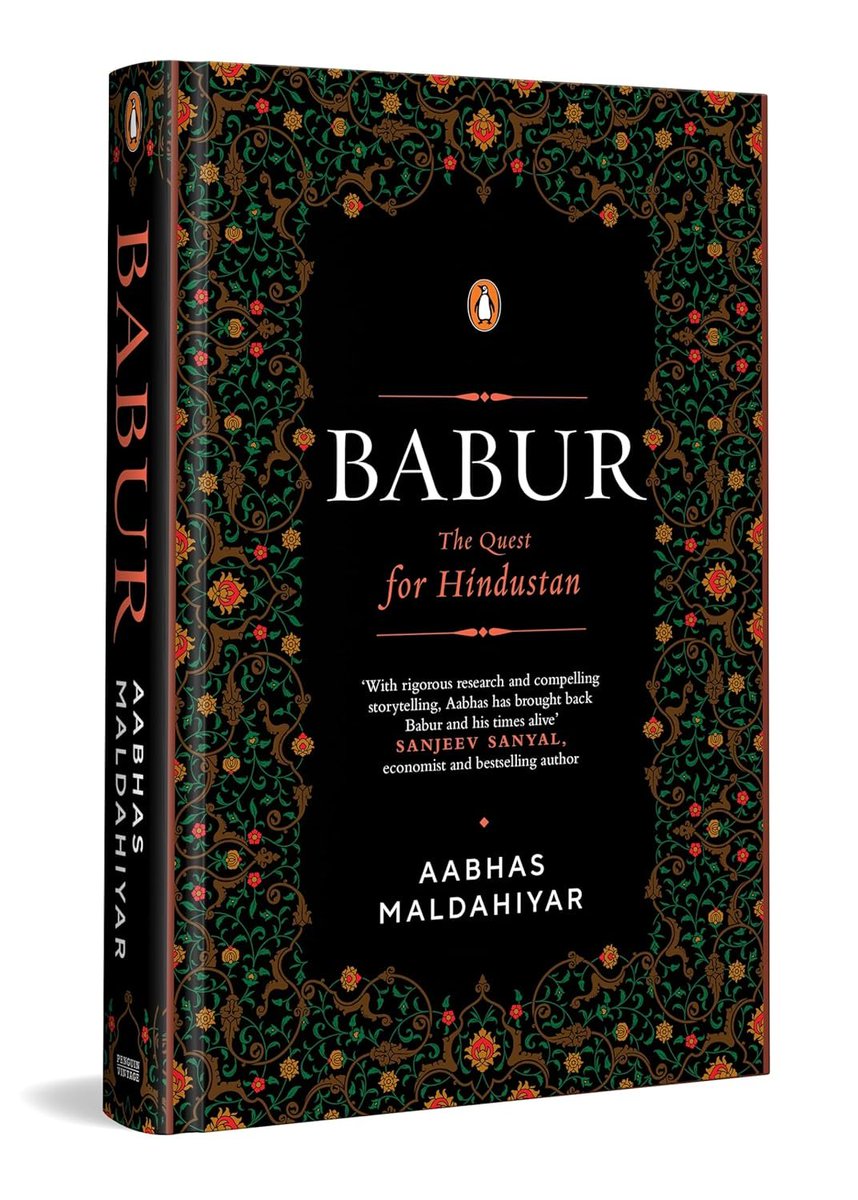
And FYI, the claim that these rulers saw Hindustan as their natural home is something I have addressed at length in the introduction section of my book Babur: The Quest for Hindustan, through references drawn from primary sources and contemporary records.
I would request @toi to provide me space to publish a detailed rebuttal supported by primary sources, because history deserves engagement through manuscripts and evidence rather than selective remembrance.
And for those who genuinely wish to understand Babur beyond social-media caricatures and selective narratives, I would recommend going through my volume works on Babur (images attached) based on primary sources.
🧵Pāṇḍyas of ancient Tamiḻakam self-presented themselves as descendants of the Kuru-Pāṇḍavas in their 8th-century copper plates.
So when did that claim start, and why?
A dynasty famous in the 3rd century BCE waits a full millennium, until 769 CE, to put a Pāṇḍava-descent claim in writing.
But the Tamil tradition got there first. Caṅkam poetry calls the Pāṇḍyas Kavuriyar (கவுரியர்), the Tamil for Sanskrit Kauravya, meaning "descendant of Kuru".
The formal Sanskrit claim comes with the Velvikkuṭi copper plates of Jaṭila Parāntaka (c. 769–770 CE). And here the praśasti makes a fascinating move that I think is widely underappreciated.
It does not claim descent from a specific Pāṇḍava or from the Pūru–Bharata–Kuru–Pāṇḍu trunk or claim descent from Yadu, Turvasu, Druhyu, or Anu.
It claims descent from Purūravas Aila, the apical Candravaṃśa king before all branching.
The praśasti also names a primordial king, Pāṇḍya, who ruled the coastal region in the previous kalpa and was reborn as Budha, Purūravas's father. The dynasty's identity is made coterminous with the very origin of the Candravaṃśa.
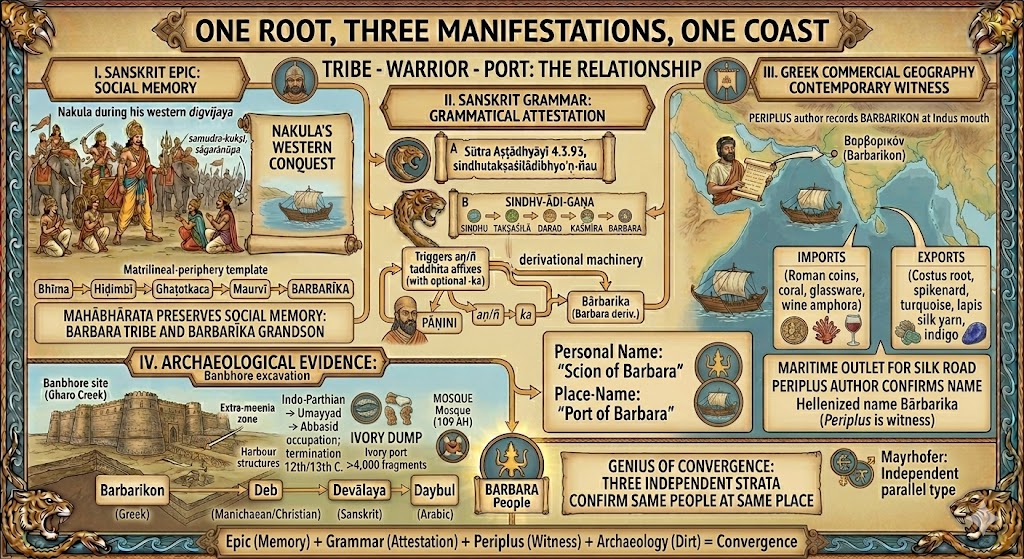
One root, three manifestations, one coast:
What is the actual relationship between the tribe, the warrior, and the port?
➖ Mahābhārata locates a Barbara tribe on the sea-coast (samudra-kukṣi, sāgarānūpa) at the western frontier of Bhāratavarṣa, subjugated by Nakula in the western digvijaya, alongside the Pahlavas.
➖ Pāṇini's Gaṇapāṭha, datable to 4-6 millennium BCE, four to six centuries before the Greek Periplus, lists Barbara as a janapada in the Sindhv-ādi-gaṇa, grammatically clustered with Sindhu, Takṣaśilā, Darad, and Kaśmīra.
Sūtra 4.3.93 prescribes the aṇ/ñ taddhita affixes (with optional -ka) to derive forms of provenance from these janapadas: Sindhu → Saindhava; Barbara → Bārbarika.
The same Sanskritic derivational machinery generates both:
➖ the personal name Bārbarika = "scion of the Barbara people," the grandson worshipped from Khāṭū Śyām in Rajasthan to Yalambar in Kathmandu, embedded in the epic's matrilineal-periphery template (Hiḍimbī → Ghaṭotkaca → Maurvī → Barbarīka), structurally identical to Ulūpī–Irāvāṉ and Citrāṅgadā–Babhruvāhana.
➖ the place-name Bārbarika = "port of the Barbara people," which the Greek merchant of the Periplus c. 60 CE transcribes as Βαρβαρικόν, easily Hellenized because Greek barbarikós "foreign" happened to be a phonetic and semantic match. He did not need to invent a "foreigners' market" name; the local Sanskrit-Prakrit form Bārbarika was already in use, generated by Pāṇini's rule from a janapada that the Mahābhārata had already placed on that coast.
The convergence is not just an accident,
The bald, three-arrowed warrior beheaded by Kṛṣṇa before Kurukṣetra, the lapis-lazuli emporion described by an Egyptian Greek under Gondophares, and the archaeological mound on the Gharo Creek where an Italian-Pakistani team is still digging in 2026, all three bear the name of a people whom Pāṇini already knew, two and a half thousand years ago, as the Barbara of the sea-coast at the mouth of the Sindhu.
The genius of the convergence, three independent textual strata, Sanskrit epic (~3rd c. BCE), Sanskrit grammar (~5th–4th c. BCE), and Greek commercial geography (~60 CE) preserve, in three different registers (mythological, grammatical, mercantile), the same people at the same place. The epic provides the social memory, Pāṇini provides the grammatical attestation, the Periplus provides the contemporary witness, and Banbhore provides the dirt.
Mayrhofer was right that Greek bárbaros and Sanskrit barbara are independent expressive lallworts, neither borrowed from the other.
Same memory, refracted through three lenses, of the people the Indus produced.
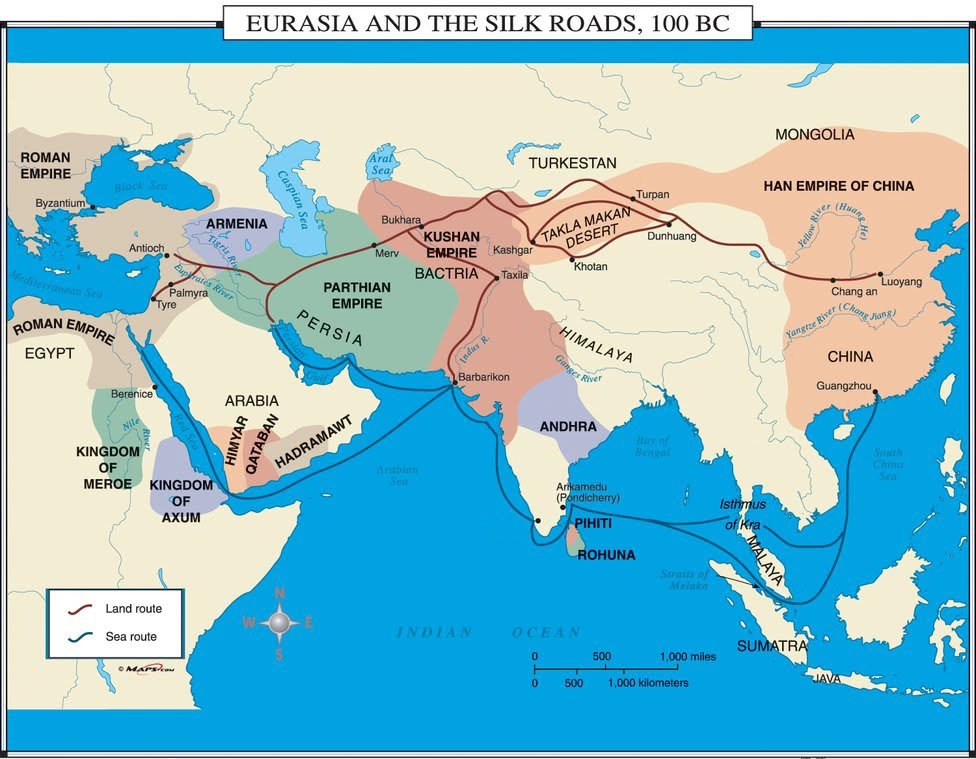
🧵 Barbara–Barbarīka–Barbarikon Complex: Three Words Across 1,000 Years Map
A Greek merchant in 60 CE sails into the Indus delta and writes down the name of the port:
Βαρβαρικόν (Barbarikon)
For two centuries, scholars dismissed it as Greek slang for an emporium, meaning "The foreigners' market." A Hellenistic genericism, nothing Indian about it.
They were wrong.
This is the story of how three names, Barbara-Barbarīka-Barbarikon, across the Sanskrit epic, Pāṇinian grammar, and Greek commercial geography, all point to one people at one place: the sāgara-kukṣi, the belly of the sea, at the mouth of the Sindhu.
Hally War, a respected environmentalist from Meghalaya, will be awarded the Padma Shri for his over five decades of work preserving the Khasi tradition of bio-weaving by nurturing the iconic Living Root Bridges in the East Khasi Hills.
Through this rare practice, he has helped connect remote areas, strengthen ecological balance, and promote sustainable living rooted in indigenous knowledge.
Beyond his environmental work, he has guided local communities in carrying forward this living heritage, supporting sustainable tourism and ensuring that traditional wisdom is passed on to future generations. His lifelong dedication stands as a powerful example of harmony between humans and nature.
#PeoplesPadma2026 #PeoplesPadma #PadmaAwards2026
@HMOIndia@PadmaAwards@moefcc@airnews_shi@ddnewsshillong