Thanks to the @NYTimes for inviting me to speak at Climate Forward yesterday.
I’ve always believed we need to hold our beliefs lightly and remain open to new evidence as it emerges.
The evidence increasingly supports polymetallic nodules as the best way to meet growing demand for the critical metals that power our energy, technology and industrial systems.
The future is metallic.
https://t.co/UUAANftORt $TMC
$TMC Q2 Call Updates:
1) TMC is actively in confidential funding processes with multiple US government agencies named in Trump’s executive order.
While those discussions remain confidential, management said it does not currently intend to pursue other capital market transactions until further public updates.
CEO Gerard Barron:
“The company does not currently intend to pursue other capital market transactions until such time as further updates are publicly released.”
What that means: no equity offering, follow on, ATM, convertible, or equivalent capital markets raise is currently planned before we hear more on the government funding process.
2) Allseas is moving the first commercial collection system into procurement now, with fabrication expected to begin in Q4 2026.
Installation and commissioning still targeting Q4 2027. Initial capacity 3Mtpa.
3 million wet tonnes of nodules per year. Thats the starting point with two collectors on the Hidden Gem. If processed in the US, that single system alone could cover roughly a quarter to a third of current American nickel and cobalt demand.
Allseas is funding a meaningful portion of the preproduction costs, recoverable from production revenues. Alignment is strong.
Allseas exclusivity remains an important part of the setup. Gerard confirmed the offshore mining arrangement is exclusive.
Allseas could only offer another system elsewhere if it first offered that system to TMC and TMC declined.
Gerard said the likelihood of that happening is very low because TMC wants multiple systems in the water.
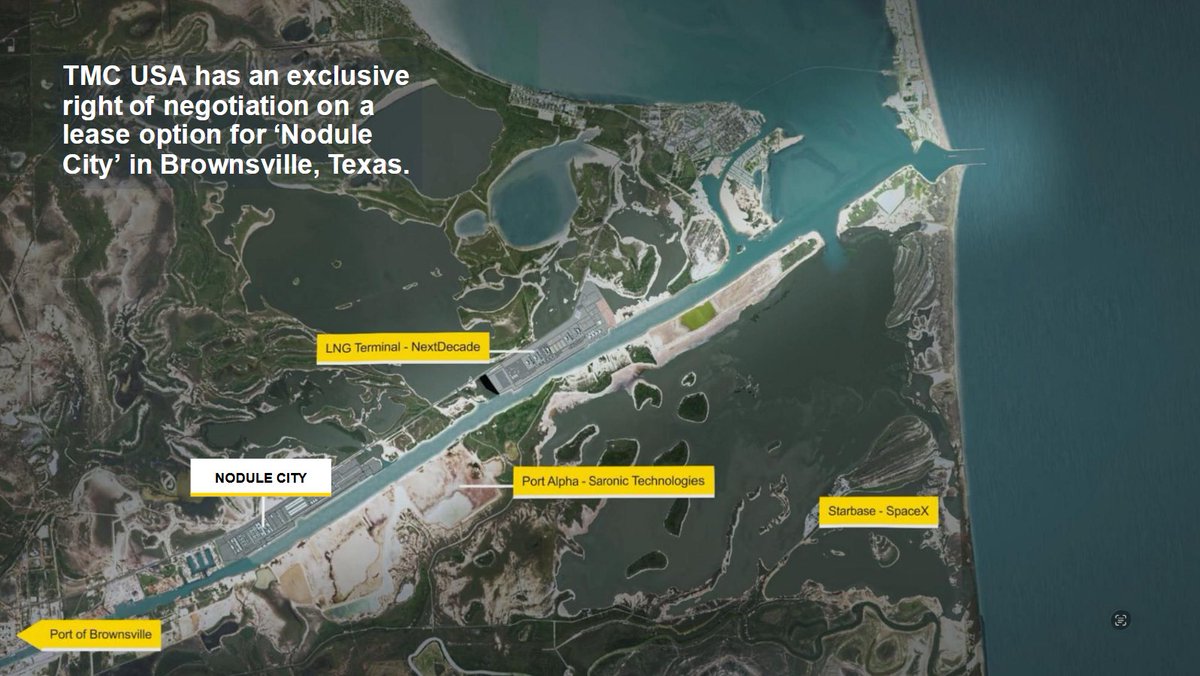
3) Mariana Minerals is becoming a major execution partner. Theyre helping advance permitting, construction, processing, automation and plant design at Nodule City, Brownsville.
The Prefeasibility for a potential 12 Mtpa industry park is nearing completion. Modest spend underway for the work that unlocks potential government support.
Feasibility level work on the first smelting stage is underway with Mariana Minerals (the software/automation heavy processing partner that just raised $310M).
TMC has an exclusive right of negotiation over the Brownsville site. The area being evaluated is 1,466 acres, and No final investment decision has been made, and any future capital commitment remains contingent on US government support.
4) Management is looking out for shareholders and doing what it can to avoid unnecessary dilution.
TMC decided not to extend the September 2026 SPAC warrants. The 15M public warrants have an $11.50 strike, but extending them would also require extending 9.5M private warrants that can be exercised cashlessly.
CFO Craig Shesky also noted that extending them would require extending the private warrants, which are:
“unlikely to result in any incremental cash proceeds to the company while still diluting existing shareholders.”
So management chose to let the warrants expire rather than accept dilution that may bring little additional cash.
The read through is pretty clear: management appears confident enough in the upcoming catalysts to wait rather than raise/dilute around today’s valuation.
If they believed $11.50 was as good as it gets, taking the cash would have been the easier decision.
Why accept unnecessary dilution around an $11.50 strike when management says the stock is undervalued and expects major catalysts ahead and believes the equity should be valued materially higher?
5) New mutual services agreement with Eco Minerals, another US company pursuing its own NOAA application.
Eco can provide TMC vessels, AUVs, marine survey capacity and offshore services at preferential pricing. TMC provides ~15 years of resource definition, environmental and permitting expertise.
A joint offshore campaign is possible later this year to gather more data and potentially move additional USA-A tonnage toward reserves.
6) Permitting continues moving under the US pathway.
USA-A Federal Register publication/public comment is imminent. Certification is now expected in October 2026 due to an administrative delay, not an issue with the application.
A Q1 2027 permit is no longer expected, but management still expects it well ahead of the Q4 2027 vessel commissioning target.
USA-B, covering ~122,000 km², is also moving into formal EIS review.
7) Resource economics remain unchanged.
$5.5B PFS NPV + $18.1B initial assessment = $23.6B combined stated NPV.
Across both projects, the studies point to roughly $369B in undiscounted revenue and >$200B in EBITDA.
Management directly acknowledged the stock has lagged the operational progress and resource value.
Craig Shesky:
“Our market cap is undervalued relative to the resource itself by any reasonable peer based metric.”
8) TMC’s scientific/environmental dataset continues to be a major part of the moat.
NORI has completed:
22 offshore research campaigns
959 research days at sea
More than 1 petabyte of data
41 peer-reviewed papers
That work supports permitting, environmental review and TMC’s ability to move resource categories toward reserves.
9) US government support for the broader critical minerals strategy remains strong.
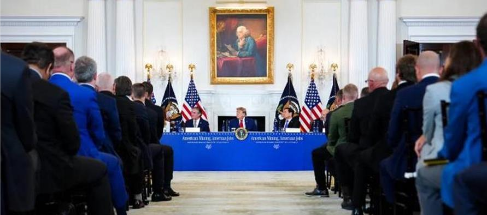
Gerard attended the Aug. 7 State Department critical minerals roundtable alongside senior Trump administration officials.
Trump again reiterated support for deep seabed mining.
Important distinction: no direct nodule collection funding was announced at that event. TMC’s own government funding processes remain separate and confidential.
10) TMC is building beyond just one vessel and one processing plant.
Management is working across US shipbuilding, marine logistics, autonomous vessels, environmental monitoring, processing, refining and rare earth development.
The goal is an integrated American deep seabed critical mineral supply chain from collection all the way through delivery of finished metal products.
11) TMC is keeping PAMCO Japan as a processing fallback while Brownsville advances.
Management said they’re maintaining the partnership with PAMCO specifically to preserve processing optionality, so the US build is the preferred path without leaving TMC dependent on a single route.
So TMC keeps an existing processing route available while working toward domestic US processing.
12) Offshore logistics are also being optimized.
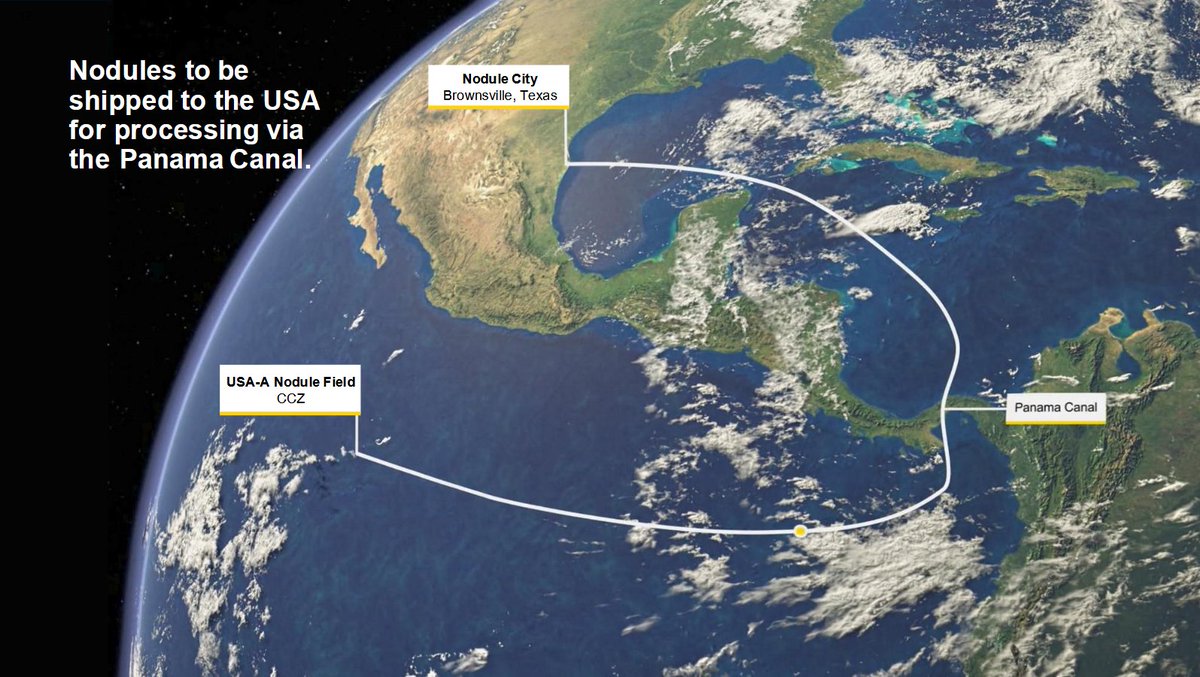
A typical shipment would carry ~60,000 tonnes of nodules from the CCZ to Brownsville.
The Panama Canal is the base case, but TMC is also studying a Cape Horn route as autonomous vessels become more practical.
They’re also integrating USV/AUV technology for logistics, environmental monitoring, situational awareness and continued resource definition.
13) Failed attempt against the U.S. pathway: China, Russia and Greenpeace supported an effort seeking an ITLOS advisory opinion targeting seabed mining outside the UNCLOS/ISA framework.
“The effort failed and received significant pushback from member states across Europe, Asia and the Pacific.”
14) TMC also got a favorable outcome on the ISA side.
The ITLOS Seabed Disputes Chamber unanimously prescribed provisional measures protecting NORI and TOML rights to due process and fair treatment in their disputes with the ISA.
Days later, the ISA Council approved a 5 year extension of NORI’s exploration contract by consensus.
15) Liquidity remains solid.
TMC ended Q2 with $143M of liquidity, including $44M of undrawn credit capacity.
Management expects cash on hand to cover working capital and capex commitments for at least the next 12 months.
A large portion of the Allseas liabilities are also deferred until production.
TLDR(Q2 was about exectution) Government funding talks are active, and management currently doesnt plan on doing any offerings at all. Allseas is moving into procurement while funding a meaningful portion of preproduction costs, with the first 3Mtpa system alone potentially covering 25-33% of current US nickel/cobalt demand. Brownsville is advancing, Q4 2027 commissioning remains intact, liquidity is solid, management is protecting shareholders from unnecessary dilution, and the stated $23.6B NPV remains unchanged.
ICYMI: The Energy Department launched a $100 million initiative to build America’s critical minerals workforce and strengthen domestic supply chains thanks to @POTUS!
MINE, BABY, MINE!
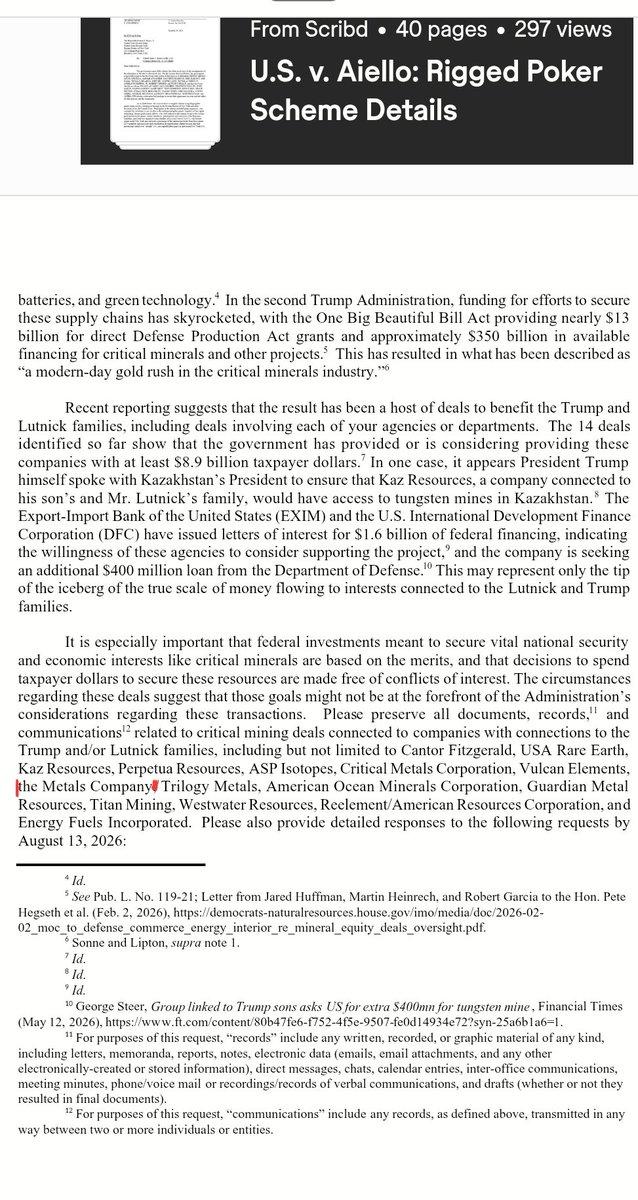
$TMC Congress just revealed confirmation of various deals between the USGOV and critical minerals companies. Nobody cares about the request they're making, top lawyers are involved, what's most important is, that TMC is on the list!!! 😉🧑🏻🚀
https://t.co/BlVWUY0Xm3
@themetalsco #DSM #Criticalminerals #deepseamining #copper #REE
#metalsprocessing #TMC
#Nickel #cobalt #manganese
TMC Welcomes Unanimous Decisions by International Tribunal for the Law of the Sea Ordering the ISA to Respect NORI and TOML’s Due Process Rights.
Read the press release: https://t.co/5GJXRlyyGO #deepseamining
China dominates in global critical mineral processing, but @RepPfluger’s bipartisan EMRTAI Act aims to change that.
This legislation directs @EPA to investigate and support systems that recover US sources of critical minerals, helping ensure China can no longer corner the market on the materials our economy and national security depend on.
🌊Good update on the critical metals resting on the deep seabed
TLDR; “Who extracts these minerals will determine more about the next century than most of the decisions being made in Washington… The floor of the Pacific is the last great untapped resource extraction prize on Earth.”
Excerpts: “The target for this mining is a 104.5 million acre stretch of seabed between Mexico and Hawaii known as the Clarion-Clipperton Zone (CCZ), where US Geological Survey estimates suggest deposits contain more nickel, cobalt, and manganese than all known worldwide land-based reserves combined. The full CCZ is estimated to contain up to 30 billion metric tons of nodules — a deposit, at current valuations, worth up to $18.4 trillion.
Critical minerals demand is accelerating beyond what the existing supply system was designed to handle. By 2035, EVs could account for as much as 70% of global new car sales. The critical minerals supply system has no plausible path to keeping pace.
In the US alone there are 570 gigawatts of battery storage projects waiting to be added to the grid. The International Energy Agency (IEA) has projected that demand for battery metals could grow by a factor of 30x by 2040 from 2024 levels.
Battery storage costs will fall another 35–55% by 2035. At that level, the economic case for new gas-fired power plants collapses because storage can undercut gas on price while performing the same grid-balancing function. But this plummeting cost curve assumes a steady flow of raw materials, an assumption that currently rests on shaky ground.
The biggest risk to this energy transition is a lack of mines. The IEA estimates the world needs 80 new copper mines, 70 new lithium mines, and 70 new nickel mines to meet projected demand. Historically new copper mines take 15-20 years or longer to come online. Closing this gap through conventional mining alone is functionally impossible.
The structural supply shortage of the materials we need to electrify our economies will redraw the map of global power. Instead of Saudi Arabia and other petrostates holding the world politically hostage, power could shift to what we might call electrostates that possess or control the critical minerals needed for electrification.
The largest electrostate is China. Chinese companies control significant shares of global cobalt and manganese extraction in Africa and elsewhere and have locked up supply through overseas mining investments as part of a deliberate industrial strategy. China is the dominant refiner for 19 of the 20 minerals analyzed in the IEA’s Global Critical Minerals Outlook 2025. The country manufactures more than 80% of the world’s finished batteries and controls over 98% of lithium iron phosphate battery cell production.
What [Metals Company CEO] Barron was offering President Trump, in his own words, was “an amazing way of catching up from what is a very distant second place to China when it comes to critical minerals.” Four days after that Oval Office meeting, Trump signed an executive order directing the US government to expedite seabed mining licenses in international waters...
Any environmental concerns must be balanced with the reality that open-pit mining is more ecologically destructive than the methods proposed by Western deep-sea mining companies; open-pit mining projects are mostly located in countries with weaker environmental protections than the international frameworks governing the CCZ. The relevant comparison here is between different forms of mineral extraction, because extraction is necessary and environmental costs can only be mitigated, not eliminated.
The Metals Company’s PATANIA III collector vehicle uses hydraulic suction to skim nodules from the seafloor rather than the bulldozing motion of earlier prototypes, reducing sediment disturbance by roughly 90%.
‘Copper is the new oil,’ according to Robert Friedland, a legendary mining industry figure and one of the first investors in Apple. Copper is why the economics of deep-sea mining are becoming newly compelling. Copper has no real substitute. It’s also embedded in virtually every system that carries an electrical current.
China reversed course on deep-sea mining, a position it had resisted for decades. Beijing’s calculation had changed because land-based mineral strategies in Africa were proving expensive, politically unstable, and increasingly exposed. China now holds more deep-sea exploration licenses than any other country and has built a large fleet of research and survey vessels operating across the Pacific and Indian Oceans.
The appeal of deep-sea mining to China, which prizes self-sufficiency above all else, is apparent. The ocean asks nothing of you. Unlike developing nations, the ocean won’t attempt to nationalize your assets or default on a loan or hold elections with unpredictable consequences for your investments.
In the March 2026 issue of Qiushi, the Chinese Communist Party’s top theoretical journal, an editorial declared 'The 21st century is the century of the ocean; whoever wins the ocean wins the future. China is one of the earliest nations in the world to develop and utilize the ocean ... We must deeply implement Xi Jinping’s vision to build a maritime power.'
If the Chinese pursue deep-sea mining as part of an integrated strategy to control the world’s oceans, the US must treat it as a mandatory theatre of competition. The Trump administration is pushing forward. NOAA and the Bureau of Ocean Management are accelerating permitting. In late March, the US and Japan signed a memorandum of cooperation to jointly advance deep-sea mining.
Who extracts these minerals, and under what legal framework, will determine more about the next century than most of the decisions being made in Washington right now. A CCZ developed under American legal frameworks produces a different world than one developed under Chinese state direction, with output flowing into Chinese refineries, Chinese battery factories, and Chinese defense supply chains.
The floor of the Pacific is the last great untapped resource extraction prize on Earth.”
— From: https://t.co/y6xOIJ7Hw5 $TMC
Goldman has increased its forecast for the copper deficit outside the United States from 60,000 tonnes to 640,000 tonnes.
Ten times larger.
In a market already struggling to find enough metal.
The copper crunch is no longer a future problem.
Not many are watching this…
BREAKING NEWS
THE WHITE HOUSE HAS ISSUED A MEMORANDUM AUTHORIZING HIGHER PAY FOR ROLES RELATED TO NATIONAL SECURITY INVESTMENT IN AREAS SUCH AS CRITICAL MINERALS.
I said years ago, mineral security was about national security.
We are playing catch up now in real-time.












![FutureJurvetson's tweet photo. 🌊Good update on the critical metals resting on the deep seabed
TLDR; “Who extracts these minerals will determine more about the next century than most of the decisions being made in Washington… The floor of the Pacific is the last great untapped resource extraction prize on Earth.”
Excerpts: “The target for this mining is a 104.5 million acre stretch of seabed between Mexico and Hawaii known as the Clarion-Clipperton Zone (CCZ), where US Geological Survey estimates suggest deposits contain more nickel, cobalt, and manganese than all known worldwide land-based reserves combined. The full CCZ is estimated to contain up to 30 billion metric tons of nodules — a deposit, at current valuations, worth up to $18.4 trillion.
Critical minerals demand is accelerating beyond what the existing supply system was designed to handle. By 2035, EVs could account for as much as 70% of global new car sales. The critical minerals supply system has no plausible path to keeping pace.
In the US alone there are 570 gigawatts of battery storage projects waiting to be added to the grid. The International Energy Agency (IEA) has projected that demand for battery metals could grow by a factor of 30x by 2040 from 2024 levels.
Battery storage costs will fall another 35–55% by 2035. At that level, the economic case for new gas-fired power plants collapses because storage can undercut gas on price while performing the same grid-balancing function. But this plummeting cost curve assumes a steady flow of raw materials, an assumption that currently rests on shaky ground.
The biggest risk to this energy transition is a lack of mines. The IEA estimates the world needs 80 new copper mines, 70 new lithium mines, and 70 new nickel mines to meet projected demand. Historically new copper mines take 15-20 years or longer to come online. Closing this gap through conventional mining alone is functionally impossible.
The structural supply shortage of the materials we need to electrify our economies will redraw the map of global power. Instead of Saudi Arabia and other petrostates holding the world politically hostage, power could shift to what we might call electrostates that possess or control the critical minerals needed for electrification.
The largest electrostate is China. Chinese companies control significant shares of global cobalt and manganese extraction in Africa and elsewhere and have locked up supply through overseas mining investments as part of a deliberate industrial strategy. China is the dominant refiner for 19 of the 20 minerals analyzed in the IEA’s Global Critical Minerals Outlook 2025. The country manufactures more than 80% of the world’s finished batteries and controls over 98% of lithium iron phosphate battery cell production.
What [Metals Company CEO] Barron was offering President Trump, in his own words, was “an amazing way of catching up from what is a very distant second place to China when it comes to critical minerals.” Four days after that Oval Office meeting, Trump signed an executive order directing the US government to expedite seabed mining licenses in international waters...
Any environmental concerns must be balanced with the reality that open-pit mining is more ecologically destructive than the methods proposed by Western deep-sea mining companies; open-pit mining projects are mostly located in countries with weaker environmental protections than the international frameworks governing the CCZ. The relevant comparison here is between different forms of mineral extraction, because extraction is necessary and environmental costs can only be mitigated, not eliminated.
The Metals Company’s PATANIA III collector vehicle uses hydraulic suction to skim nodules from the seafloor rather than the bulldozing motion of earlier prototypes, reducing sediment disturbance by roughly 90%.
‘Copper is the new oil,’ according to Robert Friedland, a legendary mining industry figure and one of the first investors in Apple. Copper is why the economics of deep-sea mining are becoming newly compelling. Copper has no real substitute. It’s also embedded in virtually every system that carries an electrical current.
China reversed course on deep-sea mining, a position it had resisted for decades. Beijing’s calculation had changed because land-based mineral strategies in Africa were proving expensive, politically unstable, and increasingly exposed. China now holds more deep-sea exploration licenses than any other country and has built a large fleet of research and survey vessels operating across the Pacific and Indian Oceans.
The appeal of deep-sea mining to China, which prizes self-sufficiency above all else, is apparent. The ocean asks nothing of you. Unlike developing nations, the ocean won’t attempt to nationalize your assets or default on a loan or hold elections with unpredictable consequences for your investments.
In the March 2026 issue of Qiushi, the Chinese Communist Party’s top theoretical journal, an editorial declared 'The 21st century is the century of the ocean; whoever wins the ocean wins the future. China is one of the earliest nations in the world to develop and utilize the ocean ... We must deeply implement Xi Jinping’s vision to build a maritime power.'
If the Chinese pursue deep-sea mining as part of an integrated strategy to control the world’s oceans, the US must treat it as a mandatory theatre of competition. The Trump administration is pushing forward. NOAA and the Bureau of Ocean Management are accelerating permitting. In late March, the US and Japan signed a memorandum of cooperation to jointly advance deep-sea mining.
Who extracts these minerals, and under what legal framework, will determine more about the next century than most of the decisions being made in Washington right now. A CCZ developed under American legal frameworks produces a different world than one developed under Chinese state direction, with output flowing into Chinese refineries, Chinese battery factories, and Chinese defense supply chains.
The floor of the Pacific is the last great untapped resource extraction prize on Earth.”
— From: https://t.co/y6xOIJ7Hw5 $TMC](https://pbs.twimg.com/media/HLCUo5iXgAACKNm.jpg)


