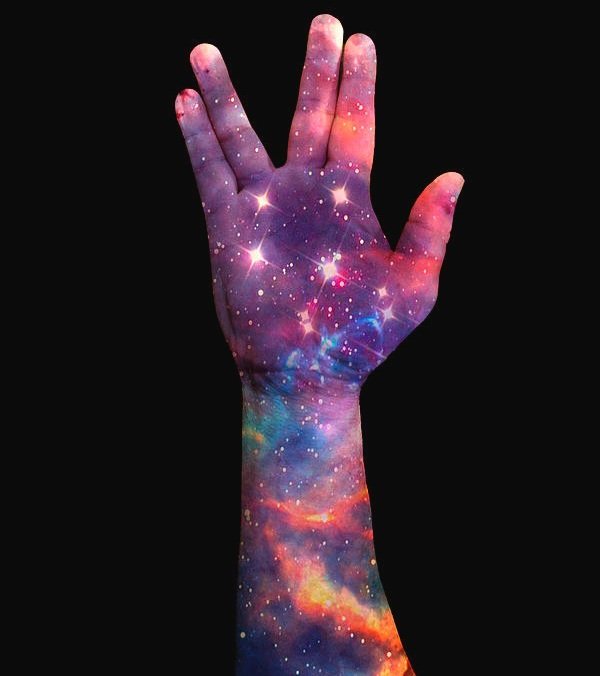
"I, a Universe of Atoms
An Atom in the Universe
Made of ✨StarStuff✨
Floating on a Mote of Dust
Lost between Immensity
And Eternity of space time
Just like YOU
My fellow cosmic being"☺️💫🌟
LLAP🖖
The planetary nebula NGC 2899 features a dramatic diagonal, bipolar gas outflow powered by the fierce radiation and winds of a central white dwarf.
Its peculiar shape may be linked to the complex interplay of two companion stars at its centre.
(Credit: NASA, ESA, STScI)
Behold: new and previously unseen imagery from our Artemis II mission!
These images were captured on April 6, 2026, when the four astronauts aboard the Orion spacecraft conducted the lunar flyby portion of their ten-day journey.
Journeying towards the Cat’s Paw Nebula (NGC 6334), a vast region of star formation roughly 5,500 light-years from Earth.
(Video by Universal-Sci - Credit: ESO/J. Emerson/VISTA Acknowledgment: Cambridge Astronomical Survey Unit)
The Spirit rover (Mars Exploration Rover A) left our planet to begin the journey to its new home OTD in 2003. This view captured 20 years ago at the beginning of 2006 shows rippled sand deposits of the "El Dorado" ripple field in Gusev Crater on Mars.
Designed for a 90-day mission, Spirit operated for more than 6 years on Mars. It's twin, Opportunity, operated for almost 15 years.
🔭 A faint smudge ✨ that holds a thousand suns, ~600 million years old.
To the unaided eye it is barely there. A soft grey patch in Cancer, the faintest house of the zodiac, the kind of thing you only notice once someone points it out. Bring any glass to it and the patch falls apart into stars. M44 sits about 577 to 610 light-years away, one of the closest open clusters to us, with roughly a thousand stars bound together across some 23 light-years of space.
The crowd is mixed. Around two-thirds are faint red dwarfs you will never pull out from a backyard, a third are Sun-like F, G and K stars, and only a couple of percent are the hot blue-white A-types that actually catch the eye. Add five aging giants and eleven white dwarfs, stars already at the end of the road, and you have the full census of a small city.
Twenty-three light-years is hard to feel, so here is a handle on it. Light needs about 23 years to cross the cluster from one side to the other. An airliner doing 900 km/h would need around 28 million years to fly the same distance. Set Praesepe beside the Hyades in Taurus, the nearest cluster of all at about 150 light-years: the two share an age and very nearly a motion through the Galaxy, close enough that they may have drifted out of the same birth-cloud long ago.
📖 When this light set out
The photons landing on the sensor tonight left Praesepe in the first half of the 1400s. Picture Europe then.
On the far end of the distance estimate, the light departed while the Council of Constance was stitching the Western Church back together and English and French armies were still bleeding each other through the Hundred Years' War, with Agincourt fresh in living memory.
Somewhere mid-journey, Brunelleschi closed the great dome over Florence, a thing nobody had known how to build.
By the time the nearer light left, a man named Gutenberg was in Mainz, fitting together a press from which the first printed books would soon come. What you are looking at is, in a quiet way, a postcard from the morning of printed knowledge.
🌍 And by the Earth's own clock
Six hundred years sounds long until you hand it to the planet. On that clock it is nothing. The coastlines sat where they sit now, the same forests stood, the climate had barely moved. Nothing came or went in that window worth marking on a geological chart. The light feels old, and to us it is. The Earth would not even notice the gap.
🫏 The manger and its two donkeys
The Greeks did not see a beehive. They saw a feeding trough. They called the cluster Phatne, the Manger, and the two stars flanking it, Gamma and Delta Cancri, were the Onoi, the donkeys, leaning in to feed. The tale Eratosthenes hands down comes from the Gigantomachy, the war of the gods against the Giants: Dionysus and Hephaestus rode into that fight on asses, and when the beasts brayed, a noise the Giants had never heard, the giants broke and ran. The donkeys were set in the sky on either side of their manger as thanks. Centuries later Ptolemy could only log the cluster as "the nebulous mass in the chest" of the Crab, with no idea what it really was.
There is something fitting in all of it. Cancer is the dimmest figure in the zodiac, and at its heart sits a humble manger that turns out, under a lens, to hold a thousand stars.
✨ Why I keep coming back
This was never a hard target. No filter, no chasing the seeing, no night lost to clouds. A wide field, a clear spring evening, and an old grey smudge that pays you back the instant you give it some glass. Sometimes that is the whole of it.
Thanks for reading and Clear Skies /@xipteras
#nightsky #BeehiveCluster
Webb has delivered the strongest evidence yet that its discovery of mysterious Little Red Dots (LRD) are “black hole stars.” They appear starting ~600 million years after the big bang, and scientists are still working out exactly what they are. https://t.co/MIEwfifyzi
@Swetilein1 You are very welcome, dear Swetilein✨️🤗✨️
Thank you so much✨️💕🤗💕✨️
I am ok. Thank you so much for asking🙏🫂🙏
I hope you are doing well too, and your day ahead is peaceful✨️🌹🤗🌹✨️
In 1967, while pursuing her Ph.D. at Cambridge at the age of 24, Jocelyn Bell Burnell made the groundbreaking discovery of pulsars. The discovery was one of the greatest breakthroughs in the history of astrophysics.