We’ve selected a new @NASAUniverse mission! UVEX — UltraViolet Explorer — will conduct a deep survey of the whole sky in two bands of ultraviolet light, providing new insights into galaxy evolution and the lifecycles of stars. Congratulations to Principal Investigator, Fiona Harrison and her team! https://t.co/H9nNIb37rV
July 2023 was the hottest month on record, according to our global temperature analysis. Overall, July was 0.43°F (0.24°C) warmer than any other July in @NASAEarth's record, and it's likely due to human activity. Details: https://t.co/2DTIfL8S1Q
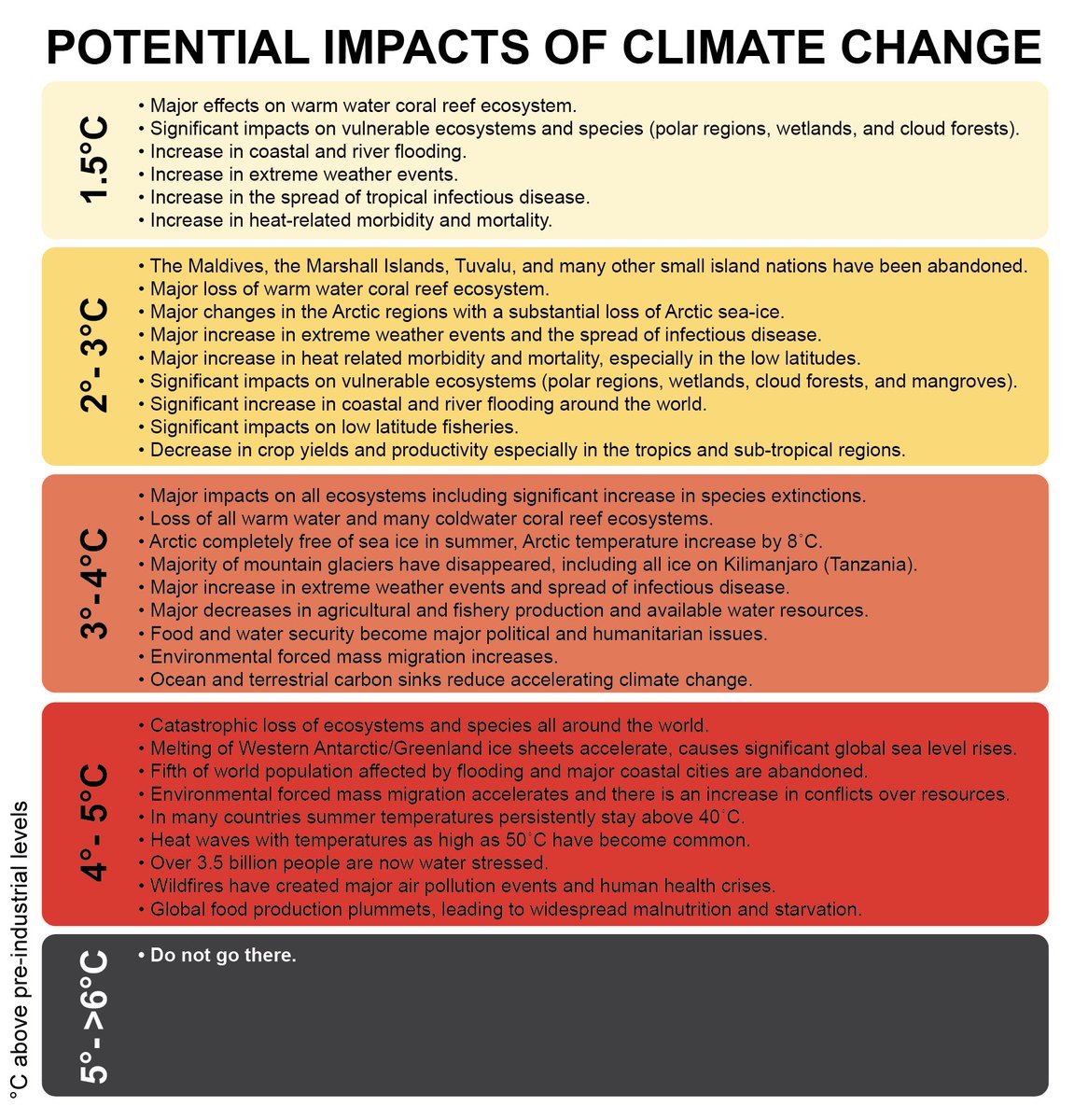
Climate change: how bad could the future be if we do nothing?
I developed this table of impacts for my book 📕 ‘Climate Change: A Very Short Introduction’ based on the @IPCC_CH 2018, 2019, 2021 and 2022 reports
Beyond 1.5°C #ClimateChange impacts gets worse and worse
Pulsars are all over the news, powerhouse astronomical magnets a million trillion times the magnitude of the Earth’s. Dame Jocelyn Bell Burnell describes their discovery in this animated Broadcast Monologue @PioneerWorks_ https://t.co/o5SqRICpVR
Congratulations to NANOGrav for detecting evidence that gravitational waves fill the cosmos.
These ripples in the fabric of space happen when massive objects like black holes circle one another before colliding. The result brings us closer to understanding how galaxies evolve. https://t.co/AKZhOS5qwe
Nice short video here explaining how pulsar timing arrays are used to detect gravitational waves. Helps you understand the @NANOGrav experiment that’s announcing results on Thursday. By @savagitsky, @mclean_ka & @Nnguyenscience for @ScienceMagazine: https://t.co/GNDXUEPW2T
Here's a video I made a while back showing one of our longest 3D-GRMHD simulations of the circum-binary disk we use to understand the state of the matter surrounding merging binary black holes: https://t.co/27Cs1c9zeP
What happens when merging binary black holes have matter falling ('accreting') onto them? Check out our recent paper showing some of the most cutting-edge 3D MHD simulations of these systems! https://t.co/iLQxRBywpS https://t.co/4AOELKhXs6 with
@ManuelaCampane1
and collaborators
Meanwhile, the binary black holes (most likely supermassive if matter surrounding them is falling onto them at significant rates, meaning black holes millions to billions times the mass of our Sun) will emit stronger and increasing-frequency gravitational waves until merging!
Let's not just focus on whether #GPT4 will do more harm or good on the job market, but also on whether its coding skills will hasten the arrival of #superintelligence – for which AI safety researchers have so far failed to discover any safety guarantees: https://t.co/D051i53B2d
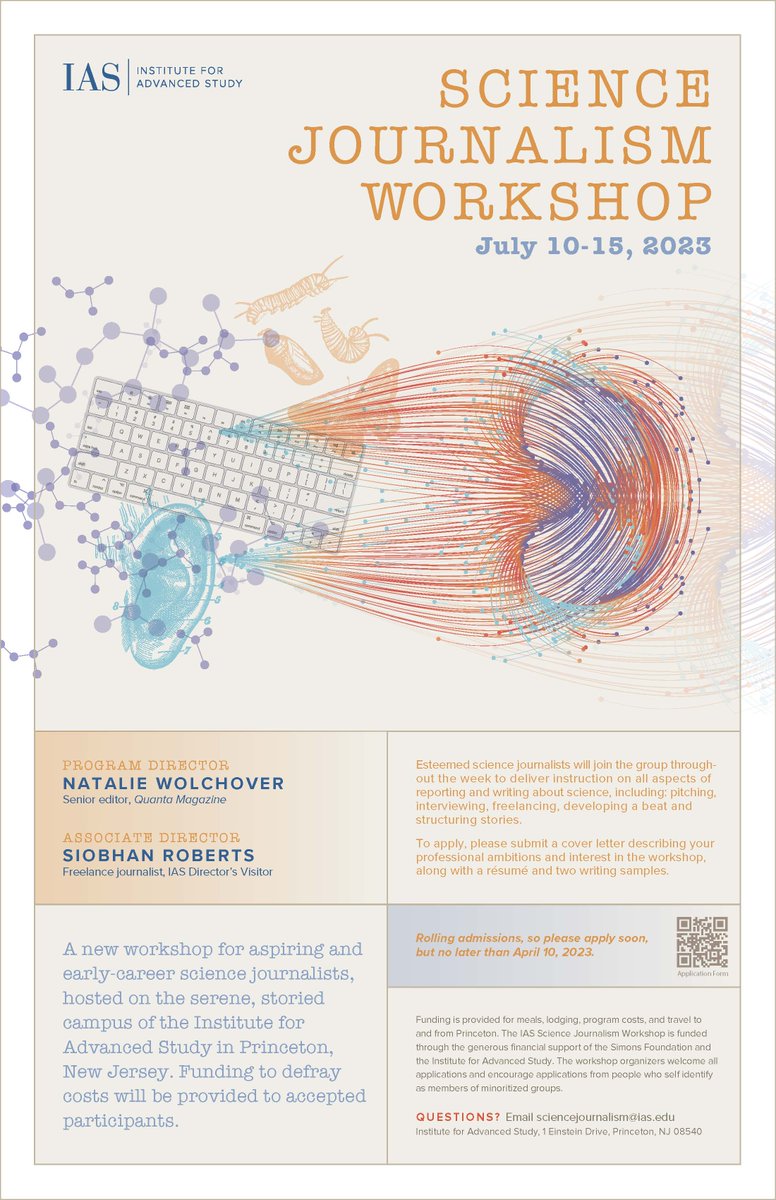
I’m thrilled to announce a new, weeklong workshop for aspiring & early-career science journalists happening July 10-15 at the Institute for Advanced Study in Princeton. Travel costs, meals, lodging covered by @SimonsFdn & @the_IAS. Apply here: https://t.co/hiMQpYtKav Pls share🙏