Very cool. Kardashev-0.7 is a swarm of 32 different models trained together with RL for Population Scaling, so they end up specialising and covering for each other without anyone assigning roles by hand. @BanburyRoadAI says it reaches frontier-level performance at roughly 0.007x to 0.02x the usual inference cost and about 0.03x the memory.
That is the same kind of self-organised division of labour you see in ant colonies and in scale-free networks, where the useful structure shows up from local interactions rather than from a central plan.
I’d like to understand the baseline against which the cost numbers are measured.
https://t.co/PZZGe84eyE
The dominant strategy in AI has been simple: make one model bigger.
Kardashev-0.7 takes a different path, it's a trained swarm of 32 distinct models, the first of its kind.
Rather than one system doing everything, it's built on the idea that specialized parts, working together, can outperform a single generalist.
@JeffBezos I am highly skeptical. This sounds highly debatable AI PR.
Past productivity surges have raised average living standards yet left many costs, especially housing, rising faster than wages, and early AI adoption has already coincided with corporate job cuts rather than shorter weeks.
Bezos’s mechanism only works if the gains are widely shared as higher real pay or lower prices; if they concentrate with capital owners, three-day weeks remain unaffordable for most mortgage holders even as output rises.
Historical declines in working hours have been gradual and incomplete, so the claim that AI will quickly make one paycheck or a three-day week sufficient rests more on optimistic assumptions about distribution than on observed evidence so far.
And keeping with the theme of brain-tech interfaces here is an interview on that very topic with @hubermanlab.
Brain-tech really is the next frontier and I’m not so distant one at that.
Andrew Huberman on @neuralink, and the next frontier for brain-computer interfaces:
"Getting people who are in locked-in syndrome to speak, or getting people who have a spinal injury to walk, which Neuralink and others are trying to develop technologies to do. That's heroic.
@elonmusk obviously understands what he's trying to achieve with Neuralink, and he's extremely savvy with respect to what can be done now, where we need to go.
I think the coolest problem that's also the biggest problem is how we can noninvasively write to the nervous system in sleep and waking states.
Who can develop, it will probably be ultrasound, a non-invasive way of selectively activating or quieting brain areas with high amounts of temporal precision.
That, to me, seems like the most important thing to resolve right now, and it's totally doable."
The work that @aryangovil, founder of SynaptrixAI, is doing is incredible. Synaptrix is focused on non-invasive BCI using EEG and MI for telepathy, and this highlights the untapped potential of merging advanced brain-computer interfaces with AI world models that simulate real-world dynamics.
There is a growing industry momentum around direct brain-AI integration, where neural data could feed into or be shaped by predictive world models for applications like enhanced cognition and immersive experiences.
I’m following this one closely! Extraordinary stuff!
a=(y,d=mag(k=(6+3*sin(y+4))*cos(i/7),e=y/5-13)-6.6)=>point((q=3*sin(k*2)+k*y/25*(9+2*sin(e*6-d*5+t*2)))+30*cos(c=d-t)+200,q*sin(c)+d*39)
t=0,draw=$=>{t||createCanvas(w=400,w);background(9).stroke(w,96);for(t+=PI/120,i=2e4;i--;)a(i/885)}//#つぶやきProcessing
// what do you see?
The possibility that terzepatide might activate brown adipose tissue is really very significant.
Active brown adipose tissue 'burns' glucose and fat within the body, which would contribute to its positive effect not only in reducing body weight, but also in lowering blood glucose and fat levels, and improving metabolism.
If this be case, it is huge news for longevity.
Food for thought! Or not.
https://t.co/nU5AclZVQJ
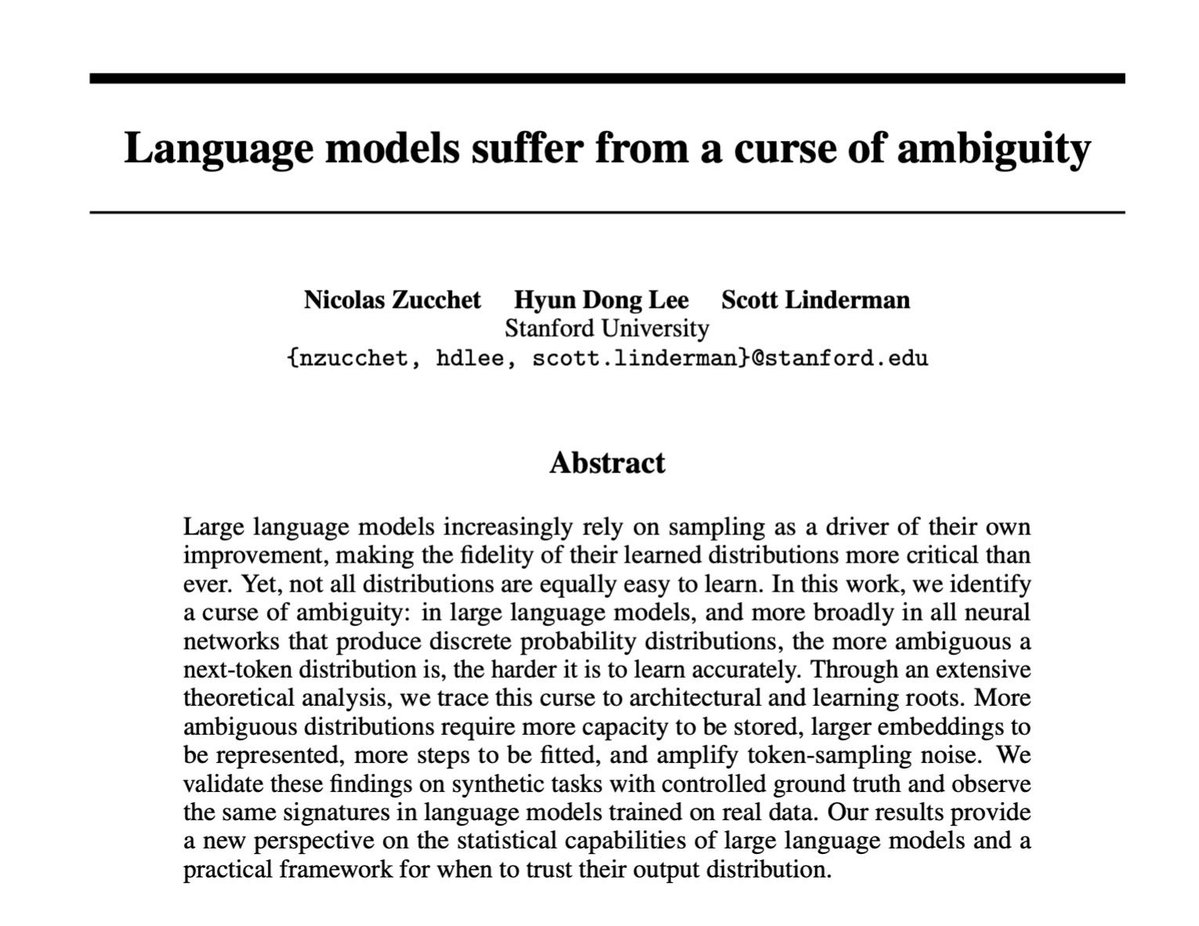
@NicolasZucchet Incredible! NeurIPS spotlight on the curse of ambiguity: high-entropy tokens need more capacity to store, larger embeddings, more training steps, and more samples to cut sampling noise.
Ambiguous tokens are expensive everywhere at once: memory, representation width, optimize time, and data.
Channel coding already works this way: high-entropy symbols demand more bandwidth and more redundancy before the message clears.
https://t.co/qWRFg1Qm60
Joining the NeurIPS celebration: our curse of ambiguity paper will be a spotlight 🎉
We show that high entropy tokens need
1. More capacity to store
2. Larger embeddings to be represented
3. More training steps
4. More samples to reduce sampling noise
Scaling laws study performance averaged over all tokens in the data; our work zooms in and sheds some light onto which tokens are harder to learn 🔬
Extraordinary on so many levels!
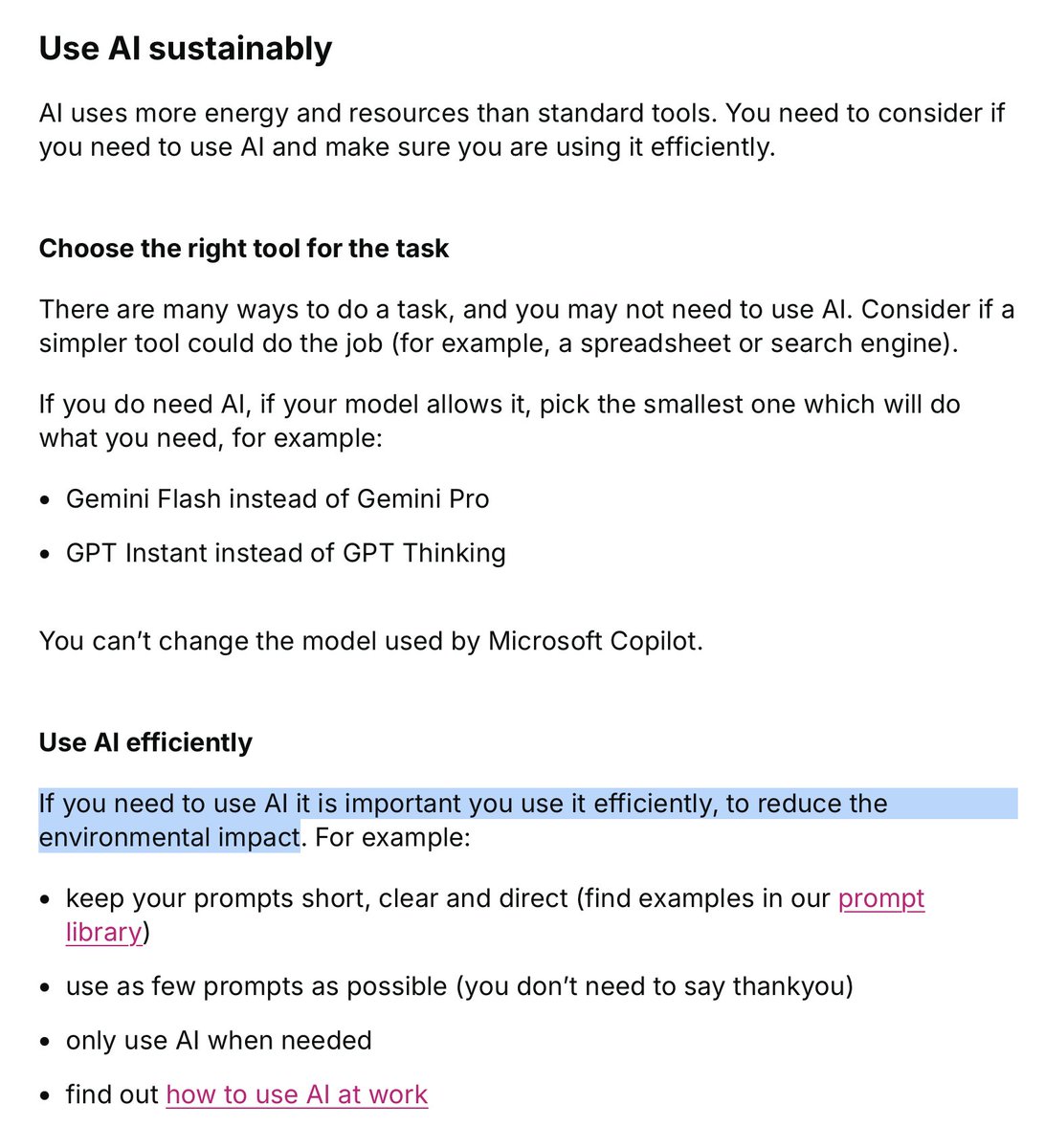
The latest UK AI ethics guidance, updated September 2026 on https://t.co/vlu3C9NYnK, prioritizes environmental efficiency because AI tools consume more power and resources than traditional methods, reflecting broader policy focus on reducing data center impacts.
Civil servants are advised first to check if a spreadsheet or simpler tool suffices, select smaller models like Gemini Flash over Pro, and keep prompts short to cut energy use!
Spreadsheet first as official AI ethics ought to send UK innovators packing.
https://t.co/agfb59vL5O
BREAKING: the UK government publishes official rules on how to use AI:
1. Ask first if you really need to use AI
2. Check if a spreadsheet can do the job before using AI
3. Choose the worst model possible so it uses less energy
4. Keep prompts short to reduce the environmental impact
5. In general, use AI only when necessary, as a climate-saving measure
With a mindset like this, we should accept the UK back into the European Union
@PamirEhsas Very impressive. Do you only do transaction work or litigation too? How do you work with barristers? Some of my barristers colleagues are not very AI savvy!
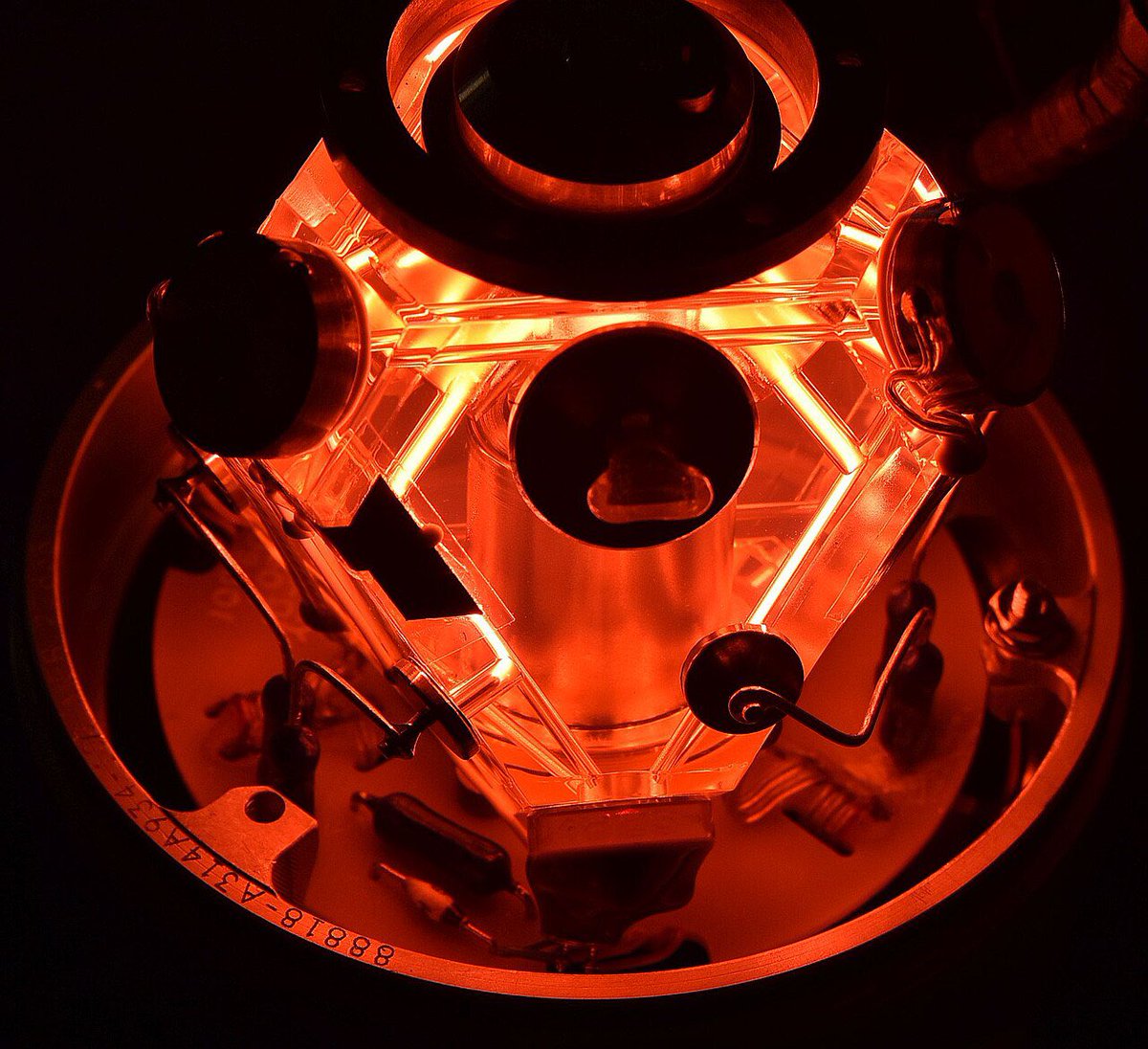
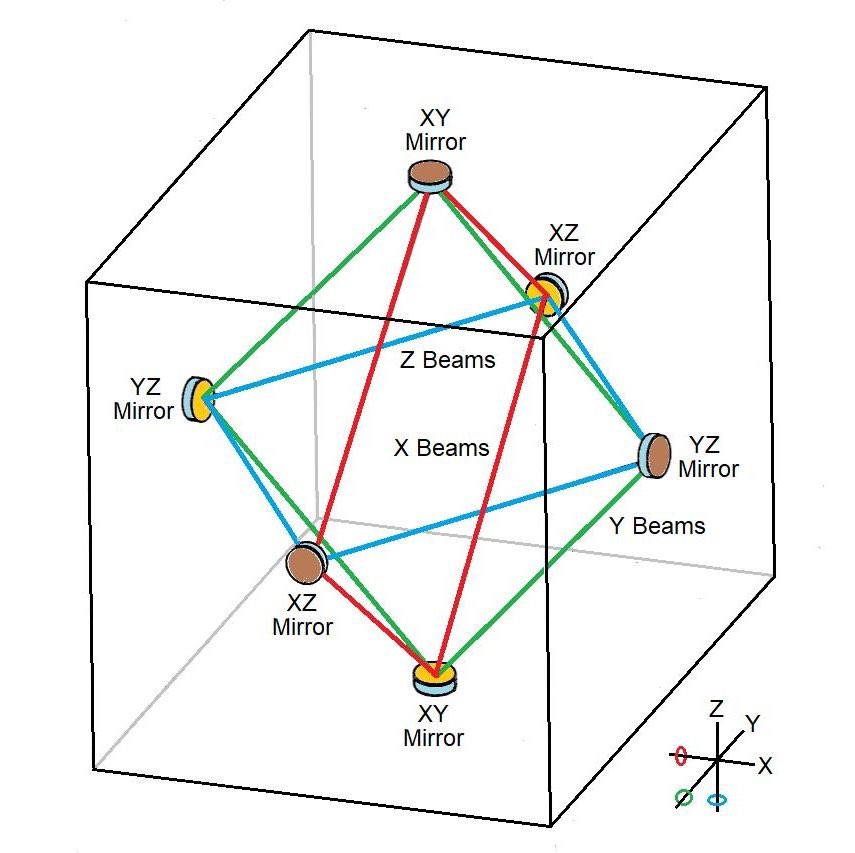
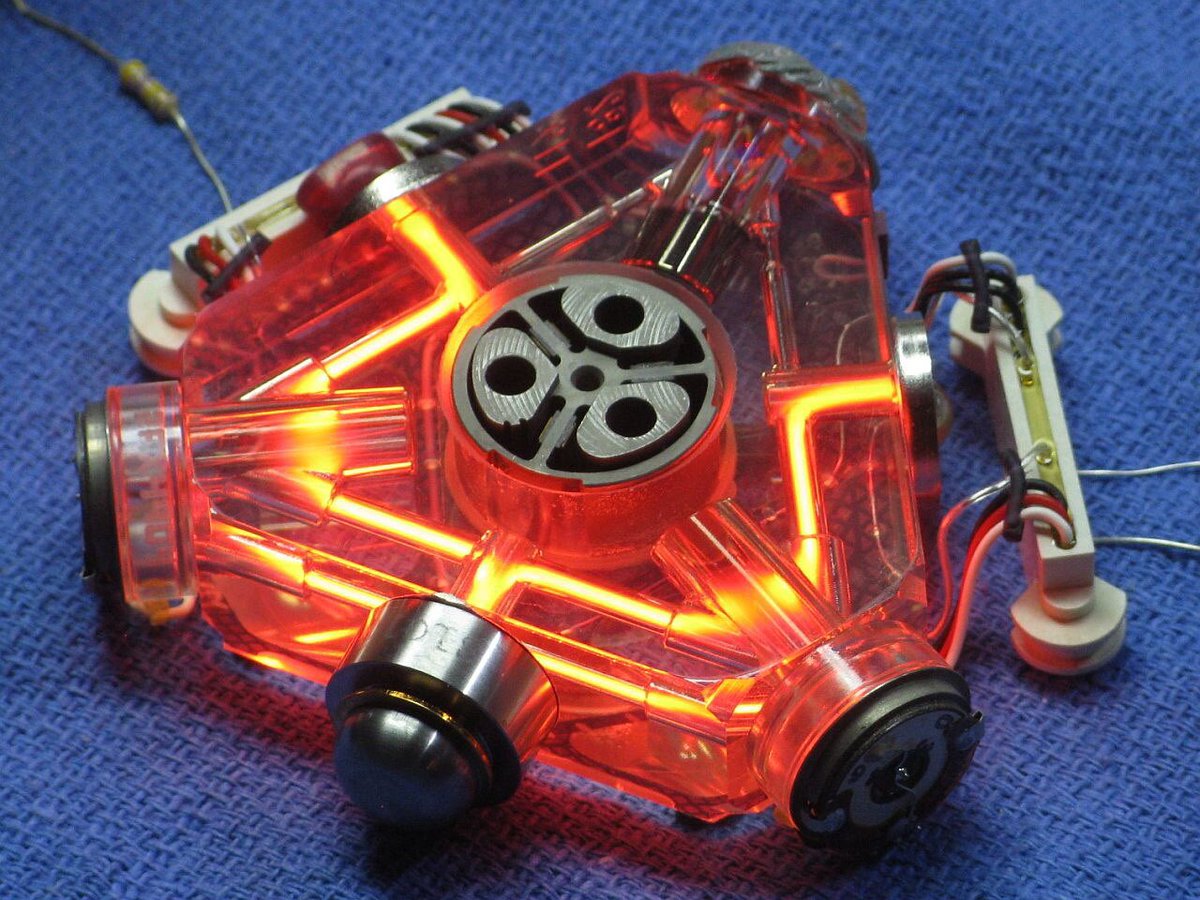
@ianbrooke interesting. Ring laser gyros keep aircraft level with the Sagnac effect, counter-propagating HeNe beams that detect rotation from a path-length shift, solid-state drift around 1/100 of a degree per hour.
Local interference between the two beams turns tiny rotation into a measurable frequency split, so inertial nav gets a global attitude without waiting on GPS.
Interferometers already work this way: a closed light path converts a geometric phase into a stable navigation signal.
https://t.co/0h2a4Gx7Mz
fun fact, we use these (ring laser gyros) to keep airplanes perfectly level. they’re solid state (aesthetically pleasing) and have a drift of 1/100th of a degree per hour. they’re the most reliable and precise component out there for inertial navigation.
they work by splitting a beam of light in opposite directions, when they meet again their coherent waves interfere and recombine, and the change in phase reflects the change in angular velocity
and really, they just look so cool.
Across 360 robotics trials on an open third-party robot-control bench, Opus 5.5 averages under a dollar a trial, 1.8× Opus 5 at half the cost, and roughly matches Astra for less!
Open harness plus released traces turns private robot-control claims into a rerunnable score surface other labs can actually check.
This type of evaluation physics is like shared flight-test benches, where a public control order parameter exists before anyone pretends a leaderboard cleared a clinical floor.
Across 360 robotics trials, Opus 5.5 averages under $1 per trial, scoring 1.8x as high as Opus 5 at half the cost and roughly matching Astra's mean score at 21% lower cost.
I absolutely agree with this. It is impossible to assess them all and these companies need to be doing the work to make themselves standout, to present something truly novel (like Jev) rather than wrappers over existing systems, or to go truly niche and solve one small ubiquitous problem not apt for resolution by the behemoths.