AI Lead & Strategy Advisor @ Alexion, AstraZeneca Rare Disease | Transforming Data Foundations in Data-Scarce Environments | What Dream Are You Building?
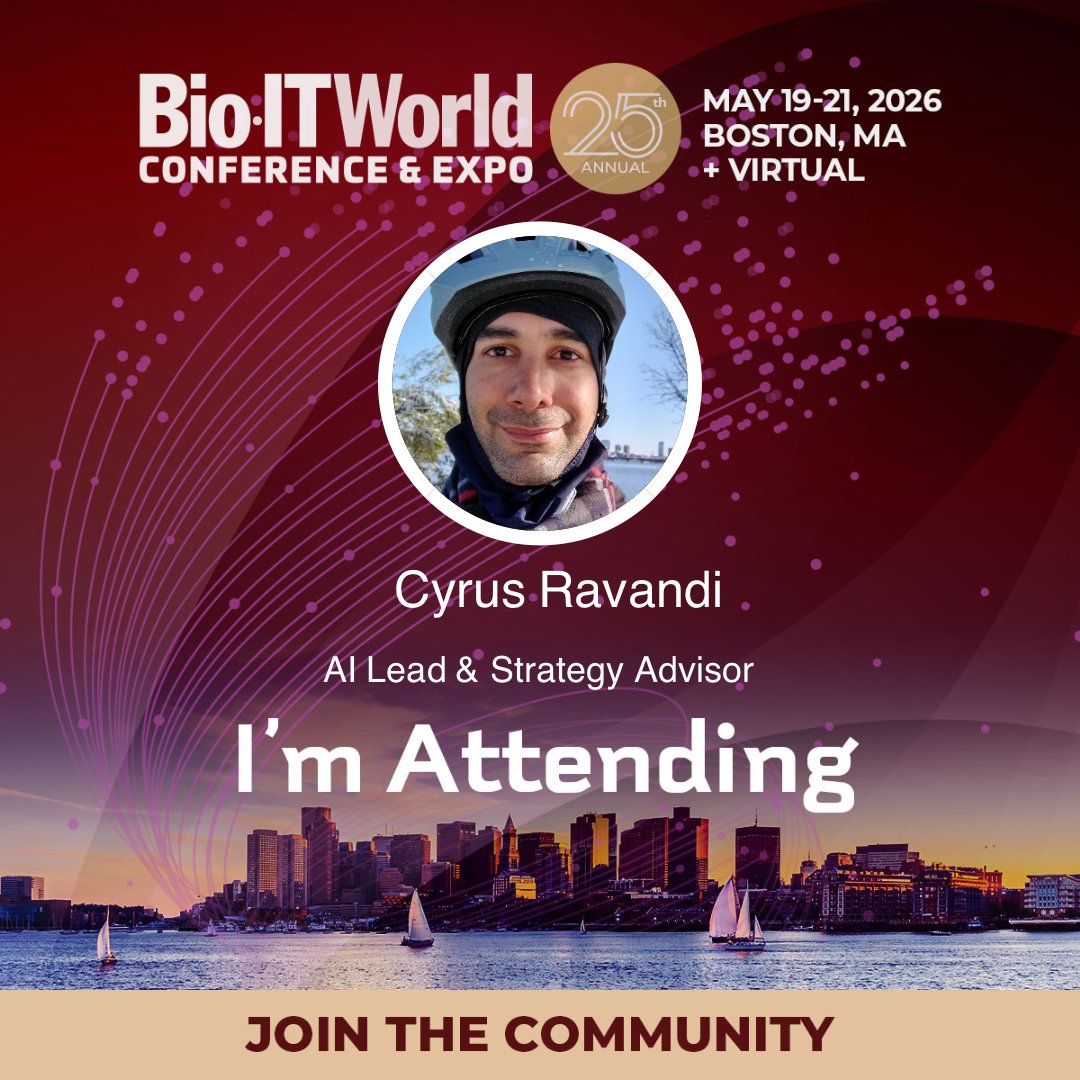
Excited to be attending Bio-IT World 2026 this May! It’s always a great opportunity to connect with the community advancing AI, data, and innovation in life sciences. If you are attending and like to meet up, send me a message.
#BioITExpo… https://t.co/TxTNEm6d5p
Today, we are launching the first publicly available AI Scientist, via the FutureHouse Platform.
Our AI Scientist agents can perform a wide variety of scientific tasks better than humans. By chaining them together, we've already started to discover new biology really fast. With the platform, we are bringing these capabilities to the wider community. Watch our long-form video, in the comments below, to learn more about how the platform works and how you can use it to make new discoveries, and go to our website or see the comments below to access the platform.
We are releasing three superhuman AI Scientist agents today, each with their own specialization:
A general-purpose agent (Crow);
An agent to automate literature reviews (Falcon); and
An agent to answer the question “Has anyone done X before” (Owl).
We are also releasing an experimental agent, Phoenix, that has access to a wide variety of tools for planning experiments in chemistry. More on that below.
The three literature search agents (Crow, Falcon, and Owl) have benchmarked superhuman performance. They also have access to a large corpus of full scientific texts, which means that you can ask them more detailed questions about experimental protocols and study limitations that general-purpose web search agents, which usually only have access to abstracts, might miss. Our agents also use a variety of factors to distinguish source quality, so that they don’t end up relying on low-quality papers or pop-science sources. Finally, and critically, we have an API, which is intended to allow researchers to integrate our agents into their workflows.
Phoenix is an experimental project we put together recently just to demonstrate what can happen if you give the agents access to lots of scientific tools. It is not better than humans at planning experiments yet, and it makes a lot more mistakes than Crow, Falcon, or Owl. We want to see all the ways you can break it!
The agents we are releasing today cannot yet do all (or even most!) aspects of scientific research autonomously. However, as we show in the video, you can already use them to generate and evaluate new hypotheses and plan new experiments way faster than before. Internally, we also have dedicated agents for data analysis, hypothesis generation, protein engineering, and more, and we plan to launch these on the platform in the coming months as well. Within a year or two, it is easy to imagine that the vast majority of desk work that scientists do today will be accelerated with the help of AI agents like the ones we are releasing today.
The platform is currently free-to-use. Over time, depending on how people use it, we may implement pricing plans. If you want higher rate limits, especially for research projects, get in touch. @m_skarlinski, @andrewwhite01, @_tnadolski, Remo Storni, @semajazarb, @ludomitch, @MichaelaThinks, as well as @jasonjoyride and his team for making such fantastic videos of us!
Honored to give the Keynote at Sunbelt 2024 in Edinburgh—my first Sunbelt! 🌍🎤
📺 Watch "Network Science: From Structure to Network Resilience" here:
🔗 https://t.co/iPmKD5yQ5K
#NetSci#Sunbelt2024#NetworkScience
“The Billion Cells Project will help clarify our understanding of the fundamental biology underpinning human health + disease while supercharging efforts at the intersection of AI & biology.” - @JCoolScience
Learn more about the project https://t.co/YaP800otuT
Nature Food: Our paper revealing the degree of food processing in 50K+ items sold by Walmart, Target & Whole Foods is just out! 🍎📊
PDF at https://t.co/AHR1woOhsm
See the data in action at https://t.co/oYf5pHGj21
Thank @menicgiulia, @BabakRavandi et al.
'The Misplaced Incentives in Academic Publishing'
"Many of the largest, under-appreciated sins of publishing do not arise from the journals themselves, but from the professional ecosystem that defines modern academia."
New for @undarkmag:
https://t.co/rN1h6rD1Xv
Exciting start to 2024 with a few papers. Paper #2: inspired by seminal work of @ZacconeAlessio and @emanueladelgado on origin of elasticity in colloidal gels, and in collaboration with @LilianHsiao, Max Bi, Babak Ravandi and others, led by @Nabi_137 👇🏼 https://t.co/GilDhdD6hM
🧵Excited to share that we @Dyno_Tx have launched our 2nd product Dyno eCap 1, a generative AI designed protein validated extensively in nonhuman primates, as a breakthrough capsid with potential to solve the delivery challenge for variety of eye diseases. https://t.co/iLBhCPCT4V
🚨 JOB ALERT 🚨
We are building the next generation of Therapeutics Commons @ProjectTDC!
Our vision is to lay the foundations for AI & therapeutics, eventually enabling AI to learn on its own and acquire knowledge through continual refinement
We are seeking postdoctoral research fellows and students, machine learning and data specialists, biomedical AI fellows, and an AI community manager who will lead research in AI to advance molecular drug design and clinical drug development
⤵️ Apply
https://t.co/sRJhHVxkbI
🌏 Location
@HarvardDBMI@harvardmed@Harvard
💊 You will spearhead research in foundation models, large-scale knowledge graph AI, multimodal learning, and generative AI
🧪 We will create universal benchmarks, develop efficient AI agents, and use data-centric approaches to establish open data and model hubs
🏥 There is a strong emphasis on educational and outreach initiatives in collaboration with our US and international partners to ensure responsible and ethical use of AI in drug development
@harvard_data@KempnerInst@AI_for_Science@SymposiumML4H@iscb
Is science becoming less disruptive in the last decades? Such a claim was made and received much attention, but @ralexbentley@svalver et al. did the math, and the result is the opposite: disruption is there and keeps growing https://t.co/es4zNJCmR0 @BlaiVidiella@SDuranNebreda
I updated my list of firsts in network science with the first application of information theory to measure the level of organization in networks (Nicolas Rashevsky, 1955)
https://t.co/zOi5ORlvd5
New Paper in @NatureComms: Assessing how processed is your food.
"Machine learning prediction of the degree of food processing"
Available at https://t.co/lgBUAI1QZA and https://t.co/tUyYxpWGp2
With @menicgiulia @BabakRavandi @Dmozaffarian
#FoodProcessing
What is the "right" level of detail required to model and understand a complex system? We know that, on different scales, details on lower levels are often unnecessary. Why? Gene networks are a perfect illustration. Check this comment by S. Bonhordlt https://t.co/lP1OQCmjoI
Excited to share our new paper, ‘Accelerating network layouts using graph neural networks’ just out in @NatureComms with @csabath95, @nimatabari, and @yuqirose: https://t.co/zXZaXrKQIx
NeuLay is a machine-learning framework to speed up network visualization.
See thread: