1/12. How do cortical interneurons select specific pyramidal cells during development? Julie Jezequel in @Rico_lab has identified specific cellular and molecular codes that interneurons use to target pyramidal cell types @NatureComms@dev_neuro@MRC_CNDD@KingsIoPPN
Today in @Nature, we report a spatial single-cell atlas of human cortical development, revealing surprisingly early specification of human cortical layers and areas.
We built an interactive browser to explore the spatial data: https://t.co/Xy3JcsSpYw
Paper link below👇
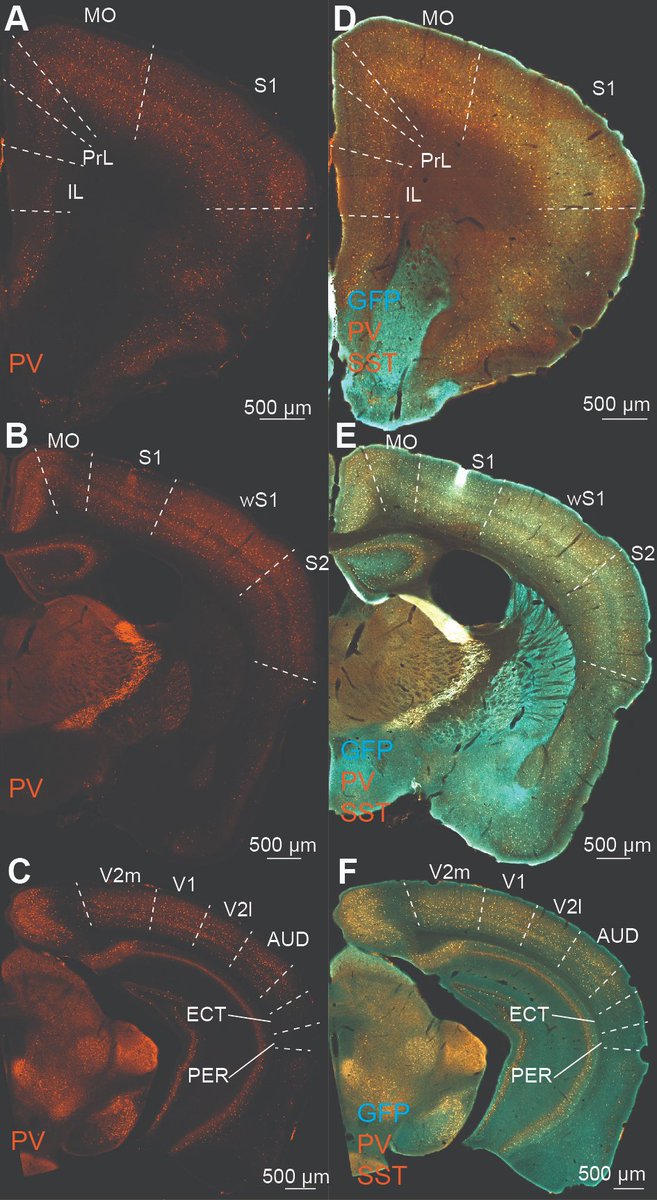
Association cortices were shown to stain poorly for PV in many species, and neuroanatomists have used this to delineate these areas. Only recently this has been investigated in the context of inhibitory cell types:
https://t.co/x6gGwADzqT
https://t.co/btgQOSVUB2
Just out! Thanks to @jhtsong, Ryan Doan, @OldManTae and to the @AllenFrontiers Center for Human Brain Evolution! Remarkable that HARs carry as much or more recessive genetic risk for ASD as more highly conserved regulatory elements! @HHMINEWS @BCHNeuroRes@harvardmed
Excited to publish a broad set of enhancers to target interneuron types in the brain, along with a broad set of collaborators. This is part of the BI armamentarium, which together will help revolutionize the targeting and understanding of brain circuits.
https://t.co/NWI7xHreB8
Our exploration of the mechanism regulating the terminal differentiation of PV interneurons in the mouse cortex. Exciting new work from Monika Moissidis and colleagues @dev_neuro@MRC_CNDD
Our work about contrasting patterns of somatic mutation accumulation between oligodendrocytes and neurons in the aging human brain, is now online in @CellCellPress! Huge thanks to @sarabiz86 @JoeLuquette@peter_j_park@ChrisAWalsh1. See tweetorial (1/10). https://t.co/KD7qcoTnJY
A review article with @studerl on "Epigenetic control and manipulation of neuronal maturation timing" and models of potential interactions between molecular pathways controlling developmental rates.
https://t.co/0Ja8WvXrYR
Excited to share that our paper on an epigenetic barrier setting timing of maturation in human neurons is finally out @Nature! https://t.co/uTfZXiEJki.
How do neurons integrate excitatory and inhibitory inputs in a developing circuitry with remarkable neuronal diversity? If you are interested, do not miss our latest paper preprint in BioRxiv by my exceptional postdoc Tim Kroon in @Rico Lab, #synapses, #interneurons, #cortex.
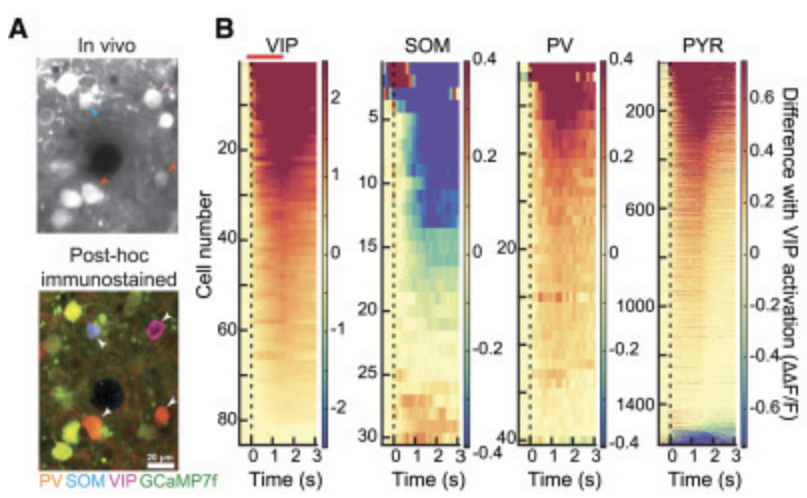
Please check out our study on VIP interneurons & attention, now published in @NeuroCellPress.
Particularly proud that this first paper from the lab is essentially a negative result!
https://t.co/hKahyBIkrn
Led by the amazing @DMyersJoseph with @k47h4 @marianf_otero & @ClopathLab
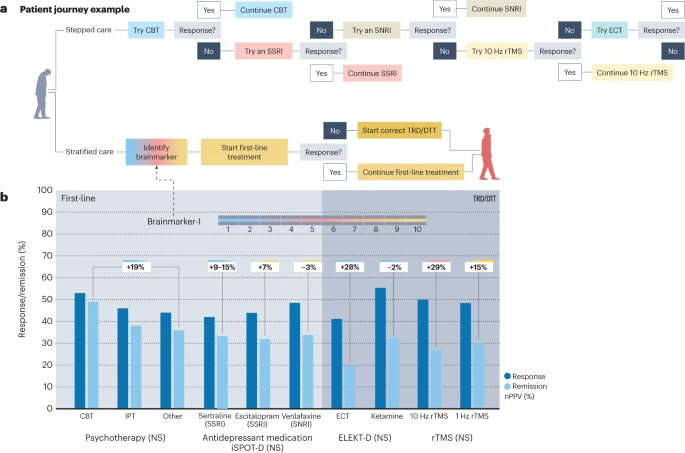
Our biggest EEG biomarker study to date just got published in @NatMentHealth
Alpha peak frequency-based Brainmarker-I as a method to stratify to pharmacotherapy and brain stimulation treatments in depression
Here we show that Brainmarker-I can help stratify between various antidepressants treatments from psychotherapy, sertraline to TMS protocols, ECT, Ketamine etc. Stratification potential validated for most treatments using blinded out-of-sample validation.
Conclusion: We hereby present a clinically actionable transdiagnostic treatment stratification EEG biomarker that can successfully assign patient subgroups to various ADHD and MDD treatments, and is ready to be implemented in clinical practice.
https://t.co/lpGuJOfiZn
Huge effort by first author @HVoetterl
Thanks to the whole team @Sack_BSClab@DeepPsy1 Sven Stuiver, Renee Rouwhorst, @AmouriePrentice@DiegoPizzagalli@NikitaVinne Jeroen van Waarde, Martin Brunovsky, Iris van Oostrom, Ben Reitsma, Johan Fekkes & @hanvdij
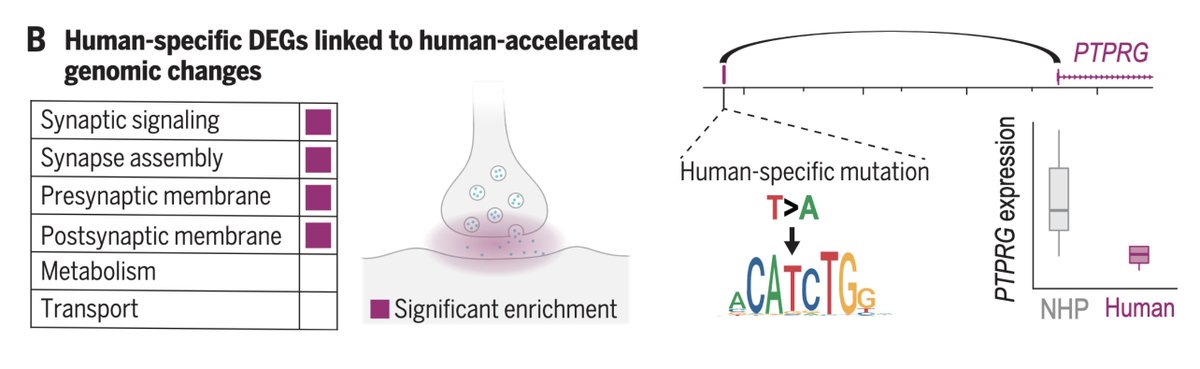
3/4 There are hundreds of human-specific differentially expressed genes (DEGs)! A significant fraction of them is associated with specific synaptic signaling pathways and are found near regions of the genome with human-accelerated mutations and deletions (HARs and hCONDELs).