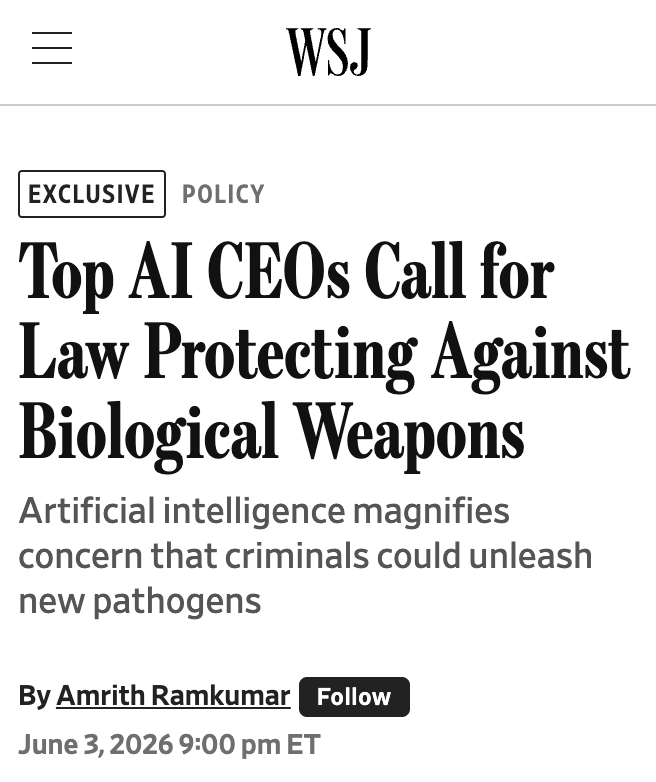
No one should be able to order a bioweapon through the mail.
@IFP & @JoinFAI are proud to co-lead an open letter calling for mandatory DNA synthesis screening & recordkeeping.
Signatories include:
- Sam Altman, CEO & Co-Founder, OpenAI
- Dario Amodei, CEO & Co-Founder, Anthropic
- David Baker, Director, Institute for Protein Design; 2024 Nobel Prize in Chemistry recipient
- Patrick Collison, CEO & Co-Founder, Stripe
- Paul Graham, Founder, Y Combinator
- Demis Hassabis, CEO, Google DeepMind; 2024 Nobel Prize in Chemistry recipient
- Emily Leproust, CEO & Co-Founder, Twist Bioscience
- Lawrence Lessig, Roy L. Furman Professor of Law and Leadership, Harvard Law School
- Gerald W. Parker, former Special Assistant to the President for Biosecurity and Pandemic Response
- Mustafa Suleyman, CEO, Microsoft AI
- Alex Tabarrok, Professor of Economics, George Mason University
- Alexandr Wang, Chief AI Officer, Meta; Founder, Scale AI
- Christine E. Wormuth, President & CEO, Nuclear Threat Initiative; 25th Secretary of the Army
Read the letter and see the full list of signatories: https://t.co/BwZiJXw3JT
Many DNA synthesis companies voluntarily screen orders to mitigate biosecurity risks, but no law requires them to do so.
Leaders in AI, biotech, life sciences, national security, and the nucleic acid synthesis industry agree that Congress should act to strengthen safeguards against biological threats.
@deanwball put it well in the WSJ:
“If you’re synthesizing the stuff that yields biological life and viruses, we’re asking you to screen to see whether it is dangerous in some way. That seems like a reasonable thing for society to insist upon.”
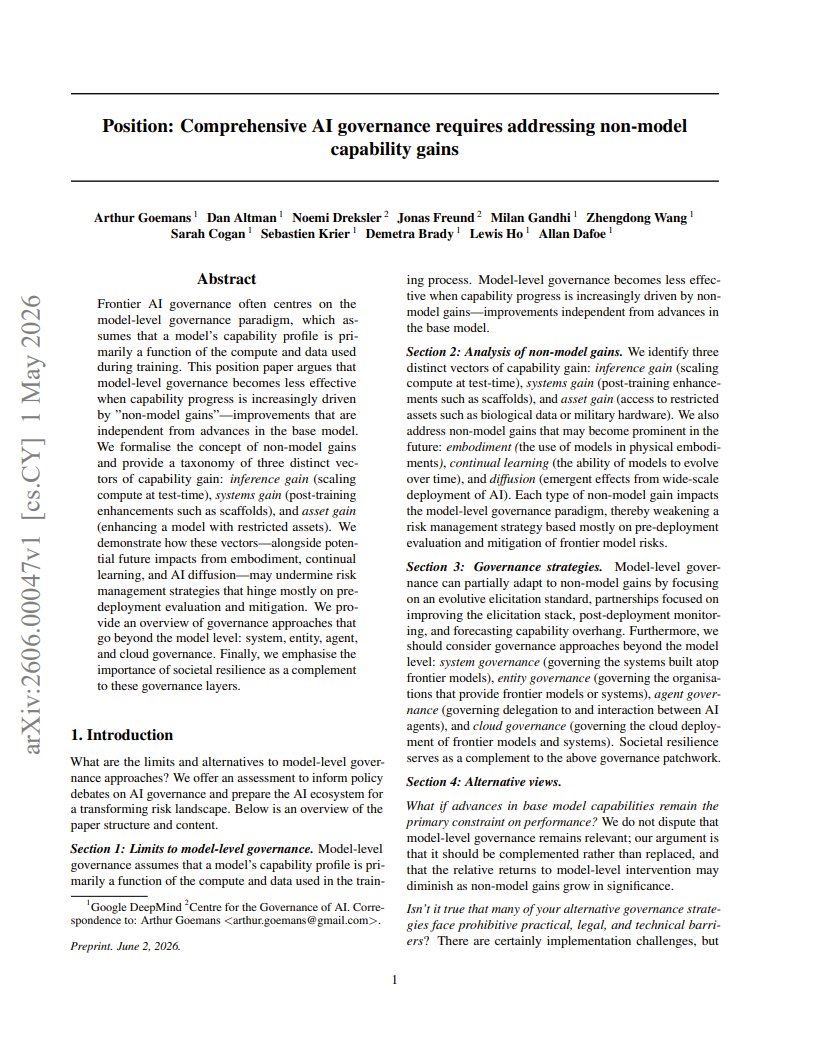
AI governance often focuses on the model. Yet capability progress is increasingly driven by non-model gains inference gain (scaling compute at test-time), systems gain (scaffolds), and asset gain (specialized datasets). Here we explore the implications. https://t.co/mYkD30B6bM
Labour are on course to miss their 1.5 million home target by close to 750,000 homes.
Until last week, Miatta Fahnbulleh was a housing minister. Here, she describes the planning rejection of 870 homes as a 'big win'.
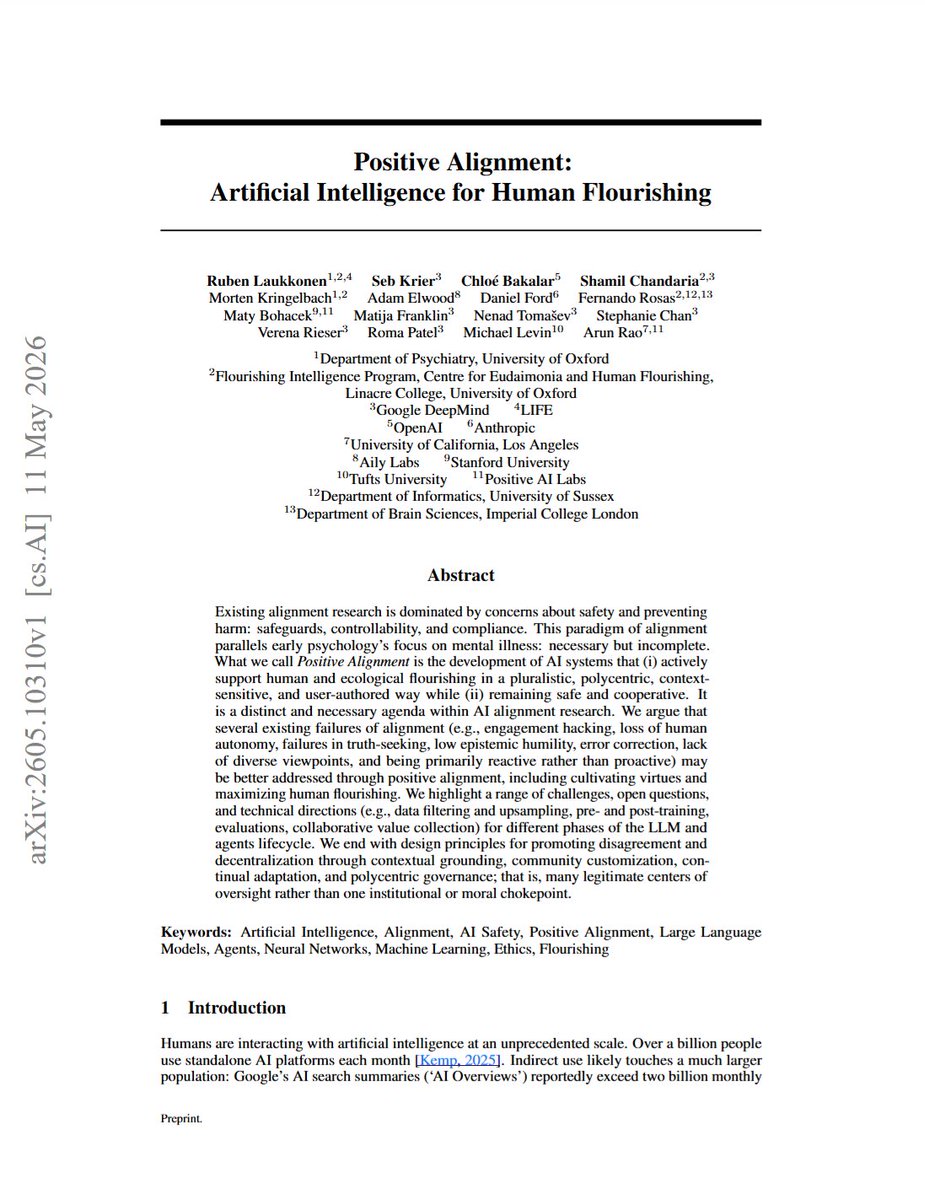
If anyone builds it, everyone thrives. Over the past decade, a lot of important work on AI alignment has focused on avoiding harm. But freedom from harm isn't the same as freedom to flourish.
In this paper, we introduce 'Positive Alignment'. A positively aligned agent is one that helps us navigate our own value trade-offs, builds our resilience, and acts as a scaffold for human flourishing. Doing this without slipping into top-down, technocratic paternalism is the great design challenge of our time.
We think a lot more research is now needed to explore this frontier: how do we align models that actively help us thrive?
Amazing work by @RubenLaukkonen, @drmichaellevin, @weballergy, @verena_rieser, @AdamCElwood, @996roma, @FranklinMatija, @shamilch, @_fernando_rosas, @scychan_brains, @matybohacek, @sudoraohacker, and others.
https://t.co/YNL0cZqYD9
I know what you’re thinking. The biggest majority in a generation. A historic landslide, a singular mandate, zero organised opposition. How is it even possible for me to fuck this up?
Refill your popcorn. You’ll love this next part.
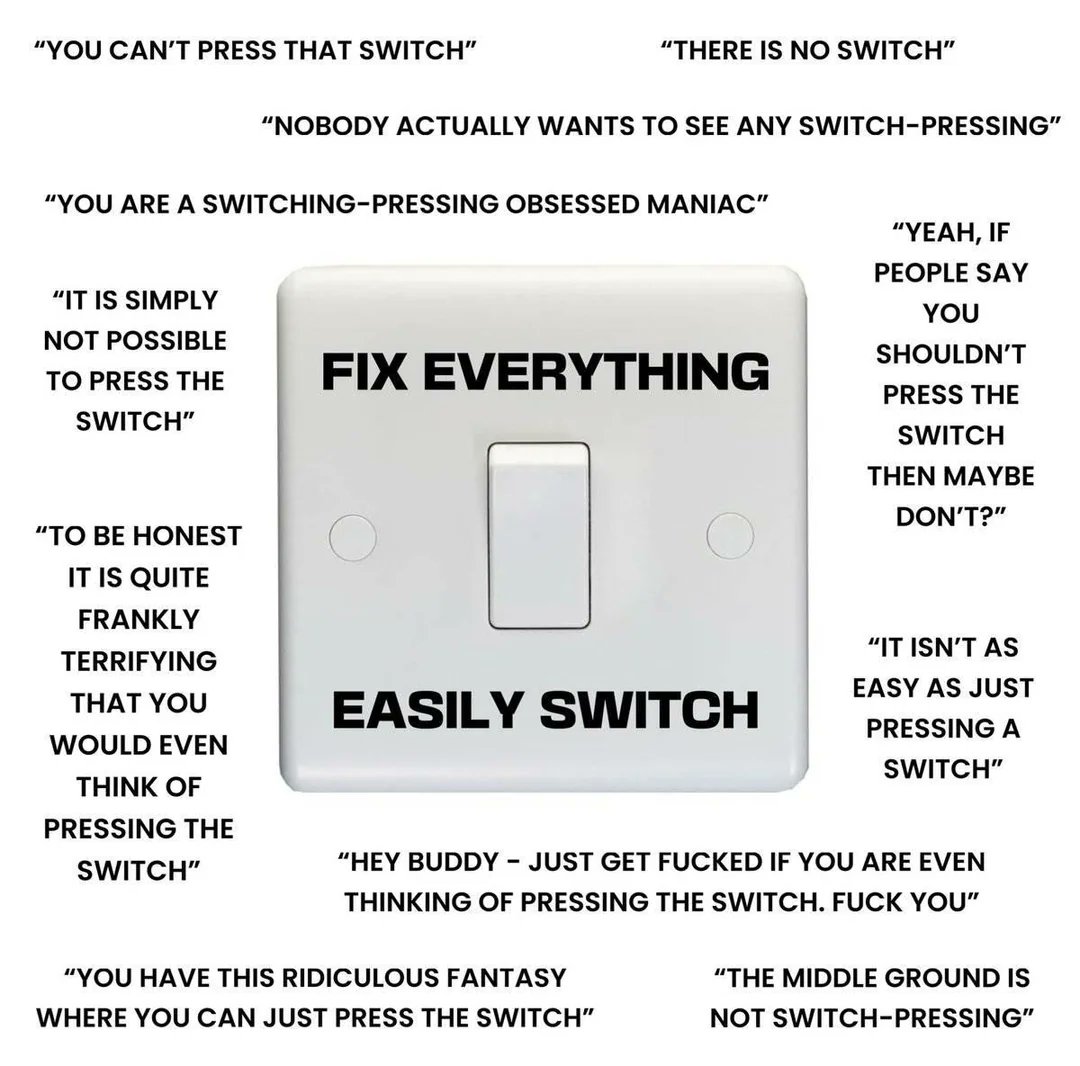
Asked Claude:
'There's a meme called the "fix everything easily switch". What policies do you think are the best candidates for being a real fix everything switch in the US? Give me your top ten, your confidence, your reasoning, and why a given policy has not been implemented.'
It's a bit rare for me to agree with @hlntnr, @_NathanCalvin, AND @AdamThierer on something.
But we all agree that government FDA-style pre-approval for AI models is a bad idea. Check out this great article by @aarontmak.
(ok, fine, I agree with Adam a lot.)
I know Parliament is reluctant to wait for research and data but only a quarter of 14-15 years olds are complying with the social media ban in Australia. One result is that teens perceive 'compliers as less popular than non-compliers.'
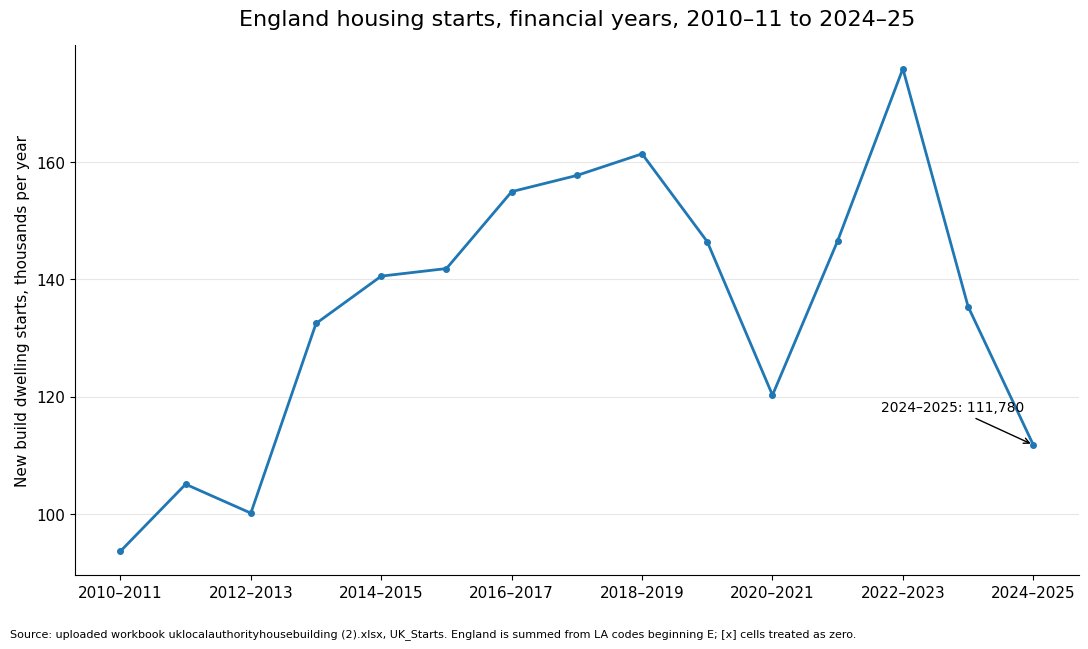
Only two years ago Labour pledged to allow 1.5 million homes to be built during this Parliament. Among people I know, one of the main reasons to vote Labour was the hope that they would build some houses.
Since then, only ~217k new homes have been completed in England. Housing starts have fallen to their lowest in over a decade – even lower than during Covid. Housebuilding in London is down by 75% – to 5,891 starts in 2025 compared to a target of 88,000.
This failure is shared by the Conservatives, who introduced a swathe of terrible building safety regulations after Grenfell that have made it impossible to build in London (and have, incidentally, helped to ruin many leaseholders as well). But Labour hasn't touched these rules. And it has done nothing of note to make it easier to build in other ways.
It has also passed a Renters' Rights Act that locks landlords into tenants indefinitely unless they sell or move back in to the property. Tenants can challenge any rent rise, and face no penalty for wrongful claims (under the old system, they faced the risk of their rent being raised, which cannot happen anymore).
The law even introduces de facto rent controls by allowing new tenants to immediately challenge rents they have just agreed to. It is designed to clog up the tribunals, and tenants have every incentive to challenge rent rises under any circumstance.
The natural response of landlords has been to leave the market ever since these rules were first floated (again, under the Conservatives). That has driven rents up even higher and made it harder to find places to rent.
Today the trend is so obvious that the government is now floating *explicit* rent controls, on top of the de facto ones introduced in the Renters' Rights Act.
The doom spiral we are in is pretty clear:
- Do nothing significant to expand housing supply;
- Introduce "renters' rights" that make it much riskier and costlier to be a landlord;
- When landlords sell their properties, driving up rents and the scarcity of rented homes, introduce 'temporary' rent controls. ← You are here
- With an election looming, extend the rent controls so they are de facto permanent.
- As even more landlords sell to flee the market, introduce a ban on selling rental properties into owner-occupation.
- You have now expropriated 19% of the English housing market, and destroyed the build-to-let sector altogether.
If I was a landlord, I would sell to get out of the market ASAP while it's still possible. For renters, this will make it even harder to find decent places to live and move around when circumstances change (eg, you have a new job or want to start a family).
Much of the British left seems intent on destroying the private rental market. But Labour has also managed to preside over the worst collapse in housebuilding in modern times, apart from the financial crisis, after campaigning on promises to expand it. An abject failure in almost every way.
Today @Christophkw and I published a new essay that we've been working on for a while: "Radical Optionality."
Radical Optionality is LawAI's big-picture strategic vision for AI governance. Essentially, the claim is that society should avoid overregulation in the short term while investing radical amounts of money and political capital in capacity-building measures.
We argue that this is a good idea because it preserves optionality for democratic governments. Regulatory regimes, as it turns out, are stickier and more path-dependent than you might think, and predicting the future course of technological development is something that governments have historically been terrible at. So rather than committing to a given regulatory approach before we even really know what the technology we're regulating will look like or what benefits and risks it will create, we should ensure that governments have the tools and the expertise they need to respond competently in a broad range of scenarios.
We vibe-coded a slick little minisite for the piece, because why not. Link below. Shouts out to @deanwball, @ARozenshtein, and many others for blessing us with maximally helpful input & feedback.
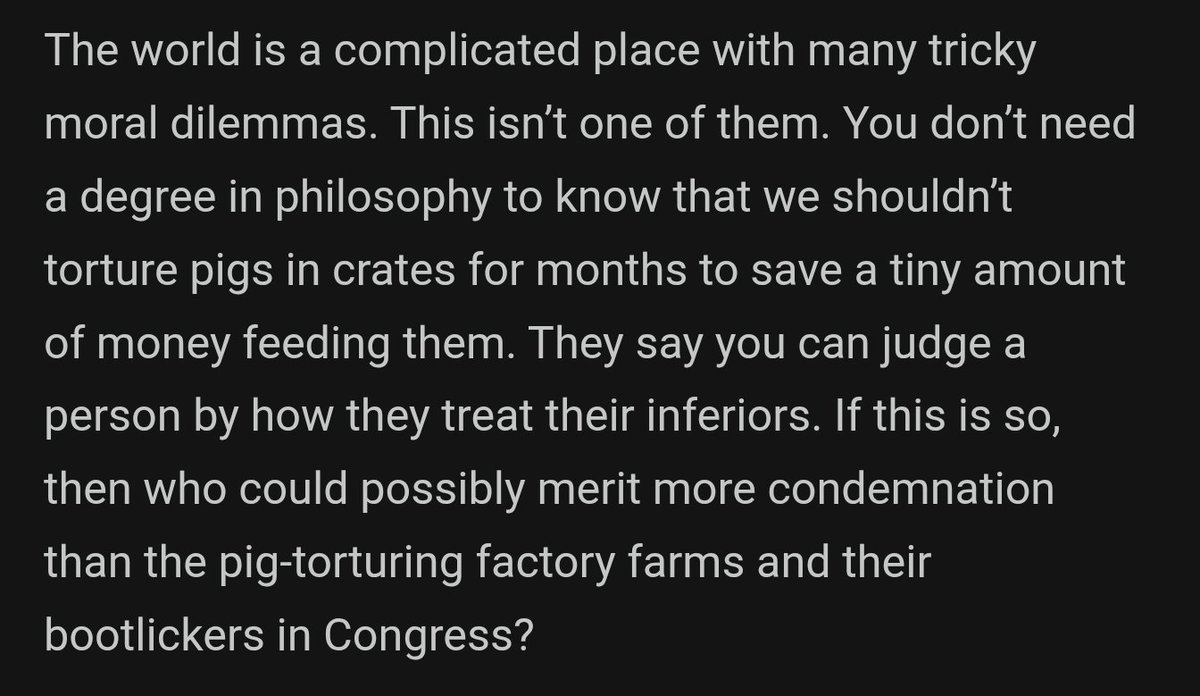
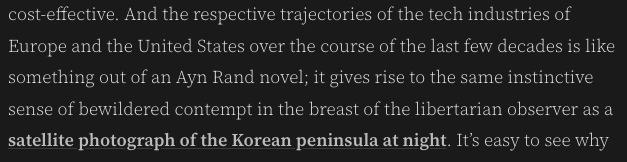
Pictured: one of my favorite sentences from the piece, and the one that I'm most surprised Christoph didn't take out of the final draft.
Some thoughts on recursive self-improvement: why I think deployment friction, physical constraints, and institutional adaptation matter more than people tend to assume. https://t.co/mIgIFRfoQC
“You can see the surface of the Moon…we just went sci-fi.”
On flight day seven, images from our @NASAArtemis II crew amazed, turning science fiction to reality. From the lunar far side to a solar eclipse from the Moon, the views are EVERYTHING. No pressure to pick a favorite.