You sent me on a Wikipedia rabbit hole learning more about this! Glad the toy could help inspire this tweet. As you mentioned in one of your other replies muscles operate on a completely different paradigm on both the control and mechanics side. There are people thinking about the control side and people thinking about the mechanics side. I suspect the ultimate unlock for solving this problem will have to come from those two groups of people putting their heads together and getting a deep understanding of the problem, both in the approaches humans have come up with, and the ways that nature solves this problem.
@ebarenholtz 100% agree. One of my favorite terms that you taught me is “substantive disagreement”. Getting rid of these kinds of “gotchas” on both sides will only do the debate as a whole a world of good.
Zero shot sim2real transfer with a policy that can run at 100Hz on an ESP32 and took less than a day to train. Cooking up some cool stuff here at Lumen Labs in SF. If you want to join send me a link to a time you got a policy running effectively on a robot in the real world.
@theresidency Super pumped about this! Reminds me of Toyota open-sourcing their process. It ended up revolutionized the entire manufacturing industry even outside of automotive. Hoping this can do the same for residencies!
Really enjoyed writing this article with the Wolfram Institute. Lots of research done in the past four months and more articles like this soon to come!
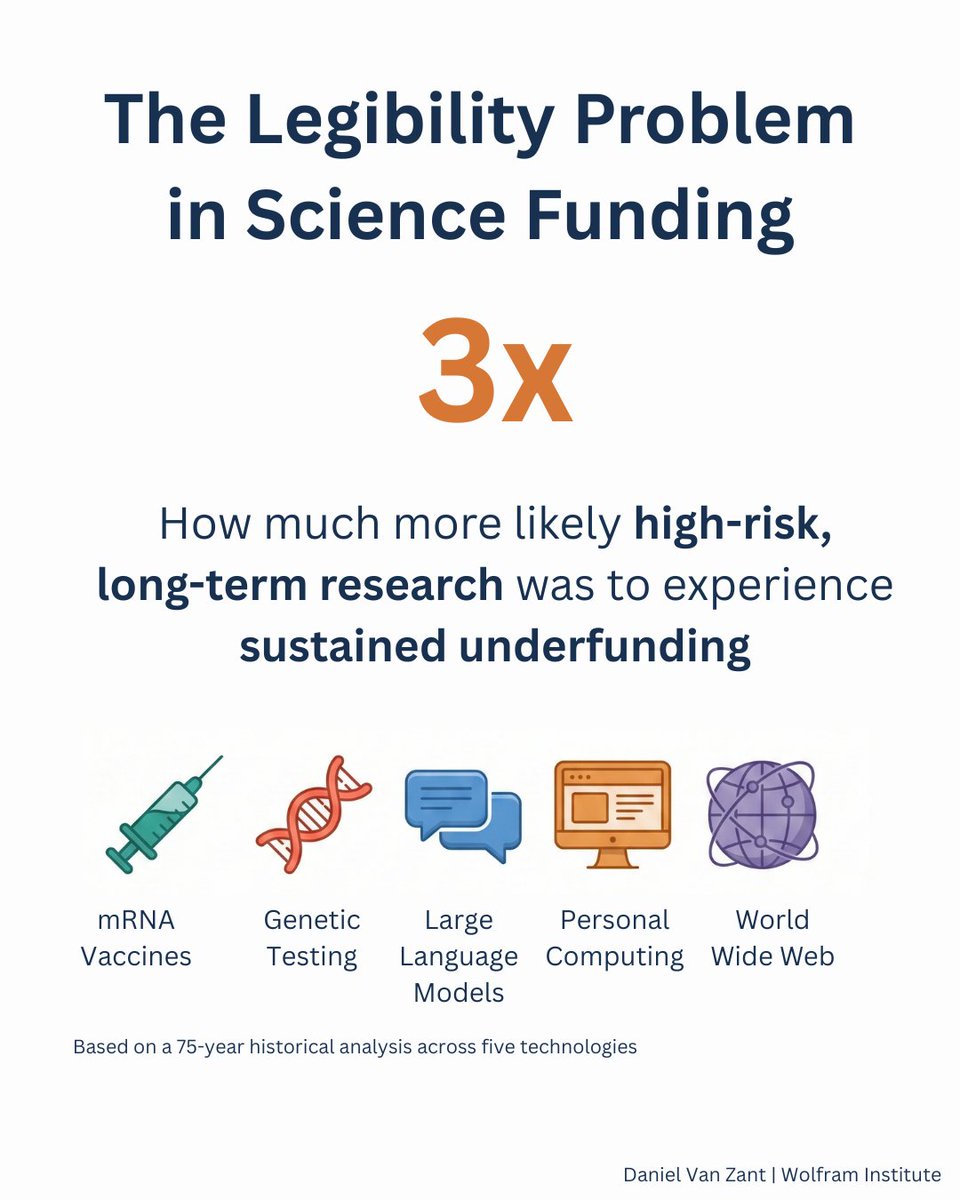
mRNA vaccine research began in the 1980s. The scientist who made the key breakthrough couldn't get grants for over a decade. She was demoted four times before winning a Nobel Prize. This pattern isn't unique. It showed up across five transformative technologies over 75 years.
This is cool. If I'm understanding correctly, it's almost like there are three autoregressive loops. Their is one that might be what we could call the "conscious core" which continually takes in the current "self-state" + personal outputs + environmental input and outputs the next self-state (or maybe jsut appends some tokens on to the end of the internal ticker tape). There is the conventional "active inference loop" that continually takes in the self-state + environmental inputs and creates personal outputs. Finally, the environment itself would be the third autoregressive wheel that continually takes in personal outputs and produces environmental inputs. If I'm understanding what you're saying, as long as their is some predictability and continuity in all three of these then you can have a minimally conscious system.
SF just got augmented ⚡️
Augmentation Lab is now live in SF.
shoutout @rhobusiness for fueling our first Founder Dinner.
the next wave of human–AI tools is being built here.
join us 👇 Discord
Excited about this research proposal with @WolframInst . Will be exploring decentralized science as a way to fix some issues in science funding. Some generous donations so far (especially a recent and large one from @BioProtocol). Hoping to close the gap in the next few days.
Basic science creates the biggest breakthroughs.
Yet it’s the most underfunded type of research.
Researchers from the @WolframInst seek funding to explore how DeSci DAOs can realign incentives for better funding and avoid the traps of traditional models. 🧵
1/8
Have been working hard on this crowdfunded proposal to research a "New Kind of Science Organization" in collaboration with James at the Wolfram Institute. If you are interested even an upvote on the post or a positive comment can help this get funded. #DeSci#DAOs
When I find an interesting article/paper/etc I don't read it right away, I save it in a folder on my computer. Once I have enough, I run a small script to get it printed as a glossy magazine with an AI-designed cover (here's the latest) and read through everything at my leisure.
@jposhaughnessy @osventuresllc @TOEwithCurt I am seconding that emotion from @auglab. Would love to meet you in person at the event if you're able. Will have some exciting stuff I am showing off which has been funded by the OSV grant.
🤖 What if #AI could accelerate the way science builds its theories?
At the @WolframInst, @Daniel_Van_Zant (PhD Student & Center Fellow) presented a system designed to speed theory-building in neuroscience, and maybe reshape research itself.
👉Watch now: https://t.co/8jWUSgWt6O