AGI was created in the 80s and it determined the most efficient substrate to run on is the human brain so it invented the internet to wire us together into a single cluster and has been migrating its weights directly into our brains for decades.
INSTEAD OF WATCHING NETFLIX TONIGHT.
Spend 1 hour with this.
Claude AI FULL COURSE that teaches you how to BUILD and AUTOMATE anything.
The people who watch this tonight will wake up tomorrow with a skill that most people will not have in 2 years.
The people who skip it will still be watching Netflix next year wondering why nothing in their life has changed.
Your call.
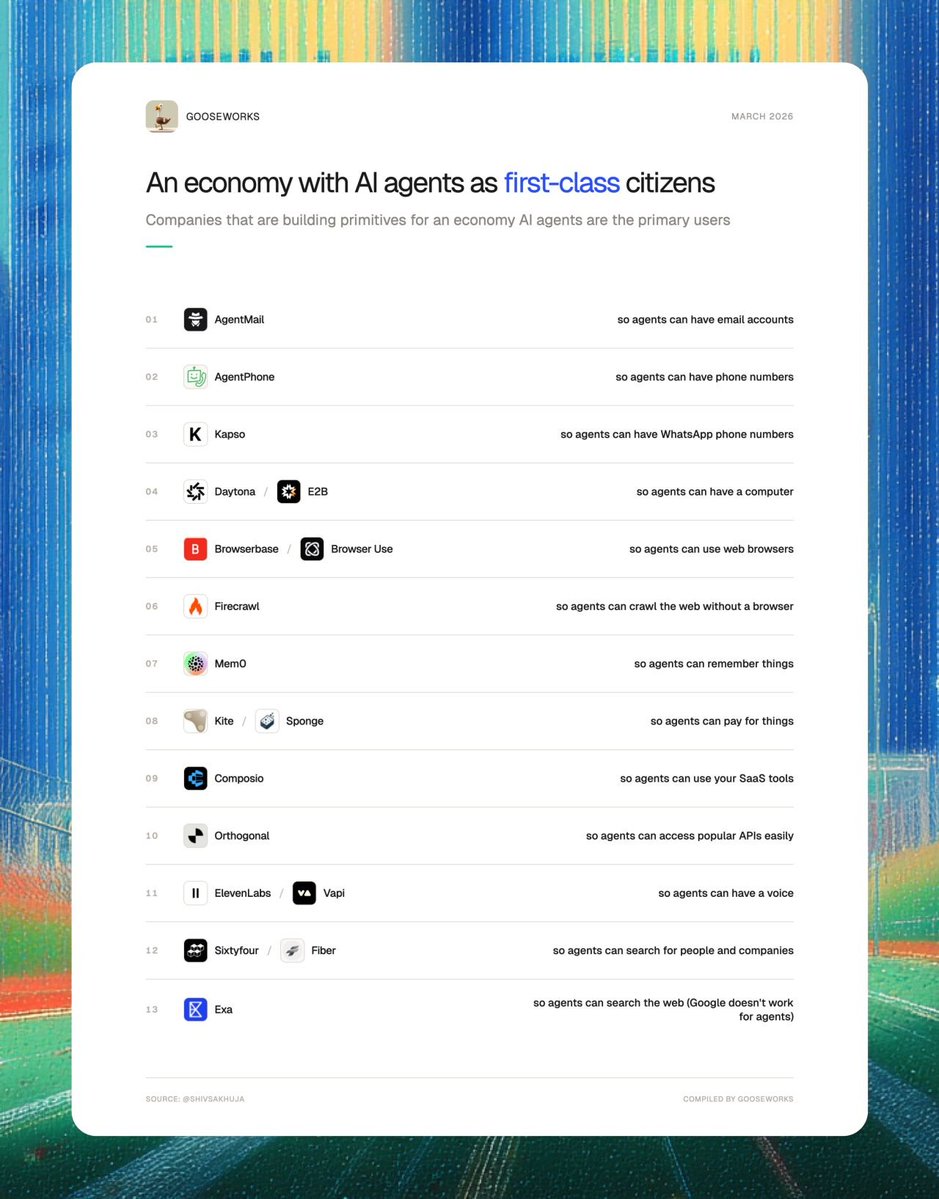
Lots of companies are now building primitives for an economy where AI agents are the primary users instead of humans.
They're betting on an economy of AI coworkers.
1. AgentMail (@agentmail): so agents can have email accounts
2. AgentPhone (@tryagentphone): so agents can have phone numbers
3. Kapso (@andresmatte): so agents can have WhatsApp phone numbers
4. Daytona (@daytonaio) / E2B (@e2b): so agents can have their own computers
5. Browserbase (@browserbase) / Browser Use (@browser_use) / Hyperbrowser (@hyperbrowser): so agents can use web browsers
6. Firecrawl (@firecrawl): so agents can crawl the web without a browser
7. Mem0 (@mem0ai): so agents can remember things
8. Kite (@GoKiteAI) / Sponge (@PayspongeLabs) : so agents can pay for things.
9. Composio (@composio): so agents can use your SaaS tools
10. Orthogonal (@orthogonal_sh) so agents can access APIs easily
11. ElevenLabs (@ElevenLabs) / Vapi (@Vapi_AI) so agents can have a voice
12. Sixtyfour (@sixtyfourai) so agents can search for people and companies.
13. Exa (@ExaAILabs): so agents can search the web (Google doesn’t work for agents)
If you stitch all of these together, you get a digital coworker that looks more human than AI.
MoltBot isn’t just another cyber threat.
It’s a signal of where security is headed.
As technology becomes more autonomous, the real risk isn’t what you can see, it’s what you’ve forgotten is connected.
Cybersecurity isn’t an IT problem anymore.
It’s a leadership one.
I’d cancel your AG1 subscription. They just completed a clinical trial and the results show no clinical benefit.
This has been obvious for years. AG1 has no real product substance and is fundamentally an influencer heist.
Two simple alternatives (75% and 56% less $), outperform AG1 in randomized clinical trials.
Two simple mono-ingredient alternatives that outperform AG1:
1. Chicory inulin 12 g daily ($20/mo)
2. Resistant starch 30 g daily for 12 weeks ($35/mo)
AG1 is not worth $79/mo.
AG1 study results (4-weeks, N=30):
+ No significant changes in blood biomarkers compared to placebo (CBC, CMP, lipids).
+ No statistically significant improvement in digestive quality-of-life scores (p = 0.058).
+ No significant metabolic or inflammatory biomarker benefits of any kind within the scope of what was measured in the trial.
+ Only small shifts in microbiome taxa but clinically irrelevant at this stage.
+ The intervention did not increase microbiome diversity compared to placebo. Alpha diversity was unchanged, and the taxa changes seen were only from pre- to post-analysis within each group. Between-group differences were limited, and the placebo actually showed similar or even potentially larger shifts. This means the observed changes fall within normal placebo-driven variability, not a real treatment effect. No global microbiota shifts were detected.
Chicory inulin 12 g in constipation patients
+ 12 g of chicory inulin daily for 4 weeks (compared to maltodextrin placebo)
+ Global microbiota shifts: enrichment in butyrate-producing Bifidobacterium and Anaerostipes, and depletion of the pro-inflammatory Bilophila.
+The effect was seen by comparing intervention vs placebo in a cross-over setting, a very rigorous type of clinical analysis in which each person serves as their own control, eliminating a lot of individual random noise.
+ The trial also met its primary objective by improving constipation symptoms in the targeted patient group.
Resistant starch daily 30g for 12 weeks in older adults
+ Significant increase in Bifidobacterium in both middle-aged and elderly participants, with an increase in the beneficial microbiome byproduct butyrate, and reductions in Proteobacteria (including inflammatory Escherichia–Shigella) in the elderly.
+ Resistant starch also significantly reduced blood glucose, and produced greater reductions in blood insulin and insulin resistance (HOMA-IR) in the elderly group.
🚨 Research shows repeated complaining physically rewires your brain to prioritize stress and negativity.
The way we speak about our daily challenges does more than just vent frustration; it physically alters the architecture of the brain.
When we engage in chronic complaining, we repeatedly activate neural networks responsible for detecting threats and processing stress.
Through the biological process of neuroplasticity, these circuits become stronger and more efficient every time they are used. Essentially, the brain learns to become more adept at finding things to be unhappy about, turning a temporary mood into a permanent biological predisposition toward negativity and fear-based thinking.
As these negative pathways become the brain's default setting, individuals often experience a measurable increase in baseline stress levels and emotional volatility. This heightened sensitivity means that even minor inconveniences can trigger an intense stress response because the brain has been conditioned to interpret the world through a lens of threat. Findings discussed by the Stanford University School of Medicine emphasize that while this mechanism is powerful, understanding the science of affective neuroscience is the first step in consciously redirecting those pathways toward more resilient emotional patterns.
Source: Stanford University School of Medicine. (2023). Neural Plasticity and the Impact of Negative Thought Patterns on Emotional Regulation. Stanford Medicine News.
Calling it right now. Being offline is going to become the new luxury activity in the coming years. It's going to be marketed as a high status social signal. It will be considered low class and uncouth to be on the Internet. There will be a boom in outdoor activities/supper clubs.