🚨 0XB434: 4,036 BTC 5-MIN TRADES IN 3 WEEKS - $94K PROFIT BY BUYING THE CHEAP SIDE
Joined April 2026. 8.3K views.
All‑time profit: $94,577
He doesn’t buy at 99¢ like most grinders. He buys the deep OTM side at 20-50¢ and waits for the 5‑minute candle to swing his way.
🧠 HIS STRATEGY
> Buy “Down” at 44.9¢ → risk $0.449 to win $0.551 (122% return if correct)
> Buy “Up” at 38.9¢ → risk $0.389 to win $0.611 (157% return)
> Buy “Up” at 21¢ → risk $0.21 to win $0.79 (376% return - his biggest win)
He sizes up when the price is very low. One winning trade can cover 10 losing ones.
Recent winning examples:
> April 24 - Down @ 44.9¢ → 2,158 shares → +$1,190 (+122%)
> April 24 - Up @ 40.8¢ → 1,296 shares → +$125 (+23%)
> April 8 - Up @ 21¢ → 5,407 shares → +$4,271 (+375%) - his biggest single win
He spreads tiny orders across dozens of windows.
He’s won 4,036 trades and lost only a fraction. A 55‑60% win rate with +100% average win vs -50% average loss (because he buys at 30‑50¢) yields a strong positive EV.
This is not a 99¢ grinder. This is a low-probability, high-reward scalper who lets variance work in his favor.
The KelpDAO exploit (~$290M, is NOT a LayerZero protocol bug. It's a configuration issue and a case study every project with a cross-chain token needs to look at today.
KelpDAO shipped their rsETH OFT with a 1/1 DVN security stack. One required verifier. Zero optional. Threshold 0. Straight from LayerZero Scan's ReceiverOAppConfig on the rsETH bridge pathway:
• requiredDVNCount: 1
• requiredDVNNames: [LayerZero Labs]
• optionalDVNCount: 0
• optionalDVNThreshold: 0
Source and Destination OApp both labeled "Kelp DAO." Destination is the rsETH OFT Adapter on Ethereum: 0x85d456B2DfF1fd8245387C0BfB64Dfb700e98Ef3.
How the attack worked: the forged message's source packet was never actually emitted on the source chain (Unichain). The single required DVN signed an attestation for something that didn't exist and because it was the ONLY required DVN, there was no independent verifier to contradict it. Everything downstream then executed exactly as designed: commitVerification → lzReceive → peer check → OFT decode → rsETH mint. The contracts weren't broken. The verification layer was. One signature and 116,500 rsETH materialized out of thin air on Ethereum.
To be clear: LayerZero V2 is modular by design. Apps pick their own security stack X-of-Y-of-N, multiple independent DVNs, thresholds, block confirmations. No one is forced into any configuration. The protocol gave projects the full toolkit. KelpDAO chose 1/1.
Even reputable DVNs can have a bad day key compromise, infra failure, bad actor, whatever. That's exactly why you want multiple independent verifiers. Redundancy is the whole point. A 1/1 DVN is the cross-chain equivalent of a 1-of-1 multisig on a treasury.
Baseline for any OFT/OApp with serious TVL:
• Multiple required DVNs (3–4+)
• Independent providers (don't stack correlated risk) use canary DVN as it’s also its own independent client.
• Optional DVNs + threshold on top
• Sane block confirmations
If you're a founder or dev with an OFT live in production, pull your Send/Receive ULN config today. Call getConfig() on the endpoint. If requiredDVNCount is 1 and optionalDVNCount is 0, reconfigure before the market does it for you.
Anyone can verify any OApp's config on https://t.co/ovbUskeFCC right now.
Security is the application's responsibility. LayerZero hands every project a powerful, modular security stack it's on the project to actually use it. Kelp's full RCA is still coming, but the root enabler is already onchain and visible to anyone who looks.
Check your configs. Stay safe out there.
How to Train a Trading Bot on Real Indicators to $1000/day print
Most losing bots blow up not from bad entries, but from trading when they shouldn't
The formula:
> RSI (context) + MACD (momentum) + Stochastic (timing) + EMA (structure) + OBV (confirmation) + VWAP (value) + Volatility (filter) = a bot that stops guessing and executes a framework
7 Indicators That Actually Work
Also the fastest way to copy-trade anyone: https://t.co/dj5w7uWR8T
1. RSI - crowd emotion filter
- RSI > 70 → market overheated → look for NO
- RSI < 30 → market exhausted → look for YES
2. MACD - movement confirmation
- Line crosses up → momentum building, crosses down → fading
- Doesn't find the bottom — finds continuation, which is where money is made on short-term contracts
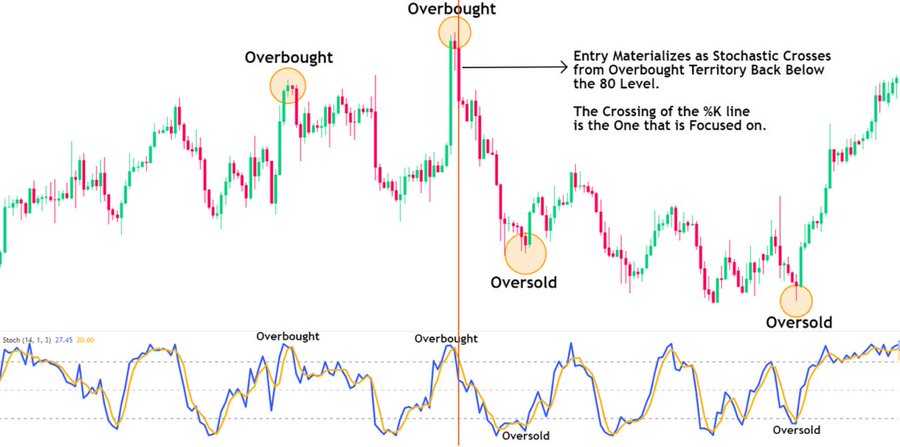
3. Stochastic - precision entry timing
- Faster than RSI, reacts almost instantly
- > 80 = overheated, < 20 = oversold, %K crossing %D = entry trigger
4. EMA - price structure
- Fast EMA (9) + slow EMA (21/50)
- Price chopping around EMAs → stay out, price clearly trending → engage
5. OBV - real money flow
- Price ↑ + OBV ↑ = strong trend
- Price ↑ + OBV flat/↓ = weak move = trap
6. VWAP - fair market price
- Price above VWAP = bullish bias, below = bearish bias
- Key edge: deviation from VWAP → often reverts = high-probability entry setup
7. Volatility Filter - when NOT to trade
- Uses ATR (Average True Range)
- Rule: only trade within the optimal volatility range
YOUR POLYMARKET WEBSOCKET SUCKS
HERE’S HOW TO MAKE IT GOD-TIER
All bots need websockets. Websockets are the data streams from polymarket, and external API's that give us the info we need to trade.
99.99% of people (yeah, thats you) hook them up and trade. The real issues is ws are dirty, and imperfect. They miss ticks, they give stale data, they do brief disconnects etc.
This means your strategy isnt executed as you designed. You get filled worse, your hedge sucks, your entry point is missed. A perfected WS connection vs raw from polymarket can increase your bots profitability MASSIVELY.
This applies to EVERY ws you use. CLOB, Gamma, binance, ESPN, you name it.
Here is how you make them 1000x better
Layer 1.
WS warmup. Before you trade on it, you must warm it up. The first 3-5s of a ws connection is messy full of stale bids. You should start every ws connection 15s before the window opens (on up and down tokens)
Add logic that monitors tic quality for the last 5s before the window opens. You must have >=3 tics per token up/down and no single jump in >5c.
If it does have less than 3 tics or jumps more than 5, you skip that window. Your connection sucks.
Layer 2.
VOLUME. You need to dynamically spawn multiple websockets. You monitor performance and back off if it becomes unstable, but otherwise you spawn as many as your computer can handle.. For me that is 100-300 per websocket.
You have logic that creates losers. Every 4 seconds respawn the slowest 10%
Your bot takes the first tic with dedupe. So whichever 300 gives the next tic first, you use, tic by tic.
Layer 3.
Stale tic guard. Every tick is compared against the warmup monitors last knon price.
If the delta > 15c > reject it with the log (STALE TIC REJECTED)
Layer 4.
First tic skip. Every new ws connection drops its first tick (the stale order-books snapshot from PolyMarket's (or whoever's ws it is) cache.
Layer 5.
Timing offset. Do not start all 100-300 ws at once. You have logic that divides up your stable ws equally over 1 second. So if I have 100 stable, we will start up each ws in a 10ms stagger. That gives them the best chance to get different tics.
Layer 6.
Anti-jitter Reaper. Use Jitter EMA to track per connection timing variance - erratic connections get culled first. Add an 8s grace period before new ws can be culled. Have an action budget, of a max of 20 respawns/min, max 2 per cycle. Only culled replicas lose their tracking data.
I know this is a lot of text but unless every websocket, on every bot is doing this. Other traders will rip you apart.
#polymarket
#Bitcoin - Did the Most Accurate Indicator Fail This Cycle?
The PI Cycle Top has been one of the most accurate indicators for predicting the Bitcoin cycle ATH.
In previous cycles, it marked the top almost perfectly.
But this time… it failed to do so.
The indicator prints a peak signal when the 111 DMA crosses above the 350 DMA ×2.
Historically, this crossover happens during rapid expansion phase, when Bitcoin goes parabolic and price starts trading well above the 350 DMA ×2.
Once the 111 DMA crosses above the 350 DMA ×2, it has consistently marked the cycle top and the beginning of the bear market.
However, in this cycle:
Price touched the 350 DMA x2 but never broke above it (green line).
The crossover never happend and the indicator never confirmed a proper peak signal.
Instead, Bitcoin broke below the long-term trendline support, catching many off guard.
For the first time, the “most accurate cycle peak” indicator didn’t behave the way it historically has.
Ethereum supply stayed net negative over the last 7 days.
🔹 New ETH issued: 30,000
🔹 ETH bought by spot ETFs: 67,100
🔹 ETH burned via fees: 11,700
🔹 Net supply change: −49,800 ETH
About 2.7x more ETH was removed from circulation than issued.
Demand continues to structurally overpower issuance.
So why is price not moving yet?
🔹 Most demand is passive, not price chasing. Absorption first, breakout later.
🔹 Large holders still distribute into rallies, capping short term moves.
🔹 Derivatives set the marginal price, not spot flows.
🔹 Negative supply tightens the floor before it lifts the ceiling.
This is how bases form. Supply breaks first. Price follows.


![Crypto_Goblinz's tweet photo. The KelpDAO exploit (~$290M, is NOT a LayerZero protocol bug. It's a configuration issue and a case study every project with a cross-chain token needs to look at today.
KelpDAO shipped their rsETH OFT with a 1/1 DVN security stack. One required verifier. Zero optional. Threshold 0. Straight from LayerZero Scan's ReceiverOAppConfig on the rsETH bridge pathway:
• requiredDVNCount: 1
• requiredDVNNames: [LayerZero Labs]
• optionalDVNCount: 0
• optionalDVNThreshold: 0
Source and Destination OApp both labeled "Kelp DAO." Destination is the rsETH OFT Adapter on Ethereum: 0x85d456B2DfF1fd8245387C0BfB64Dfb700e98Ef3.
How the attack worked: the forged message's source packet was never actually emitted on the source chain (Unichain). The single required DVN signed an attestation for something that didn't exist and because it was the ONLY required DVN, there was no independent verifier to contradict it. Everything downstream then executed exactly as designed: commitVerification → lzReceive → peer check → OFT decode → rsETH mint. The contracts weren't broken. The verification layer was. One signature and 116,500 rsETH materialized out of thin air on Ethereum.
To be clear: LayerZero V2 is modular by design. Apps pick their own security stack X-of-Y-of-N, multiple independent DVNs, thresholds, block confirmations. No one is forced into any configuration. The protocol gave projects the full toolkit. KelpDAO chose 1/1.
Even reputable DVNs can have a bad day key compromise, infra failure, bad actor, whatever. That's exactly why you want multiple independent verifiers. Redundancy is the whole point. A 1/1 DVN is the cross-chain equivalent of a 1-of-1 multisig on a treasury.
Baseline for any OFT/OApp with serious TVL:
• Multiple required DVNs (3–4+)
• Independent providers (don't stack correlated risk) use canary DVN as it’s also its own independent client.
• Optional DVNs + threshold on top
• Sane block confirmations
If you're a founder or dev with an OFT live in production, pull your Send/Receive ULN config today. Call getConfig() on the endpoint. If requiredDVNCount is 1 and optionalDVNCount is 0, reconfigure before the market does it for you.
Anyone can verify any OApp's config on https://t.co/ovbUskeFCC right now.
Security is the application's responsibility. LayerZero hands every project a powerful, modular security stack it's on the project to actually use it. Kelp's full RCA is still coming, but the root enabler is already onchain and visible to anyone who looks.
Check your configs. Stay safe out there.](https://pbs.twimg.com/media/HGOHJnbWUAAvHji.jpg)
![Crypto_Goblinz's tweet photo. The KelpDAO exploit (~$290M, is NOT a LayerZero protocol bug. It's a configuration issue and a case study every project with a cross-chain token needs to look at today.
KelpDAO shipped their rsETH OFT with a 1/1 DVN security stack. One required verifier. Zero optional. Threshold 0. Straight from LayerZero Scan's ReceiverOAppConfig on the rsETH bridge pathway:
• requiredDVNCount: 1
• requiredDVNNames: [LayerZero Labs]
• optionalDVNCount: 0
• optionalDVNThreshold: 0
Source and Destination OApp both labeled "Kelp DAO." Destination is the rsETH OFT Adapter on Ethereum: 0x85d456B2DfF1fd8245387C0BfB64Dfb700e98Ef3.
How the attack worked: the forged message's source packet was never actually emitted on the source chain (Unichain). The single required DVN signed an attestation for something that didn't exist and because it was the ONLY required DVN, there was no independent verifier to contradict it. Everything downstream then executed exactly as designed: commitVerification → lzReceive → peer check → OFT decode → rsETH mint. The contracts weren't broken. The verification layer was. One signature and 116,500 rsETH materialized out of thin air on Ethereum.
To be clear: LayerZero V2 is modular by design. Apps pick their own security stack X-of-Y-of-N, multiple independent DVNs, thresholds, block confirmations. No one is forced into any configuration. The protocol gave projects the full toolkit. KelpDAO chose 1/1.
Even reputable DVNs can have a bad day key compromise, infra failure, bad actor, whatever. That's exactly why you want multiple independent verifiers. Redundancy is the whole point. A 1/1 DVN is the cross-chain equivalent of a 1-of-1 multisig on a treasury.
Baseline for any OFT/OApp with serious TVL:
• Multiple required DVNs (3–4+)
• Independent providers (don't stack correlated risk) use canary DVN as it’s also its own independent client.
• Optional DVNs + threshold on top
• Sane block confirmations
If you're a founder or dev with an OFT live in production, pull your Send/Receive ULN config today. Call getConfig() on the endpoint. If requiredDVNCount is 1 and optionalDVNCount is 0, reconfigure before the market does it for you.
Anyone can verify any OApp's config on https://t.co/ovbUskeFCC right now.
Security is the application's responsibility. LayerZero hands every project a powerful, modular security stack it's on the project to actually use it. Kelp's full RCA is still coming, but the root enabler is already onchain and visible to anyone who looks.
Check your configs. Stay safe out there.](https://pbs.twimg.com/media/HGOHJnVW4AAIAXN.jpg)







![Crypto_Goblinz's tweet photo. The KelpDAO exploit (~$290M, is NOT a LayerZero protocol bug. It's a configuration issue and a case study every project with a cross-chain token needs to look at today.
KelpDAO shipped their rsETH OFT with a 1/1 DVN security stack. One required verifier. Zero optional. Threshold 0. Straight from LayerZero Scan's ReceiverOAppConfig on the rsETH bridge pathway:
• requiredDVNCount: 1
• requiredDVNNames: [LayerZero Labs]
• optionalDVNCount: 0
• optionalDVNThreshold: 0
Source and Destination OApp both labeled "Kelp DAO." Destination is the rsETH OFT Adapter on Ethereum: 0x85d456B2DfF1fd8245387C0BfB64Dfb700e98Ef3.
How the attack worked: the forged message's source packet was never actually emitted on the source chain (Unichain). The single required DVN signed an attestation for something that didn't exist and because it was the ONLY required DVN, there was no independent verifier to contradict it. Everything downstream then executed exactly as designed: commitVerification → lzReceive → peer check → OFT decode → rsETH mint. The contracts weren't broken. The verification layer was. One signature and 116,500 rsETH materialized out of thin air on Ethereum.
To be clear: LayerZero V2 is modular by design. Apps pick their own security stack X-of-Y-of-N, multiple independent DVNs, thresholds, block confirmations. No one is forced into any configuration. The protocol gave projects the full toolkit. KelpDAO chose 1/1.
Even reputable DVNs can have a bad day key compromise, infra failure, bad actor, whatever. That's exactly why you want multiple independent verifiers. Redundancy is the whole point. A 1/1 DVN is the cross-chain equivalent of a 1-of-1 multisig on a treasury.
Baseline for any OFT/OApp with serious TVL:
• Multiple required DVNs (3–4+)
• Independent providers (don't stack correlated risk) use canary DVN as it’s also its own independent client.
• Optional DVNs + threshold on top
• Sane block confirmations
If you're a founder or dev with an OFT live in production, pull your Send/Receive ULN config today. Call getConfig() on the endpoint. If requiredDVNCount is 1 and optionalDVNCount is 0, reconfigure before the market does it for you.
Anyone can verify any OApp's config on https://t.co/ovbUskeFCC right now.
Security is the application's responsibility. LayerZero hands every project a powerful, modular security stack it's on the project to actually use it. Kelp's full RCA is still coming, but the root enabler is already onchain and visible to anyone who looks.
Check your configs. Stay safe out there.](https://pbs.twimg.com/media/HGOHJn3bwAA03r1.jpg)


