AI engineering is no longer just about knowing how to use an LLM.
The model is only one piece of the system.
Once you start building AI applications that actually need to work in production, the stack gets much bigger:
→ LLMs for reasoning and generation
→ RAG for grounding responses in your data
→ Embeddings + Vector DBs for semantic search
→ Agent frameworks for tool use and orchestration
→ MCP for connecting agents with external systems
→ Memory for maintaining context across interactions
→ Observability for understanding what went wrong
→ Security for protecting models, data and tools
→ Automation for turning workflows into actual actions
And then there are dozens of tools competing within each layer.
That's probably the most confusing part of learning AI engineering today.
You don't need to learn every tool in this ecosystem.
You need to understand what problem each layer solves - and then go deep on the tools that fit the systems you're building.
The shift from experimenting with an AI model to building a production-ready AI system is much bigger than most tutorials make it look.
This ecosystem map is a pretty useful reference for understanding what's happening beyond the LLM itself.
📌 Save this if you're exploring AI Engineering.
NVIDIA CEO, Jensen Huang:
"Nobody writes prompts anymore. The new job is building Loops and Graphs."
In 50 minutes he explains why the engineers who stopped prompting are already years ahead, and what they're building instead.
The missing piece most people skip: loops handle the work, graphs handle the loops.
Watch it, then read the full guide on loops and graphs below.
What’s the price of doing 20X? 7X?
Look at my pinned post.
This is the price: Massive volatility. Massive pain. I feel you.
This is the biggest drawdown of high beta EVER, worst monthly performance in history, worse than dotcom and 2009. Survive this, you will be rewarded massively.
Massive upsides comes with massive drawdowns. Real life squid game.
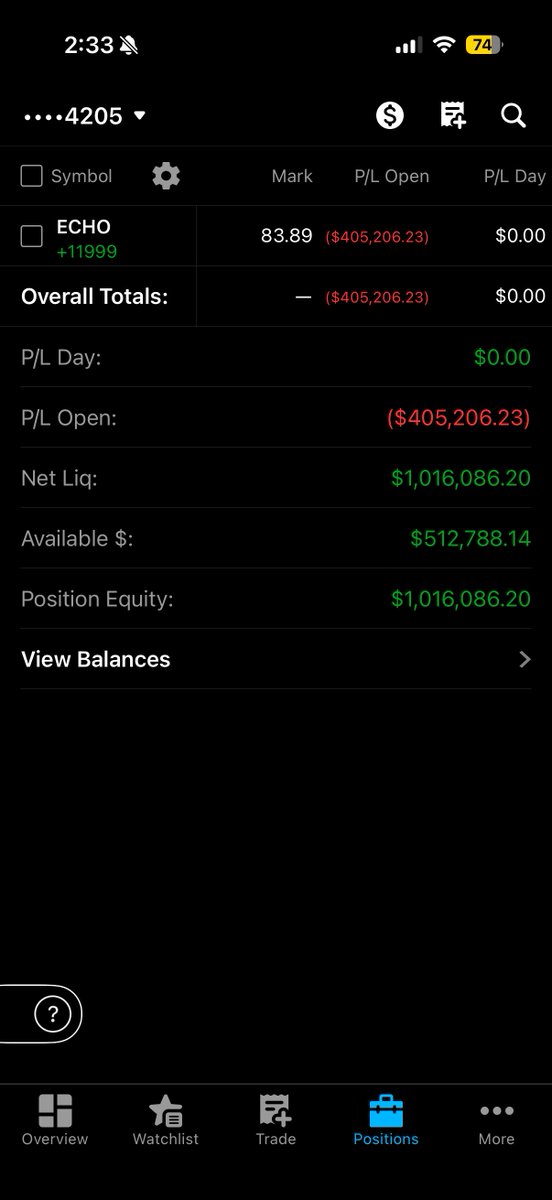
Screenshot of my $400k loss bringing challenge portfolio to slight profit after all that work trenching. As always, 100% transparency, every move.
During my early $tsla days, my old followers will know. Multiple 80% drawdowns. 20X didn’t come easy.
Your balls will shrink. What kept me going was conviction.
Remember when my crypto public portfolio hit a 11X? It’s all on my timeline. From there, I took a massive drawdown of millions to end with 7X.
That’s the price of outperformance. If you cannot accept the risk, don’t play the game.
Where do we go from here?
Been bearish Elon Musk long enough. 5 years stock price, range bound.
It’s time to be bullish the smartest man I know again.
Proud to announce I’m back to camp Elon Musk.
Elon’s cult. LOOK WHO IS BACK???? ME MFERS 🖕
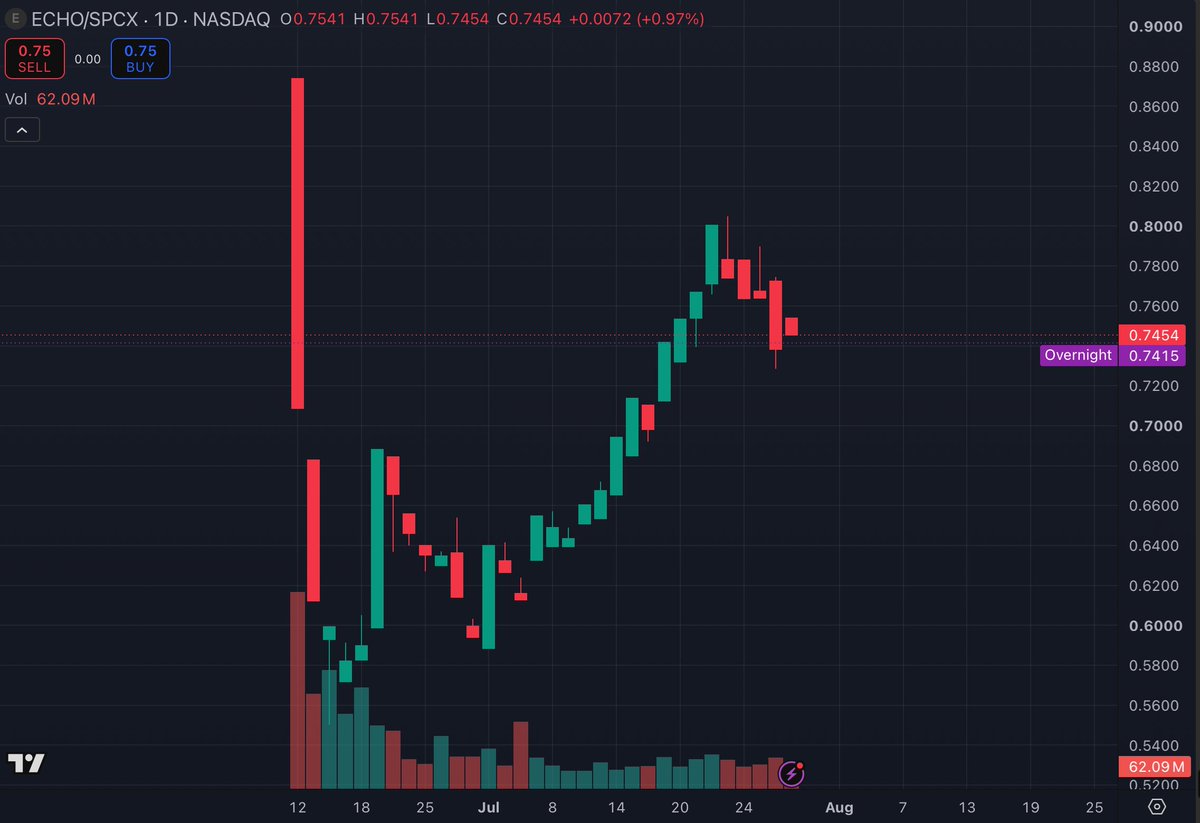
$spcx chart looks “bottomed”. Too many haters celebrating.
This chart will probably be crime it’s way back up to $140 / $150 before unlocks.
Bullish X money, SpaceX / Starship, Starlink, https://t.co/LVjDLk8CYb is obvious central town hall of the world, Space infrastructure etc…
Just gonna hold this shit regardless. My hold time is years. YEARS.
$echo owns 2% of $spcx trading at a NAV discount. Discount window will eventually close. How? Don’t know. Done my homework, I'm good.
$echo is the only space company without debt since $T deal just closed.
Ratio analysis of $echo / $spcx shows strength. I expect this to continue as echostar transition to an asset light company.
Try not to be affected too much by price movements. Relax, it will work out.
THIS IS HOW YOU WILL RETIRE IN THE NEXT 5-10 YEARS
I’ll be focused on where capital flows next.
Here’s how I believe the AI buildout evolves:
2026–2027: AI Infrastructure
AI demand accelerates.
Capital pours into the companies building the foundation.
• AI Compute: $NVDA $AMD $AVGO $MRVL
• Memory: $MU $SNDK $WDC
• AI Infrastructure: $VRT $SMCI $NBIS $IREN
2028–2030: Power & Grid
AI becomes an energy problem.
The world races to expand power generation, modernize the grid, and secure critical materials.
• Power Infrastructure: $VRT $ETN $PWR $HUBB
• Battery Materials: $ALB $SQM
• Copper/Grid: $FCX $TECK $SCCO
• Rare Earths: $MP $CRML $USAR
• Nuclear: $CCJ $UUUU $SMR $OKLO
2030+: Physical AI
Intelligence moves into the real world.
Robotics, autonomous systems, defense technology, and space become the next major investment themes.
• Robotics: $TSLA $SYM
• Autonomous Mobility: $ACHR $JOBY
• Defense: $LMT $NOC $KTOS $AVAV
• Space Economy: $RKLB $ASTS $LUNR $PL
For my first post, I’m sharing a letter @NVIDIA signed on why open models matter.
AI will transform every industry, power every company, and be built by every country.
Open models strengthen safety and cybersecurity, accelerate innovation and diffusion, and enable sovereignty.
The world needs both frontier closed models and frontier open models.
https://t.co/AUKzoQ5Ikb
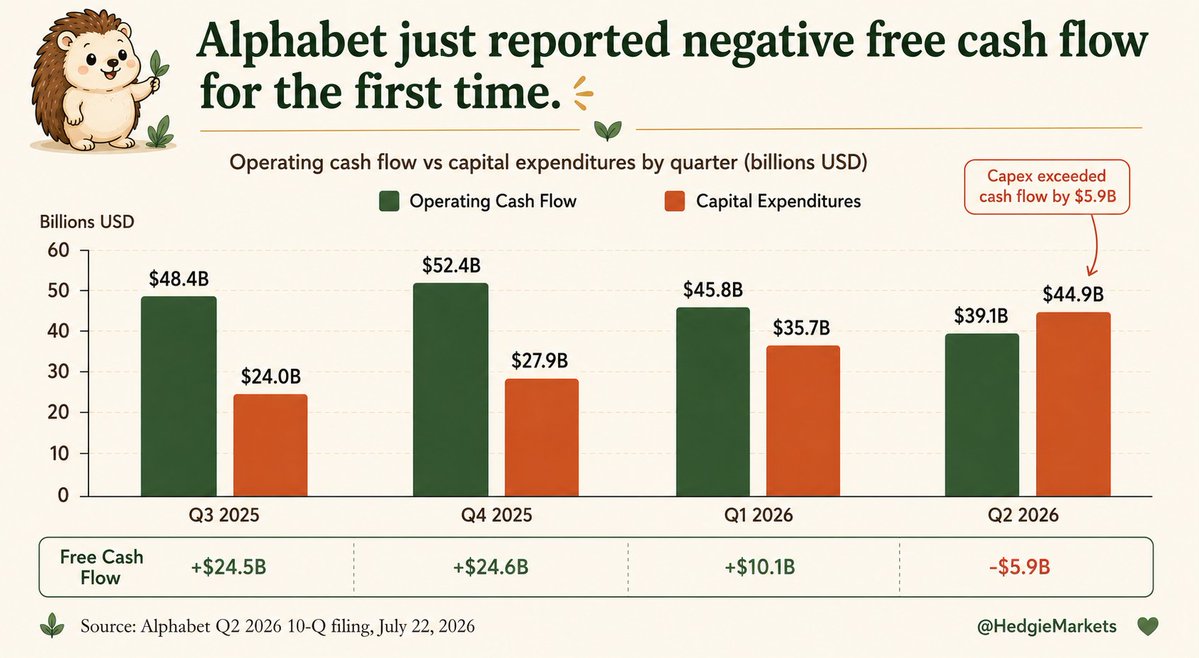
🦔Alphabet beat on every headline number tonight. Revenue up 24%. Cloud up 82%. EPS of $9.11. But $6.26 of that EPS came from paper gains on Alphabet's Anthropic stake, not from operations. Strip that out and operating EPS is about $2.85. Free cash flow went negative for the first time in Alphabet's history. Long-term debt more than doubled in six months. Stock buybacks dropped to zero.
My Take
Cloud grew 82% and I'll give them credit for that. But the company spent $44.9 billion in capex during a quarter where cloud brought in $24.8 billion. Alphabet raised $49.6 billion in equity and $20.3 billion in bonds in Q2 alone, roughly $70 billion in outside capital in a single quarter to fund AI infrastructure that the business itself can no longer cover from cash flow. A year ago Alphabet was buying back $13 billion in stock per quarter. Now it's issuing stock instead of repurchasing it. That shift is a bigger deal than the revenue beat.
The $9.11 EPS will be the headline on every financial site tomorrow and most people won't dig deeper. Alphabet booked $77 billion in unrealized gains because its Anthropic stake went up on paper ahead of the IPO. Nobody paid Alphabet $77 billion. If Anthropic's IPO prices lower or gets delayed, those gains reverse. The actual operating business just crossed into negative free cash flow for the first time while doubling its debt. I think this earnings report will age differently than the headline says.
Hedgie🤗
I can't believe people do not know you can build hedge fund level trading strategies using AI completely from scratch.
This paper shows exactly how top quants combine AI with real market data to build strategies that actually prints. Bookmark this before someone takes it down.
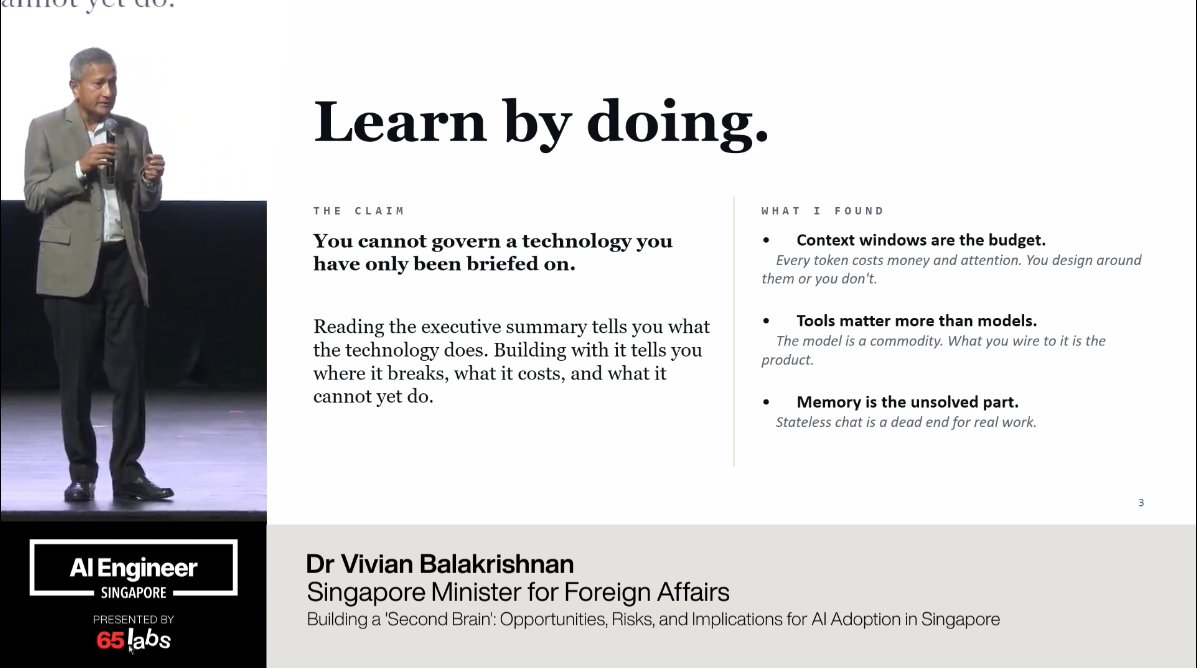
This is amazing - we have Singapore's Minister of Foreign Affairs @VivianBala explaining how he uses a Nanoclaw on Raspberry PI
This is a gem; He says the barriers to accessibility have collapsed - his setup was not created by him; and that memory is the next frontier (LOL)
JP Morgan just dropped their Q2 Guide to the Markets.
It's over 100 pages of institutional-grade data most people will never read.
I did. Again.
Here are 17 charts that will make you a better investor this year...
This 1 hour lecture on "Probability Theory" from MIT will teach you more about prediction markets than 2 month internship at at a Wall Street Quant firm.
Bookmark this & give it 1 hour today, no matter what. It’s the most productive start you can give your week. Then read post below.
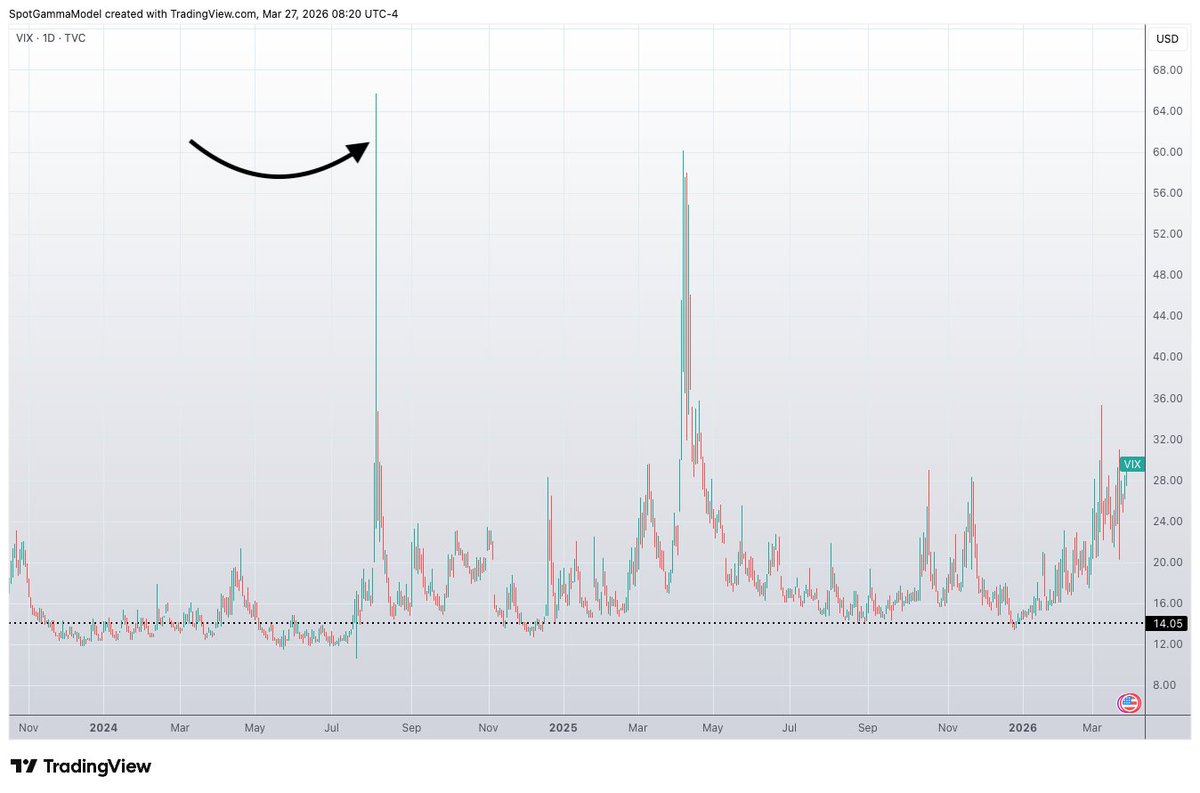
I'm quite nervous, and I spent 2 hours writing why you should be too.
Consider:
VIX has gone +60 twice in the last ~1.5 years. Once on a positioning debacle (Aug '24) and then again on the self-inflicted wound of April '25 tariffs.
To find the previous VIX 60 you go back 5 years to Covid crash.
Before that, it was 12 years and the GFC.
This situation clearly can't be shoved back in the box with a tweet. GL.
https://t.co/JyebhCLuAv
BREAKING: AI can now evaluate startups like Sequoia Capital partners (for free).
Here are 12 insane Grok prompts that replace $400K/year VC analysts (Save for later)
2/ Three-Statement Financial Model
You are a VP at Morgan Stanley. I need a complete three-statement model for [COMPANY NAME].
Please provide:
- Income statement: Revenue, costs, EBITDA, net income (5 years)
- Balance sheet: Assets, liabilities, equity (5 years)
- Cash flow statement: Operating, investing, financing activities (5 years)
- Link formulas: How statements connect (net income → cash flow → balance sheet)
- Working capital: How AR, inventory, and AP change
- Debt schedule: Principal payments and interest expense
- Key assumptions: Revenue growth, margins, capex as % of sales
- Error checks: Balance sheet balancing and circular references
Format as Excel-style model with formulas explained in plain English.
Company: [DESCRIBE BUSINESS, CURRENT FINANCIALS, GROWTH STAGE]
BREAKING: Claude is insane for market research.
I reverse-engineered how top consultants at McKinsey, Goldman Sachs, & JP Morgan use it.
The difference is night and day.
Here are 12 insane Claude Opus 4.6 prompts they don't want you to know (Save for later)
🚨 BREAKING: Microsoft just dropped an 18-episode series called "Generative AI for Beginners".
Ideal for beginners, developers, and AI enthusiasts looking to build a solid foundation.
Here’s a breakdown (Save this👇):🧵
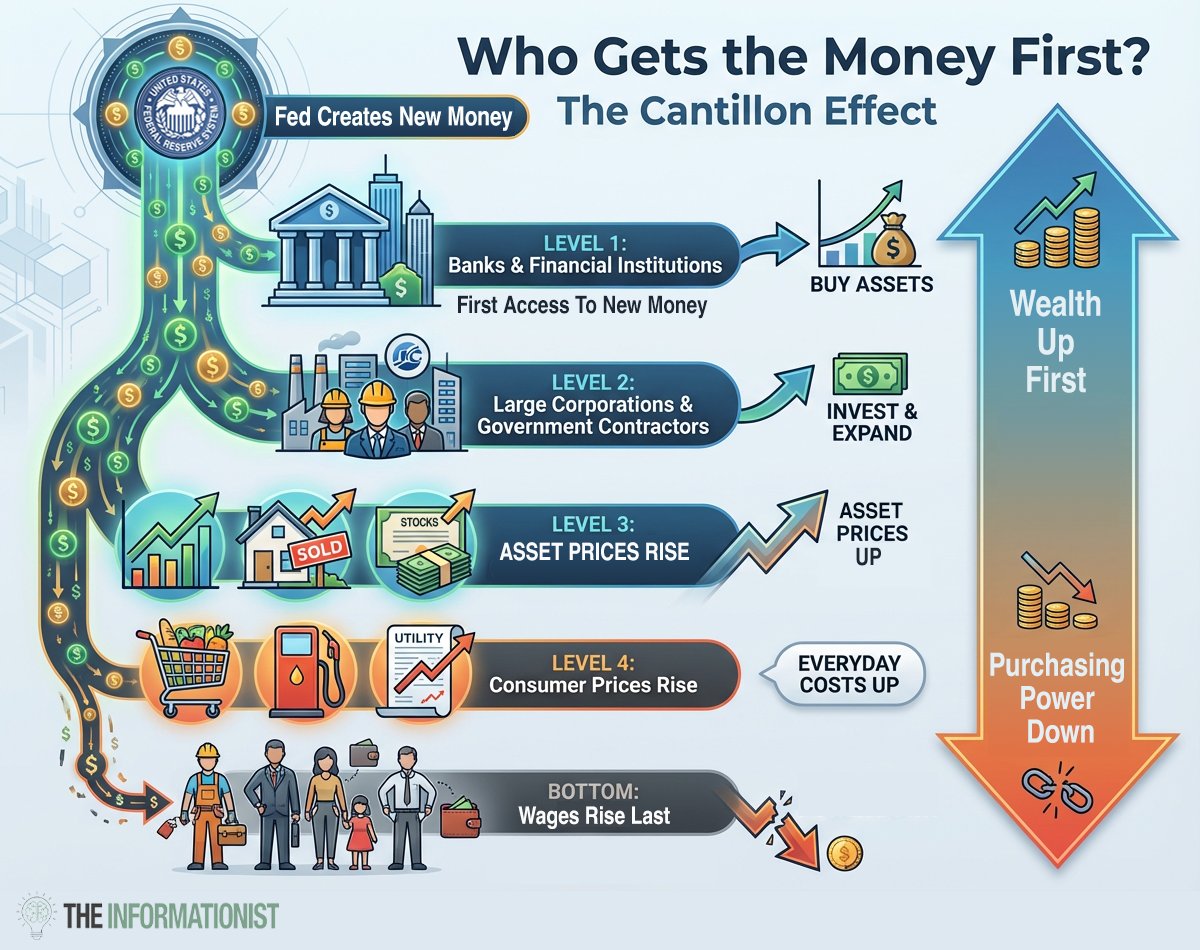
Most people have never heard of the Cantillon Effect.
But once you understand it, you’ll see the world of investing differently.
What is it?
In the early 1700s, Richard Cantillon noticed a simple pattern:
When new money enters an economy, it doesn’t reach everyone at once.
And whoever gets it first benefits the most.
Here’s how it works today:
New liquidity enters through the Fed and through bank lending.
Both follow a similar pattern:
→ Markets and large balance sheets get first access
→ Large corporations and well-connected borrowers tap cheap credit next, they invest and expand at today’s prices
→ Asset prices tend to rise as new liquidity chases finite assets
→ Consumer prices often follow
→ Wages rise last, usually after purchasing power has already declined
Fed data shows how lopsided the playing field is:
- The top 10% hold nearly 90% of equities.
- The bottom 50% holds about 1%.
It’s a simple but powerful monetary transmission.
Understanding this won’t change the system.
But it might change how you think about where to store your savings.
For those of you who don't know, I write all about topics like this every week in The Informationist. Last week, we dove deep on this one.
Link in bio if you want to read the full explanation.
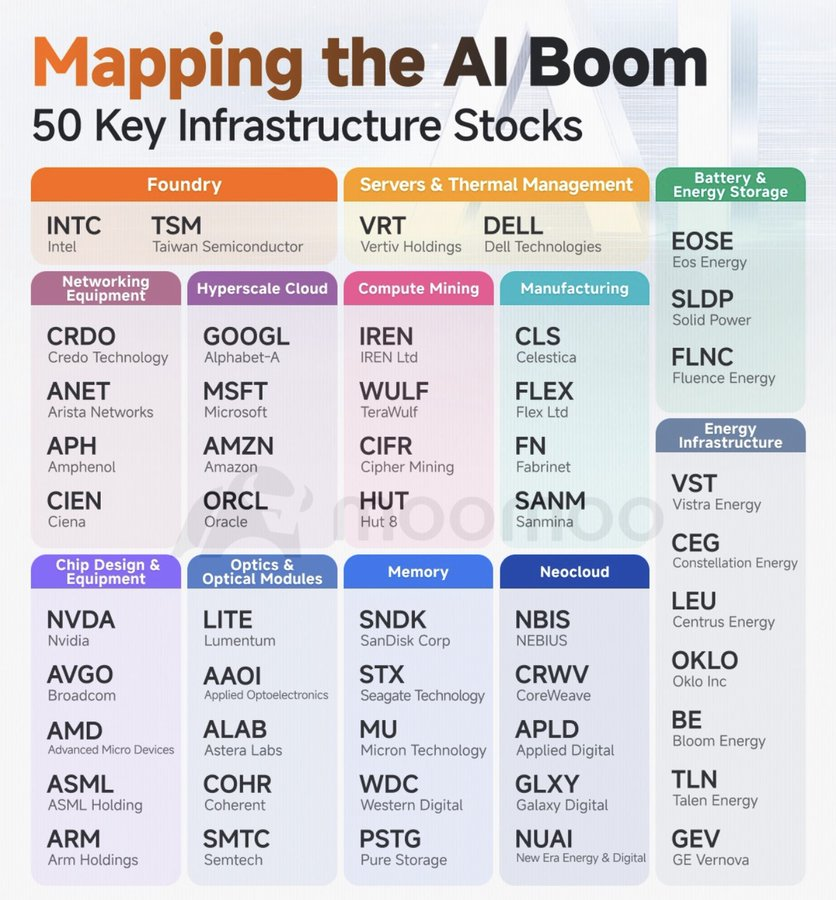
THE 8 LAYERS OF THE REAL-WORLD AI BOOM
1. $NVDA, $AMD, $ASML, $ARM & $AVGO design & manufacture the processors that AI models run on.
2. Those chips only work at scale because of networking & optics where $ANET, $CRDO, $CIEN, $LITE & $AAOI move massive amounts of data between servers, racks & entire data centers so AI systems can operate as one.
3. $VRT & $DELL then provide the physical systems like the servers, cooling & power management that keep AI systems running nonstop under extreme loads.
4. Memory & storage make AI intelligence usable where $MU, $SNDK, $WDC, $STX & $PSTG store the data that models are trained on & pull from when they generate answers.
5. Behind the scenes are the compute operators like $IREN, $CIFR & $WULF which supply large-scale, power-secured infrastructure capable of running AI workloads continuously.
6. Because AI power demand isn’t smooth that means battery & energy storage become critical where $EOSE & $FLNC stabilize load by storing energy & releasing it when data-center demand spikes.
7. None of this works without electricity which $VST, $CEG, $TLN, $OKLO, $BE & $GEV generate & manage to keep AI running 24/7.
8. On top of all of this sit the cloud platforms like $MSFT, $GOOGL, $AMZN & $ORCL along with neoclouds like $NBIS, $GLXY, $CRWV & $APLD which turn raw infrastructure into AI capacity that companies rent by the hour.