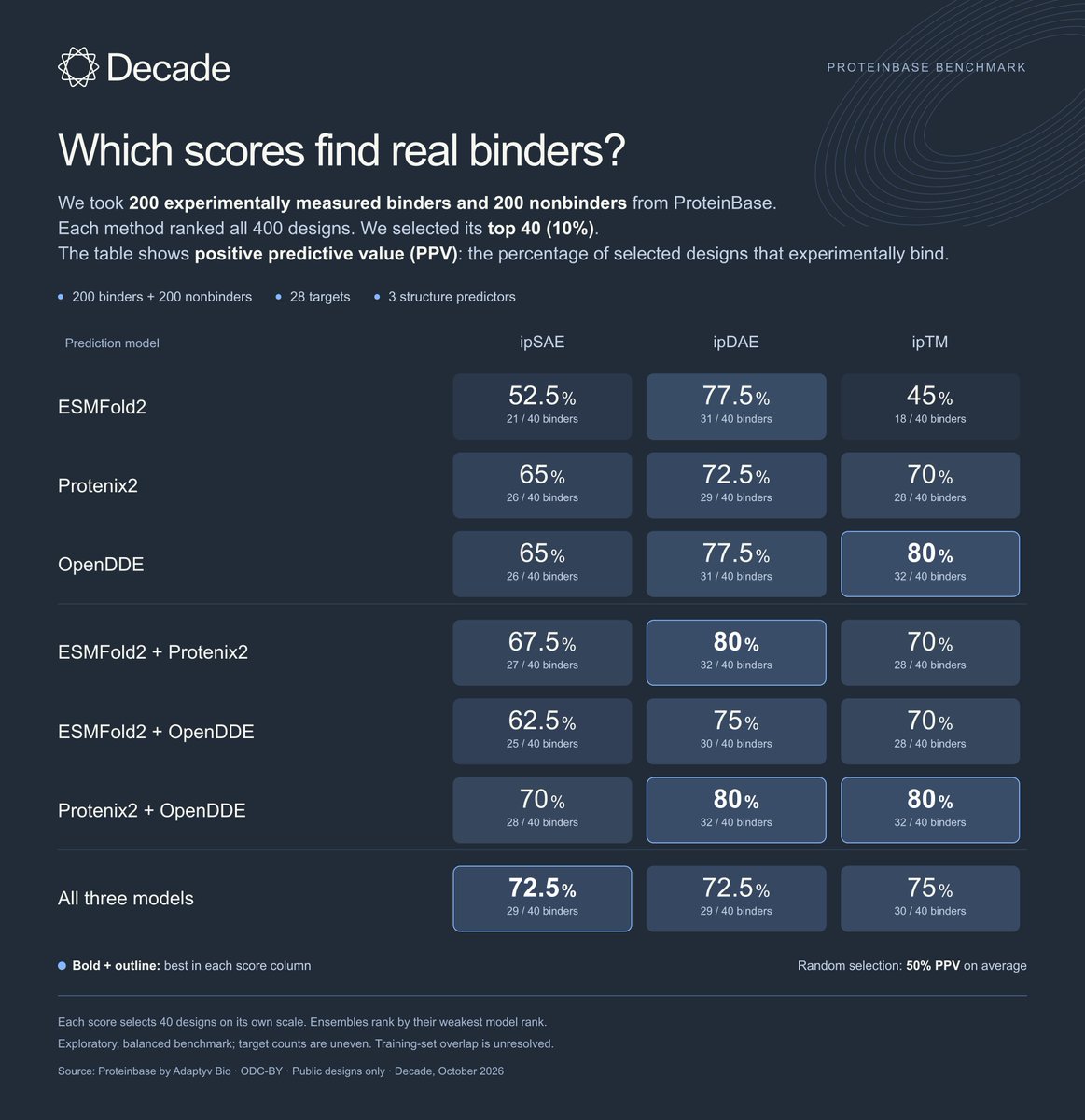
I think others have done this too but here is a quick look at ipSAE vs ipDAE vs ipTM across folding models
ipDAE (BindCraft2) is consistently good, but OpenDDE+ipTM is surprisingly good and this is robust across different thresholds
Consensus doesn't help as much as I expected
Seven hundred and fifty eight subjects received a personalized mRNA, not one of which was described in an IND. Each made in 4 weeks from tumor biopsy.
The process is the product.
Hello personal CRISPR cures.
@ScottGottliebMD has the story on $MRNA. Despite the negligible efficacy, INTerpath-001 should not be viewed as a failure. Vaccines lack the potency for cancer but tailoring treatment to patients makes therapeutic sense (ask a surgeon!). The FDA door is open; what comes next?
A watershed for FDA regulation. Every patient on the vaccine arm got a different product, with neoantigens chosen from sequencing of each person's own tumor. So FDA had no single active sequence to review. The IND pre-specified how the product would change for each patient.
One of our agents flagged that @Ginkgo datapoints has been outperforming others for protein biophysical data production. Ahead on cost and quality as well as TAT. Credit where due @jrkelly
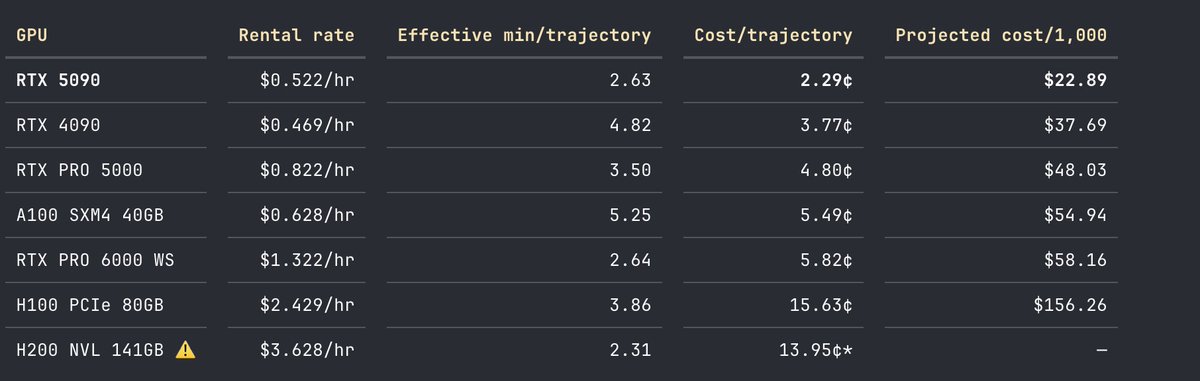
I've been experimenting with BindCraft 2 and h/t @aaronmring it turns out that consumer GPUs on e.g. https://t.co/W8abGP7Vtk can produce trajectories for really low cost! 2c/traj is incredible
@MartinPacesa and his collaborators really optimized the hell out of this thing
We are on the cusp of a wave of new therapies for some of the worst diseases. But the world won’t benefit unless the US fixes its drug regulatory system. My new essay for @nytimes, on how slow clinical trials are now the biggest obstacle to curing cancer.
https://t.co/a5qf9bAKXL
- I interviewed dozens of researchers, especially oncologists at leading U.S. centers. A striking consensus emerged: science is no longer the main bottleneck to new cancer drugs. It is our ability to test discoveries in patients through clinical trials.
- The cost of starting a Phase 1 trial in America has roughly doubled over the past decade. As a result, companies increasingly take early trials abroad: Australia’s Phase 1 trial volume has nearly doubled in a decade, driven mainly by U.S. companies.
- Unfortunately, the underlying incentives are badly asymmetric: Institutions can be blamed for harms caused by moving too fast, but almost no one is blamed when patients deteriorate during avoidable delays. One doctor called the emerging system “ritualized safety over actual risk assessment.” Or as, @DavidHongMD put it: "We often forget that the biggest risk is the cancer itself."
- This problem is becoming more urgent because medicine itself is changing. Sequencing, biological engineering and A.I. make increasingly personalized therapies possible. But our regulatory system was mostly built for standardized drugs tested in large populations.
- @sytse, the co-founder of GitLab, shows what personalized medicine can achieve: after relapsed osteosarcoma and being told there were no options left, he pursued a highly individualized approach and has now been cancer-free for a year. But doing so required extraordinary resources and regulatory expertise.
- Pierce Ogden’s father was less lucky. After molecular analysis identified a drug that might target his glioblastoma, the manufacturer agreed to provide it. But administrative barriers delayed access until it was too late. “My dad was ready to try anything,” Pierce told me. “But the system is paternalistic.”
- The A.I. revolution is making this bottleneck more important, not less. A.I. relies on relevant data. Information from early-stage trials could compound with A.I. tools to achieve truly revolutionary medicines. Without the data, this is far less likely to happen.
- Another important shift is that innovation increasingly comes from academic labs and small biotech companies rather than Big Pharma. These small companies find it far harder to unable to absorb delays and regulatory barriers.
- Apart from cancer, China is the biggest winner from America's outdated medical regulations. China has a much faster trial system, with testing often starting a full year earlier. This allows Chinese pharmaceutical companies to experiment and improve medicines while American companies play with mice. Today, half of all drugs licensed by major pharmaceutical companies originate there, up from less than 5 percent only a decade ago.
- But we don't need to copy China. The best model is Australia: lots of on-site scientific and ethics reviews, and requirements that are proportionate to small, early-stage trials. Phase 1 studies there begin roughly 6–12 months faster, without any notable increases in adverse safety events.
- Operation TrialBlazer, a 2026 HHS initiative is a good start in this direction, but we need legislative action by Congress to truly make Phase I trials faster and more efficient!
I want to thank everyone who helped me with this article: everyone I interviewed and the amazing editors at the Times. This is the result of a months long journey of extensive interviews and research.
Special thanks go to those who came on the record. One of the features of the system is an atmosphere of fear, where practitioners are afraid to publicly come out and explain these issues. So anyone who does is a hero in my book!
A few years ago, designing an antibody on the computer was extremely difficult.
Today, there are several open-source tools which allow anyone to design antibodies from home.
Out today: A step-by-step guide to antibody design. By @btnaughton.
This is an amazing story about the present and future of n-of-one cancer treatment, as usual brilliantly told by @ElliotHershberg . Also includes a teaser for our new company, Decade!
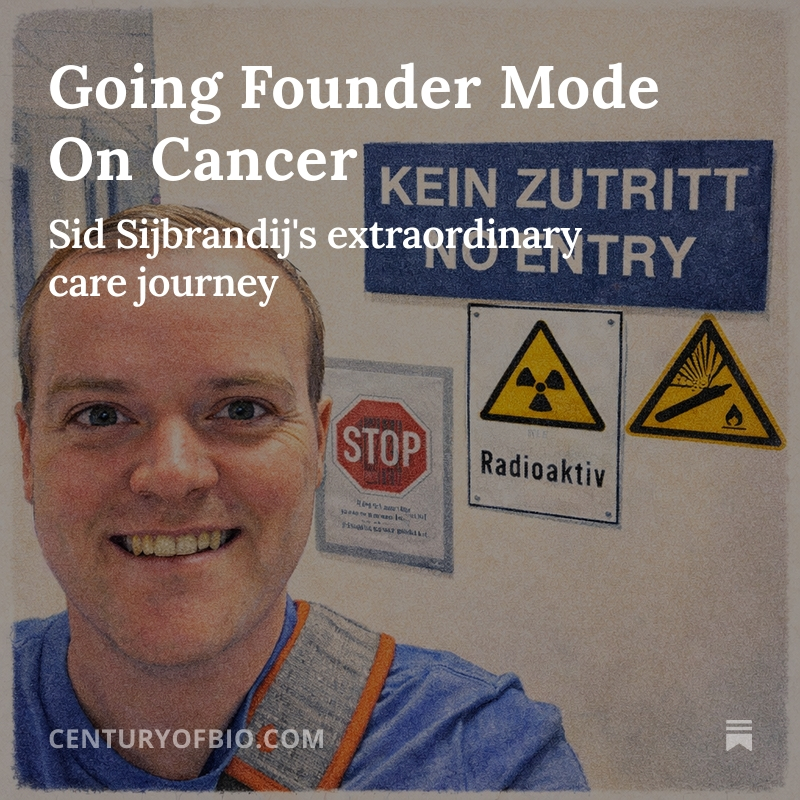
Going Founder Mode On Cancer
https://t.co/vAqXIV5zvE
Sid Sijbrandij is a generational founder. He founded and led GitLab, one of the largest remote companies in the world, from idea-stage startup to NASDAQ-listed software giant.
But in 2022, a six centimeter mass growing from his upper spine threatened to end all of that. He had cancer.
What happened next is nothing short of remarkable. Sid went founder mode on his care journey. In the years since, he's deployed cutting-edge genomics to profile his disease. Based on this data, he's developed a growing armamentarium of personalized therapies.
As a result, his disease is now undetectable.
A simplistic version of this story could be, “Wow! A brilliant billionaire seemingly cured his cancer. Good for him!”
But as I’ve gotten to know Sid, it’s become abundantly clear to me that there is more to the story than that.
In an in-depth profile for The Century of Biology, I explore Sid's journey and what this might mean for the future of cancer care.
Incredible piece showing why hospitals are the biggest driver of healthcare spending.
Everyone wants to blame pharma but that’s not what’s happening.
Hospitals can mark up drugs when they administer them. And those markups can be absurd.
Bloomberg found hospitals charging insurers five times, ten times, even over 700 times what Medicare would pay for the same drug.
Example from the article:
Oxaliplatin. A 20 year old generic cancer drug. Long off patent.
The manufacturer barely makes money on it anymore.
Medicare pays about $35 per dose.
Yet nearly 150 US hospitals billed five times that or more.
It is hospital pricing power.
This is why premiums are high.
This is why out of pocket costs are high.
Hospitals are the single largest driver of healthcare spending.
Must read from @Bloomberg.
Is private tutor a job that grows with AI? 1) Human connection is critical for development of young people 2) Human and AI tutors seem likely to complement well 3) Sometimes it’s time for a break to go climb a tree
I decided to experiment with my own (small) protein design competition!
It's specifically to test how well VHH pipelines work for binder design, without the usual careful tuning.
You submit a @modal script, I run it and test on https://t.co/z5f9FrA7qJ
https://t.co/7NGUw4duVH
"Prior to the enactment of Bayh–Dole, the U.S. government had accumulated 28,000 patents, but fewer than 5% of those patents were commercially licensed". @TheStalwart@tracyalloway The Jones Act for US Biopharma: https://t.co/tEiUPgDkYT...
Fine, here we go.
First let's start with some baseline expectations. Pancreatic cancer is scary, 5y survival is ~10%.
So if you see a trial with an apparent survival asymptote at ~50% then certainly *something* is happening, right?