Great insights!
Nevertheless, the greatest transformation may occur after the purchase, not before it.
Agents could radically improve the ability to evaluate whether a purchased product or service actually delivered its promised value. And they can continuously measure value received against cost. This is big.
It means competitive pressure can become continuous rather than concentrated at the point of acquisition or contract renewal.
Businesses that consistently deliver measurable value may see their reputations compound.
On the other hand, those relying on customer inertia, opaque performance, or difficult switching could face substantial pressure.
Assorted things I've been mulling over regarding agents in the economy:
• Companies are in some sense the original superintelligence. It's often the case that they can use their amortized cognitive surplus to advance their interests against those of certain consumers: relative to the optimization capacity of companies, consumers can be inattentive, underinformed, irrational, etc. (Think, say, of some of the classic insurance upsells at the end of a booking process, which is typically priced substantially above what a regular policy would cost.) Herbert Simon introduced the idea of bounded rationality, and firms often end up benefiting from it. Thanks to personal agents, we will probably get somewhat more rational in how we engage with companies.
• How exactly will outcomes change? Well, certain kinds of price discrimination will work less well (how do coupons work if every agent hunts fastidiously for them?), and certain kinds of customer cross-subsidy will change (today, people who forget to cancel subscriptions subsidize those who don't). Taken across the economy as a whole, I'm not sure what the incidence of all of this will be.
• In corporate strategy, people have long debated the relative importance of distribution and product quality. Perhaps you've made something better, but does anyone know about it? Won't people just continue to buy the ACME Corp Mousetraps? Personal agents will, I think, act as a kind of structural subsidy for product quality. How would markets look different if individuals always spent at least 10 hours researching their purchases? On the margin, focusing on making a product better is, I think, going to become a more effective strategy for companies. This is good!
• It true, a corollary is that information about product quality will become more important and impactful. Today, most people have very limited ability to aggregate and integrate such data, but agents will have insatiable thirst for such signals. (It's often said that data is becoming more valuable because it helps in the training of models. That's obviously true, but I think there's a secondary way in which it's more valuable simply as a complement to cheaper intelligence.)
• A big question is whether agents will increase superstar effects (rational agents all settle on the same product) or increase dispersion (because everyone has slightly different tastes and preferences, which agents are good at eliciting, finally overcoming the artificial clustering we've been subjected to).
• Many internet companies have monetized demand routing, which is in turn often predicated on short attention spans. "I'll click on the first thing I see." This has led to some amount of inefficiency, as companies try to propitiate capricious ranking algorithms and incur various placement fees. It's not all deadweight loss (willingness to pay is itself a kind of signal, which is valuable to buyers), but it's not great. How will the nature and value of this routing change in a world of personal agents? I don't know the answer, but I think that the effects might be pretty big.
• Much of what I'm writing hinges on the assumption that personal agents will be on the consumer's side. I suspect that that will be the winning strategy, but whether it's true, and what it means to be true, involves a lot of other questions.
Taken as a whole, the market is a massively parallelized, decentralized, and highly imperfect value attribution machine, and, taking stock of all of the effects, it seems to me that the quality point may well be the biggest: that agents will change the nature of the backpropagation such that the rewards for better products increase. Maybe this is too optimistic, but I suspect (and hope) that companies that make things that they're proud of will feel that the universe is a little more partisan in their favor.
Come on, don’t get too apocalyptic now 🙂
This is a route problem, not a production shutdown and not a European collapse.
Saudi term barrels to Europe via the East-West line are off for October while Gulf loadings continue. Some volumes are already moving east on spot. That distinction is critical.
After all, 577,000 barrels a day is roughly 8 percent of OECD Europe’s recent non-OECD crude imports. Enough to tighten the market and force refiners to pay up. Not enough to stop them. North Sea, U.S., and African barrels exist. Orlen is already buying replacements. That is how oil markets absorb a preferred-grade shortfall.
And, the screen agrees. Dated Brent printed $130 earlier in the week and has since settled near $104–105. Markets are pricing a finite logistics shock, not the disappearance of Saudi supply.
Riyadh has every reason to restore the line quickly. Lost contracts and drifting customers are expensive. The six-week full-repair window is more credible than the catastrophe versions.
Last but not least, the risk that actually matters is indeed compounding, another strike, a delayed restart, further Red Sea trouble, or the gap running into winter, but are not there yet.
Φτιάξαμε τον Νότη: έναν (πάρα) πολύ ενημερωμένο AI γείτονα, που παρακολουθεί τις συνεδριάσεις (Δημοτικά Συμβούλια και Επιτροπές) του Δήμου σου και σου στέλνει στο WhatsApp όταν συζητείται κάτι για την γειτονιά σου. Μπορείς να απαντήσεις, και να ρωτήσεις πράγματα.
@paulg Also reading about this unique era, while having a discussion with my ChatGPT assistant. For maps I still look for in the literature- but for “probable imagery” it’s doing pretty good. i.e. Birds Eye view of Thessaloniki right before its first fall to the Saracens (904)
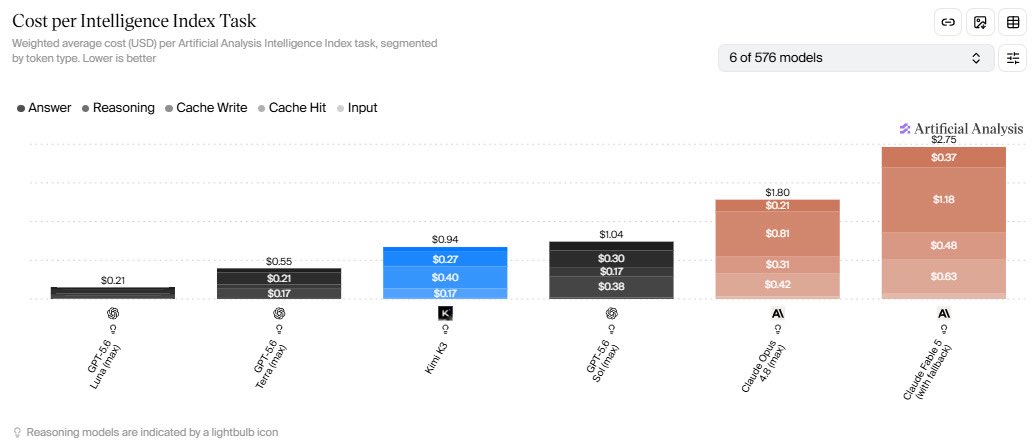
Kimi K3 may be an important inflection point for AI. Potentially negative for Anthropic and OpenAI while being net positive for essentially every other company in the world. I mean that very literally. Although the real “Sputnik moment” would be an open-source frontier model that was also token efficient unlike Kimi K3 which is 50-70% more expensive to run than GPT 5.6 per Artificial Analysis.
Rationale:
A world where there are only 2-3 dominant frontier labs with 90% inference margins is net negative for every other layer while being awesome for those 2-3 labs. Those labs would become monopsonies for power, data centers, semiconductors and hyperscalers and would obviously vertically integrate over time into all those layers while also completely subsuming the application/software layers.
Anything that lowers margins and increases competition at the model layer is good for every other AI layer: power, semiconductors, hyperscalers, neoclouds and yes even software.
This is why Jensen is so supportive of open-source. An open-source model requires the *exact* same amount of compute to run as a closed frontier model of similar size and architecture. Kimi K3 is roughly the same price as GPT 5.6 Terra on a per token basis, which actually suggests that it is less computationally efficient as I am sure that GPT 5.6 is priced to a higher margin than K3. And given that K3 is a token wastrel, i.e. token inefficient, it is significantly more expensive per task than GPT 5.6 and Grok 4.5, which are much more token efficient. Cost per token and token efficiency (i.e. intelligence density per token) are the drivers of intelligence per unit of cost. The winning AI companies will be those that offer the most intelligence per $ over time.
Lower margin % at the model layer = more margin $ at every part of the infrastructure layer and is a godsend for software. This can happen either through open-source models like K3 at the frontier *or* having a vertically integrated model company like Meta, SpaceX or Google at the frontier. Both outcomes result in a lower margin % at the model layer as vertically integrated model companies don’t really care where the margin $ come from. This is why it was so painful for OpenAI and Anthropic when Google was right there with them from a model competitiveness perspective and why Grok 4.5 and Muse 1.1 were just as important as Kimi K3.
The reason Kimi K3 is only *potentially* negative for Anthropic and OpenAI is 1) the @ericvishria point that the Claude and ChatGPT products and harnesses may be more important than their models today and 2) the hypothesis that they have much more advanced model checkpoints internally that are already being used for RSI. In the latter scenario, reaching RSI even a few months ahead of other labs might be enough to cement a permanent lead.
Time will tell on both points. And likely fairly quickly.
Caveat would be that since Kimi K3 is not token efficient and thereby actually more expensive than ChatGPT 5.6, we may need to see a more token efficient open-source model at the frontier or see Grok 5/Composer 4/Muse 2 at multiple points on the Pareto frontier for this potential risk to Anthropic and OpenAI to play out. And I am sure they will both vertically integrate as quickly as possible while continuing the product/harness strength they have shown over the last 8 months.
In fact, Europeans should be even more dismayed by their stalled-out economy, shrinking international relevance, and subservient military position BECAUSE of its other accomplishments. It's embarrassing for a great bloc to be this feeble!
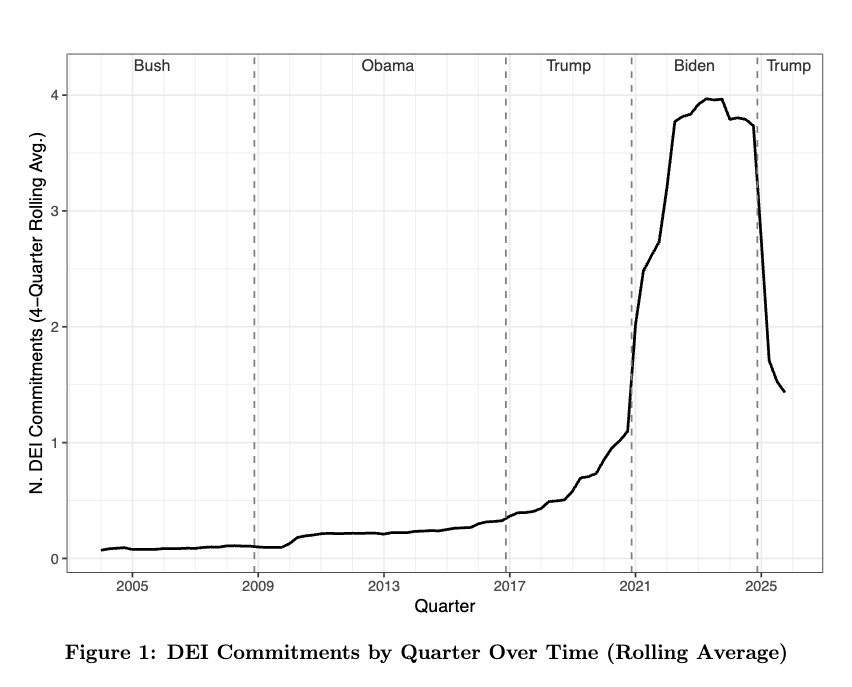
The rise and fall of wokeness: DEI commitments in corporate securities disclosures filed with the SEC. To me this seems a trailing indicator; most other measures of wokeness take off well before 2019 and peak in 2020 or 2021. But the shape! That's what a moral fashion looks like.
@lindayaX@spikedonline Indeed! Australia’s version results are underwhelming so far. UK version risks the same i.e. symbolic wins, enforcement theater, or escalation with even worse consequences
So true!
Now the goal is to build around what humans, institutions, markets, and the physical world will still struggle with after the technology becomes cheap.
P.S. and some of the additional things that people will continue to stay timelessly important are human psychology, entropy, scarcity, and the need to convert uncertainty into confidence.
The faster technology moves, the more I think about Bezos' question
What won't change in the next 10 years?
Things I've been writing down over time:
- Humans will always need shelter, food, energy, and healthcare.
- The desire for ownership and the accumulation of wealth.
- The physical world will move more slowly than the digital one.
- Every increase in technological capability, especially AI, will require more energy.
- People and businesses will continue to need access to capital.
- Capital will continue to seek returns that exceed inflation.
- Underwriting methods evolve, but demand for credit (loans) is persistent.
- Trust remains scarce and becomes increasingly valuable as content, code, and fraud become cheaper.
- Verified identities and reputation becomes more important as information becomes abundant and synthetic.
- Long-term wealth creation and dynastic (multi-generational) thinking predate modern technology, and will persist.
- Coordination and transaction costs never fully disappear; market friction will continue to justify the existence of firms and intermediaries.
- People will continue to compete for status.
- Consumers will pay a premium for products and services that confer status.
- Time remains fixed at 24 hours per day.
- But attention is a finite resource and an enduring constraint.
- Products that credibly save time (or enable delegation) have a perpetual market.
- Inaccessible, proprietary data will be a persistent moat. The more inaccessible and difficult to aggregate, the deeper the moat.
- People want accountability, recourse, and clearly identifiable responsibility when things go wrong.
- Regulation consistently lags technological innovation.
- Compliance requirements, licensing, and regulatory moats persist even when machines can perform the underlying task.
- Local knowledge remains valuable and difficult to replicate.
- Heterogeneous markets (like real estate) continue to reward people with deep contextual understanding.
- Incumbent organizations tend to underinvest in disrupting their own businesses, which always creates opportunities for challengers.
Bezos' insight on what wouldn't change in 10 years was "Customers will always want lower prices and faster delivery."
It's boring/ true, but I think that's the point.
Everything we build today can and will be rebuilt more cheaply, faster by someone else.
Build on the invariants, not the trends.
What have I missed?
@tobi@jbrunelle Totally agree! You can understand what humanity truly cherishes from seeing what types of architecture are respected and maintained/expanded throughout the centuries. I wouldn’t bet that the left building image would survive more than 30-40 years.