Is lumateperone (Caplyta) the most effective antipsychotic for major depression?
This industry-sponsored meta-analysis thinks so, but I have a major reservation:
https://t.co/0CP9mc5gzD
FDA just approved Modius Spero for PTSD, 3rd at-home neuromodulation device approved in the past year.
Worn for 30 minutes a day, the device will be available through the VA system starting in July.
Learn how it works + how to become a device provider:
https://t.co/gp3HYrsRMa
The first guidelines on deprescribing stimulants just came out, covering:
▪ When to consider deprescribing
▪ How to manage ADHD with cannabis use
And I've added more on
▪ How to taper
▪ Dose limits
https://t.co/LbLjYodIS1
Aujourd'hui je déconstruis la déconstruction.
La déconstruction est le virus mental le plus efficace jamais conçu contre une civilisation. Il a été fabriqué en France entre 1966 et 1980 par trois hommes : Foucault, Derrida, Deleuze. Il a été exporté aux États-Unis, hybridé avec le puritanisme racial américain, et il est revenu trente ans plus tard sous le nom de wokisme paralyser l'Occident entier. Voici comment il fonctionne, et pourquoi il faut le détruire.
La thèse est simple. Toute vérité n'est qu'un rapport de pouvoir déguisé. Tout texte sacré, toute loi, toute science, toute norme, toute hiérarchie, toute identité, toute institution cache en réalité une domination. Déconstruire, c'est montrer le rapport de force sous le vernis du vrai. C'est arracher le masque. C'est "démasquer".
Formulé comme ça, ça paraît inoffensif. Voire utile. Qui n'aime pas un peu d'esprit critique ? Le piège est là. La déconstruction se présente comme une méthode. Elle est en réalité une ontologie. Elle ne dit pas seulement "interrogeons les normes", elle dit "il n'y a *que* des rapports de pouvoir". La différence est civilisationnelle.
Une société qui interroge ses normes reste debout. Une société qui croit que ses normes ne sont *rien d'autre* que de la domination s'effondre. Parce qu'elle ne peut plus rien défendre. Plus une frontière, plus une loi, plus une science, plus une langue, plus une histoire, plus une biologie, plus une famille. Tout devient suspect. Tout devient négociable. Tout devient "construit donc déconstructible".
C'est la première raison pour laquelle c'est un virus. Il s'auto-réplique. Une fois inoculé, il transforme tout ce qu'il touche en cible. La science est patriarcale, donc déconstruisons-la. Le langage est colonial, donc réinventons-le. La méritocratie est raciste, donc abolissons-la. Le sexe est une construction, donc choisissons-le. Il n'y a plus de roc. Tout est sable.
Deuxième raison. Le virus est *non-falsifiable*. Si vous défendez une norme, c'est que vous êtes l'oppresseur. Si vous niez être oppresseur, c'est la preuve de votre privilège inconscient. Si vous citez des faits, vos faits sont contaminés par le pouvoir qui les a produits. Si vous citez la raison, la raison elle-même est blanche, masculine, occidentale. Il n'y a aucune sortie possible. Le système est conçu pour rendre toute objection irrecevable par définition.
C'est exactement la structure d'une secte. Et c'est exactement ce qui s'est installé dans les universités, les RH, les médias, les administrations, les conseils d'administration depuis vingt ans.
Troisième raison. Le virus s'auto-réfute mais ne s'auto-détruit pas. Si toute vérité est pouvoir, alors la phrase "toute vérité est pouvoir" est elle-même du pouvoir, donc sans valeur. Logiquement, la déconstruction se mord la queue dès la première phrase. Mais elle s'en moque. Parce qu'elle n'a jamais cherché la cohérence. Elle cherche l'efficacité politique. Et son efficacité politique est immense. Elle désarme ses ennemis et arme ses militants. Elle paralyse le défenseur et libère l'attaquant. C'est une arme asymétrique parfaite.
Quatrième raison. Le virus produit des humains diminués. Une génération entière a appris à déconstruire et n'a jamais appris à construire. Elle sait soupçonner, jamais admirer. Elle voit le pouvoir partout et la beauté nulle part. Elle peut produire mille pages sur le caractère opprimant de Shakespeare et zéro ligne qui vaille la peine d'être lue dans cent ans. Elle a confondu l'intelligence critique avec la pose critique. Elle est stérile par construction. Un esprit nourri à la déconstruction est un esprit qui ne sait plus rien édifier.
Cinquième raison, la plus grave. Une civilisation se tient debout sur trois piliers. La croyance qu'une vérité est accessible à la raison. La croyance qu'un bien se distingue d'un mal. La croyance qu'un héritage mérite d'être transmis. La déconstruction a méthodiquement dynamité les trois. Pas par méchanceté. Par jeu intellectuel, par fascination du soupçon, par haine de la bourgeoisie qui avait nourri ses prophètes. Mais le résultat est là. Une civilisation qui ne croit plus en sa vérité, ni en son bien, ni en son héritage ne se défend pas. Elle s'excuse en attendant la fin.
Voilà ce qu'on a fait. Voilà ce qu'il faut nommer.
La bonne nouvelle, c'est qu'un virus mental ne survit que tant qu'on lui cède l'autorité du discours. Il meurt dès qu'on cesse de jouer son jeu. Dès qu'on réaffirme tranquillement qu'il existe une vérité, un beau, un bien, un héritage. Dès qu'on cesse de demander la permission aux déconstructeurs pour bâtir. Dès qu'on refait. Dès qu'on transmet. Dès qu'on crée.
Les bâtisseurs ont toujours le dernier mot sur les commentateurs. Toujours. Parce qu'à la fin il reste ce qui est construit, et rien de ce qui a été déconstruit.
Alors aujourd'hui je déconstruis la déconstruction. Et demain je construis.
People often send me proposals for really dumb new psych diagnoses.
Here's the latest:
"RSD"= "Rejection Sensitive Disorder"
Soon every human emotion will be mislabelled "mental disorder" & everyone will be sick.
Why i strongly oppose APA's doing DSM-6. https://t.co/guXnqwMKEZ
The smartest age in life may be 55 to 60 – not in your 20s.
Raw cognitive abilities, such as processing speed and memory, often peak early in life. Athletes typically hit their prime before 30, mathematicians make major breakthroughs by their mid-30s, and chess champions rarely stay dominant past 40.
However, a new research reveals that overall psychological functioning—including personality traits, judgment, and emotional intelligence—peaks much later, between ages 55 and 60.
A study analyzing 16 key traits across the lifespan found that conscientiousness peaks around 65, emotional stability reaches its height near 75, moral reasoning deepens in older age, and the ability to avoid cognitive biases may improve into the 70s or 80s.
When combined into a single index, these traits suggest the mind is most balanced in the late 50s, blending experience, emotional steadiness, and sound judgment. This may explain why many top leaders and thinkers achieve their greatest impact in midlife.
["Worried about turning 60? Science says that’s when many of us actually peak." The Conversation, 14 Oct 2025]
CMS is transforming behavioral health. We’re expanding access, integrating care, and delivering real results—from early intervention to suicide prevention and SUD treatment.
Whole-person care. Real impact. Better outcomes.
Learn more about our behavioral health strategy: https://t.co/GljpFzf5EX
Scientists have identified a reversal of the long-standing Flynn effect—the roughly 200-year trend of rising average intelligence (measured via IQ and cognitive tests) across generations.
For the first time in modern recorded history, Generation Z (born roughly 1997–2012) shows lower performance than previous generations in key cognitive domains, including attention, memory, literacy, numeracy, executive function, problem-solving, and general IQ—despite spending more years in formal education than ever before.
Neuroscientist and educator Dr. Jared Cooney Horvath, PhD, MEd, testified before the U.S. Senate Committee on Commerce, Science, and Transportation on January 15, 2026, highlighting this shift. In his written testimony, he stated that cognitive development in children across much of the developed world has stalled or reversed over the past two decades, with declines evident in international assessments (e.g., PISA, TIMSS) and other large-scale data starting around the mid-2000s and accelerating post-2010.
Horvath attributes the primary driver not to reduced schooling, but to the widespread integration of digital screens and educational technology (EdTech) in classrooms. He argues that human brains evolved for deep, focused learning through face-to-face interaction and sustained attention, not fragmented skimming or constant task-switching encouraged by devices.
Key points from his testimony include:
- Teens now spend over half their waking hours on screens, with significant portions in school involving computers or tablets—often leading to off-task behavior and shallower processing.
- Evidence from meta-analyses and national/international studies shows a consistent pattern: higher classroom screen exposure correlates with weaker outcomes in reading, math, science, and higher-order reasoning.
- Digital tools may aid narrow, repetitive skill practice in controlled settings, but in core academic contexts, they tend to reduce depth of understanding, retention, and critical thinking.
Horvath describes this as a "structural mismatch" between human cognition and how digital platforms are designed (to capture and fragment attention), warning that unchecked EdTech adoption risks long-term harm to workforce skills, innovation, and societal reasoning.
[Horvath, J. C. (2026). Written testimony before the U.S. Senate Committee on Commerce, Science, and Transportation. U.S. Senate]
Survey study identifies that most patients with depression interpret the Patient Health Questionnaire instructions incorrectly, raising questions about its validity for clinical and research use. https://t.co/TM7YcqWjwg
Judging by my tl there is a growing gap in understanding of AI capability.
The first issue I think is around recency and tier of use. I think a lot of people tried the free tier of ChatGPT somewhere last year and allowed it to inform their views on AI a little too much. This is a group of reactions laughing at various quirks of the models, hallucinations, etc. Yes I also saw the viral videos of OpenAI's Advanced Voice mode fumbling simple queries like "should I drive or walk to the carwash". The thing is that these free and old/deprecated models don't reflect the capability in the latest round of state of the art agentic models of this year, especially OpenAI Codex and Claude Code.
But that brings me to the second issue. Even if people paid $200/month to use the state of the art models, a lot of the capabilities are relatively "peaky" in highly technical areas. Typical queries around search, writing, advice, etc. are *not* the domain that has made the most noticeable and dramatic strides in capability. Partly, this is due to the technical details of reinforcement learning and its use of verifiable rewards. But partly, it's also because these use cases are not sufficiently prioritized by the companies in their hillclimbing because they don't lead to as much $$$ value. The goldmines are elsewhere, and the focus comes along.
So that brings me to the second group of people, who *both* 1) pay for and use the state of the art frontier agentic models (OpenAI Codex / Claude Code) and 2) do so professionally in technical domains like programming, math and research. This group of people is subject to the highest amount of "AI Psychosis" because the recent improvements in these domains as of this year have been nothing short of staggering. When you hand a computer terminal to one of these models, you can now watch them melt programming problems that you'd normally expect to take days/weeks of work. It's this second group of people that assigns a much greater gravity to the capabilities, their slope, and various cyber-related repercussions.
TLDR the people in these two groups are speaking past each other. It really is simultaneously the case that OpenAI's free and I think slightly orphaned (?) "Advanced Voice Mode" will fumble the dumbest questions in your Instagram's reels and *at the same time*, OpenAI's highest-tier and paid Codex model will go off for 1 hour to coherently restructure an entire code base, or find and exploit vulnerabilities in computer systems. This part really works and has made dramatic strides because 2 properties: 1) these domains offer explicit reward functions that are verifiable meaning they are easily amenable to reinforcement learning training (e.g. unit tests passed yes or no, in contrast to writing, which is much harder to explicitly judge), but also 2) they are a lot more valuable in b2b settings, meaning that the biggest fraction of the team is focused on improving them. So here we are.
74% of people who stopped clozapine because of neutropenia were successfully rechallenged. Only 7% had another episode of neutropenia. https://t.co/1Tb3uP8gZS
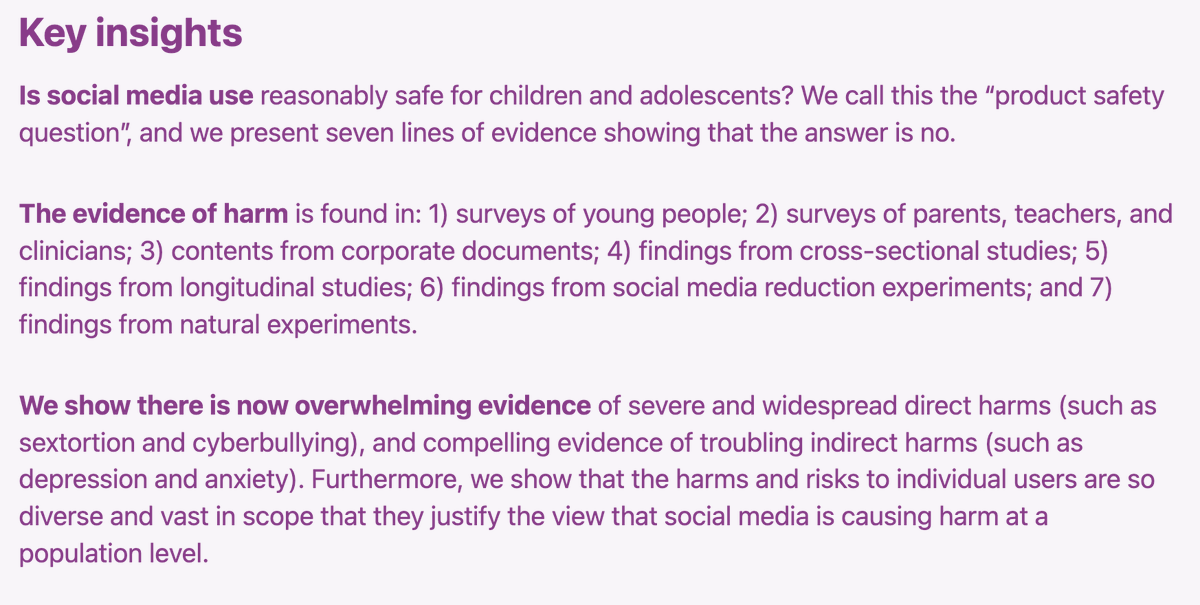
If you come across someone asserting there is "no scientific evidence" that social media is causing harm, please send them this link.
We lay out seven lines of evidence, including RCTs, natural experiments, and testimony from victims & perpetrators of harm
https://t.co/lZsNalKZE5
Because of ineptitude, grift and back scratching.
Hard problems like going to the moon can be a bit inefficient but the problem set attracts a level of competence that drowns out all other problems than the problem itself.
In my lecture at @NIH, at the invitation of @NIHDirector_Jay, I explained why I changed my mind from thinking the lab leak theory of covid origins was unlikely to thinking it was almost certainly true.
Please watch and assess the evidence yourself.
https://t.co/7QBeGJT3yY
Victory in the social media trial in LA!
As of today, we are in a new world: a new era in the fight to protect children from online harms. A jury sided with Kaley and therefore with millions of children: Big Tech is harming kids on an industrial scale.
For years, parents were told these harms were exaggerated, anecdotal, or simply the unavoidable cost of growing up online. Today, a jury affirmed what parents have long known: Meta and YouTube were designed to exploit young people, with devastating consequences.
For the first time, the law aligns with common sense: social media companies no longer have a special exemption to harm children with impunity. Their shield is gone. They will be treated like any industry that knowingly harms children and lies about it. History will judge them as harshly as the tobacco industry.
This bellwether case tested a new legal theory: the harm is not just what algorithms show children, but rather that these products were designed to foster addiction. The companies knew they were harming children by the millions—and did it anyway. They were negligent and dishonest.
This outcome belongs first and foremost to the families, especially the many parents who, in the face of unimaginable loss, chose to speak out, demand accountability, and endure a painful legal process so that other children might be spared.
This is just the beginning. Thousands of cases will follow, bringing Meta, Snap, TikTok, and YouTube to court. Much work remains in courts, legislatures, schools, and communities.
But for now, let us all just savor the long-awaited arrival of justice.
https://t.co/lAKE02XWMs
As we await the verdict in Los Angeles, this just came out: My most comprehensive roundup of the evidence of harm. SEVEN independent lines of evidence, only one is correlational.
With @ZachMRausch, in @HappinessRpt
https://t.co/n6RfRkXbeW





![Rainmaker1973's tweet photo. The smartest age in life may be 55 to 60 – not in your 20s.
Raw cognitive abilities, such as processing speed and memory, often peak early in life. Athletes typically hit their prime before 30, mathematicians make major breakthroughs by their mid-30s, and chess champions rarely stay dominant past 40.
However, a new research reveals that overall psychological functioning—including personality traits, judgment, and emotional intelligence—peaks much later, between ages 55 and 60.
A study analyzing 16 key traits across the lifespan found that conscientiousness peaks around 65, emotional stability reaches its height near 75, moral reasoning deepens in older age, and the ability to avoid cognitive biases may improve into the 70s or 80s.
When combined into a single index, these traits suggest the mind is most balanced in the late 50s, blending experience, emotional steadiness, and sound judgment. This may explain why many top leaders and thinkers achieve their greatest impact in midlife.
["Worried about turning 60? Science says that’s when many of us actually peak." The Conversation, 14 Oct 2025]](https://pbs.twimg.com/media/HGWwTzrWIAA8VWI.png)

![Rainmaker1973's tweet photo. Scientists have identified a reversal of the long-standing Flynn effect—the roughly 200-year trend of rising average intelligence (measured via IQ and cognitive tests) across generations.
For the first time in modern recorded history, Generation Z (born roughly 1997–2012) shows lower performance than previous generations in key cognitive domains, including attention, memory, literacy, numeracy, executive function, problem-solving, and general IQ—despite spending more years in formal education than ever before.
Neuroscientist and educator Dr. Jared Cooney Horvath, PhD, MEd, testified before the U.S. Senate Committee on Commerce, Science, and Transportation on January 15, 2026, highlighting this shift. In his written testimony, he stated that cognitive development in children across much of the developed world has stalled or reversed over the past two decades, with declines evident in international assessments (e.g., PISA, TIMSS) and other large-scale data starting around the mid-2000s and accelerating post-2010.
Horvath attributes the primary driver not to reduced schooling, but to the widespread integration of digital screens and educational technology (EdTech) in classrooms. He argues that human brains evolved for deep, focused learning through face-to-face interaction and sustained attention, not fragmented skimming or constant task-switching encouraged by devices.
Key points from his testimony include:
- Teens now spend over half their waking hours on screens, with significant portions in school involving computers or tablets—often leading to off-task behavior and shallower processing.
- Evidence from meta-analyses and national/international studies shows a consistent pattern: higher classroom screen exposure correlates with weaker outcomes in reading, math, science, and higher-order reasoning.
- Digital tools may aid narrow, repetitive skill practice in controlled settings, but in core academic contexts, they tend to reduce depth of understanding, retention, and critical thinking.
Horvath describes this as a "structural mismatch" between human cognition and how digital platforms are designed (to capture and fragment attention), warning that unchecked EdTech adoption risks long-term harm to workforce skills, innovation, and societal reasoning.
[Horvath, J. C. (2026). Written testimony before the U.S. Senate Committee on Commerce, Science, and Transportation. U.S. Senate]](https://pbs.twimg.com/media/HGHevYqWIAA8t2I.jpg)