India did have writing since 1800 BCE. They is incontrovertible epigraphical evidence for it.
The oldest Ashokan style Brahmi is actually discovered by Niraj Rai in Dandakaryanya dated to 1000 BCE. Note that this dates prior to the invention of the Aramaic script.
Recently a 1000-700 BCE Painted Greyware layer turned up Prakrit Brahmi inscriptions in Haryana.
S.R. Rao uncovered an inscription that was transitional between Harappan script and the Indus script. This is dated to around 1400 BCE.
India did have writing since 1800 BCE. They is incontrovertible epigraphical evidence for it.
The oldest Ashokan style Brahmi is actually discovered by Niraj Rai in Dandakaryanya dated to 1000 BCE. Note that this dates prior to the invention of the Aramaic script.
Recently a 1000-700 BCE Painted Greyware layer turned up Prakrit Brahmi inscriptions in Haryana.
S.R. Rao uncovered an inscription that was transitional between Harappan script and the Indus script. This is dated to around 1400 BCE.
For years, major institutions have framed India and Hindus through the lens of nationalism, extremism, and suspicion. But what we've uncovered on @Wikipedia raises a deeper question: who gets to write the public record?
Our investigation found that a small cluster of anonymous editors controlled more than 80% of the @HinduAmerican page. Among the findings:
Blatant Conflict of Interest: The editors aggressively shaping HAF’s page were the exact same people controlling the Wikipedia profiles of HAF's legal adversaries and academic critics.
Inserting False FARA Allegations: Editors laundered complaints from HAF's opponents into "facts," using demands for a DOJ investigation to falsely brand HAF as a foreign agent
Administrative Silencing: An admin with supreme platform permissions deleted quotes from HAF's leadership, stripping the organization of its right to reply to allegations.
Over four years (2021-2025), editors systematically erased HAF’s identity as an American civil rights group, transforming its Wikipedia page into a heavily curated dossier of accusations. Our report from @npovmedia documents how it happened. 👇
🚨NEW INVESTIGATION: A Fortune 500 company reportedly cancelled a @HinduAmerican training session after employees circulated its Wikipedia page.
That page tells readers HAF aligns with Hindu nationalism, threatens academic freedom, and has been accused of acting as a foreign agent.
We traced who built that narrative. The same handful of accounts kept appearing across HAF, its critics, activist groups, and key public figures—building an interconnected narrative that now feeds Google and AI systems.
Full investigation in thread. Receipts 👇
the West pushes pro-capitalist free market policies in every other developing country, but in India they do the opposite and want the "70% street sh*tting" pre-2014 leftists to remain in power.
is it because they do not want to repeat the 'China mistake' of 'allowing China' to do free market reforms + state-incentivized industrialization?
also funny to see @suhasinih and other pre-2014 Indian regime propagandists push "journalism is in danger" narratives.
the West pushes pro-capitalist free market policies in every other developing country, but in India they do the opposite and want the "70% street sh*tting" pre-2014 leftists to remain in power.
is it because they do not want to repeat the 'China mistake' of 'allowing China' to do free market reforms + state-incentivized industrialization?
also funny to see @suhasinih and other pre-2014 Indian regime propagandists push "journalism is in danger" narratives.
Great! But archeological evidence shows Iron is used in India much before 1500 BCE. Hyderabad showed 2400-1800 BCE and recent Tamil Nadu excavations showed 3200-1800 BCE. So, definitely, iron was in use in India between 3000-2000 BCE long before it was used anywhere else in the world which was from 1500 BCE.
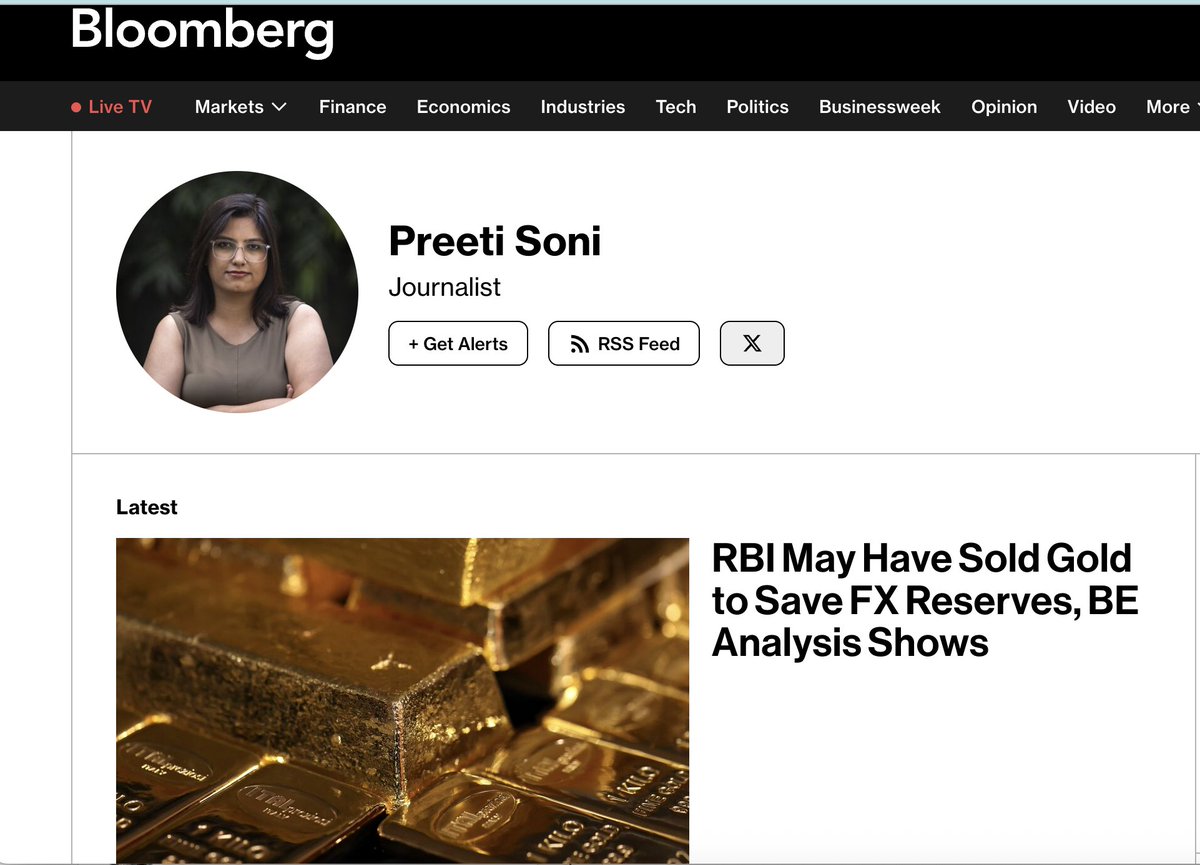
Why did @preeti_msoni delete/deactivate her X account after posting a malicious article falsely claiming "RBI sold gold to save forex reserves" ?
This is the typical scoot and shoot policy followed by these serial slanderers who work for DS media like @business - they claim to be journalists but in reality they are propagandists who will sell the nation for a few rupees
I hope GoI takes stringent action against Bloomberg and this person. Enough is enough - @MIB_India@FinMinIndia@RBI
The debate over Thiruvalluvar, Pashupati, Buddhism vs Brahmanism, co-opted "tribal gods," etc... all stem not just from simply bad faith & the relentless need of the 'deconstruction' of Hinduism, but also the rejection of both contemporary & ancient Indian understanding of religion.
A lay follower of a Dharmic panth did not rest their understanding of their beliefs on obscure metaphysical differences or even outward appearances as such - people visiting shrines of different deities or revering different gods was completely normal.
Even today, a single family will have members who feel closer to Shiva, Shakti, or Vishnu yet will happily pay heed to festivals and temples of other deities. Similarly with many Jains, Buddhists, & Sikhs.
This is just completely & utterly normal in Dharmic faiths & the Indian experience of religion at large.
Rather the onus should be squarely on academics, particularly from the West and - even more egregiously - their malevolent followers in Indian academia, for not picking up on this obvious phenomenon that was omnipresent in the past as well as today.
Instead their fetish for categorization and exalting of textual theory over lived reality has created artifical fissures, no doubt doused in modern political activism. Where otherwise in the past, there just wasn't these types of conflicts en masse. Rather such conflict was the exception rather than the rule.
For the first time in Ramanathapuram district, a Tamil Brahmi inscription was found. Based on paleography, the inscription appears to date back nearly 2,000 years. What is written in the stone is
𑀆𑀧𑀷𑁆𑀷𑀽𑀭𑁆 𑀏𑀶𑀺𑀬𑁆 𑀫𑀸𑀡𑁆𑀝𑀼 𑀯𑀺𑀵𑀼𑀦𑁆𑀢 𑀅𑀢𑁆𑀢𑀺𑀬𑀷𑁆 𑀓𑀻𑀭𑀷𑁆 𑀓𑀮𑁆
Appanur Eri(y) Maandu Vizhuntha Athiyan keeran Kal
That is, Athiyan Keeran, who fought in the battle at Appanur and died.
The stone appears to have been erected in his memory, making it a hero stone (nadukal)
AAP was a special purpose vehicle (SPV) created by members of Sonia Gandhi’s National Advisory Council (NAC), when they realised the INC was sinking.
CJP is the SPV of all the AAPtards who realised the AAP is sinking - desperate to remain relevant.
All rats, all sinking ships
Meet Siddharth Menath. Full time employee of @PwC India (@PwC_IN). Occasional author at Newsminute. Planning violence on 6th June & hoping to blame it on the police. These people are so predictable. Please note @DelhiPolice@AmitShah@gupta_rekha
But the claim that writing did not exist in India before 300 BCE (Aśokas time) is said with a straight face by some western students of India, who disregard earlier brāhmi epigraphical evidence to the contrary. That’s surprising.
@Saatvata too pointed out to three problems in these Max-Müllerish claims.
One the realities you face when writing about "early Buddhism" is that we do not have any faithful records of what Śākyamuni Buddha said. The early Buddhist canons (including Pāli), as Norman (1983: 7) noted, “show evidence of being translated from a dialect of Middle Indo-Aryan.” This means that everything we have is at best a translation from something earlier. There was no writing in the Buddha's time (that comes only after Aśoka), meaning that whatever we have is a translation of a set of oral testimonies that are supposed to be traced back two or three centuries to a historical figure. On top of that, the extant texts already belong to sectarian groups with their own competing values and ideas. The earliest documentable forms of Buddhism are already quite mature and settled in their doctrines.
The Vedas weren't transcribed in writing until the late medieval period.
They were transmitted orally for thousands of years and were preserved through complex combinatorial recitation patterns which functioned as check-sums.
Moreover, the epithet Paśupáti is used several times in the Śatarudriya hymn.
Although it's unfortunate that the Indus seal was incorrectly labeled as Paśupáti, it's equally wrong for modern scholars to assert that Paśupáti is unattested as the epithet of Rudrá in the Vedas or to assert that the Aṣṭamūrti concept is merely a later Puranic or Agamic development.
The text you provided clearly states:
"The Rig Veda was not written down until sometime in the early- to mid-first millennium B.C. at the earliest (Basham 1967; Thapar 2002)."
They are providing a terminus post quem and not a terminus ante quem.
They are NOT claiming that there is strong evidence in favour of transcription of the Ṛgveda during the early mid-first millennium B.C.
Moreover, neither AL Basham nor Romila Thapar are epigraphers or philologists.
If they were, they would've been aware of the problems inherent is assuming such an early transcription of the Vedas.
The inscriptions at the time of Aśoka employ a notoriously minimalist, low-resolution form of the Brāhmī script:
• There is no way to mark sounds like ṛkāra/ḷkāra/ṝkāra, visarjanīya, etc. in the earliest form of Brāhmī.
• There is no way to distinguish between anusvāra and anunāsika in the earliest form of Brāhmī.
• Despite the frequency of geminate consonants in spoken MIA variants (the "Prakrits"), geminate consonants were not explictly marked in the earliest forms of Brāhmī and only true consonant clusters were written as ligatures.
• Early Kharoṣṭhī was even more minimalistic than early Brāhmī & lacked any visual distinction between short and long vowels.
There is simply no feasible way to transcribe नॄँᳲ पा॑हि शृणु॒धी गिरः॑ (nṝ̃́ḫ pāhi śṛṇudhī́ gíraḥ) from ṚV [Śākalya-saṃhitā] 8.84.3 or य इ॒मा विश्वा॒ भुव॑नानि चाकॢ॒पे (yá imā́ víśvā bhúvanāni cākḷpé) from AV [Śaunaka-Saṃhitā] 7.92.1 into minimalist scripts like early Brāhmī or Kharoṣṭhī whilst also maintaining phonemic and accentual precision.
During slightly later periods (i.e. the early centuries AD), when writing in India became advanced enough to capture Vedic Sanskrit phonemic peculiarities (pitch accent, etc.), it's quite likely that portions of the Vedic corpus were committed to writing as mnemonic aids for students, though this practice was also viewed with suspicion in more orthodox circles.
This taboo is reflected in the Vṛddha-Gautama-smṛti and Anuśāsana-parvan of Mahābhārata:
veda-vikrayiṇaś caiva vedānāñ caiva dūṣakāḥ।
vedānāṃ lekhinaś caiva te vai niraya-gāminaḥ॥
"Sellers of the Veda, corrupters of the Veda, and those who commit the Veda to writing are bound for hell."
Those who recite the Vedas using the aid of written transcripts are listed among the six lowest kinds of reciters in the Yājñavalkya-śikṣā and Pāṇinīya-śikṣā:
gītī śīghrī śiraḥ-kampī tathā likhita-pāṭhakāḥ।
anarthajño 'lpa-kaṇṭhaś ca ṣaḍ ete pāṭhakādhamāḥ॥
"The one who sings [the mantras], the hasty reciter, the one who shakes his head when reciting, the ones who read from a written text, the one who is ignorant of the meaning [of the mantras], and the one with a light voice - these six are the lowest kinds of reciters."
It's worth noting that the Vṛddha-Gautama-smṛti is a comparatively late Dharmaśāstra.
Likewise, the Anuśāsana-parvan is absent in the Mahābhārata Parvan list present in the Kuṣāṇa-era Spitzer Manuscript from the Qizil Caves of East Turkestan, indicating that the parvan was likely a comparatively late addition to the Mahābhārata, possibly during the Gupta period.
The dating of the śikṣās is highly contested, though they almost certainly postdate the Nirukta of Yāska, the Prātiśākhyas, and even the Śabdānuśāsanam of Pāṇini (popularly known as the "Aṣṭādhyāyī").
Claims that Yājñavalkya-śikṣā was composed by Yājñavalkya Vājasaneya of Mithilā (or even that the Pāṇinīya-śikṣā was composed by Pāṇini) are highly dubious.
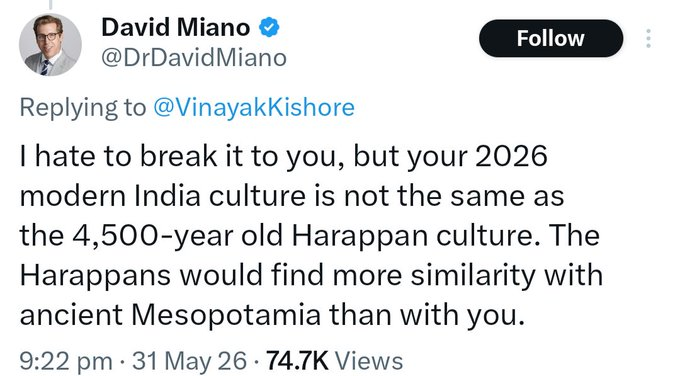
It's funny to see BMAC saw a smooth continuum till 500 BC - the Steppe Barbarians who passed through BMAC left it untouched but destroyed everything in India. How do people come up with such weird theories?
What's this guy talking about?
The wells we see in backyard of Indian homes, the brick houses, the bullock carts, the rangoli, the co-existence with wild animals, the bangles, the pottery, the toys, the ditches on the side of roads, the use of millet, the textiles - so much hasn't changed in India since Harappan times.
Perhaps no other civilization has such an unchanged continuous history for some 7000+ years preserving itself and its dangerous wild animals as well. If a Harappan time travels to present day India, he will instantly feel at home. Albeit scoff at the bad sanitation and cleanliness of our modern towns, I am sure.
@Indic_Arya_LM Ok. But I remember reading that spoked wheels were introduced in to india as per the AMT/AIT.
Whereas the Sinauli chariots were solid wheeled and slower.
AMT claim is - spoked wheels were absent in IVC and present after IA languages entered.
@yajnadevam@typingvanara The question remains “Why are they not writing anything before Ashoka?”
it Is premised on paucity of any Brahmi lettering before 300 BCE and increase after that - a “literacy gap”?
Or were they just using perishable writing materials earlier?