New in #practicalRO: Simulation-Free Single-Fraction High-Dose Radiotherapy for Non-Spine Bone and Soft Tissue Metastases. #radonc https://t.co/BIJpijnzjF
Updated SFRO dose constraints for organs at risk in adult patients.
#Radonc
New recommendations from the French Society of Radiation Oncology cover #normofractionation , #hypofractionation , #SBRT and #reirradiation.
They offer a unified, practical framework adapted to modern techniques (IMRT/SBRT), while noting that many limits still derive from 3D-CRT data — clinical judgment remains essential in complex cases.
A useful tool to help minimize normal-tissue toxicity in daily practice.
https://t.co/Br0dLHeddn
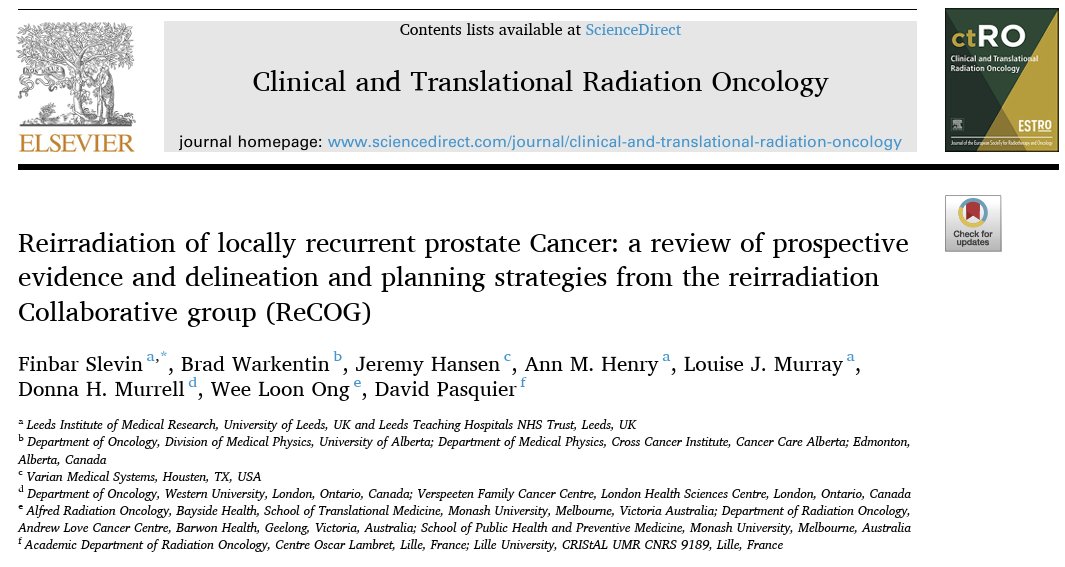
ReCOG Reirradiation of Locally Recurrent Prostate Cancer
20 published prospective studies of SBRT or brachytherapy reirradiation for radiorecurrent prostate cancer. No phase 3 trials.
Most series report low rates of high-grade GU and GI adverse events, with outliers: 16% late G3 GU in one SBRT cohort, and 12% G4 rectoprostatic fistula in an LDR series that delivered primary-equivalent doses and reported no bladder or urethra constraints.
Planning is not standardized. Focal to whole gland with or without SIB, CTV margins 0 to 7 mm, OAR structures split between Bladder vs Bladder_Wall, Rectum vs Rectal_Wall, Urethra vs Urethra_PRV.
The gap that stands out: every published study applies de novo, course-specific constraints to the reRT plan alone. None use cumulative EQD2. Only 1 of 11 ongoing studies (RO-PIP) will.
Prostate may be the one site where this is defensible. Prior dose is near-uniform (74 to 80 Gy whole gland in most series), intervals are long, and the relevant OARs are parallel with steep gradients. A fixed second-course constraint is close to a cumulative one when everyone starts from the same place. A prior brachytherapy Delphi reached consensus that constraints should not depend on prior dose.
In practice it reduces to what my dosimetrists actually get from me: keep 105% out of the urethra, rectum, and bladder. Don't sweat the dose distribution prior course.
Dosimetry aside, appropriate patient selection is most important, as it is in all reirradiation cases, regardless of site.
#RadOnc #OncTwitter #PCSM
https://t.co/oetBXOA0Eg
Are you interested in knowing more about the hematological consequences of radiopharmaceutical therapy (radioligand therapy) in patients with neuroendocrine tumors and prostate cancer? If so, we have the right article for you...
@MrinalPatnaik@Yael_Kusne@sonbol_bassam@WallaceKleinS
https://t.co/qMybUPIUI1
@SprakerMDPhD@OncoAlert Yes, this is a major departure from BCLC - TACE no longer default upfront treatment, while SBRT & Y90 elevated to first line in some scenarios.
📌 Postmastectomy chest wall radiotherapy for breast cancer (SUPREMO): 5-year quality-of-life results from a randomised, controlled, phase 3 trial
🔗 https://t.co/yZcK4dbRO1
@OncoAlert#OncoAlertAF
👉🏻the main finding of 5-year analysis of the SUPREMO QOL substudy is that chest wall radiotherapy leads to a modest increase in local chest wall symptoms, which improve over time, without significant effect on overall QOL and other domains.
📌 Validation of the ESTRO target volume consensus guideline for early-stage breast cancer in the DBCG Skagen Trial 1
🔗 https://t.co/lbINZYWhiY
@OncoAlert#OncoAlertAF
🔸 Prospective validation of ESTRO target volume guideline.
🔹Based on phase III trial, DBCG Skagen Trial 1, with 2,963 breast cancer patients.
🔸Loco-regional recurrences occurred almost exclusively within the ESTRO CTVs.
🔹No evidence supporting routine expansion of ESTRO-defined volumes.
🔸Supports adequacy of ESTRO volumes in contemporary radiotherapy.
New in #practicalRO: Omission of Sentinel Lymph Node Biopsy Among Women Aged 50 to 70 With Early-Stage Breast Cancer: Applying an Updated ASCO Guideline to a Real-World Population. #radonc https://t.co/mDuwB5KAqe
I’m not sure why this algorithm has drawn so much criticism.
At its core are the history and physical examination—perhaps the very steps many of us are most likely to overlook. Let’s start there; we can always add dozens of arrows in every direction afterward.
High-Dose Vitamin D Showing Promise in Mitigating Skin Toxicities from Cancer Treatments
📰🔗 https://t.co/vyIe8KjJis
Recent developments in oncology care highlight the potential of high-dose vitamin D in alleviating skin toxicities associated with chemotherapy and radiation therapy.
@JAMADerm
#RadOnc #RadOncNews #RadiationOncology #CancerCare
Media Source: https://t.co/svIqVf7V0p Photo by Arcaion on Pixabay
📖 Looking for recommendations for a summer read? Look no further - the @OncNewsCentral Summer Book Recommendation list is back! https://t.co/o3gUCCDFff
AI Innovations in Mammogram Risk Scores Aid Future Breast Cancer Prediction
🔗 Read the full article: https://t.co/z9714M9vHS
Recent advancements in artificial intelligence (AI) have enabled researchers to generate dynamic breast cancer risk scores from screening mammograms.
(Image from Radiology Journal)
#RadOnc #RadiationOncology #CancerCare #BreastCancer #AI #Mammogram
🚀 New publication!
Our prospective study shows that MR-guided adaptive SBRT to the prostate bed after radical prostatectomy is safe and feasible, with no Grade ≥3 toxicity, no Grade ≥2 GI toxicity, preserved quality of life.
🔗https://t.co/R7Oxzbwx3U
👏Thanks to all authors!
🚨 Can pre-op radiation improve outcomes after revision total knee arthroplasty (TKA) for arthrofibrosis? 🦴☢️
A new single-institution study suggests yes.
🔹 13 patients with severe arthrofibrosis after prior TKA underwent 8 Gy × 1 RT within 24 hours before revision TKA + rotating hinge arthroplasty.
📈 Key findings:
🦵 ROM improved 69.5° → 98.3° (mean +28.8°, P<0.01)
💪 PROMIS Physical Function +7.8 points
😌 PROMIS Pain Interference −10.1 points
✅ No RT-related adverse events or reoperations reported
💡 These early results support pre-op RT as a promising adjunct for refractory arthrofibrosis, with improvements in both mobility and PROs.
Although small, retrospective (n=13), and with short follow-up, this study can set the stage for future work!
@ASTRO_org
https://t.co/pJtH1W0TzN
This is such an important point. With radiotherapy for oligoprogression now known to improve OS in CRPC thanks to @GiulioFrancoli1, it’s worrying that most drug trials don’t even collect enough data to know what radiotherapy was used and to where.
This new #RedJournal article from @reshmajagsi et al asks how can we safely combine PARP inhibitors and radiotherapy in breast cancer management? SWOG 1706 is a trial that can help inform practice. Read about it here: https://t.co/691SCf48fT
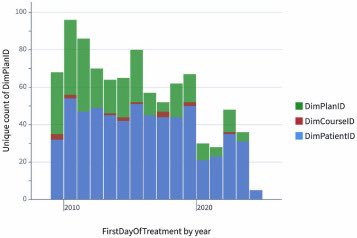
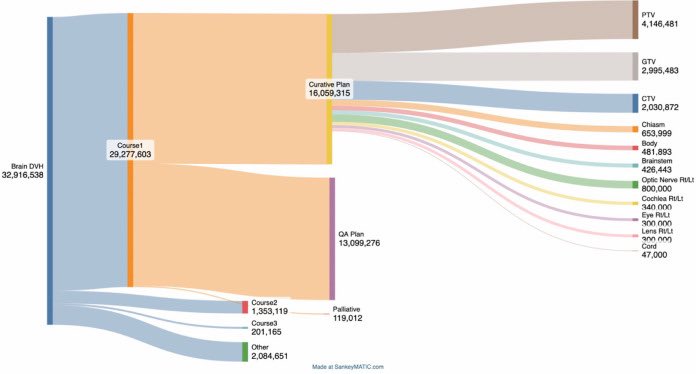
📌 Transforming 15 Years of Single-Center Radiation Therapy Data Into an Artificial Intelligence–Ready Resource: Challenges, Standardization, and Opportunities for Precision Oncology
🔗 https://t.co/eVc4mNpfTJ
👉🏻Using 15 years of RT data (2,482 patients, 4,090 treatment courses, 6,946 plans), the authors developed an AI-ready radiation oncology dataset and introduced rt4ml, an open-source Python package for RT data preprocessing.
👉🏻 In a pilot cohort of 510 patients with primary CNS tumors, ML models were developed to predict re-irradiation, with integrated clinical data available in a clinically annotated subset.
#RadOnc #AI #PrecisionOncology @ASTRO_org