Former GP & SAS Psychiatrist, President elect #RSMHypnosis @RoySocMed Past President @BSCAH1 Nocebo avoidance! #integratedcare Functional Disorders (own views)
Can you help @FndPortal ? Hypnosis & FND seem to have a lot in common. Misunderstood, fear, stigma, “real state”, lack of research plus focus of attention, beliefs, agency, dissociation. Charcot’s theory of a “psychodynamic lesion”due to an erroneous belief could be key?
New in @NatureComms: How does the brain generate the sense that your hand is your own? Using MEG and the rubber hand illusion, we mapped body ownership millisecond by millisecond and found three phases of activity, starting before touch. https://t.co/qcncdtzLAq
🧠 Migraine is a chronic neurological disorder that affects over 1 billion people globally each year, with women predominantly affected.
A recent Seminar discusses typical symptoms, mechanisms, and treatment options: https://t.co/WsE2Ga48am
I’m telling y’all don’t sleep on the brain... 🧠🤔
Expectations, placebo/nocebo effects, predictive coding…it directly extends to the immune system.
This shit is crazy…
@Nature https://t.co/Zwhp4o2OCz
Check 1-2. Very honoured to give yesterday’s plenary presentation at ACLP 2026 in San Diego 🙏🧠
It focused on our evolving understanding of how expectations/beliefs can modulate brain-body circuits and either improve (placebo) or worsen (nocebo) ~1/3 of symptoms across medicine
Each word you say is planned by a small patch of brain above your left ear, about a quarter of a second before you say it. It sits in a temporal lobe region textbooks describe as only for listening. Our paper today in @ScienceMagazine: https://t.co/EXOgl3YsNI
@UCSF@NeurosurgUCSF
🌱 Can reading recovery stories help recovery itself?
There’s growing evidence that hope, positive expectations and shared experiences matter.
#FND and #ME/#CFS and #Chronic pain have important overlaps.
Here is a wonderful collection of recovery stories for ME/CFS/Chronic pain👇
https://t.co/eyc7YfHSqo
https://t.co/7NBGd44iY5
#FND #MECFS #Recovery
@PaulGarnerWoof@Fionas_Story
Do you know how to teach your patients (persons w/disease) the simple home maneuver; the Semont Plus to alleviate their dizziness from benign positional vertigo. If we all learn this technique and teach it, we will save the healthcare system a bundle. @JAMANeuro trial
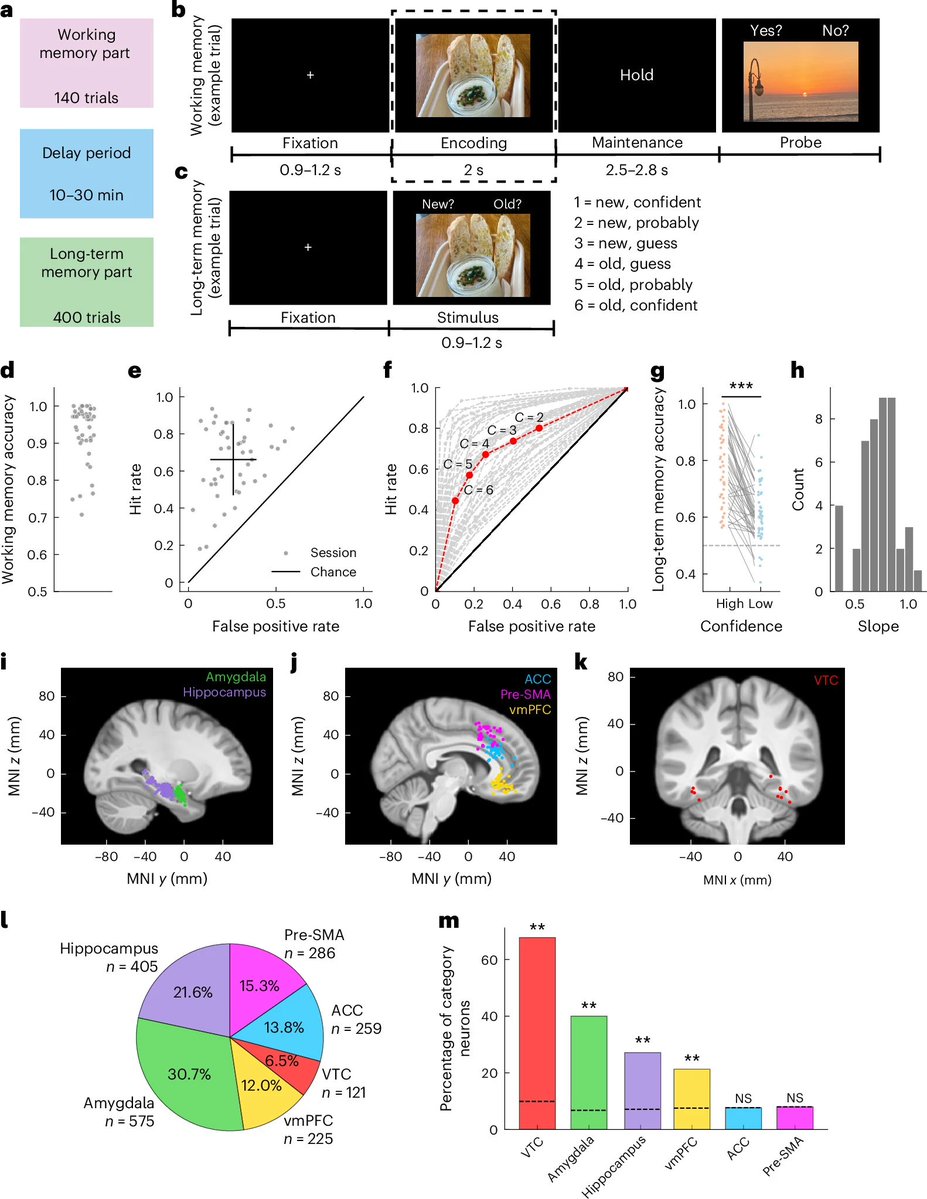
Most of what we see in a day never becomes a memory, and the neural signals that decide what does are still poorly understood. The question also matters clinically, because electrical stimulation of the human amygdala can improve memory for images of neutral objects, but it has been unclear which cells such a treatment should target.
Xiao, Rutishauser and colleagues recorded single neurons in patients with drug-resistant epilepsy who had electrodes implanted to locate their seizures. Patients viewed new photos from five categories (people, food, animals, cars and landscapes) and 10 to 30 minutes later, reported which ones they recognized and how confident they were.
About 40% of amygdala neurons responded more to one category than to the others. On average, these neurons fired more for photos of their preferred category that were later recognized than for those that were forgotten. Photos from other categories showed no difference. The signal appeared about 350 ms after the image, nearly a second earlier than in the hippocampus. It held after accounting for how pleasant or arousing the photos were, and it replicated in a second group of 95 patients with a different task. The authors propose that the amygdala helps select what gets encoded, beyond its role in emotion and point to these cells in the right amygdala as a possible therapeutic target. The study is correlational, so it does not show that these neurons cause the memory.
Fig. 1 from Xiao et al. (2026), Nature Neuroscience. CC BY-NC-ND 4.0. Unmodified.
A reminder that Functional Neurological Disorder is recognised in NHS England’s specialised neurology service specification, published April 2026. Alongside Epilepsy, MS and other neurological conditions, FND is included for specialist assessment and treatment planning. #FND
What if the brain's electrical connections are much smarter than we thought? Electrical synapses are specialized connections that allow brain cells to communicate directly through tiny channels called gap junctions. Unlike chemical synapses, which rely on neurotransmitters to carry messages between neurons, electrical synapses permit rapid communication through the direct flow of electrical current. Alberto Pereda and Adam Miller describe in a new review in Nature Reviews Neuroscience why we may need to rethink what an electrical synapse actually is, and how it works.
Key points:
- Electrical synapses are not simply passive channels connecting neurons. They are dynamic structures capable of changing the strength of communication between brain cells.
- Gap junctions are supported by a complex network of proteins, including connexins, scaffolding proteins and regulatory molecules that control how electrical signals are transmitted.
- Neurotransmitters such as dopamine, synaptic activity and molecular processes can modify electrical coupling, suggesting that electrical synapses may play a much more sophisticated role in brain plasticity and network function than previously appreciated.
My take: This review resonates w/ me because it challenges a fundamental assumption about how the brain communicates. For decades, we have frequently thought about electrical synapses as relatively simple connections and chemical synapses as the more adaptable and sophisticated partners. That distinction may be misleading. Electrical synapses can change, adapt and interact w/ chemical signaling systems. As someone who spends much of my time thinking about Parkinson's disease, dopamine and deep brain stimulation (DBS), I find this particularly fascinating. We frequently focus on which brain circuits are firing abnormally and how stimulation can alter their activity. However, could we also be missing an important part of the story by not paying enough attention to how neurons are electrically connected and how those connections change? This is a basic neuroscience review, not evidence that manipulating electrical synapses will improve DBS outcomes, however it opens important questions for future research.
Here are 5 points that resonated w/ me:
1- Electrical synapses are not fixed electrical wires. Their strength can change depending on brain activity and the molecular environment.
2- Dopamine may influence more than chemical signaling. It can also regulate electrical communication between neurons, a fascinating concept when thinking about Parkinson's disease.
3- The proteins surrounding gap junctions may be just as important as the channels themselves. The machinery supporting a connection can influence how that connection functions.
4- Electrical and chemical synapses do not operate in isolation. Their interactions may help explain how brain circuits adapt, synchronize and process information.
5- Could understanding electrical synapse plasticity eventually help us develop smarter neuromodulation approaches, including more personalized DBS? We do not yet know, however this is an exciting direction worth exploring.
https://t.co/MQL4BJBeuv
The controversial discovery that our brains can generate new neurons surprisingly late in life is now prompting a rethink of adult brain health, pointing the way to better treatments for stroke, dementia and depression https://t.co/4UN3Ll8HHY
Why we need speech and language therapy in functional neurological disorder services - Lorna Dixon. @FNDSociety@The_BNPA
https://t.co/sEfZdaRuDx via @YouTube