One of the most important issues for me is electoral reform so I am quick to point out that our current FPTP system is indeed quite flawed.
However, even under our current FPTP system your vote still matter a great deal. So please please please don't for get to cast it!
For all the Americans here just a friendly reminder that that election is just a little over 3 weeks away!
And on that topic, I found this interesting and enlightening as to how much your vote might actually matter:
https://t.co/HJIhMGaIjK
@Sharkk_baiit generative art =/= generative AI art. the term generative art existed long before AI and has nothing to do with it. The two terms just happen to be similar but nonetheless unrelated
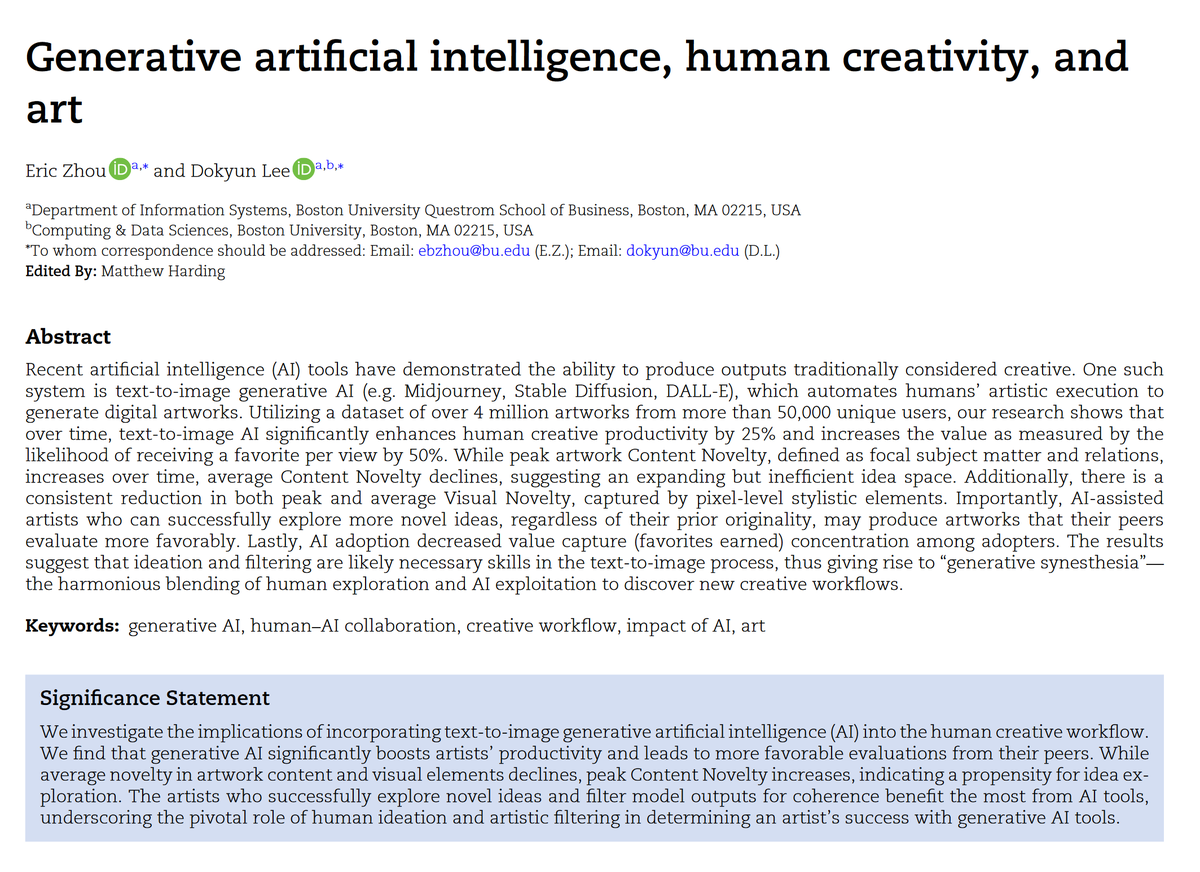
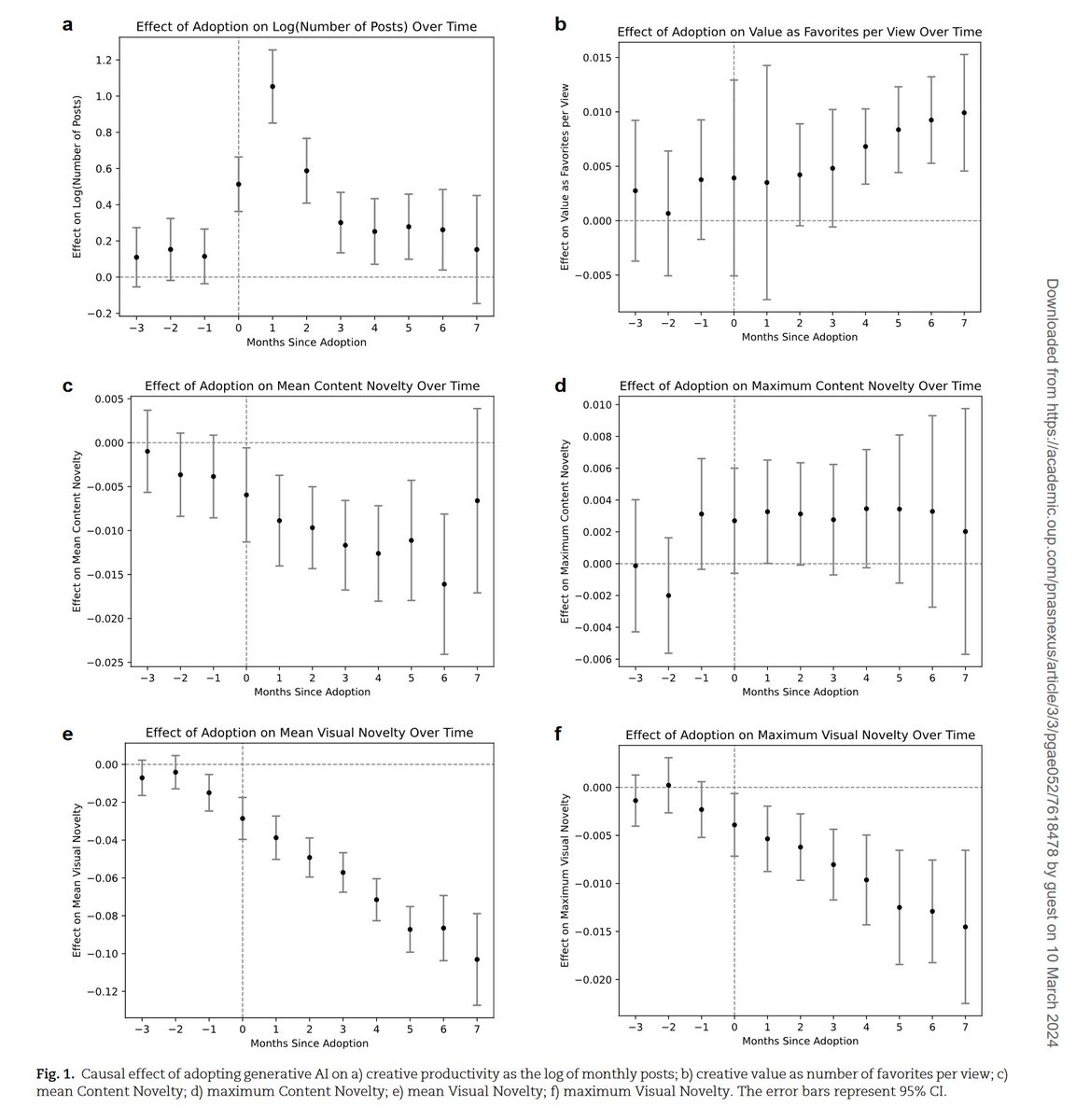
Adopting AI made internet artists much more productive & greatly boosted the appeal of their art... but also lowered the novelty of most folks' work.
However, the most creative artists are able to use AI to become much more creative, exploring new options https://t.co/CtQpT06FXV
Remember how Sam Altman told the US Senate he had no “direct” investment in OpenAI? and how they gushed over his apparent selflessness?
👉He didn’t mention that (presumably) he had equity in YC which likely has equity in OpenAI.
And now this:
👉“OpenAI Agreed to Buy $51 Million of AI Chips From a Startup Backed by CEO Sam Altman”
#candor
@ShawnFumo@SashaMTL It's because the author meant to say per 1000 generations.
From the paper:
(stable-diffusion-xl-base-1.0) generates 1,594 grams of 𝐶𝑂2 for 1,000 inferences, which is roughly the equivalent to 4.1 miles driven by an average gasoline-powered passenger vehicle
@SashaMTL I thought the paper said this was per 1,000 generations. Not per 1 generation.
From the paper:
(stable-diffusion-xl-base-1.0) generates 1,594
grams of 𝐶𝑂2 for 1,000 inferences, which is roughly the equivalent to 4.1 miles driven by an average gasoline-powered passenger vehicle
Seems like the first news article with leaks from the board, and possibly the first to represent something like their perspective?
I have to say, if @sama was trying to keep board members from saying anything negative about OpenAI's safety practices in public, I think this is really bad behavior on Sam's part.
Sam acknowledges that the stuff OpenAI's trying to build toward has a strong chance of killing literally everyone on Earth. This is not a game. These are not normal tech companies.
If no one with privileged information about these companies is allowed to say anything public about the relative merits of DeepMind's approach, OpenAI's approach, Anthropic's approach, etc., then that severely limits humanity's ability to use any tools at all to improve our approaches and converge on sane practices.
If you disagree with Toner's analysis, you should argue against it, not try to suppress it in order to protect your company's reputation and bottom line. This seems totally obvious to me. (Though, again, maybe the NYT article here isn't fairly summarizing what happened. The article was co-written by Cade Metz, who often gets lots of basic facts wrong in his articles — indeed, I can spot some obvious errors in this one already.)
I do have to say, I remain confused about why the board has said so little about their reasoning. I don't know what the real story is here, but if the real story is "EAs trust Dario to safely steward AI but don't trust @sama", then even if they're right to think Sam is too reckless for this role, it's important that they be open and public about their reasoning.
(But maybe that's not their motivation at all? I notice I'm confused about a bunch of things here.)
Stepping back a bit, as someone who's pretty lacking in details about what's been happening at OpenAI internally, it sure seems concerning from where I'm standing that OpenAI's entire safety leadership team and a big chunk of its safety talent mutinied a few years ago, apparently based on concerns that safety wasn't being taken seriously enough...
... and that OpenAI's nonprofit board then came around to the same view a few years later ("Sam and OpenAI aren't prioritizing safety enough")...
... and that in neither case has there been any public accounting at all of what exactly happened, what the different factions' arguments are, etc.
And if the NYT anecdote is true and Sam is pretty obsessed with blocking people from criticizing OpenAI in public, Sam may be directly responsible for no public accounting having ever occurred. (Or maybe there's a more general "don't criticize us or let the public / outsiders be in a position to evaluate our safety practices" culture at the company.)
If there were serious safety concerns behind Dario and co. exiting OpenAI years ago, then it seems like there almost can't be a prosocial justification for keeping the facts under wraps about what happened, years later. Surely this stuff matters. Surely the public, and employees at these companies, and the broader research community would be in a better position to evaluate "is company X going to get us all killed?" if there weren't this effort to suppress discussion.
This comment and its subthread by @austen are massive🤦♂️by two people who seemingly understand neither the history nor the legal structure of OpenAI. Some important context:
👉The board shouldn’t have fired Toner doing this kind of research; that’s what OpenAI was built to do. The for-profit was there to subsidize that research not to eliminate it.
👉OpenAI itself has published many other related papers, including their analysis that famously said that GPT-2 was too dangerous to release.
👉OpenAI recently pledged even more $ for this general kind of research.
👉Toner’s reputation for excellence in this kind of research is WHY the board hired her.
👉Presumably Sam and whomever was on the board when she was appointed chose her for that very reason.
👉The nonprofit board had, by design, and by by-law, the top level obligation, and their obligation was to safety and benefit to humanity.
If Toner found a flaw in that design, the company had an obligation to look into it, not to repress it.
The number of people simply unable to imagine that the Board acted in a good faith with a legitimate and serious concern boggles my mind.
We don’t of course know what happened, but simply dismissing that possibility seems foolish to me, especially given that they were not operating out of financial self interest, unlike all the other actors here.
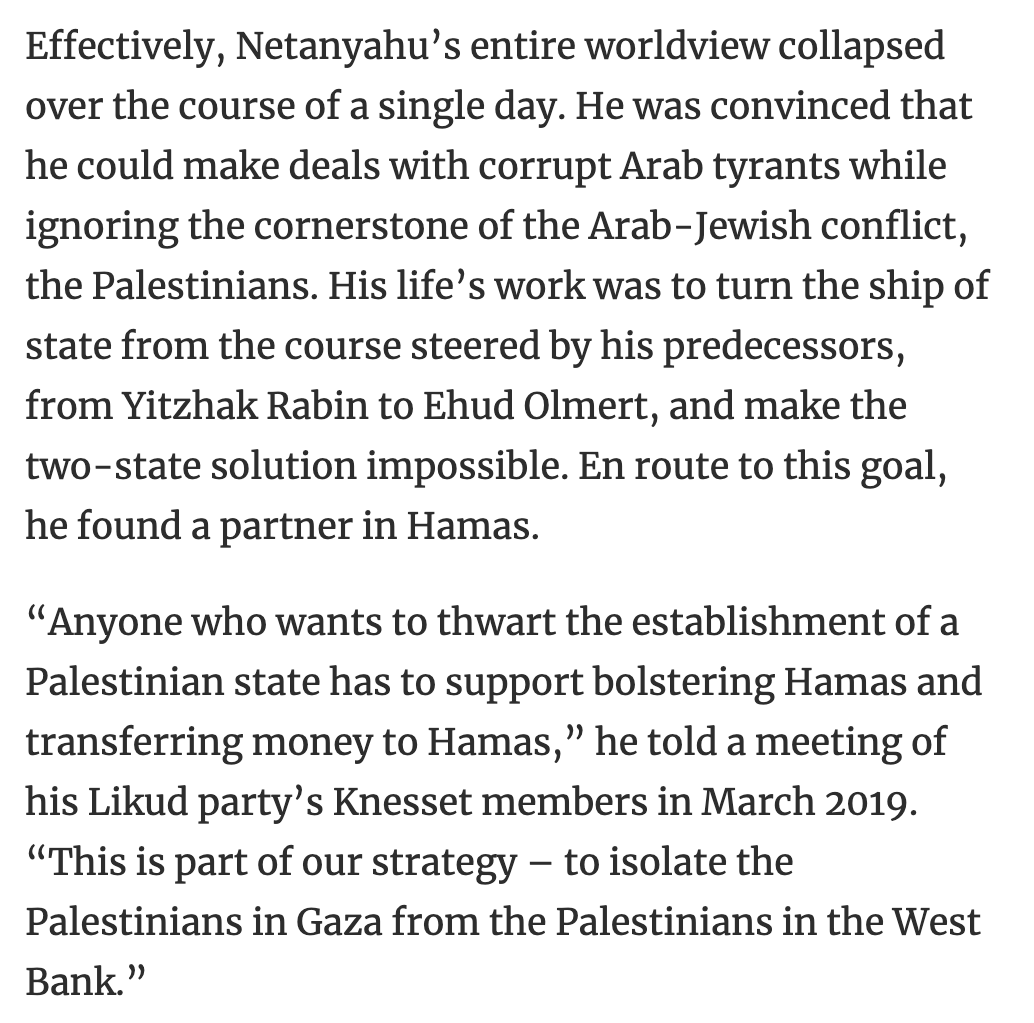
“Anyone who wants to thwart the establishment of a Palestinian state has to support bolstering Hamas and transferring money to Hamas,” Netanyahu told his Likud party’s Knesset members in March 2019. “This is part of our strategy"
https://t.co/7lTQs9E5Zf
Learning that Benjamin Netanyahu actively supported Hamas in order to undermine Palestine is so extraordinarily horrifying, I don't know what to say. From Haaretz
https://t.co/6vKW42MmOy
@XRMultiverse@stealcase The developers of the ai would be the ones heald liable for creating an ai that is able to mimic art styles used to train it. A commercially safe ai would only be able to recreate generic styles that are not associated with a specific artist (unless they license that style)
@XRMultiverse@stealcase The developers of the ai would be the ones heald liable for creating an ai that is able to mimic art styles used to train it. A commercially safe ai would only be able to recreate generic styles that are not associated with a specific artist (unless they license that style)
@XRMultiverse@stealcase You could have copyright protections on art style that 𝘰𝘯𝘭𝘺 𝘢𝘪 𝘨𝘦𝘯𝘦𝘳𝘢𝘵𝘰𝘳𝘴 𝘸𝘰𝘶𝘭𝘥 𝘣𝘦 𝘳𝘦𝘲𝘶𝘪𝘳𝘦𝘥 𝘵𝘰 𝘢𝘩𝘦𝘳𝘦 𝘵��. i.e. an artist mimicing an art style is fine but midjourney doing it would not be.
Humans would still be free to mimic any style