To soften the blow of the stock market losing $2.8 trillion today, we have represented the drop with Parkway's Thanksgiving Po Boy, available every Wednesday in November.
The AI infrastructure depreciation bear thesis is getting DESTROYED by actual GPU rental data.
For the last couple of years, bears have argued that companies spending billions on GPUs will get crushed by depreciation as newer chips come out but the actual GPU rental market is telling us a completely different story.
According to data from a16z, GPU rental rates are holding up significantly better than traditional six year depreciation schedules would suggest. $NVDA H100 rental rates are 54% above their modeled depreciated value, H200s are 143% above, B200s are 111% above, and even the RTX PRO 6000s are 73% above. What's even more interesting is that H200 and B200 rental rates have actually increased substantially despite newer generations of GPUs entering the market.
This is EXTREMELY bullish for AI infrastructure companies. The entire bear thesis assumes older GPUs will quickly lose their economic value. But demand for compute is growing so quickly that even older GPUs remain useful for inference, fine tuning, and smaller AI models. Not every workload requires the latest Blackwell or Rubin chips. If rental rates remain elevated for longer than expected, these companies could generate significantly more cash flow from their existing GPU fleets without constantly replacing their hardware. It could also improve financing economics as lenders become more confident in the long term revenue potential of these assets.
Obviously, rental rates alone don't determine profitability, and utilization and operating costs still matter. But the bigger takeaway is that the market may be significantly underestimating how long these GPUs can remain economically productive. And if inference demand continues growing at this pace, the economics of owning AI infrastructure could end up being a lot better than investors currently expect.
@MinervaCap I’m looking at total earnings, and more closely the unemployment rate. Still healthy if not a little anemic. Everything comes down to employment.
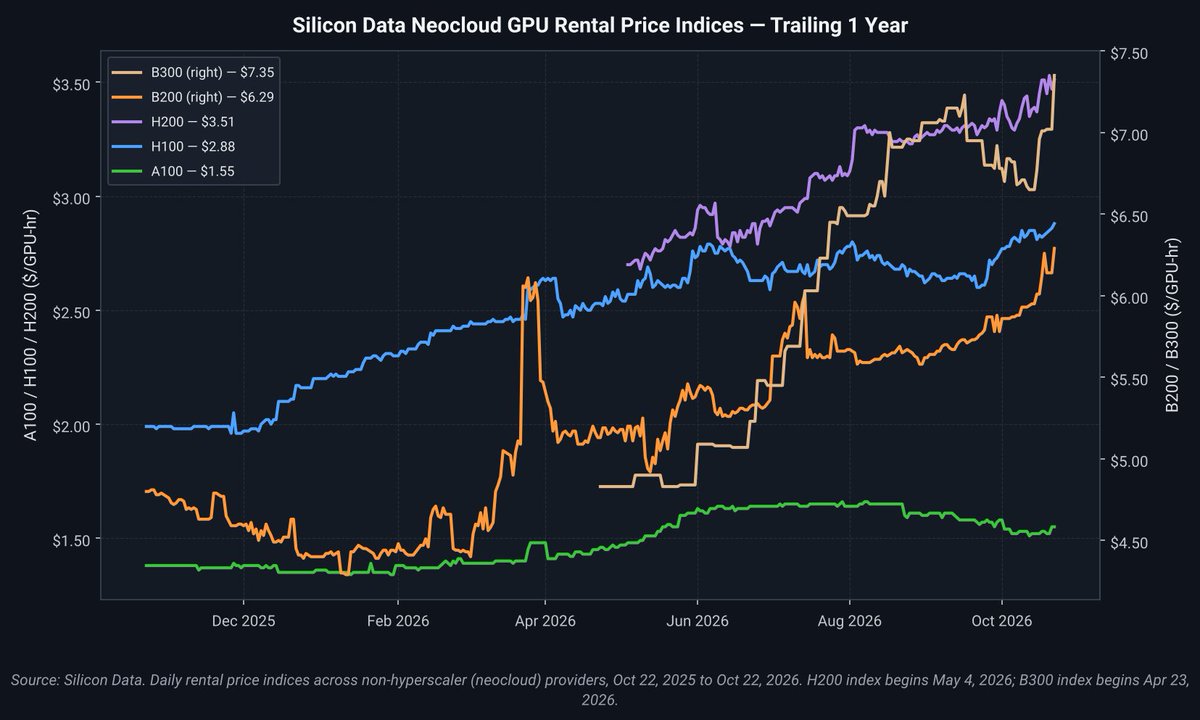
GPUs are aging like fine wine, with rental rates up across the board since January 1st
Approximate change YTD:
- H200: +160%
- B200: +120%
- RTX PRO 6000: +65%
- H100: +35%
Even the 6-year-old A100 rents for more than it did at the start of the year
Charts of the Week: https://t.co/KJWFSaIGCd
Another day, another round of on-demand GPU rental indices surging across the board and reaching ATHs. Even the A100 index, which recently saw some softness, seems to be inflecting a little.
There have been approximately 40-50 datacenters cancelled across the US. These datacenters were still in the speculative phase and not baked into any earnings projections for contractors and suppliers. Existing cloud providers will have marginally more pricing power.
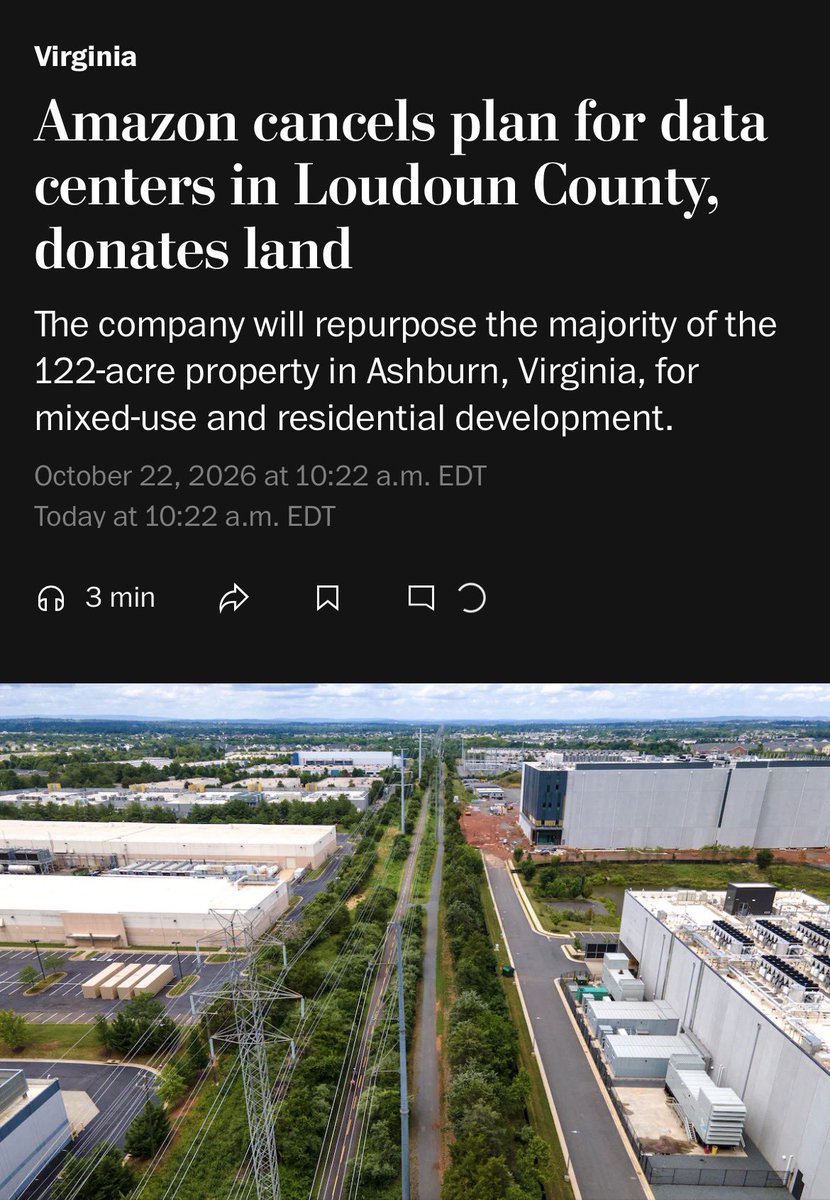
Coincidence? $AMZN cancels data center plans with billions of $NVDA GPUs in warehouses
were those GPUs meant for that campus?
they are “donating” the land that they spent $427 million on
The second cancellation this week after $MSFT dunked on Nscale for power
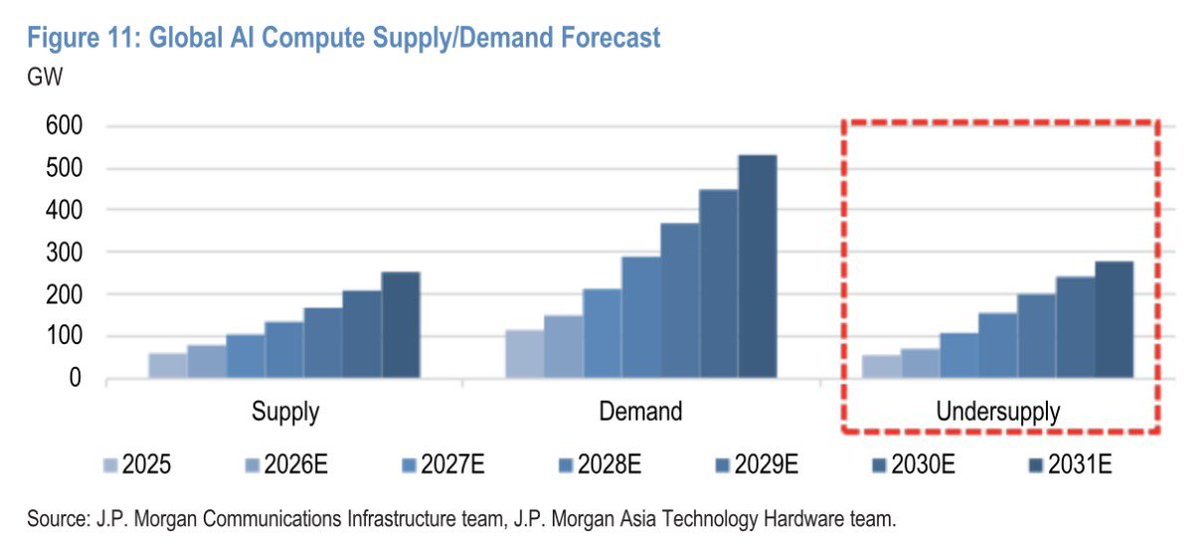
JPMorgan just dropped an ABSOLUTELY INSANE forecast for AI compute.
According to JPMorgan, global AI compute demand is expected to reach roughly 530 GW by 2031, while available supply is projected to reach just 250 GW. That leaves us with a staggering 280 GW shortfall, even after the industry spends hundreds of billions of dollars expanding capacity. We're talking about global AI compute supply potentially QUADRUPLING between 2025 and 2031, yet the shortage is expected to get even WORSE. In fact, JPMorgan estimates the gap between supply and demand could expand from roughly 50 GW today to nearly 280 GW by 2031.
And here's why this matters so much. When demand consistently outpaces supply, the companies controlling scarce compute capacity gain enormous pricing power. This is especially important for neoclouds like $NBIS and $CRWV, which are building out GPU infrastructure to serve customers that simply cannot secure enough compute capacity through traditional hyperscalers. If JPMorgan's projections are even remotely accurate, GPU rental pricing could remain stronger for much longer than investors currently expect, supporting higher utilization rates, long term contracts, and potentially stronger returns on deployed infrastructure. But the opportunity extends FAR beyond neoclouds. Companies like $NVDA and $AMD benefit from the continued need for accelerators, memory manufacturers like $MU benefit from increasing demand for high-bandwidth memory, and networking, storage, power, and cooling providers all become increasingly important as the industry attempts to close this gap.
And this is where I think the market is making a BIG mistake. Investors are so focused on whether AI companies are spending TOO MUCH money that they're overlooking the possibility that the industry STILL isn't spending enough to satisfy future demand. The real constraint isn't necessarily a lack of customers willing to pay for compute. It's the ability to manufacture enough chips, secure enough electricity, build data centers fast enough, and actually bring that capacity online. And that is EXACTLY why I continue to believe the biggest winners in AI won't necessarily be the companies building the models, but the companies supplying the infrastructure required to run them.
Five percent government bonds is not a crisis. High rates are the price of money when the economy is still growing, and inflation is still above target. With rates at this level, is it worth adding safety to your portfolio?
https://t.co/dt0LzPGcTN
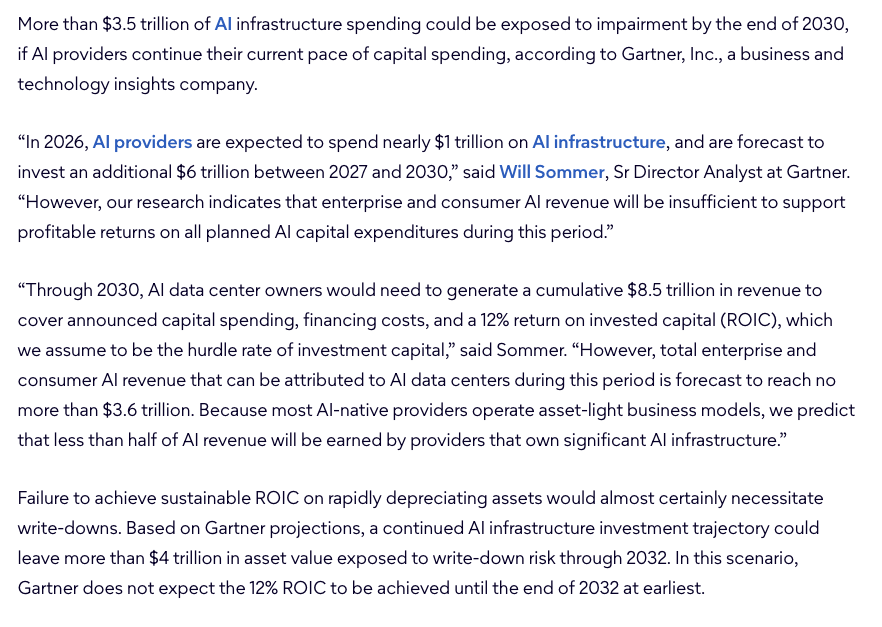
Gartner says that by 2030, 80% of neoclouds will have ceased operations, that AI data center owners would need to generate $8.5 trillion in revenue to cover the current spend and hit an ROIC of 12%, and that $4tr+ in assets face writedown risk by 2032.
https://t.co/SW7k68J4aK
Just how full is the hyperscaler/AI IG debt pipeline: there have been zero deals since the start of September. And SPVs not doing better.
As a reminder, debt becomes capex, becomes revenue, becomes EPS.
Without debt, there is no EPS growth.