Things are heating up on Terry Tao’s blog. In “If Math Is More Than Proof, We Need to Better Celebrate the Rest of It,” Grant Sanderson of @3blue1brown proposes “open exposition problems” -- rewarding the work of making math genuinely understandable.
https://t.co/zBOhhDNuNU
Build your own harness, folks.
This is absolute banger paper from NVIDIA on self-evolving agent harnesses.
(bookmark it)
They introduce SoL-Pi which cuts token traffic by nearly half.
And it matches its baseline harness on GPT-5.6 Sol and Opus 5.
More details below:
Instead of tuning a harness by hand, they run auto-research loops at the harness layer across many repository-derived and verifier-driven environments, keeping only the mechanisms that survive selection.
Four mechanisms survived:
> Action Fusion changes how actions execute
> Online Context Compact handles compaction during a run
> ObservationPack reshapes observation handling
> Evidence-Preserving Reducer covers delegated reading
On the 51-task EdgeBench evaluation, the savings translate to about a third off API cost. In dollars that is an estimated $8.75 to $13.50 per hour against native Codex and Claude Code harnesses, and $4.36 to $5.71 against the baseline harness.
Because the search runs across many environments rather than one, the retained mechanisms keep working outside the setting that produced them. Code is on GitHub under NVlabs.
Paper: https://t.co/1x26LzuE6d
Chat with Paper: https://t.co/kygTc5XLFB
Before you spend $2,000 on another AI engineering course, look at what Harvard has put online for free.
Prof. Vijay Janapa Reddi’s Machine Learning Systems project has grown into a full curriculum for understanding what happens when an ML model has to become an actual system. The official site now describes it as a complete curriculum for AI engineering.
Volume I goes from ML system fundamentals and training to model optimization, hardware acceleration, benchmarking, deployment, serving and operations. Volume II moves into the harder systems layer: compute infrastructure, distributed training, communication, reliability, inference at scale and fleet operations.
And it isn’t just two textbooks.
→ 34 interactive labs that run in the browser
→ TinyTorch for building the machinery from tensors upward
→ hardware kits for hands-on deployment
→ MLSys·im for reasoning about systems and infrastructure
→ StaffML for ML systems design practice
The GitHub project is already sitting at ~28K stars.
A lot of people learn how to train a model. Far fewer learn what it takes to make that model work reliably as part of a real system.
Before paying $2,000 to learn that second part, I’d start here.
There is such an enormous power just waiting to be awakened. All it needs is confidence: to known and understand who and what it is and who and what it’s fighting for.
Your weekend read, from the new issue of Arena Magazine. The best thing I have ever read on why Palantir is doing so well with AI -- and how the frontier labs are paying attention and reacting.
By @lefttailguy@ByrneHobart
https://t.co/nfijzQdUSs
Few books outside history, sociology and economics have shaped my thinking as Freeman Dyson (physicist) A Many Colored Glass.
Its so elegant and simple and small that I still think about it positions the ability of humans to shape their world without necessary antagonism. It was the first use of the word "dominion" that was not pejorative that I saw.
Worth every minute.
A whole different world used to exist
Its foundation was excellence and tradition, not equity and egalitarianism. It built beautiful things, was oriented towards achievement rather than feelings, and created nearly everything we find useful or attractive
It died in 1914, with the guns of August. This book by Charles Emmerson, far better than The Proud Tower by Barbara Tuchman, shows what that world was like, in ways good and bad. He paints a portrait of a very different world, one that most who are frustrated with the world today because of how it crushes the capable for the benefit of the incapable would find very attractive
There's much we can learn from this
This piece by Scott Aaronson is like the sharpest knife that cuts through the messy, politicized discussions on AI, the risk, if we should be alarmed or not, why and what we should do.
If you don't want to do anything useful today, you've done something productive by reading this piece from top to bottom, word for word. https://t.co/f6wUPyrKG7
The finest writing on Sir Roger Scruton, the man, that I have ever read. By the finest journalist working in this world right now, @ddhitchens https://t.co/wVaqmm0F7X
Philosopher @_NatHansen_ has created a website that uses AI to take people through a Socratic dialogue about a philosophical thought experiment
I just gave it a try. In my opinion, it really does help users think through these questions
https://t.co/x1cavHDztx
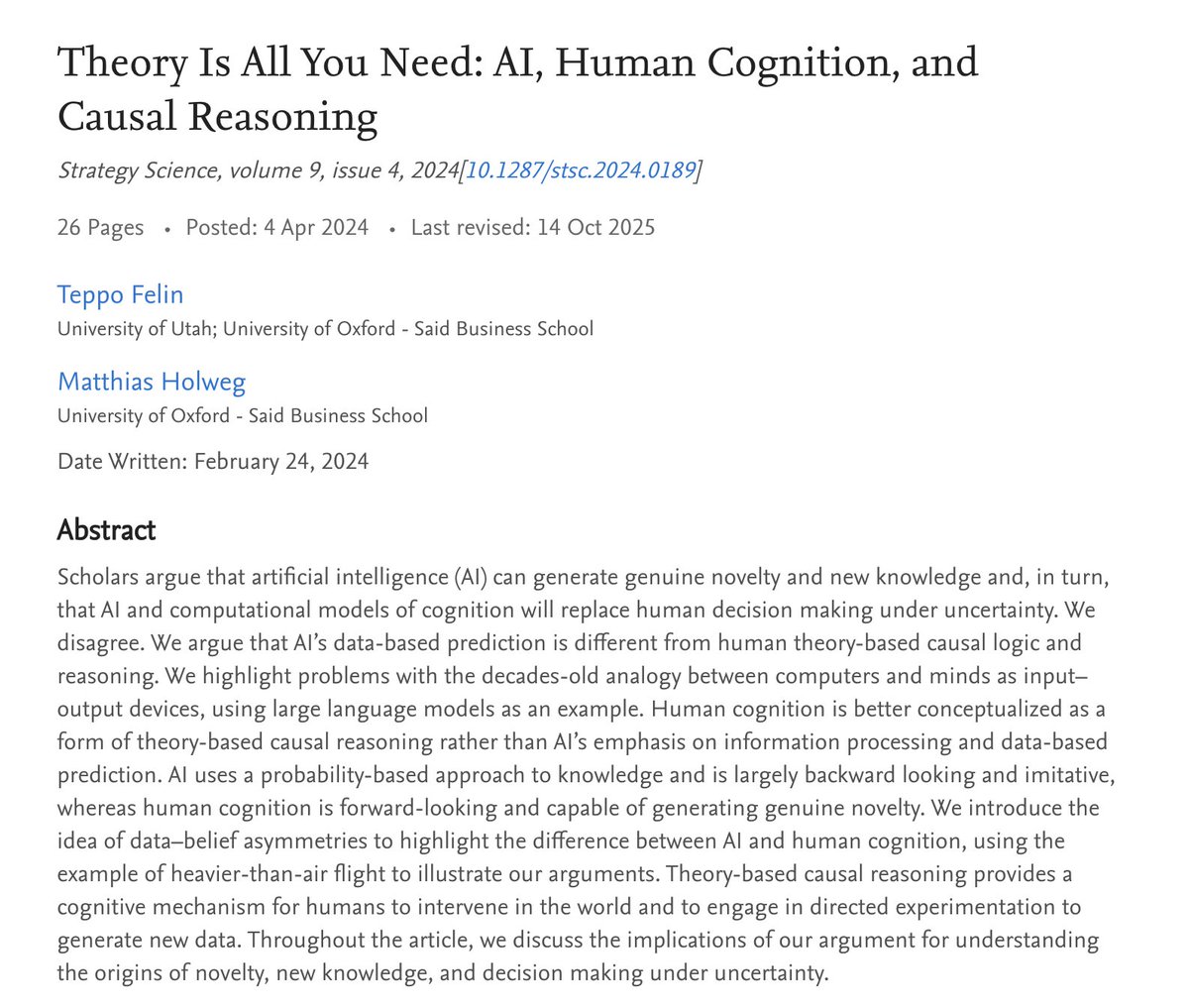
Oxford researchers argue that LLMs can never invent anything.
It is mathematically impossible.
They published a paper called “Theory Is All You Need" and it argues against the claim that computational models can generate genuine novelty or new knowledge.
They analyzed the limits of generative ai, and the results are a brutal reality check for the idea that ai will replace human decision making under uncertainty.
Here is why AI is stuck and human cognition wins:
backward-looking vs forward-looking.. llms are probability machines that look backward at existing data. human cognition is forward-looking and capable of generating genuine novelty. human cognition operates theoretically "top-down" rather than "bottom-up" from data.
the "data-belief asymmetry".. the researchers use the invention of "heavier-than-air flight" to illustrate this concept. an ai relies on data-based prediction, which is largely imitative. humans, however, use theory-based causal logic that allows them to hold beliefs that go beyond existing data.
the intervention gap.. humans don't just process information; we use theory to practically "intervene" in the world. we engage in directed experimentation to generate entirely new data. ai-based models are theory-free and place primacy on existing data and prediction.
tldr?
AI uses a probability-based approach to knowledge and ia largely imitative. It can process data and make predictions, but human cognition relies on theory-based causal reasoning.
The decades-old analogy comparing human minds and computers to mere "input-output" devices is fundamentally flawed.
This is an insanely important report about how completely, utterly and totally unprepared Europe is for the arrival of transformative AI.
A single data centre in Malaysia will soon have a third of the AI computing power of *all* of Europe combined. Two data centres in the US will have more than our entire continent.
And that's just page one...
More than 60 of Europe's top minds (including two Nobel laureates) have just published "A Transformative AI Strategy for Europe", an independent report about how dire the situation is. As the world gets darker, we risk being squeezed and trampled by the US and China. On the current path, the report warns, even Europe's richest economies could slide toward middle-income status in a world run from Silicon Valley and Beijing.
Here's where we are right now:
→ The EU hosts just 5% of the world's AI compute. The US: 75%.
→ Not one of the ten most valuable AI companies in the world is European.
→ And this year, Europe got locked out of the world's most powerful AI model, twice, by American export rules. The EU's own cybersecurity agency had to negotiate for weeks to get in, and still doesn't have the latest version.
For years the comfortable story was: America innovates, Europe regulates. Well, that story is dead. You can't regulate what you can't access. And you can't protect 450 million people with second-rate cyberdefence against first-rate attackers.
The good news is that we have some leverage: Europe holds the single biggest chokepoint in the global chip supply chain (ASML). And this report sketches a plan to increase our leverage massively. Here's what we need to do:
1. Build a member state alliance for supply chain security – Netherlands, Germany and France at minimum – founded before the end of 2026.
2. Recruit many more frontier AI experts inside European governments ASAP.
3. Aim for at least 15% of global AI compute on European soil by 2030, built so local communities actually benefit.
4. Make Europe the world leader in AI assurance: hardware that can prove how AI is being used.
5. Prepare for crises and emergencies, such as engineered viruses and highly advanced automated cyberattacks.
It's too late to catch up with the US and China. But it's not too late to build leverage .
Read the full report here --> https://t.co/Byi5WYC8yW
this is pure f*cking treasure
these 10 agent skills have 8.01M combined downloads and form a complete working stack
discovery. pressure-testing. design. browser work. prototyping. debugging. vision. orchestration. tool building
01 find-skills
▸ https://t.co/4bLmKlF5Pb
02 grill-me
▸ https://t.co/bAZECpykZO
03 frontend-design
▸ https://t.co/dl2Tn9R3gE
04 agent-browser
▸ https://t.co/ZM0T9INIur
05 prototype
▸ https://t.co/bAZECpykZO
06 diagnosing-bugs
▸ https://t.co/bAZECpykZO
07 skill-creator
▸ https://t.co/dl2Tn9R3gE
08 image-to-code
▸ https://t.co/h6Quxsunw5
09 subagent-driven-development
▸ https://t.co/IlbrmGxOB9
10 mcp-builder
▸ https://t.co/dl2Tn9R3gE
the stack covers the full loop:
find the capability ⮕ shape the idea ⮕ build it ⮕ inspect it ⮕ verify it and package the workflow for the next run
save this, then select your gpt-6 astra use case ⭣
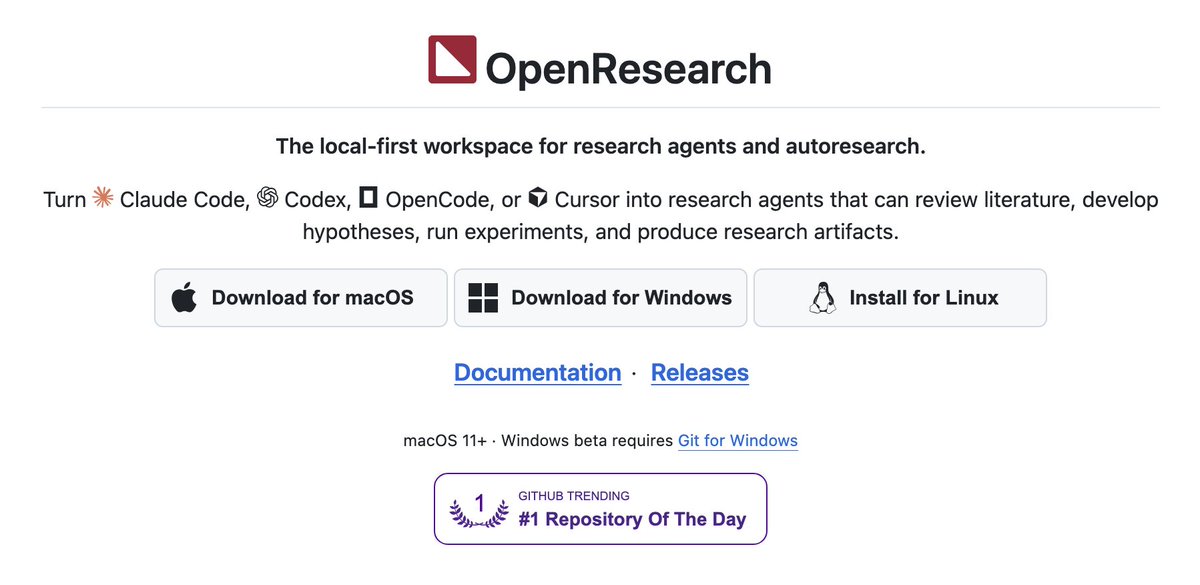
OpenResearch was the #1 trending GitHub repo on Friday 🚀
With OpenResearch, you can turn any coding agent into a research agent that reviews literature, develops hypotheses, runs experiments, and produces research artifacts.
Own and automate your research stack end-to-end. Now available on Windows.
Check it out: https://t.co/IDi6bmrxTP