BREAKING.: Biggest privacy token $ZEC crashed over -50% in the last 24 hours and wiped out $5 Billion from its market cap.
The flaw was hidden inside Zcash's Orchard privacy pool since May 2022 and remained undetected for nearly 4 years despite multiple security audits.
Security researcher Taylor Hornby reportedly used Claude Opus 4.8 AI model to build a working proof-of-concept that successfully generated counterfeit ZEC in local testing on May 29.
Although the bug has now been patched on June 2, The issue is that Zcash's privacy design makes it impossible to know if any fake ZEC was minted before the fix. Unlike Bitcoin, where anyone can verify the supply, Zcash's privacy design makes it impossible to audit whether fake coins were secretly minted before the fix.
The team denies any fake ZEC was minted, but traders are selling on the fear alone. Imagine someone secretly adding extra chips to a casino, but because of the way the system works, neither the casino nor the players could tell which chips were real and which were fake.
Shielded Labs is exploring a proposed Network Upgrade to allow anyone to verify the integrity of Zcash supply.
Zcash $ZEC was allegedly exploited by Claude Opus 4.8 and is down 25% today
If they release Mythos, we might see a bloodbath across the entire crypto sector
LATEST: More than half of all $BTC in circulation is now held at an unrealized loss, a signal that has coincided with every major bear market bottom in history.
let me give a proper explanation on how this shit works because seeing a lot of fake news
when you see these insane candles happening on random tokens like LAB, RAVE, Momentum etc it’s because of a group of people do what is called “active market making”
almost all of these “active market makers” are based in China/Asia. many claim to be able to achieve results like RAVE and LAB but few can actually properly deliver
typically these AMMs will either approach projects prior to launch or after launch (if certain conditions can be met). but scammy projects also look to approach them
the deal is usually that the AMM will put up the capital needed to push the token to the insane highs you see, and in return for the project letting the AMM “crime” their token they split whatever the profits are once the crime is complete
so how does the crime work and how do the people involve profit?
the first thing you’ll notice is that all these tokens have perp listings (usually binance perps) but very few spot listings
this is intentional. the first major requirement for this crime to happen is absolute control of the spot supply of the token
by that I mean the team/insiders need to control basically the entirety of the float. RaveDAO for instance, insiders were estimated to control over 98% of the spot supply
this is vital because spot supply that isn’t controlled by insiders can be sold into the spot price being driven up by perps. to help prevent this is another reason why tokens with basically no spot listings or liquidity are chosen. if there is a lot of spot supply ready to be dumped on the AMM then it could bankrupt them, meaning the crime has failed
as it is their capital at risk, AMMs are even asking projects to put them on all the multisigs for the token supply, to ensure that nothing can be dumped while the crime is happening
so once supply is completely controlled then what?
these AMMs don’t just commit the crime from one or two binance accounts. the accounts would likely be frozen instantly. instead they have 1000s of KYC’d accounts which operate in unison to drive the perp price up
because no one has supply to sell, there isn’t any other way to drive the price back down except to short
but this is where they get you
the AMM can squeeze any short placed, as every shorter will have their breaking point. either their own tolerance or a liquidation point. every short that gets liquidated or stopped out is profit for the AMM
add onto the fire that because of huge dislocations between underlying and perp price, you get some insane funding rates. as I write this LAB is -1% an hour shorts pays longs (over 8000% a year). this makes it even harder for shorts to hold their position, plus the AMM is making bank on their long positions funding
BriskCapital is right when he says they wouldn’t have let him win with this size of a short position, especially publicly. his mistake was trying to short it in the first place, which is exactly what the AMMs want you to do. where do you think the 7 figs he lost went to?
then whenever they decide the crime is complete they pull the rug and you see the collapse candle to zero. because they are the only entity holding the bid up, they have complete control over when and how the price collapses (meaning they can also likely join in on the short)
my advice is to not touch these tokens. if you want to feel something just buy a small amount for fun. definitely do not buy anything sizeable, do not make any trades on leverage and DO NOT SHORT
you are trying to compete against an entity that has complete control over where price goes
Plans released for a $16 billion mile-long ship capable of carrying 80,000 people.
The 'Freedom Ship' would be home to about 50,000 people, with space for 10,000 tourists and 20,000 crew members.
"The Freedom Ship is envisioned as a permanently mobile city at sea designed for long-term residence rather than short-term travel," the company says.
The ship would be about 8 times the size of the current largest ship in the world, the Royal Caribbean’s Icon of the Seas.
The plans include a 15,000-seat stadium, schools, colleges, shops, clubs, a water park, a music hall, museums, parks, and more.
The ship, which would run on nuclear, would be too large to dock and would remain in international waters.
Freedom Cruise International says it would go around the world every two to three years.
Insane.
A British biologist looked at 200,000 years of human history and found that the entire reason humans broke out of poverty was not intelligence, not language, not even agriculture, but one mechanism so simple a 6-year-old could explain it.
His name is Matt Ridley.
He is a zoologist by training, an evolutionary biologist by career, and in 2010 he wrote a book called The Rational Optimist that quietly argued the most important fact about human progress had been hiding in plain sight for the entire history of economics.
Naval Ravikant has been telling people to read everything Ridley has ever written for the last 15 years. The reason is the argument inside this one book.
For 200,000 years, anatomically modern humans walked around with the same brain you have right now. Same skull size. Same neural architecture. Same raw capacity for language, planning, and abstract thought.
For roughly 190,000 of those years, almost nothing happened. Generation after generation lived and died inside the same Stone Age toolkit their great-great-grandparents had used. Then somewhere around 50,000 years ago, the line on the chart of human progress started to tick upward. Then it bent. Then it exploded.
The question Ridley spent years on was the only question that mattered. What changed.
It was not the brain. The brain had been the same for 190,000 years. It was not language, which had existed long before the takeoff. It was not even agriculture, which arrived only 10,000 years ago and was actually preceded by the upward bend, not the cause of it.
What changed was that humans started trading with strangers.
This sounds too small to be the answer. Ridley argues that it is the answer to almost everything. The moment one human exchanged a useful object with another human from a different group, something happened that no other species on earth had ever done.
Two ideas that had developed in isolation came into contact. The flint knapper learned what the spear maker had figured out. The fisherman from the coast learned what the hunter from the forest had figured out. The two pieces of knowledge fused into something neither side could have produced alone.
Ridley calls this ideas having sex. The phrase sounds frivolous and it is meant to. The point is that ideas, like genes, get better when they combine with other ideas from different lineages.
An idea sitting inside one head, no matter how brilliant the head, eventually hits a ceiling. The same idea exposed to ten thousand other ideas does something genes do under sexual reproduction. It mixes. It recombines. It produces offspring nobody planned.
The cleanest proof of this argument is the most uncomfortable case study in the book. Tasmania.
Around 10,000 years ago, rising sea levels cut Tasmania off from mainland Australia. A population of roughly 4,000 humans was now isolated on an island, with no possibility of contact with the rest of humanity. They had the same brains. The same language. The same starting toolkit as their cousins 150 kilometers north. The natural experiment was now running.
What happened next is something no economist or geneticist had ever predicted.
The mainland Australians kept inventing. Boomerangs. Spear-throwers. Fishing nets. Bone needles for sewing fitted clothes. Watercraft with paddles. Their technology compounded slowly across the centuries.
The Tasmanians went the other way. They did not just fail to invent the new tools their cousins were developing. They started losing the tools they already had. Fishing was abandoned within a few thousand years. Bone tools disappeared. Fitted clothing disappeared. They forgot how to make fire from scratch and started carrying lit firebrands from camp to camp instead, relighting their fires from a neighbor's whenever their own went out.
By the time European explorers arrived in the 17th century, the Tasmanians had the simplest toolkit of any human society ever recorded. Their material culture had gone backward for 8,000 years.
The archaeologist Rhys Jones called it a slow strangulation of the mind.
Joseph Henrich at Harvard later proved with formal mathematical models that there was nothing wrong with Tasmanian brains. There was something wrong with their network. A toolkit requires a critical mass of people exchanging skills to maintain itself.
The act of teaching a skill is imperfect. Every generation loses a small percentage of what the last generation knew. If your population is large enough and trading widely enough, those losses get caught and corrected by someone else who still remembers.
If your population shrinks below a certain threshold and stops mixing with outsiders, the small losses compound until entire technologies disappear.
This is the part that should haunt anyone reading this in 2026.
Intelligence is not a property of the individual brain. Intelligence is a property of the network the brain is connected to. A genius in isolation will produce less than a mediocre thinker inside a dense exchange of other mediocre thinkers.
The thing your ancestors needed in order to break out of 190,000 years of stagnation was not better brains. It was better connections between brains they already had.
The implication for any individual is direct and uncomfortable. If you are smart and isolated, you will be outproduced by people half as smart who are connected.
The most successful people in any field are almost never the smartest people in it. They are the ones positioned at the intersection of the most idea flows. They are reading more authors than their competitors. They are talking to more people from more disciplines. They are in the rooms where ideas from different lineages bump into each other.
Ridley ends the book on the line that sounds optimistic but is actually a warning its this "The future will be invented by people who connect ideas, not by people who guard them."
The most expensive "no" in Wall Street history, Bear Stearns turned down half of KKR for free, he left with $10k at 32, started an industry
Bear Stearns no longer exists, his firm manages $500 billion
"if you always worry about what you can lose and never worry about how much you'll make, you'll always make money"
"if you don't like change, you're going to like irrelevance a lot less"
bookmark and watch it today - it will change the way you think about risk, failure, and building something from nothing ↓
The debt Burry called fake is trading 6% above its face value.
Apollo has already booked $250 million in gains on this position.
Debt built on fake numbers does not trade above par, It collapses.
The deal was announced in a public Apollo press release on January 7, 2026. Latham and Watkins, Proskauer Rose, and Sullivan and Cromwell are named as legal counsel on the transaction.
These are three of the largest law firms on Wall Street.
Valor is a fund managed by Valor Equity Partners a real, established asset management firm with institutional limited partners.
The structure is a chip sale leaseback. Nvidia sold the GPUs. Valor holds legal title. xAI leases and operates them. Every party is named. Every dollar is disclosed.
This structure is not unique to this deal. Meta, Oracle, and CoreWeave have moved more than $120 billion in AI infrastructure off their balance sheets using identical SPV structures funded by PIMCO, BlackRock, Blue Owl, and JPMorgan.
This is now standard practice across every major technology company building AI infrastructure.
Athene holds $34 billion in regulatory capital with a 441% RBC ratio against a 100% regulatory minimum. 95% of its portfolio is fixed income. 97% of that fixed income is investment grade. The leverage target is below 30%.
The Bermuda structure operates under a regime the European Union recognizes as equivalent to its own Solvency II standard.
The NAIC classifies Bermuda as a Qualified Jurisdiction. A dollar of reserves there carries identical regulatory weight to a dollar held in the US.
None of this means the risks do not exist. xAI burns approximately $1 billion a month.
The SPV structures do add leverage that does not show up cleanly on balance sheets.
These are real concerns. But there is a difference between a known, disclosed, priced risk and a fraud. This is the former.
🚨Michael Burry just said Elon Musk and Nvidia's deal is built on fake numbers.
Burry published a detailed breakdown calling the entire structure "Fugazi", his word for fake.
He is alleging that billions of dollars in Nvidia chips are being hidden off balance sheets, and that American retirees are unknowingly funding the whole thing.
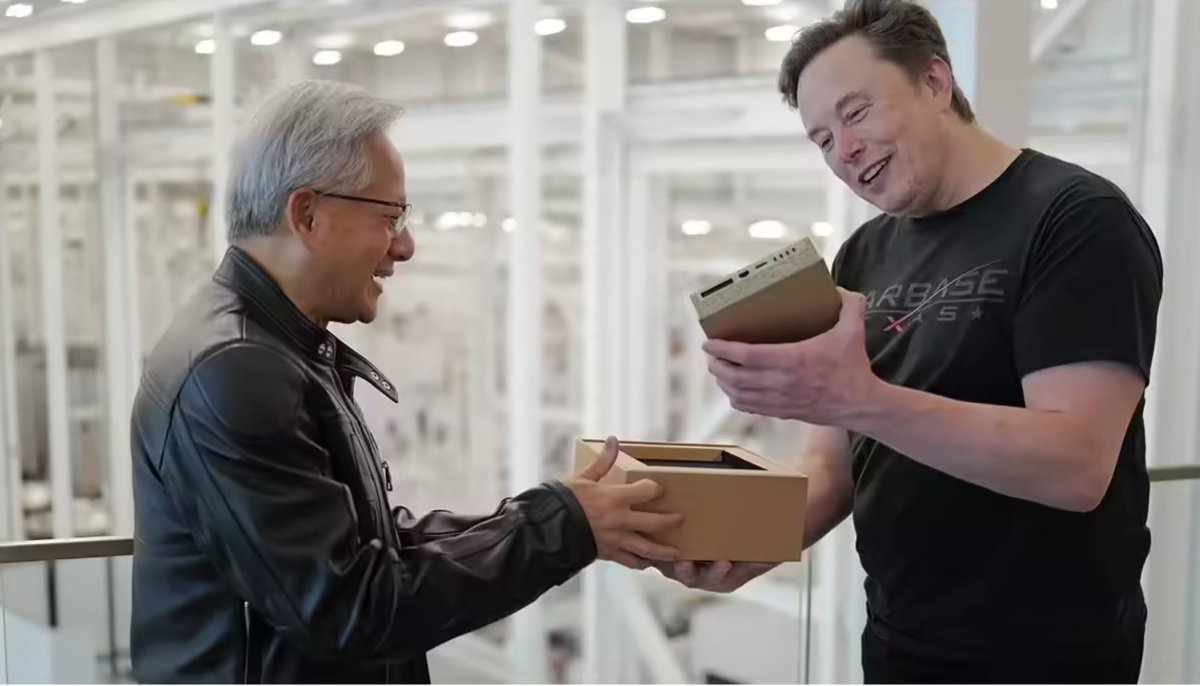
Nvidia, the world's largest AI chip company sold $5.4 billion worth of its most advanced GPUs, the GB200, to a company called Valor.
Valor is not a real operating business. It is a special purpose vehicle, a shell company created specifically to hold these chips and nothing else. Nvidia also invested $1.9 billion of its own money directly into Valor on top of the sale.
Those 100,000+ chips are now physically inside xAI's data center. xAI is Elon Musk's artificial intelligence company, the one that builds Grok. xAI is using every single one of those chips right now to run its AI models.
But here is what Burry is flagging.
Neither Nvidia nor xAI owns those chips on paper. Valor, the shell company holds legal title. That means $5.4 billion in GPU assets do not show up on Nvidia's balance sheet as inventory.
They do not show up on xAI's balance sheet as assets. They are legally invisible to both companies.
Nvidia gets to book the $5.4 billion as a completed sale and record it as revenue. xAI gets full use of the chips without owning them. And the risk disappears into a shell company in the middle.
Now here is where American retirees enter the picture.
Valor needed $3.5 billion in debt to fund this structure. Apollo provided it. Apollo is one of the largest asset managers on earth with $1.03 trillion under management and $834 billion specifically in private credit.
Apollo raised the $3.5 billion, packaged it into debt securities, and sold those securities to Athene.
Athene is Apollo's own insurance company. It sells fixed and indexed annuities, retirement savings products, to ordinary Americans.
When a retiree buys an Athene annuity, they believe their money is sitting in safe, stable investments. That money is now inside a structure funding Elon Musk's AI data center.
The numbers inside Athene are most alarming.
Athene holds $74.2 billion in reserves. It has moved $217 billion in assets into a captive insurer based in Bermuda, meaning those assets sit outside normal US insurance regulation and oversight.
Of the entire portfolio, 34.7%, equal to $103 billion, is classified as Level 3 assets.
Level 3 is an accounting classification that means there is no observable market price for these assets. No outside party can independently verify what they are actually worth.
The leverage sitting on top of those unpriced assets is 16 times.
Burry's says:
Every step of this structure is technically legal and publicly disclosed. But the entire thing was deliberately engineered across 8 to 12 steps to move credit risk off balance sheets and away from any market pricing.
- Nvidia books the revenue.
- Apollo collects the fees.
- xAI gets the computing power.
- And retirees sitting at the bottom of a 16x leveraged Bermuda insurance structure, holding $103 billion in assets with no market price carry the risk without knowing it exists.
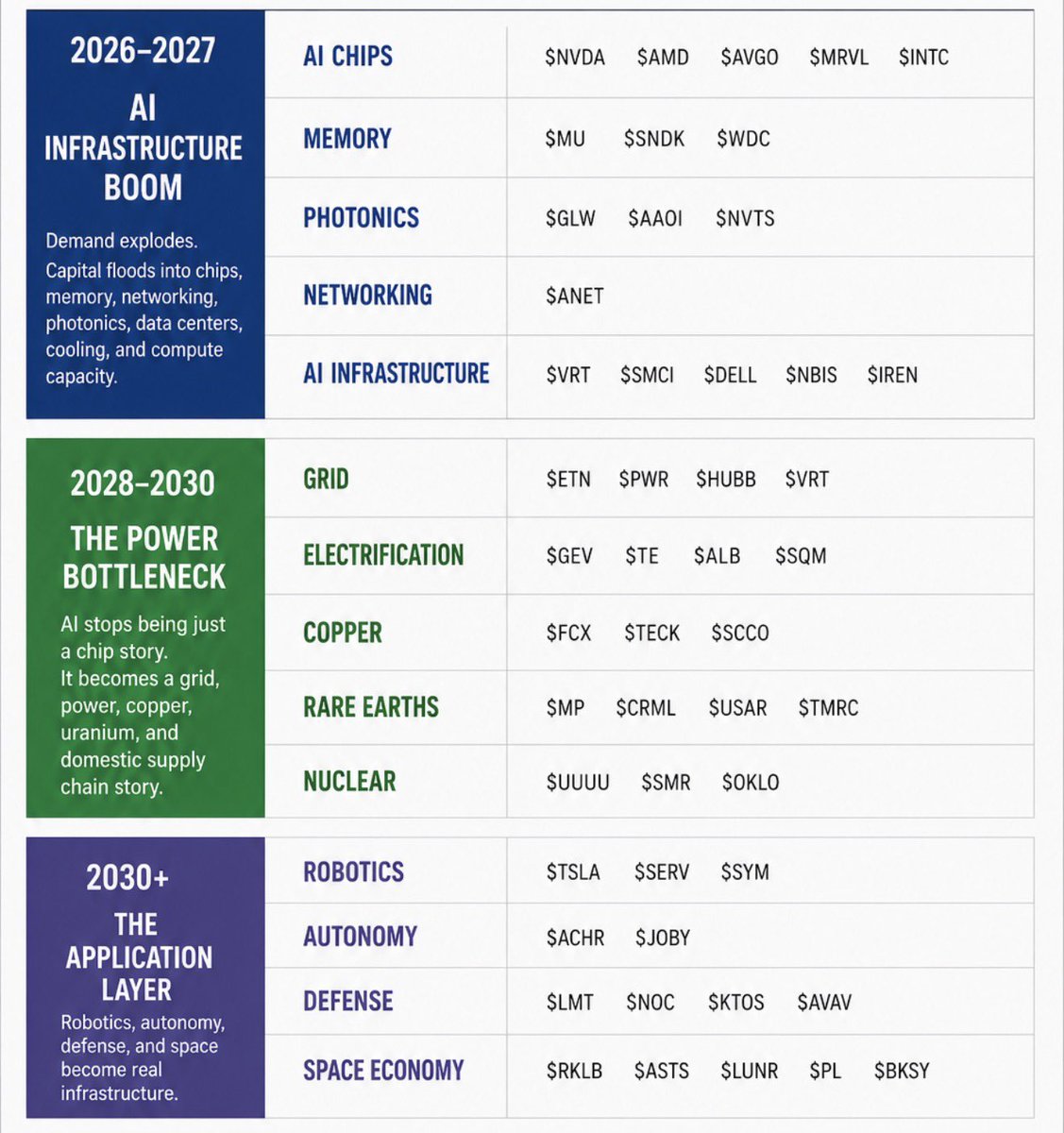
The next 5-10 years will RETIRE you.
MILLIONAIRES will be made from the AI super cycle build out.
Here’s how I and those following me will position:
2026–2027: AI Infrastructure Boom
Money floods into chips, memory, networking, photonics, data centers, cooling, and compute capacity.
AI Chips: $NVDA $AMD $AVGO $MRVL $INTC
Memory: $MU $SNDK $WDC
Photonics: $GLW $AAOI $NVTS
AI Infrastructure: $VRT $SMCI $DELL $NBIS $IREN
2028–2030: The Power Bottleneck
It becomes a grid, power, copper, uranium, and domestic supply chain story.
Grid: $ETN $PWR $HUBB $VRT
Electrification: $GEV $TE $ALB $SQM
Copper: $FCX $TECK $SCCO
Rare Earths: $MP $CRML $USAR $TMRC
Nuclear: $UUUU $SMR $OKLO
2030+: The Application Layer
Robotics: $TSLA $SERV $SYM
Autonomy: $ACHR $JOBY
Defense: $LMT $PLTR $KTOS $AVAV
Space: $RKLB $ASTS $LUNR $PL $BKSY
I’m trying to help you position and become a MILLIONAIRE. I will make sure it happens.
INSTEAD OF WATCHING AN HOUR OF NETFLIX TONIGHT.
This 1 hour Stanford lecture by Joel Peterson will teach you more about negotiation and getting what you want than most people learn in years.
Bookmark it and give it an hour, no matter what.
Financing the Global Industrial Renaissance with Apollo CEO Marc Rowan
Marc Rowan is CEO of Apollo Global Management, one of the most important financial institutions and the largest provider of retirement income in the world. In this conversation, he joins a16z's David Haber to discuss the story of Apollo, the state of public and private markets, how the AI revolution will be financed, and more.
00:00 Intro
00:52 Drexel, Milken & the origins of "clean sheet thinking"
04:55 The Apollo origin story: From unemployed to $6 billion
08:46 How Apollo became a trillion-dollar firm
13:00 Permanent capital, origination & why assets are the scarce resource
16:08 Democratizing private markets: Daily pricing & new capital channels
22:04 Where venture meets credit: Financing the industrial renaissance
30:01 AI, enterprise software & which jobs will be replaced or enhanced
38:52 Moral leadership: UPenn, merit & doing right over easy
46:02 Apollo's culture: Playing to win & building to outlast the founder
My conversation with @DanielSLoeb1, his first ever podcast and one I've been wanting to do for years.
Dan started Third Point in 1995 with $3 million. Today the firm manages over $24 billion across equities, credit, venture, and insurance.
Along the way he wrote some of the most iconic activist letters.
We discuss:
- Why deep value stopped working
- The power of writing
- The Twitter and XAI credit trades
- Lessons from FTX and Danaher
- The Sony and Sotheby's stories
- What makes a great analyst today
- The importance of kindness
I feel lucky we all get to learn from one of the greats.
Enjoy!
Timestamps:
0:00 Intro
2:48 Macro Views and Tech Trends
5:13 The Roots of Third Point
10:30 Evolving to Quality and Thematic Investing
19:07 Market Psychology and Inefficiencies
24:10 Good and Bad Corporate Governance
29:19 Activism
31:23 Sotheby's
41:37 AI
44:28 Sony
52:50 Danaher's Operating System
56:31 Building an Insurance Business
59:25 FTX
1:05:17 What Makes a Great Analyst Today
1:07:24 The Next Decade
1:10:00 Kindest Thing
Just listened to Marc Rowan on the A16Z podcast and thought the origin story of Apollo was one of the most interesting snippets from the conversation
During the 1990s, Drexel had just collapsed under the weight of the Milken junk bond indictment. It was a bad time in the markets, with real estate prices crashing and a S&L crisis happening at the same time
Marc Rowan and his future co-founders became unemployed bankers in the middle of a financial crisis but continued to work for their clients without any hopes of ever getting paid.
In the midst of this, they received a call from the French government bank, Credit Lyonnais, with an offer to start an M&A boutique firm under their brand name
After taking a meeting with Credit Lyonnais, Rowan and team left with $800M of French government money to invest. By the end of that year, they had accumulated $6B of the bank's money and became the profit center of the French bank
Eventually, Credit Lyonnais begins to struggle and sells the profit center of the business to its largest client, Francois Pinault, a French industrialist billionaire
Apollo used his funding base as a starting point and eventually diversified out to take in other investors across the US and Europe. Credit Lyonnais eventually went under and was later consolidated into what is Credit Agricole today
What a crazy ride
Rule changes for the SpaceX $SPCX IPO:
Index providers waived the profitability requirement and cut the seasoning window from 90 days to 5.
This forces over $30 trillion in passive 401k and retirement money to buy SpaceX at IPO valuations.
Bloomberg Intelligence estimates S&P 500 funds must absorb 19% of SpaceX's float within 6 months.
Russell 1000 and Nasdaq 100 funds will absorb 24%.
The rules built to protect passive investors:
1. S&P 500 has required 12 months of trading and 4 quarters of GAAP profitability since 2002. Both waived.
2. Nasdaq cut its inclusion window from 90 trading days to 15.
3. FTSE Russell cut its to 5.
All three benchmarks are now structured to buy SpaceX at IPO pricing.
A man who reads old books cannot be fully captured by modern stupidity. He has dead kings, prophets, poets, killers, saints, drunks, generals, and madmen whispering in his bloodstream. The feed has no chance against this.
Wer sich fragt, wie schnell sich Dinge ändern können:
Die Hohenzollern, die Habsburger, die Romanows oder die Ottomanen regierten über 300 bis 800 Jahre.
Über Nacht verschwanden sie 1918.
Niemand hätte am 8. November 1989 auch nur einen Cent darauf gewettet, dass die DDR am nächsten Tag faktisch verschwindet.
Soziale Prozesse sind extrem nicht-linear.
Nur weil es seit etwa 80 Jahren im „Westen“ relativ stabil war, heißt das nicht, dass das noch 3 weitere Monate so bleiben müsste.
Never forget what the Panama Papers exposed:
The wealthiest people on Earth were hiding fortunes offshore, dodging taxes, shielding assets, and protecting generational wealth through a global network of secrecy.
Nothing changed other than a journalist investigating it was murdered.
Note: Virgin Islands crossover with Epstein files
Democracy only spread because it was the best system for producing compliant trading partners.
A democracy has elections. Elections require parties. Parties require financing. Financing requires capital. Capital has interests. So by design, every democracy in the world has a built-in mechanism that ensures the people with money have disproportionate access to the people with power.
You don’t need to bribe a dictator and hope he stays in power. In a democracy, you just fund both candidates and own the outcome regardless.
This is why US spent the Cold War toppling democracies that elected the wrong people Mossadegh in Iran, Allende in Chile, Lumumba in Congo and replacing them with dictators who were more “stable.” Stable meaning: predictable to capital.
The genius of it is the aesthetics. Democracy looks like self-determination. It has flags and anthems and moving inauguration speeches. People will die for it. But the operating system underneath is remarkably friendly to concentrated wealth arguably more so than overt authoritarianism, which at least makes the power visible.
The most honest political scientists will tell you: what actually spread after 1989 was markets. Democracy was the packaging.
And the packaging worked so well that the people inside it genuinely believe they’re free which is the final, most elegant feature of the system.
A cage you can’t see is the strongest cage ever built.