Life update: Maria @BauzaVillalonga and I have graduated, moved to London and joined @DeepMind! We are looking forward to starting exciting research projects with fantastic teams.
I'm hiring a Research Scientist in AI for extreme weather forecasting at @GoogleDeepMind London!
We're finding ML to be surprisingly effective at predicting extreme events like hurricanes, and we're starting to help forecasters save lives.
We're looking for researchers in multimodal ML, large scale deep learning and/or ML4PDEs who have a genuine motivation to work in Science and Sustainability.
Apply here: https://t.co/xN0xBcwF7u
Weather affects everything and everyone. Our latest AI model developed with @GoogleResearch is helping us better predict it. ⛅
WeatherNext 2 is our most advanced system yet, able to generate more accurate and higher-resolution global forecasts. Here’s what it can do - and why it matters 🧵
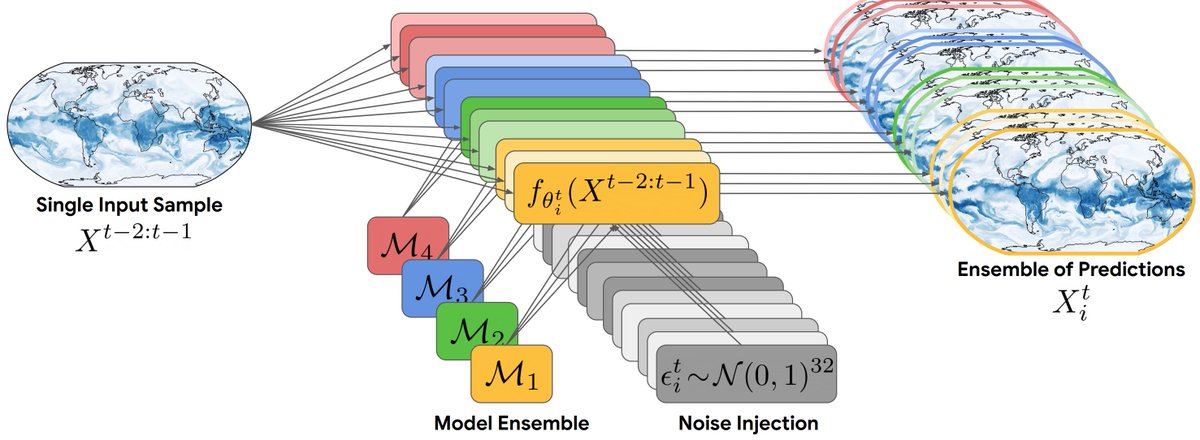
Functional Generative Networks inject noise within the function for aleatoric uncertainty with structured variability, and sample different networks for epistemic uncertainty.
They're also the core of our cyclone model running live on https://t.co/ph7DVjJXtH
Excited to announce WeatherNext 2 is live! Blog: https://t.co/eN0NNGMbyj
It leverages FGN (https://t.co/irrCzOwlWP), which surpasses our previous diffusion-based model while making predictions single-shot.
Surprisingly, optimizing only a marginal (per-pixel) loss we get skillful global forecasts!
LIVE Q&A TODAY at 4 PM ET. I'll be joined by Senior Research Scientist at Google DeepMind Ferran Alet. We'll talk about the new amazing and surprising Google DeepMind AI hurricane model. We'll be LIVE on YouTube, Facebook, TikTok, X, Instagram, and LinkIn. Looking forward to your questions!!
SCIENCE! 🔬🌎
Can we take a moment to appreciate this fact:
✅ A powerful hurricane is spinning just 200mi offshore of Florida.
✅ And yet, we haven't had the least bit of concern, because science told us all along that #Erin would turn north.
That is the power of meteorology, satellite observations, & NWP/AI models working together. Instead of panic, we can rely on data, physics, & decades of research.🌪️📡
@Weathernerds@AndyHazelton GenCast (GENC) is "corrected" as in, debiased, and should be better than vanilla GenCast intensities.
FNV3 is not quite an intensity "correction". We use ML to learn to predict intensities and wind radii directly.
@danrothenberg@GoogleDeepMind@NHC_Atlantic Interesting!
Possibly relevant, we find that EPS sometimes shows disturbances weaker than those categorized by the NHC. So it's possible that our model only deems the disturbance strong enough later in the development.
Accurate weather prediction is extremely important for keeping people safe, particularly when it comes to dangerous cyclones. Exciting to see this new initiative from @GoogleDeepMind & @GoogleResearch in partnership with @NWSNHC.
Finally, we're announcing Weatherlab https://t.co/ph7DVjKvjf a public preview where we share the predictions from our AI models.
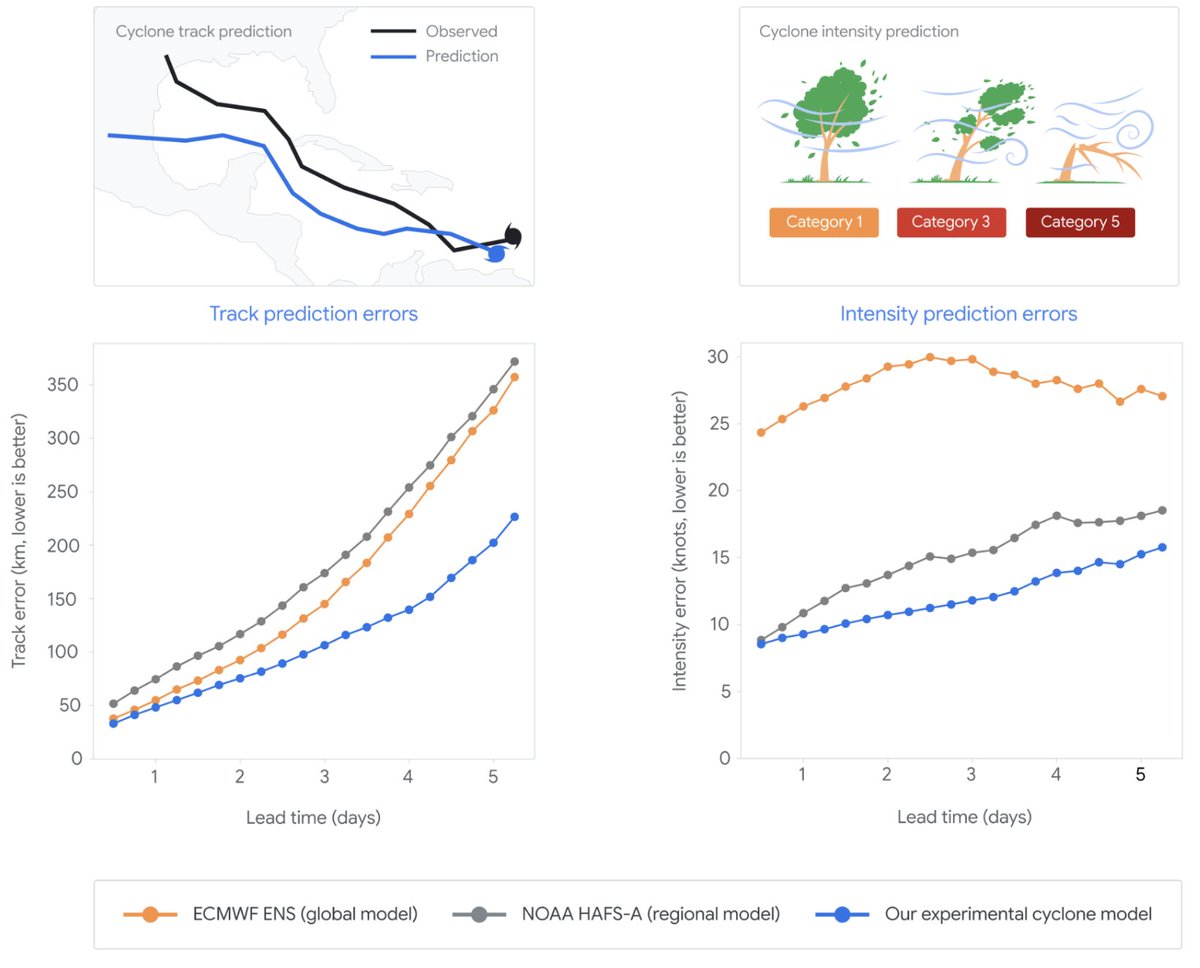
Here you can see a live prediction of a cyclone in China, where our model in blue shows more confident predictions than a leading physics-based model.
Excited to announce our new experimental cyclone model and a partnership with @NHC_Atlantic!
Traditionally, it's been hard for a model to predict tracks & intensities: one requires a global view, the other very high resolution. Our AI model achieves strong performance on both.
We’re using AI to improve cyclone prediction. 🌀
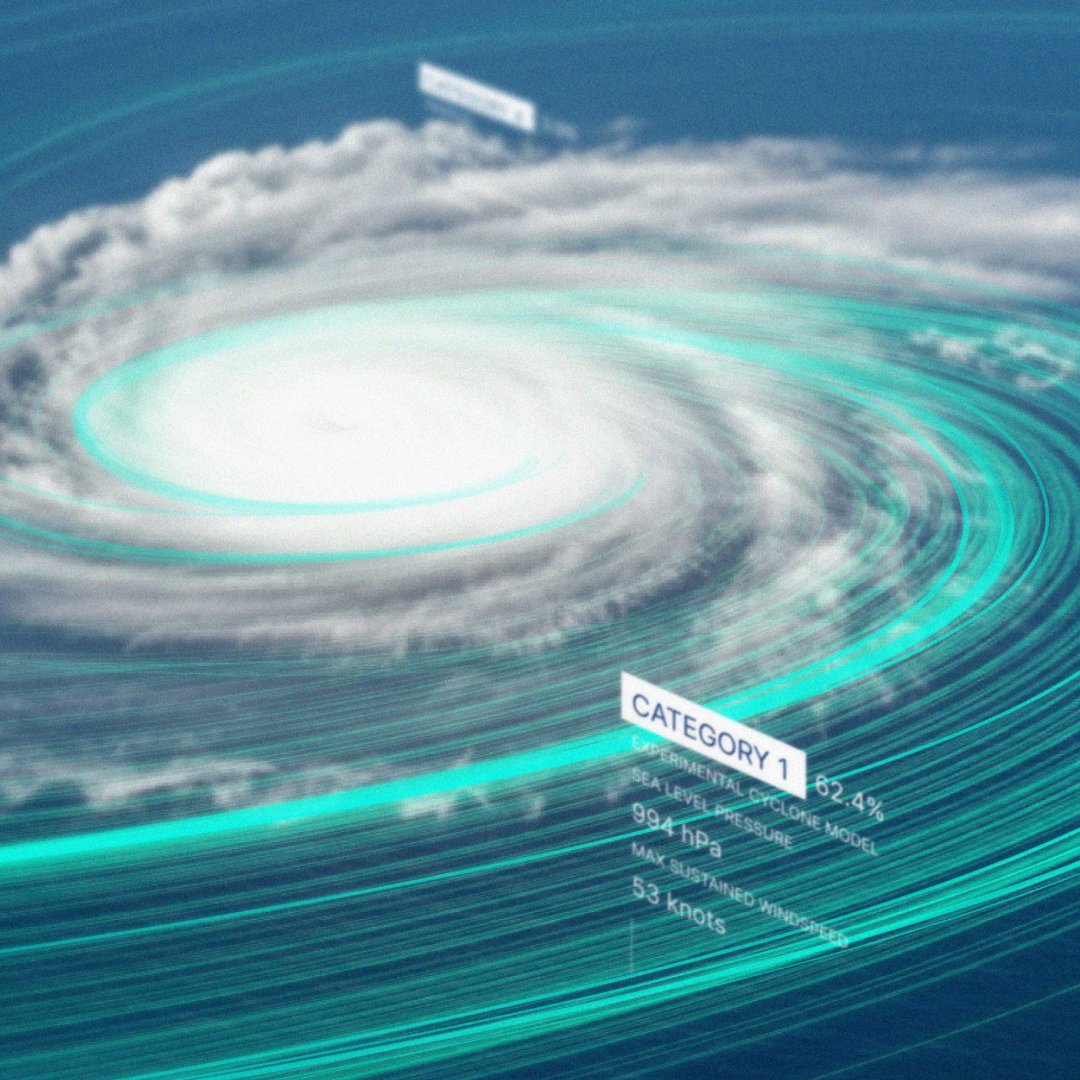
Introducing Weather Lab: a new interactive platform developed with @GoogleResearch, hosting our experimental AI weather model which can predict a cyclone’s track, intensity, size and structure.
Here’s how it works. 🧵
This season, forecasters at @NHC_Atlantic are going to see live predictions from our models, and we hope to enhance their predictions this cyclone season.
Interacting with experts at NHC, Colorado State, and other agencies has been one of the most rewarding parts of the project.
In the 'Instant edit' tab of our demo, users can ask Gemini diffusion to edit some text with an instruction. This works similarly to images where the model is initialized with the text to be edited and then does some diffusion to satisfy the instruction. If the edits are small it can be very fast!
Excited to share what my team has been working on lately - Gemini diffusion! We bring diffusion to language modeling, yielding more power and blazing speeds!
🚀🚀🚀
Gemini diffusion is especially strong at coding. In this example the model generates at 2000 tokens/sec, including overheads like tokenization, prefill, safety filters etc.
Beautiful visualizations of optimization in high dimensions and why local minima became less of a concern as networks scaled: https://t.co/bQKsu6ZCSL
IIRC this realization started around 2014-15, but the concern over local minima took multiple years to gradually fade away in the community as theoretical & empirical evidence mounted.
In my case, the conversion happened with:
1) Kenji Kawaguchi's (my labmate at the time) "Deep Learning without Poor Local Minima" 2016 paper and
2) empirically finding gradient descent highly effective for a very non-smooth problem (modular meta-learning) in 2018.
We're hiring a Research Engineer in AI for Sustainability @GoogleDeepMind (San Francisco / Mountain View).
Seeking strong engineers at the interface of machine learning, environmental sustainability, weather, dynamical systems, and/or remote sensing: https://t.co/DqpCe2hUGr
+1! It's particularly valuable advice for PhD students: AI for Science&Sustainability offers great research topics. It's far less saturated than NLP or vision, doesn't require internet-scale pre-training, and discovering the right inductive biases gives you substantial leverage.
hot take - it's not all about language. Beyond chatbots, AI has a profound ability to model more complex - and mysterious - systems, from the human body and global weather to Earth in its entirety.
I shared my views on the @TEDAIVienna stage: https://t.co/CXK0ogpxS0