I’m an engineer. I believe all technology should be both ergonomic and intuitive. MEGASTRUCTURES! US must lead in AI. Moon → Mars → Ceres → Stars. 🇺🇸 🚀 🦾
We don’t have true AI (AGI) yet. What we have are LLM algorithms that guess and hallucinate a lot. Truth is truth. We are on the road to true AI, I think, but we are not there. Take everything that comes from the ChatGPT, Claude, Gemini, and Grok algorithms with a grain of salt…
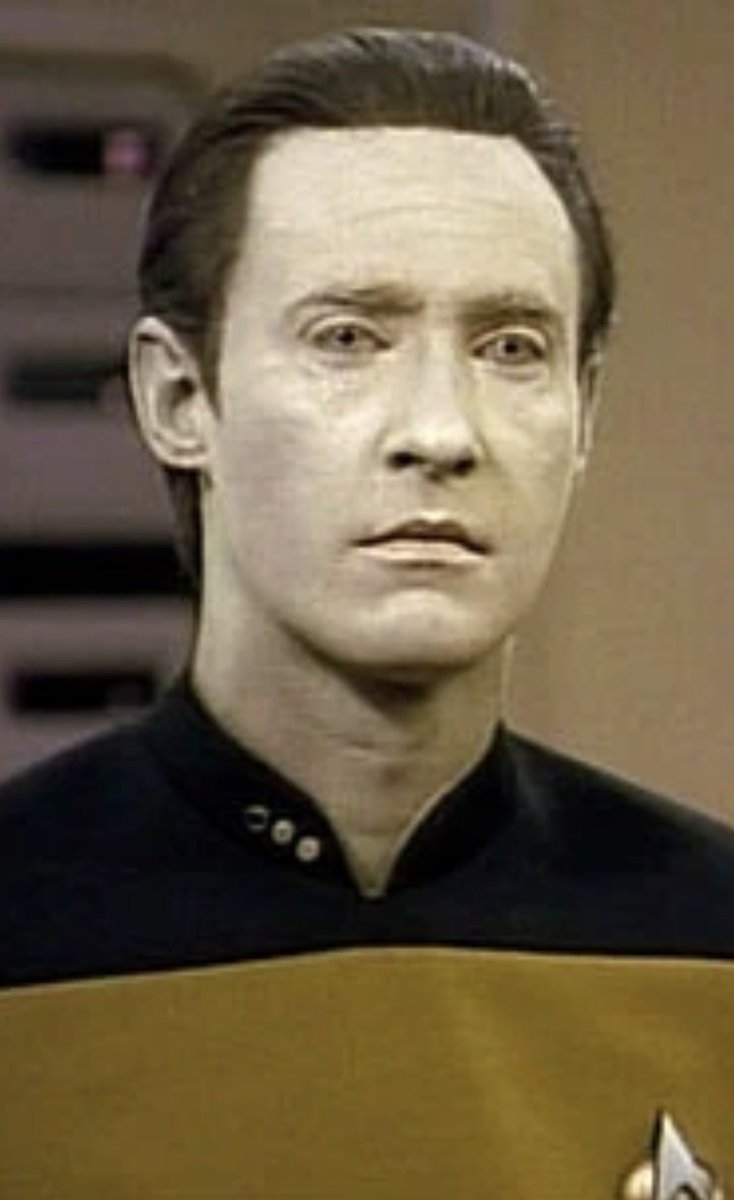
The best example of what I think actually represents AGI is Data from Star Trek: The Next Generation. This sci-fi android created by Dr. Noonien Soong and found by Starfleet in 2338 was unique even in his time.
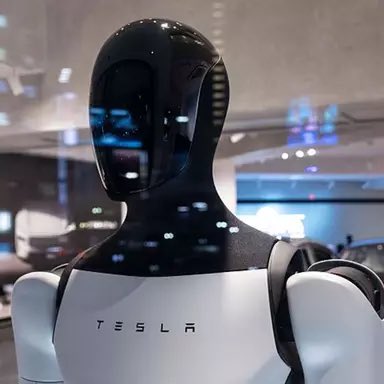
Ambulatory AGI will be a true paradigm shift in the arc of human evolution. We will be able to do things we haven’t even dreamed of yet. I’m hopeful that the @Tesla_Optimus robot is headed in the right direction. @elonmusk 🇺🇸 🚀 🦾
A mathematics professor once discovered that the sink in his kitchen had broken. He called a plumber, who arrived the next day, tightened a few fittings, and quickly fixed the problem.
The professor was pleased—until he saw the bill.
“This is a third of my monthly salary!” he exclaimed.
Still, he paid it. As the plumber was leaving, he said, “I understand your situation. Why not join our company? You could earn much more than you do now. Just one thing—when you apply, say you only finished elementary school. They prefer that.”
The professor, intrigued, followed the advice. To his surprise, he was hired. The work was simple—occasional repairs, tightening pipes—and his income improved dramatically.
Some time later, the company introduced a new rule: all employees had to attend evening classes to complete basic schooling. The professor had no choice but to attend.
On the first day, the subject was mathematics. The instructor asked a student to write the formula for the area of a circle on the board. The professor was chosen.
He walked up confidently—but then hesitated. He couldn’t recall the formula.
Determined, he began deriving it from scratch. The board quickly filled with integrals, derivatives, and complex expressions. After several minutes of work, he arrived at a result:
−πr²
Unsatisfied with the negative sign, he tried again. And again. Each time, the same result appeared.
Frustrated, he turned to the class. Behind him, the other plumbers were whispering to one another:
“Switch the limits of the integral.”
God’s top enforcer is π. A black hole can rip atoms apart, swallow light, and challenge the laws of physics as we know them, but it can never break π. It is forced to obey it.
Isotropy and smoothness are universal. One of the main obstacles to unifying general relativity and quantum mechanics is the assumption that a singularity exists at the center of a black hole.
That assumption is misguided. The true bridge between the two theories will connect them smoothly, not through a singularity.
The Gaussian integral provides just such a bridge by eliminating the sharp breaks that arise when we assume a singularity lies at the center of every black hole.
God’s top enforcer is π. A black hole can rip atoms apart, swallow light, and challenge the laws of physics as we know them, but it can never break π. It is forced to obey it.
Isotropy and smoothness are universal. One of the main obstacles to unifying general relativity and quantum mechanics is the assumption that a singularity exists at the center of a black hole.
That assumption is misguided. The true bridge between the two theories will connect them smoothly, not through a singularity.
The Gaussian integral provides just such a bridge by eliminating the sharp breaks that arise when we assume a singularity lies at the center of every black hole.
@NASAAdmin@NASAKennedy@blueorigin@JeffBezos@davill I do think it would be prudent to make sure the redesign/rebuild of LC-36 be tailored to work for both the 7x2 and the 9x4 engine versions of New Glenn.
"Aus der Kriegsschule des Lebens. — Was mich nicht umbringt, macht mich stärker."
"From the military school of life. — What does not kill me makes me stronger."
This quote from the German philosopher Friedrich Nietzsche applies to humans under stress, NOT to rocket components. In fact, the opposite is actually true with rocket components. They suffer from fatigue, micro-cracking, and plastic deformation each time they are tested.
The factor of safety (FS) on pressurized tanks and plumbing was 1.5-2.0 during the Apollo program. Dr. Wernher von Braun insisted on it. You don’t have to have that now, due to our much better understanding of the stresses, but you still must account for all unknowns with a reasonable FS. You also need a rigorous QC program.
I considered the possibility of resonance being responsible for the pad explosion, but the anomaly occurred too soon after engine ignition for that to be the culprit. I think there had to be a defect in a tank, a pipe, or a valve, that was missed during the preflight inspections.
I’m sure @blueorigin will figure it out and let us know what happened. Godspeed.
NASA is aware of the anomaly that occurred tonight at Launch Complex 36 involving Blue Origin’s New Glenn rocket at Cape Canaveral Space Force Station. Spaceflight is unforgiving, and developing new heavy-lift launch capability is extraordinarily difficult. We will work with our partners to support a thorough investigation of this anomaly, assess near-term mission impacts, and get back to launching rockets.
We will provide information on any impacts to the Artemis and Moon Base programs as it becomes available.
@CrainTim Ah, I see now. Khon-1 moved from IM-2 to IM-3 and was renamed Altus-1. You guys make it a challenge to keep up! It is all very exciting. I am pulling for you Tim.
It’s concerning to me that Khon-1 never entered its planned ‘frozen’ polar orbit due to inability of IM-2 to communicate with it after it landed on Mons Mouton. This means that we don’t really know if the orbital engineers have correctly tuned the orbit for Khon-3 and Khon-4 to account for mascons protruding into the lunar crust.
The perilune of the planned ‘frozen’ polar orbit was supposed to be around 100 km, while the apolune was supposed to be around 18,250 km. If the orbit is not properly tuned, to cancel out the perturbations of the mascons, the perilune will decrease each time around the moon. This can be countered with a prograde burn at apolune for awhile, but eventually, the satellite will run out of fuel and crash into the lunar surface.
Khon-2 will be dropped into a Halo orbit around EML-2 by IM-3. This type of orbit is not affected by mascons. Kohn-2 will backup Kohn-3 and Kohn-4.
Khon-3 and Khon-4 will be carried to the moon by IM-4. They will be dropped into a ‘frozen’ polar orbit exactly like the one that Kohn-1 was intended to occupy.
By planning this orbit so that both the Kohn-3 and Kohn-4 satellites each reach apolune at the same time they pass over the base, and placing them in the same orbit, exactly 180° out-of-phase, @NASA and @Int_Machines ensure that our new American moon base never experiences LOS with Earth.
@NASAAdmin@CrainTim
Hell yes! A real base on the Shackleton Connecting Ridge! It’s a brilliant start.
Because of the ridge's location, you have a direct line of sight with Earth whenever it rises above the lunar horizon, which lasts for about 13.5 days at a time. For the other 13.5 days of the month, the base will rely on the Khon-2 satellite for communications. Intuitive Machines (@Int_Machines) will drop Khon-2 into lunar orbit during their IM-3 mission before attempting their landing at Reiner Gamma.
But when Earth is visible? The view from the Shackleton Connecting Ridge will be spectacular. Because of the Moon’s libration, Earth will trace a slow, vertical figure-8 in the lunar sky over the course of a tropical month. It will spend roughly half the month in the top loop of the '8' and the other half in the bottom.
The link below allows you to view a very well made video and some infographics that will help you understand what the astronauts looking at Earth from our first moon base will see.
https://t.co/WeeD6M23IP
@NASAAdmin@CrainTim
Apologies, if I posted erroneous data. I had not heard about the name change. I thought Khon-1 was launched with IM-2.
So, Altus -1 is going into a Halo orbit around EML-2? I assume that Altus-2 and Altus-3 will be delivered by IM-4? Will they be placed into the type of orbit that I described for the Khon-3 and the Khon-4 satellites? Thanks for the update Tim.
Each MoonFall hopper will have HD video and photography capability.
Each MoonFall hopper will have Ground Penetrating RADAR (GPR) and a Neutron Spectrometer.
Each MoonFall hopper will have a LASER Retroreflector Array.
Each MoonFall hopper will have a Radiation Spectrometer.
@FireflySpace and @NASA should get very valuable data. This will be a huge moment. @NASAAdmin 🇺🇸 🚀 ✝️ 🙏
Four JPL-built propulsive drones – known as MoonFall – will survey the lunar surface at potential @NASAArtemis landing sites in unprecedented detail. The mission is part of the initial phase of the @NASAMoonBase initiative.
Learn more: https://t.co/2NJXRlgOoW
By the way, it is spelled Khon-1, Khon-2, Khon-3, and Khon-4. This is short for Khonstellation. The Khon-1 satellite was built by York Space Systems in Denver, Colorado. Lanteris, located in Palo Alto, California, which has been purchased by @Int_Machines, is building Khon-2 thru Khon-4 satellites. IM has also recently acquired the @goonhillyorg Earth Station network in the UK.