Scientist fascinated by how noncoding RNAs impact biomedicine. Energy from family&friends. Love #noncodingRNA, believe in #RNAtherapy, live in @CIMA_unav
The deaths of two children in separate gene-editing trials in China raise serious questions about oversight and could have a profound effect on the country’s biomedical industry
https://t.co/7KtPNIqBpy
A few months ago I was browsing google images looking at p53 western blots in the SK-OV-3 cell line for an unrelated project. I noticed an unusual western blot hosted on Thermo Fisher's website which I posted on social media. Usually I just post weird blots to PubPeer. 👇
China approves the world’s first CAR-T therapy for a solid tumor.
Hours later, the FDA responds with full approval of afami-cel and expansion into pediatric synovial sarcoma.
A remarkable day for cellular therapy.
🇨🇳 Satri-cel (CLDN18.2 CAR-T)
CT041-ST-01, refractory gastric/GEJ cancer
• PFS: 3.25 vs 1.77 months (HR 0.37)
• OS: 7.9 vs 5.5 months (HR 0.69)
• 18-month OS: 20.1% vs 8.6%
• First CAR-T ever approved for a solid tumor
🇺🇸 Afami-cel (MAGE-A4 TCR-T)
SPEARHEAD-1, advanced synovial sarcoma
• ORR: 43%
• CR: 4.5%
• Median DoR: 6.0 months
• Median OS: 15.4 months
• First FDA-approved engineered cellular therapy for a solid tumor
For decades, solid tumors were where cellular therapies went to fail.
Now, on the same day, regulators in China and the United States have approved two different engineered T-cell platforms for two different solid tumors.
A brave new world for solid tumor oncology.
Any cancer center not providing cellular therapies is going to be left in the dust.
@OncoAlert@TheGutOncLab@Onco_Nexus
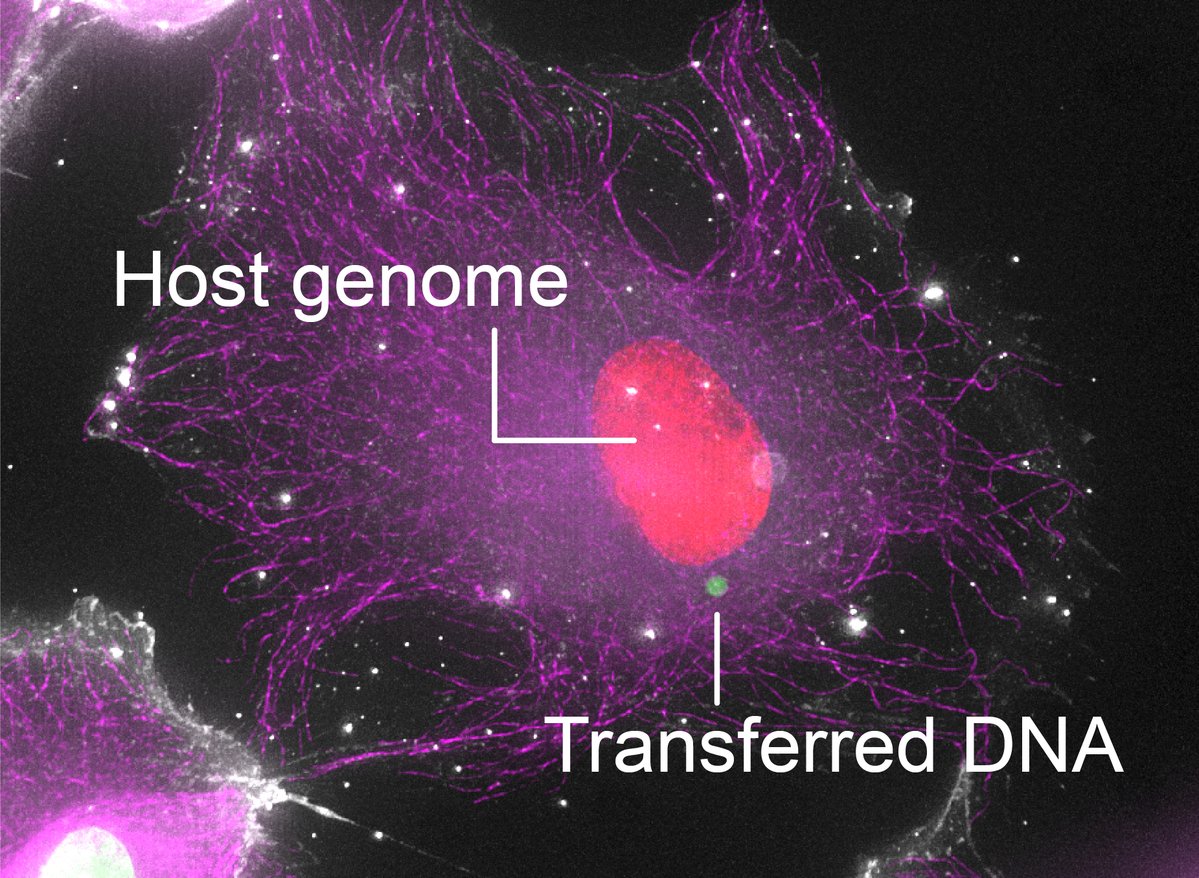
Excited to share our latest paper, out today @CellCellPress. We found that large pieces of the human genome can transfer between cells upon direct contact, endowing recipient cells with heritable phenotypic changes. (1/7)
https://t.co/SbshGhofN0
Our latest work is out in Nucleic Acids Research @OxfordJournals We introduce Optical Tweezers Curtains: a method to study interactions between proteins and DNA-ends at the single-molecule level. @CNB_CSIC@SDeBraganca https://t.co/RyxkYoFynD
Today we welcome Dr. Reuven Agami (@NKI_nl), who will present: “When Mistranslation Meets Immunotherapy” organized by @FortesLab and @MaiteHuarteLab
A leading expert in #oncogenomics, his work has pioneered genetic tools to uncover how gene regulation drives #cancer.
📢 Los fondos son limitados. Ayúdanos a que #científicas en países de desarrollo tengan los recursos que merecen. ¡Cualquier aporte hasta 50€ se multiplica!!
👉¡Dona aquí!
https://t.co/78I98WHDaq
Super nice story! Do not miss this! I am still amazed about how a small protein extension can turn PTMA protein into more oncogenic! It is great to collaborate with the great Mar Alba lab! Mar… will there be a third preprint this month? 😳
Second preprint of the month!
Analysis of stop-loss mutations in > 20,000 cancer samples shows that several oncogenes and tumor suppressor genes are recurrently mutated. Another fruitful collaboration with @FortesLab@GRIB_Barcelona
https://t.co/vEDdyc98M3
New preprint from the group!
Here we use Nanopore dRNA and Ribo-Seq data from multiple yeast species to discover tens of highly conserved microproteins encoded by uORFs in polycistronic transcripts/alternative isoforms. @the_prbb
https://t.co/Z0pKqBYaCa
"Zorevunersen es el primer tratamiento diseñado para actuar específicamente sobre la causa de #Dravet". Nuestro científico Rubén Hernández comenta en
@elmundosalud los resultados de un estudio internacional publicado en @NEJM
📰 Un reportaje de @cglucio
https://t.co/YmesI08MWf
More than 2700 3′UTRs are highly conserved.
These 3′UTRs are essential components in mRNA templates, as their deletion decreases protein activity without changing protein abundance.
Highly conserved 3′UTRs help the folding of proteins with long IDRs.
https://t.co/b6hd4AlIoX
Very happy to share our work in collaboration with @MaiteHuarteLab@ElenaGrossi8@CIMA_unav. Congratulations to all the people involved. It's been a long journey! https://t.co/KUcqEoiGB6
1/ El ARN nos abrió la puerta a las vacunas contra la COVID-19 en tiempo récord.💉
Las terapias de ARN prometen transformar la medicina, pero… ¿Hasta dónde nos pueden llevar?🤔
4️⃣ investigadores de la red #CaixaResearch nos lo explican:👇
https://t.co/V5GxhanWae