"All human beings are born free and equal in dignity and rights.” Non-profit Organizations - Italy - Prague Also see our Czech Account @ForumForHumanR2
📢SafeChat App 📱 is Available Now 📢
Designed to help women identify potential safety concerns in their conversations.
Free Access 🆓 100% Private 🔐
https://t.co/ob8COKzGaZ
Powered by CEPRODE EU https://t.co/SFKxyoAePE
Today, CFU Executive Director @RushanAbbas, @Cuyghurstudy Executive Director @AHakimIdris, and @ziba116 had an important meeting at the Norwegian Foreign Ministry. We are grateful to all foreign governments who support human rights and stand up for the rights of Uyghurs.
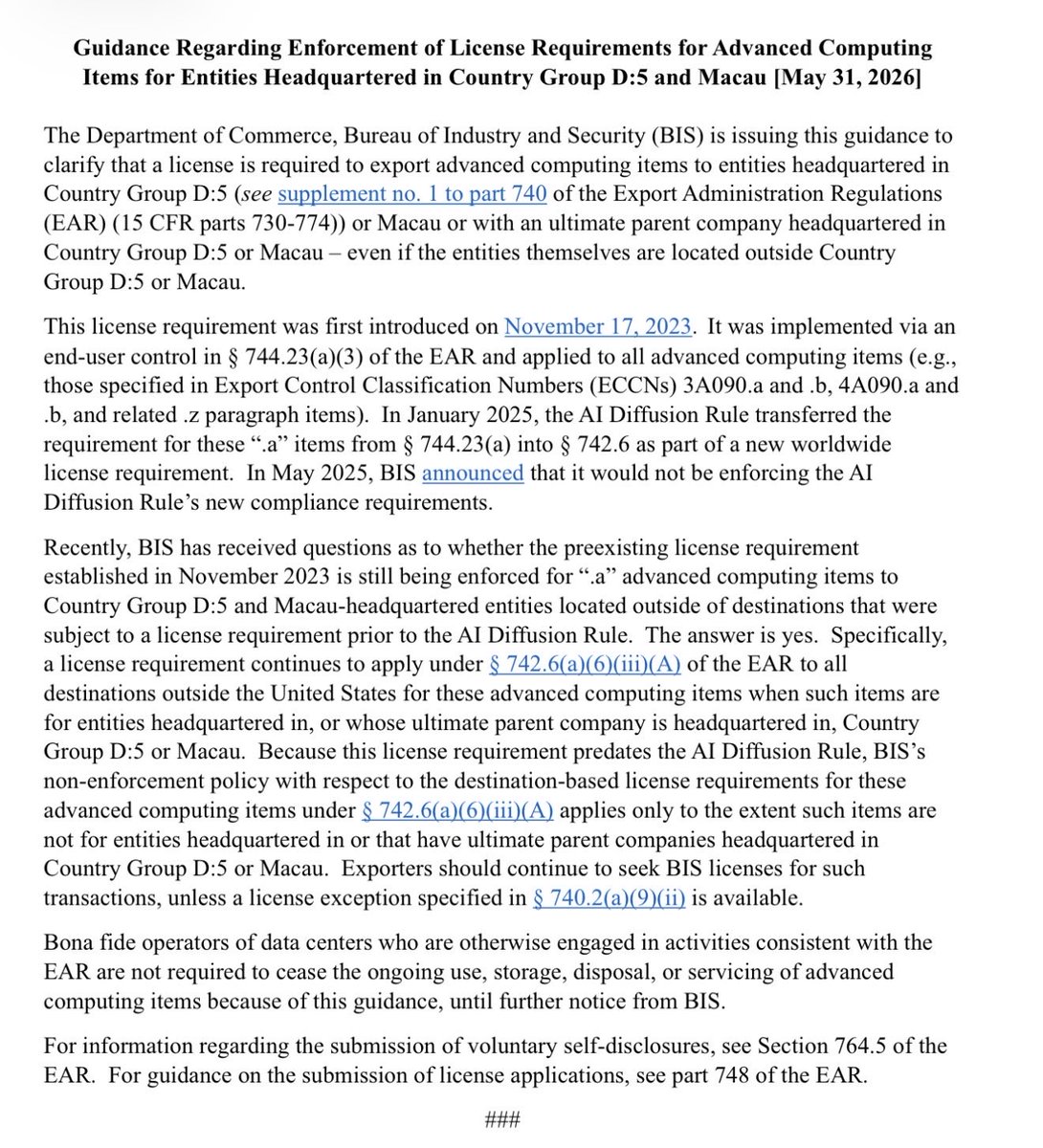
NEW: BIS just issued guidance stating that licenses are required for advanced AI chip exports to China-headquartered firms located outside of China (e.g. a Tencent subsidy in Malaysia). The reason they had to issue this statement is BIS’ non-enforcement of certain export controls have (potentially inadvertently) have allowed Chinese companies to both buy Nvidia Blackwell chips and make AI chips at TSMC, all legally and without a license. This is a HUGE problem.
Since May 2025, BIS has publicly stated that it is not enforcing certain license requirements related to AI chip shipments, and as a result, apparently Chinese companies’ overseas subsidiaries (e.g., Tencent Malaysia) have been able to legally buy Nvidia Blackwell chips without an export license - even though this had been restricted since 2023. Chinese companies have been buying these chips, very likely at scale. And because BIS has not updated export control regulations to clearly state what it IS enforcing, all of this was legal.
It actually gets worse. BIS’ non-enforcement announcement in May 2025 extends to existing US restrictions that prevent TSMC from making AI chips for Chinese companies. US export control regulations require TSMC to do enhanced due diligence on any orders that could be an AI chip, to make sure it isn’t illegally being made for a Chinese company (directly or indirectly). But these regulations require a license requirement to be in effect to work. And those license requirements largely were not being enforced.
This clarification does make clear that Blackwell shipments to China-headquartered companies outside of China are now illegal again—which is good, although obviously we have to see how many shipments have already gone to assess how much damage was done. BIS’ statement acknowledges these shipments have been happening when it says companies who bought chips under this loophole don’t have to stop using them.
HOWEVER, this statement does NOT say that BIS will enforce the parts of US regulations requiring TSMC to do enhanced due diligence on AI chip orders. This is a massive loophole that still needs to be closed. If Chinese companies can make chips at TSMC (including by using third-country cutouts to receive the chips), there is no point to restricting China’s access to AI chips or advanced chip-making tools.
Ultimately, BIS desperately needs to issue a regulation that clarifies what US export control policy for AI chips is. The reason this happened is because BIS said it is not enforcing existing regulations, but didn’t make clear what specific provisions its non-enforcement applied to, and didn’t update regulations to align with what it IS enforcing - which created massive loopholes, some of which still persist.
In America and other free countries, patients wait months or even years for an organ.
But in China, transplant wait lists are measured in weeks—or even days.
For twenty years, I’ve investigated a crime almost too horrific to name, which has culminated in my new book: “Killed To Order.”
This is the dark reality: When someone decides to go to China and pay a hefty sum for a scheduled transplant, then on the other side, an incarcerated prisoner of conscience, who has already been blood-typed and tissue-typed, is likely being killed to order.
I’m in Toronto today at the Legislative Assembly of Ontario breaking down two decades of research and answering audience questions.
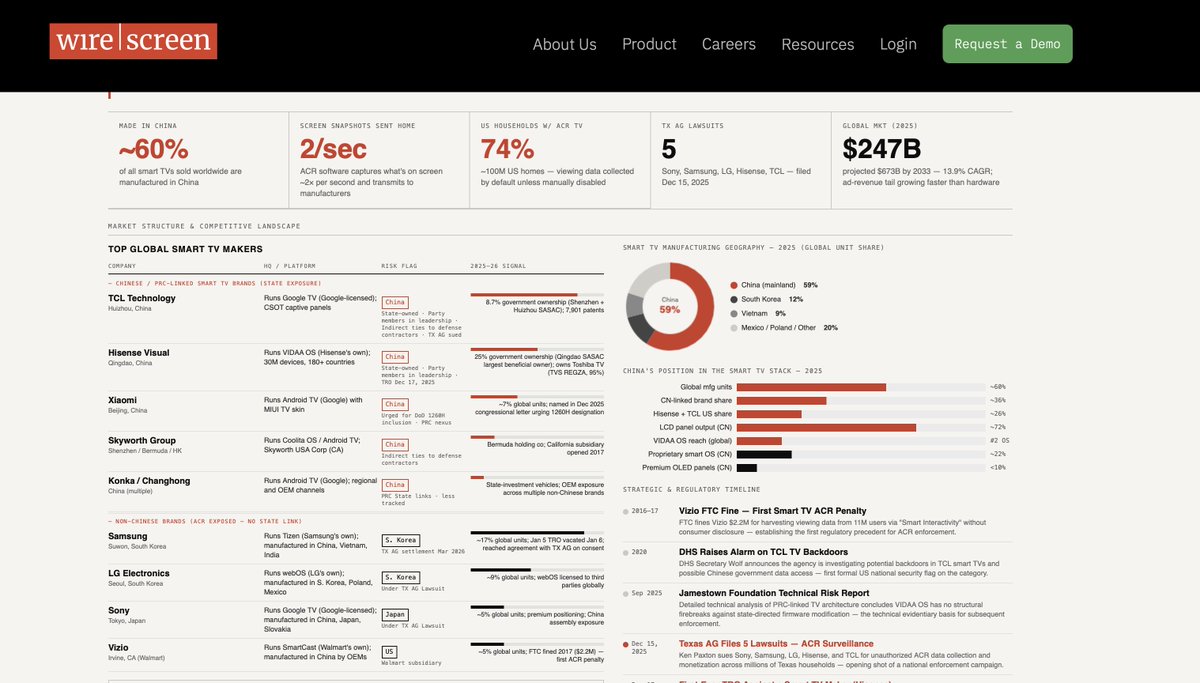
Washington is now treating the smart TV as a national security problem.
60% of the world's TVs are made in China. Hisense + TCL — both state-owned — hold ~25% of the US market. And your set captures what's on screen 2x/sec, then sends it home.
New WireScreen briefing 🧵👇 https://t.co/XDnhZRqSoV
NEW: Xinjiang has the highest detention capacity in the world, according to FT analysis - enough space for almost 1 in 40 people in the region - more than five years after the Chinese govt announced the camps had closed.
EXCL: A maker of electronic parts used in UK and other European biometric passports is owned by an investor group led by two Chinese companies that are on a US export restrictions list
w/ Rachel Rees
https://t.co/zPuGE4ex77
Welcome new alert from MI5 on CCP Transnational Repression. @ShabanaMahmood Now, targeting of UK residents must lead to designating the CCP regime under the Foreign Influence Registration Scheme. @Nus_Ghani@MartinCallanan Today’s T’graph:
Il nuovo primo ministro dell’Ungheria Péter Magyar ha incontrato la premier Giorgia Meloni a Palazzo Chigi in una mossa diplomatica per consolidare i rapporti dopo la sua recente vittoria elettorale. Entrambi hanno condiviso la volontà di collaborare sulle varie sfide europee.
JUST IN: Marco Rubio steps into the Vatican as high-level talks get underway between the United States and the Holy See.
The Secretary of State is set to meet with Pope Leo and Cardinal Parolin as diplomatic conversations pick up inside.
After oversight from Chairman @RepMoolenaar and @ChinaSelect, the National Science Foundation (@NSF) took swift action to secure the ACCESS program which is the $52 million system that provides researchers with cutting-edge supercomputing, AI, and data resources.
The Select Committee raised concerns that China-linked entities, including those on U.S. restricted lists, were gaining access to sensitive, export-controlled compute power through U.S.-based collaborators.
NSF responded by terminating ineligible accounts, strengthening disclosure requirements, and implementing ongoing compliance reviews.
Protecting taxpayer-funded innovation from adversary exploitation is essential to our national security.
https://t.co/lRLmkZYbSW
Lololol a classic of the genre.
If anyone were tempted to think that the sort of AI generated conspiracism 🇨🇳 trolls produce might be accurate, the notion that dissident Teacher Li’s work is resourced by….wait for it….THE ITALIAN GOVERNMENT (😂) should put an end to it.
From AI porn to economic threats and sanctions. We’ve seen it all.
A tour of the CCP’s coercive tactics against @ipacglobal, given to @OurCommons Human Rights Committee hearing on transnational repression last night.
Po měsících lhaní veřejnosti a spojencům premiér pochopil, že nechce být nejhorší v celém NATO.
Takže budeme mít letos 2 % HDP obranných výdajů, tedy minimum z roku 2014.
Je to skvělá zpráva, ale pořád to znamená extrémně podvyživenou obranu Česka.
The CCP’s tech strategy isn’t just about dominance, it’s about exporting its values.
After Chinese diplomats pressured #Zambia to cancel @rightscon, just days before thousands were set to attend, another reality becomes clear. China is using economic leverage and AI investments to shape what the world can say, see, and think.
Through its Digital Silk Road and a $1.5B Zambia energy deal, the CCP is pairing infrastructure with information control.
The U.S. must lead with freedom, transparency, and open innovation, or risk losing both the tech race and the battle of ideas.
https://t.co/VqUGnCHNCY
Taiwanese Ambassador Alexander Yui just delivered a stark warning:
A military crisis in the Taiwan Strait would be “much larger than what is happening… in the Strait of Hormuz.”
The economic damage would be “in the trillions and trillions of dollars.”
“And it’s not only Taiwan’s ports which will be affected.”
“It’ll affect China’s trade ports, Japan, Korea, etc.”
He warned that the scale of the crisis would be “almost unimaginable.”
“So there’s a lot at stake.”
“Not only for us, the countries in the region, but also for the United States, which is obviously a commercial partner with us and the region, also Europe.”
ARTICLE 19’s @michaelcaster on the cancellation of RightsCon, rising transnational repression, and the impact China’s influence has on all our rights.
Plus: what does this mean for civil society hoping to attend other conferences scheduled this year?
https://t.co/x7YJ1pZPIi
Výrok Andreje Babiše o tom, že politici jako Miloš Vystrčil zničili byznys v Číně, je nesmysl. Nejspíše ještě nestudoval podklady, a proto romanticky navázal na dobu, kdy od Miloše Zemana slyšel sliby investic. Jenže ty však, jak známo, z Číny nikdy nepřišly!
Podnikatelské prostředí v komunistické Číně se zásadně proměnilo. Z hlediska zájmů občanů EU je realita úplně jiná, než nám tvrdí Andrej Babiš. Ten s Čínou nikdy reálně neobchodoval. Proto bychom měli naslouchat spíše odborníkům z EUCCC (Evropská obchodní komora v Číně). Ti ve svých zprávách jasně potvrzují: v Číně už nejde o byznys, ale o ideologii.
Premiér by si měl uvědomit, že už nedělá kampaň. Nastal čas, aby naopak vláda varovala obchodníky a podnikatele, že zlatá horečka skončila. Teď nastává éra strategické opatrnosti, protože Peking přitahuje šrouby.
Dřív se v Číně řešilo, jak vydělat; dnes se řeší, jak to politicky přežít.
Čína už není 'továrnou světa', ale 'pevností', do které je těžké vidět a ze které je těžké dostat peníze.
Při vstupu na čínský trh musíte počítat s tím, že budete hrát fotbal proti týmu, který vlastní stadion, rozhodčího i míč. A také policisty, kteří vás budou při odchodu ze stadionu kontrolovat. Nakonec zjistíte, že čínský fotbal má i plnou kontrolu nad novináři, kteří o zápase budou informovat veřejnost.
Jenže Čína není jenom problém pro podnikatele v ČR. Nekalá konkurence ze strany komunistické Číny se na úrovni EU řeší doslova každý týden.
Čína dotuje své firmy tak masivně, že evropská konkurence nebojuje jenom proti firmám, ale doslova proti celému čínskému rozpočtu.
Pokud nezasáhneme včas, evropské silnice budou plné čínských aut. Jsou to dnes počítače na kolech, které budou šmírovat naše soukromí a posílat informace o kritické infrastruktuře nebo o situaci u našich vojenských základen v reálném čase do Pekingu. Naše automobilky zavřou. Čína totiž už neexportuje jenom zboží, ale i nezaměstnanost v našem průmyslu.
Stala se světovou velmocí v oceli, která je páteří naší bezpečnosti. Pokud dovolíme čínskému dumpingu zničit poslední evropské hutě, budeme příští tanky a mosty stavět ze surovin, o které budeme jezdit žádat do Pekingu.
Jenže ocelí to nekončí, strategická závislost na technologiích je dnes stejná past, jako byla závislost na ropě a plynu z Ruska. Závislost na čínských technologiích je jako stavět dům na cizím pozemku – v momentě, kdy se znelíbíte majiteli, vypne vám elektřinu i vodu.
Čína je dnes i bezpečnostní hrozba. Měli bychom proto postupovat strategicky a nedělat zbrklá rozhodnutí.
Čína zvítězí, pokud se jí podaří nás rozdělit. Buď ubráníme společný trh jako jednotná evropská pevnost, nebo nás Peking skoupí jednoho po druhém jako levné výprodejové zboží.