I have been going deep in AI, robotics, 3D printing, and medical breakthroughs. Some of which are so awesome and inspiring that I'm compelled to start sharing them here. Embrace the psychosis.
Tether is leading a landmark Series C financing round of up to $1.4 billion for NEURA Robotics, @NEURARobotics , representing one of the largest private investment rounds in humanoid robotics history.
As robotics moves into true autonomy, payment and compute systems must evolve. Tether is deploying its core technologies directly into the Neuraverse ecosystem. By integrating our open-source Wallet Development Kit ( @WDK_tether), we are embedding self-custodial wallet functionality into advanced robots so they can independently participate in the economic system. Simultaneously, NEURA will deploy Tether’s @QVAC edge-first AI runtime, allowing AI models to execute locally on-device rather than relying on remote cloud infrastructure.
Together, Tether and NEURA Robotics are building the foundation for the machine economy.
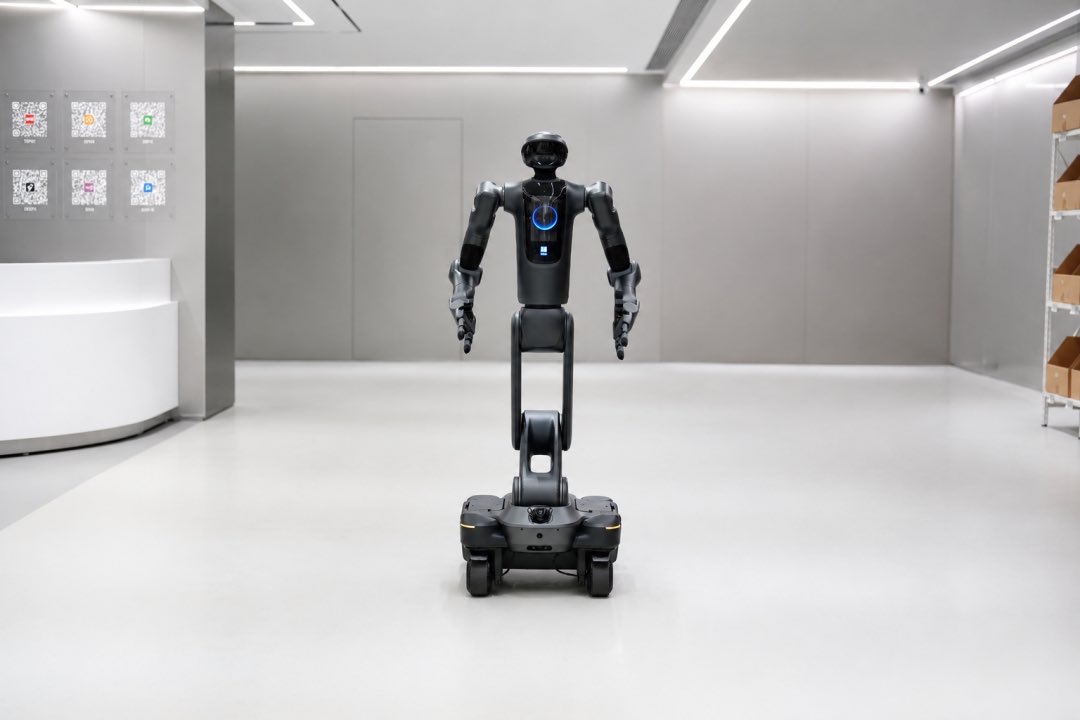
Sunday Robotics Memo is a home assistant robot designed to help with household chores.
It learns tasks like loading dishwashers, clearing tables, and folding laundry using data collected from human demonstrations through a special glove system.
With its extendable body, Memo can safely reach objects from the floor to high shelves and operate around people and pets.
US-based Ryse Aero Technologies has developed the Recon, a single-seat electric multicopter that does not require a pilot’s license to fly.
It can take off and land on both land and water, reaching speeds of up to 63 mph with a range of 25 miles.
The aircraft uses AI-assisted controls and joystick operation, making it easy to fly with minimal training.
Another humanoid worker has just joined the factory floor
Two years later,PUDU Robotics has launched the new-generation PUDU D7, built specifically for real manufacturing scenarios.
It can autonomously push carts, handle intra-line transportation, perform delicate operations, and manage material conveying,all with ease.
Powered by the PuduFM 1.0 Embodied Intelligence Model, the D7 can continuously learn, understand tasks, and evolve through real-world use.
Compared to the first generation, the new D7 feels far more productized and ready for deployment: folding and lifting body design, 2-meter reach, 14kg payload, Interactive screen,autonomous battery swapping for true 24/7 operation.
Notably, PUDU has built a full robotics portfolio covering specialized robots, humanoid-form robots, and full humanoids. Their products span four major lines--delivery, cleaning, industrial, and general embodied intelligence,with deployments in over 85 countries and regions and cumulative shipments exceeding 130,000 units.
This rich product lineup, combined with extensive real-world industry experience and operational data, is now feeding back into their humanoid robots and models--creating a powerful closed loop:scenario applications->model/robot capabilities->tangible business value.
🌌 A new AI designed a completely new antibiotic in 48 hours that kills the world’s most resistant bacteria...
Traditional methods failed for decades the AI succeeded on its first try.
📌 Source: MIT AI antibiotic discovery, Nature May 2026
It’s not every day you see a full-sized industrial robot taking a casual stroll past outdoor diners. 🤖🚶♂️
@personaaiinc just took its Gen 1 humanoid out in the Houston heat to test some new @UnderArmour treads—and officially teased that a Gen 2 launch is on the horizon.
Astribot is China’s latest robotics unicorn.
Chinese reports say the company completed a Series B at a RMB 10B+ (~$1.4B) valuation, just a few days after opening sales for T1.
The new model starts at RMB 89,900 / ~$13.6K.
Galaxea's first bipedal humanoid robot --Kengo.
Kungfu is a basic skill. watch it do housework,the kneeling and crawling motions to wipe the floor is impressive,it demonstrates that coordination, balance, and stability of its whole-body control during low-position operations.
These capabilities enable it to be applied to more commercial service scenarios, such as shopping malls, car dealerships…
🚨 AI Just Created a Material Humans Never Imagined!
Scientists have developed a revolutionary new material that is stronger than steel, lighter than foam, and up to 5 times stronger than titanium.
The most surprising part? It was designed by artificial intelligence, not human engineers.
Using AI, researchers created entirely new microscopic structures that were later 3D-printed and tested. The results could lead to lighter airplanes, stronger buildings, and more efficient vehicles.
This breakthrough shows that AI is no longer just helping scientists—it’s starting to invent alongside them.
What could the world look like when AI designs the materials of the future?
Source: University of Toronto. AI-designed nanomaterials achieve exceptional strength and lightness. University of Toronto Engineering News.
Path Robotics has developed a legged robot called Rove for large-scale industrial welding.
It moves to the worksite and scans welding seams to understand their shape.
Then, its AI performs welding and adjusts the process in real time.
Carrying a fire extinguisher into a rescue scene? 🧯
Okay, this is what a humanoid built for actual field work should start looking like.
Deep Robotics’ upgraded DR02 is clearly moving toward real-world practical applications:
• Bringing emergency gear right into active rescue sites
• Flipping switches on live electrical cabinets (yeah, while powered)
• Taking over the high-risk jobs that humans really shouldn't be doing first
And the hardware? Pure industrial grade:
• 175 cm tall | 65 kg
• IP66 rated
• Works from -20°C to 55°C
Yeah, this thing is clearly built for the grim side of industrial work.
Shenzhen-based Kinetix AI has introduced a faceless humanoid robot called KAI.
The robot is about 5 feet 8 inches tall, weighs 70 kilograms, and can carry loads up to 20 kilograms while running for around 4 hours on a single charge.
With highly flexible hands and precise movements, KAI can fold clothes, handle delicate objects, and assist with everyday household tasks.
NVIDIA announces the first open humanoid robot reference design built for robotics research.
The NVIDIA Isaac GR00T Reference Humanoid Robot combines the @UnitreeRobotics H2 humanoid robot, @SharpaRobotics Wave five-fingered hands for dexterous manipulation, Jetson Thor onboard compute, and Isaac GR00T open software and models, giving researchers a full-stack platform from data capture to model deployment.
Read the #NVIDIAGTC Taipei announcement: https://t.co/ZsT3qQKucb
Flex 2 hand by Hangzhou-based Xynova.
- Hybrid-drive system that combines cable-driven tendons with direct-drive actuation
- 23-DOF bionic hand, weighs 400 g, 2 fist closures per second
- 0.05 N force-control accuracy, back-drivable
Strong demand is pulling eldercare robots out of the demo booth and into real care workflows. 👵🤖
A new MIIT-affiliated report says China’s smart eldercare robot market is expected to pass RMB 10 billion (about $1.5 billion) in 2026.
The pressure is simple: by the end of 2025, China had 323.38 million people aged 60+, while the world is moving toward 1.4 billion by 2030.
The labor gap is just as real: China’s eldercare worker shortage is already above 5 million, and globally, care systems are running into the same aging-workforce squeeze.
The first real use cases are not flashy: transfers, fall alerts, remote monitoring, toileting, bathing, rehab, and companionship.
Scale will likely start in nursing homes, community care centers, and high-need households before it reaches the average living room.
For home adoption, the hard gates are still price, safety, privacy, reliability, and zero-training usability.
This market is not waiting for sci-fi robotics; it needs safe, boring, repeatable systems that reduce care load every day.
🩺 Canadian Scientists Build a Rice-Sized Robot That Breaks Kidney Stones — With Almost No Pain
Canadian researchers have developed a tiny magnetic robot—no bigger than a grain of rice—that can travel inside the body and break kidney stones safely, gently, and without surgery.
Instead of shock waves or invasive tools, this mini-robot uses precise magnetic guidance from outside the body. Doctors can steer it through the urinary system in real time, allowing it to reach tight areas normal instruments can’t. Once it reaches the stone, it delivers focused micro-vibrations that shatter it into fine pieces the body can pass naturally.
💡 Why this matters:
◽ Minimal pain
◽ No cuts, no incisions
◽ Faster recovery
◽ Avoids healthy tissue entirely
◽ More precision than traditional treatments
Early tests show patients experience far less discomfort because the robot targets only the stone—and nothing around it. This approach could transform kidney-stone treatment and open the door to a new era of soft, gentle, internal robotic medicine.
If upcoming trials confirm the early success, this tiny device could help millions of people avoid painful procedures every year.