Heart function stayed stable at 1 year after carefully monitored withdrawal of heart failure therapy in breast cancer survivors with recovered anti-HER2 cardiotoxicity. Work from our group at @ucl, presented by @bmdwsg as a Late-Breaking Trial at #ESCCongress 2026 & published simultaneously in @ehj_ed: HER-SAFE. @TheBHF@escardio@MycardiumAI #CardioOnc
🔗 https://t.co/pZ2m3aRnIp
Our study in @JAMACardio: 72 patients with severe AR, paired CMR, echo and CPET before and 7 months after AVR. LV volume fell 44% and mass 21%, but scar was associated with less remodelling and peak VO2 unchanged. @UCL_ICS@TheBHF@NHSBartsHealth
https://t.co/MilRzgNl8J
Excited to see our work on myocardial fibrosis and reverse remodelling after AVR for chronic aortic regurgitation published in @JAMACardio! https://t.co/8TwXiyKces
At 7 months post AVR:
🔹 LVEDV ↓44%
🔹 LV mass ↓21%
🔹 Matrix ↓15%
But focal scar did not regress #whyCMR@TheBHF
How do you handle persistently low dock position during #TMVR with the #M3 system?
If usual maneuvers fail, 2nd transseptal puncture can be considered for double guide sheath technique. Here's what we learned @CedarsCards@RajMakkarMD, out in @JACCJournals Interventions. 👇
🫀 First-in-human valve-in-valve TAVI in mechanical prostheses
Bench-to-bedside study: disc dislodgement & retrieval followed by successful TAVI.
Published in European Heart Journal.
👉 https://t.co/tORjwdmhy6
@escardio@PCRonline@secardiologia@CNIC_CARDIO@sacyl@TCTMD
So proud of @ShubhaPawar for leading this cross-disciplinary collaboration that distills today’s best evidence in aortic regurgitation (diagnosis and treatment), now in @JACCJournals. IM residencies: @ShubhaPawar is applying this season - take note. @CedarsSinai@CedarsSinaiMed https://t.co/YOouwZp1LB
Ever wondered why some pts feel every balloon inflation, while others feel nothing? 💭
Or why severe ischemia can be asymptomatic?
Our placebo-controlled, n-of-1 study — simultaneous in #Circulation & #TCT2025 — shows collateralization may be key.
🔗 https://t.co/uyAw3gXAx3
@drjohnm@divaka_perera Agree entirely that we shouldn’t be doing PCI in these patients, but important to note that REVIVED doesn’t show PCI doesn’t work, it shows PCI doesn’t improve prognosis compared with optimal medical therapy
KOLs boost Early Aortic Valve Intervention in Patients with Asymptomatic AS--Despite Dubious Evidence:
@JAMACardiology featured a strong editorial urging cardiologists to intervene early in patients who have aortic valve stenosis and no symptoms. I do not agree via @drjohnm
https://t.co/bMt8Gl1SwU @gbiondizoccai@Coronary4front@cpgale3
Should PCI be an option for first line management of stable angina symptoms?
Point and counterpoint in @CircOutcomes with final word from @bnallamo and @TCTMD
https://t.co/501Y7HHgKB
@rallamee
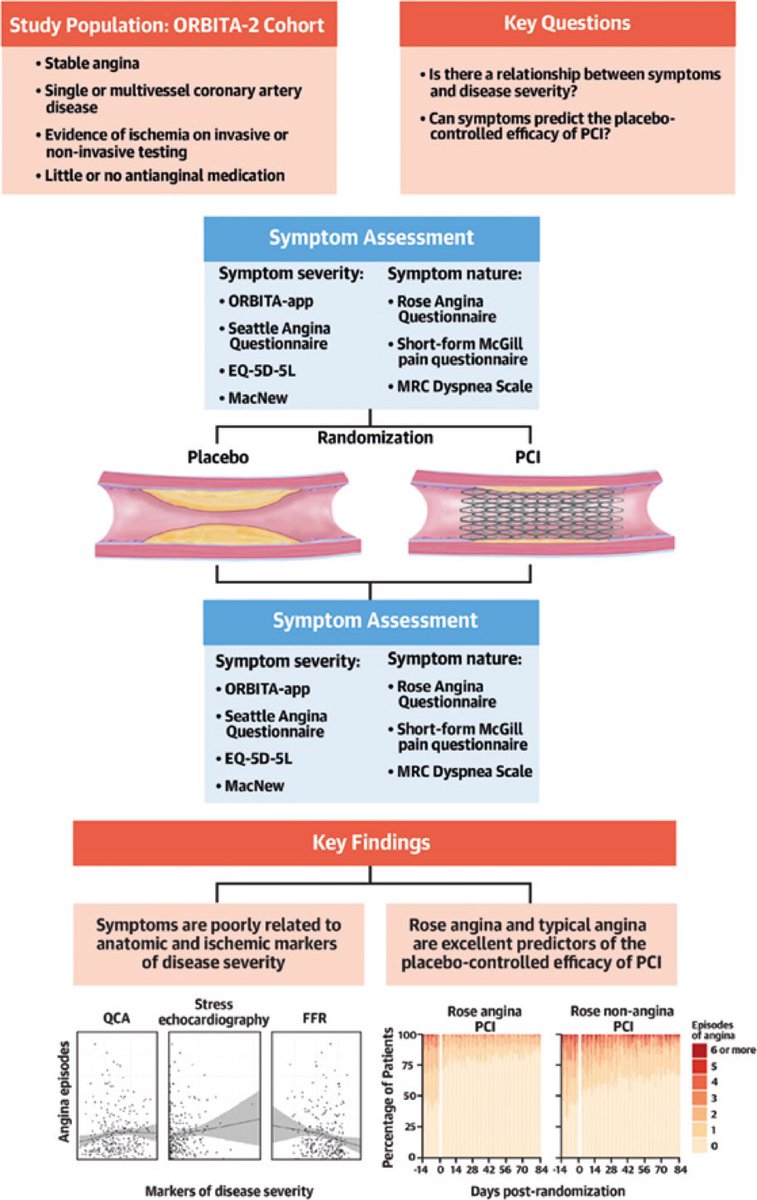
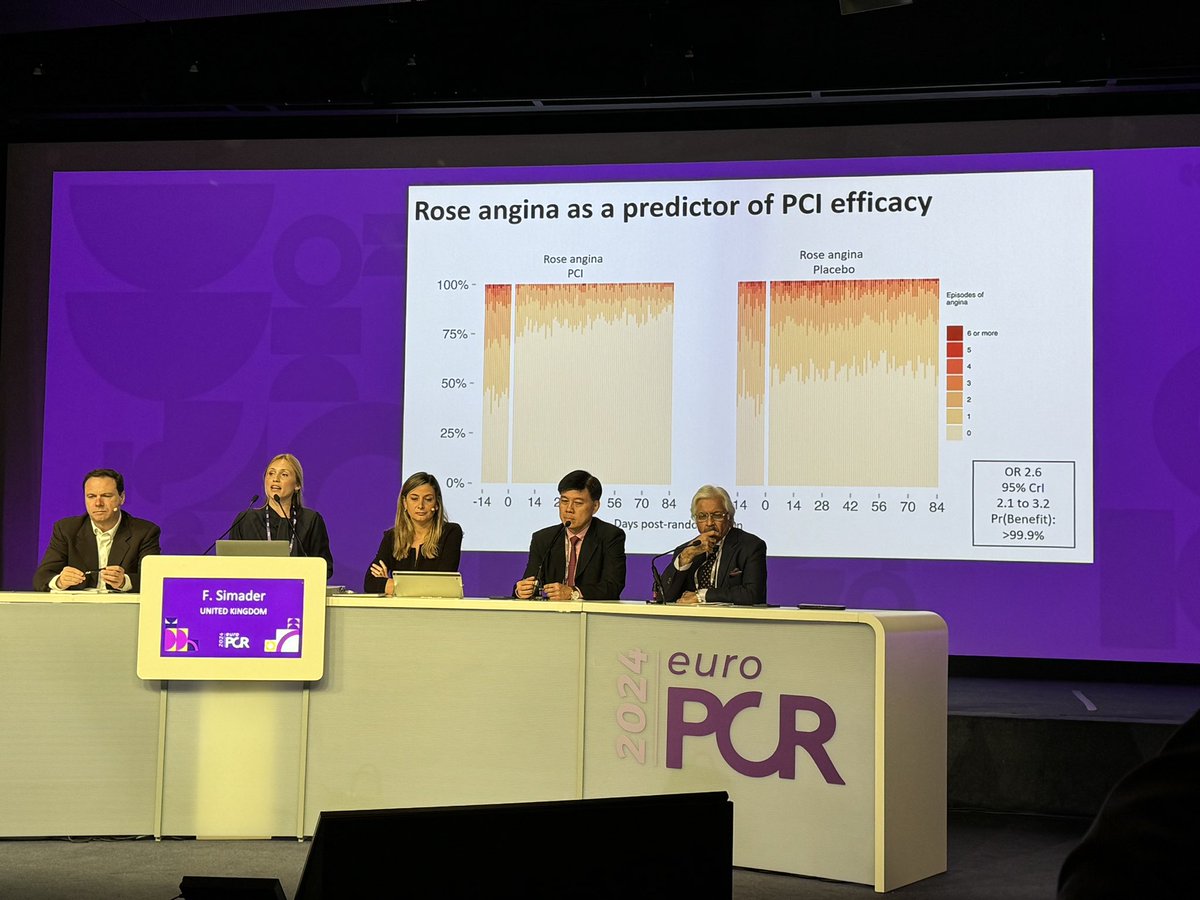
.@FloSimader on #ORBITA-2 at #EuroPCR:
📌Poor correlation between symptoms & disease severity
📌Symptom nature is a powerful predictor of the placebo-controlled efficacy of #PCI
📌Rose angina & typical angina are excellent predictors of the placebo-controlled efficacy of PCI
📌Other symptoms such as SOB are poor predictors of the placebo-controlled efficacy of PCI
In contention for BEST study of the year thus far
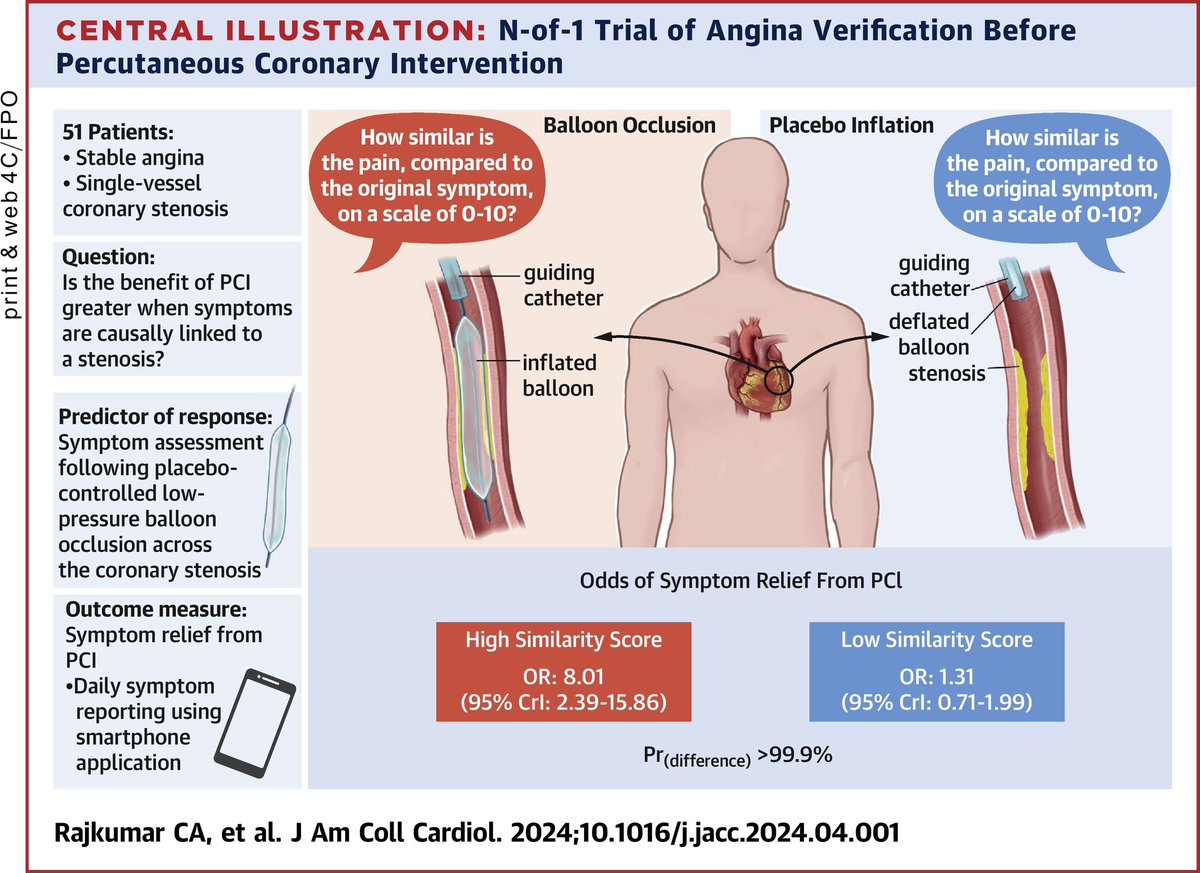
N of 1 trial of patient-blinded occlusion of target vessel
The more angina was inducible, the more symptom relief after PCI
Best 2 figures
Now, how best to verify if symptoms truly are angina?
ICYMI: Watch this insightful video by Drs. @rallamee & @rajkumar_chris where they shed light on their #JACC paper discussing the N-of-1 trial of angina verification before #PCI.
Access the full 📄 here: https://t.co/DSpWm9dLu5
#EuroPCR#ORBITA@hmkyale
In ORBITA-STAR, angina verification with an ischaemic stimulus powerfully predicted response to PCI. #EuroPCR2024
Perhaps we have been too focused on treatment when the problem always lay in the diagnosis! Published today in #JACC https://t.co/1Yj9mJ6MxS @rallamee