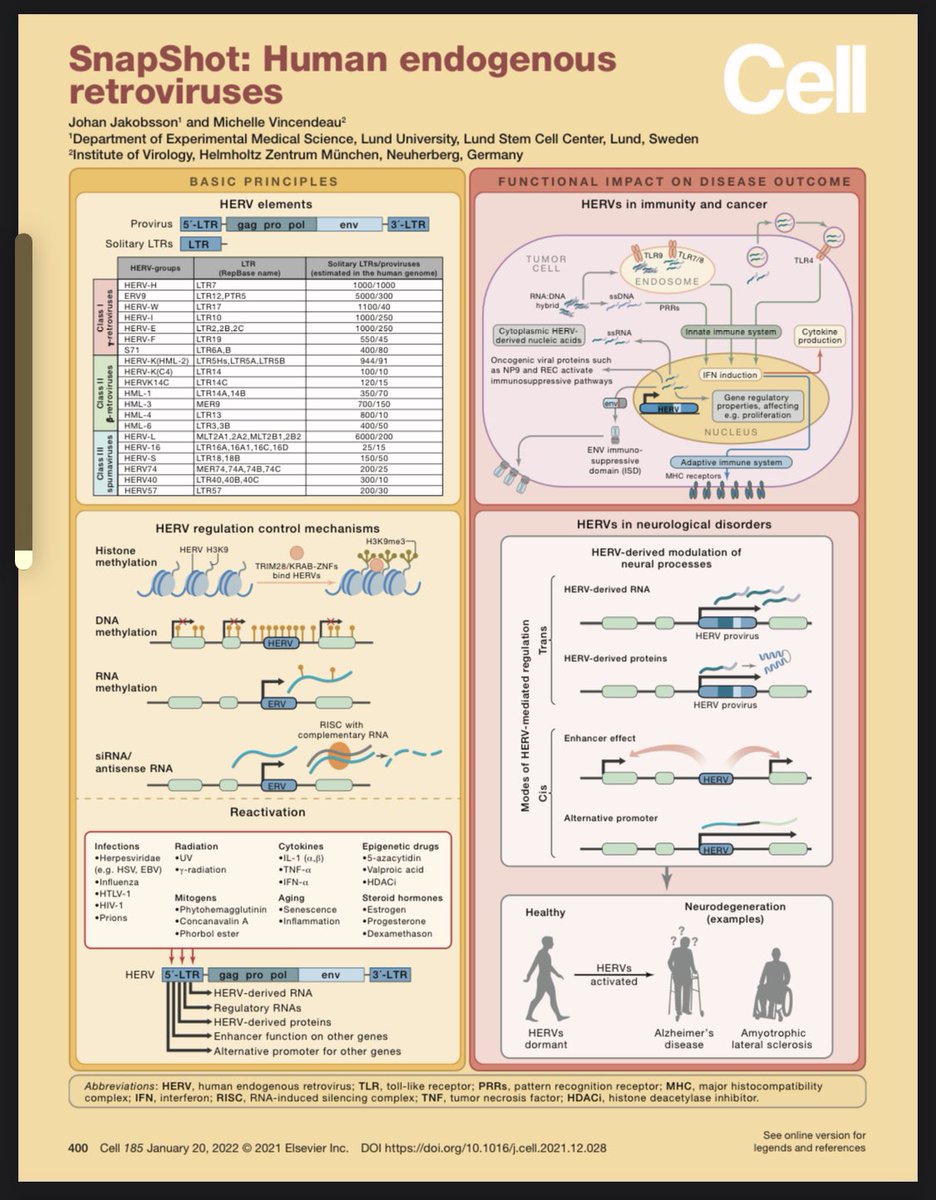
Setdb1 silences ERV derived cryptic enhancers to ensure proper hematopoiesis. Although transcription factors, such as PU.1, can bind to H3K9me3 heterochromatin, their activity is inhibited by Setdb1.
out in PNAS: https://t.co/ZWwKLghHmL
@JakobssonLab@M_Vincendeau@ch_douse Great story! Interesting that loss of DNMT1 de-represses LINE1 while "silencing mark" H3K9me3 is maintained. Much like we found in mouse endoderm IAPEz elements are derepressed in Dnmt1 ko with maintained H3K9me3 https://t.co/1VeJzuvqsp
@ControllingLMNT@LickertHeiko@NatureComms I think there will be heterogeneity. For example, an IAP element in the Mnd1 locus seems specifically regulated in neuronal cells (PMID 22991445,27798843), but not in XEN or DE cells. Maybe due to differences in TF networks. Will need to investigate better...
H3K9me3 is not sufficient for silencing endogenous retroviruses if DNA methylation is perturbed. In Dnmt1 ko endoderm cells, IAP elements fully maintain H3K9me3, while trancriptionally active.
great collaboration with @LickertHeiko
out in @NatureComms
https://t.co/1VeJzuvqsp
@ControllingLMNT@LickertHeiko@NatureComms Very good question. Unfortunately read mapping on individual IAPs is challenging due to strong homology/identity between elements. Long read sequencing will help to clarify this better.
DNA sequence-dependent formation of heterochromatin nanodomains [Graeme Thorn, Christopher Clarkson, Anne Rademacher, Hulkar Mamayusupova, Gunnar Schotta, Karsten Rippe & Vladimir Teif] https://t.co/O9RsdhIh3T
ChromHL software here: https://t.co/pq7DX8tdKC
Cartoon as a bonus!
Check out our latest research on how G-quadruplexes and transcription factors cooperate to shape the cell type-specific transcriptome.
https://t.co/wSZUeYkeEc
@GSchotta@FCernilogar@RichterLabUnipd
G4 quadruplex structures are cell type specific and associate with highly expressed genes. New preprint of a collaborative project led by @SaraNRichter_ https://t.co/4jv9reyyjf
The Kidney Contains Ontogenetically Distinct Dendritic Cell and Macrophage Subtypes throughout Development That Differ in Their Inflammatory Properties @buschraml@gschotta@FCernilogar
https://t.co/TtXRrysNes


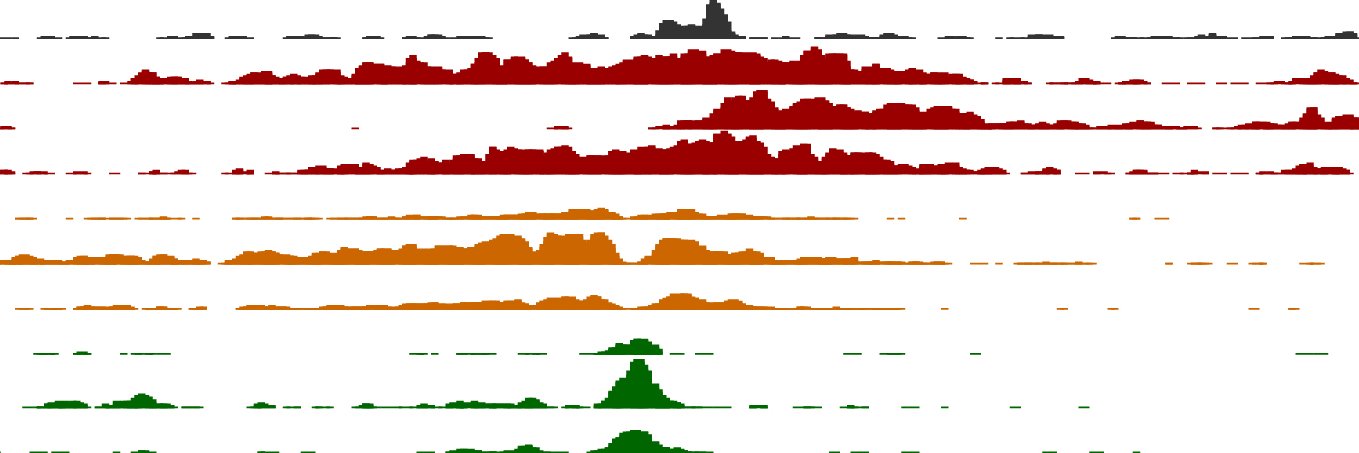


![generegulation's tweet photo. DNA sequence-dependent formation of heterochromatin nanodomains [Graeme Thorn, Christopher Clarkson, Anne Rademacher, Hulkar Mamayusupova, Gunnar Schotta, Karsten Rippe & Vladimir Teif] https://t.co/O9RsdhIh3T
ChromHL software here: https://t.co/pq7DX8tdKC
Cartoon as a bonus! https://t.co/APN8Rtg83D](https://pbs.twimg.com/media/FPrOkdUXEBEAs16.jpg)