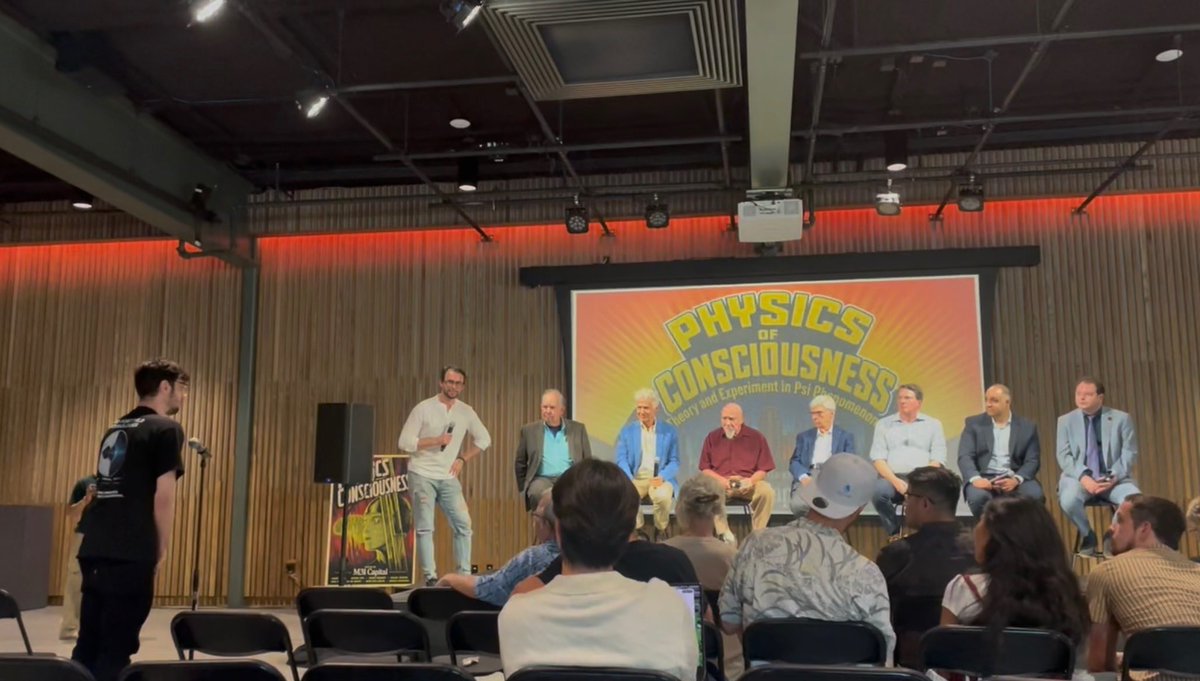
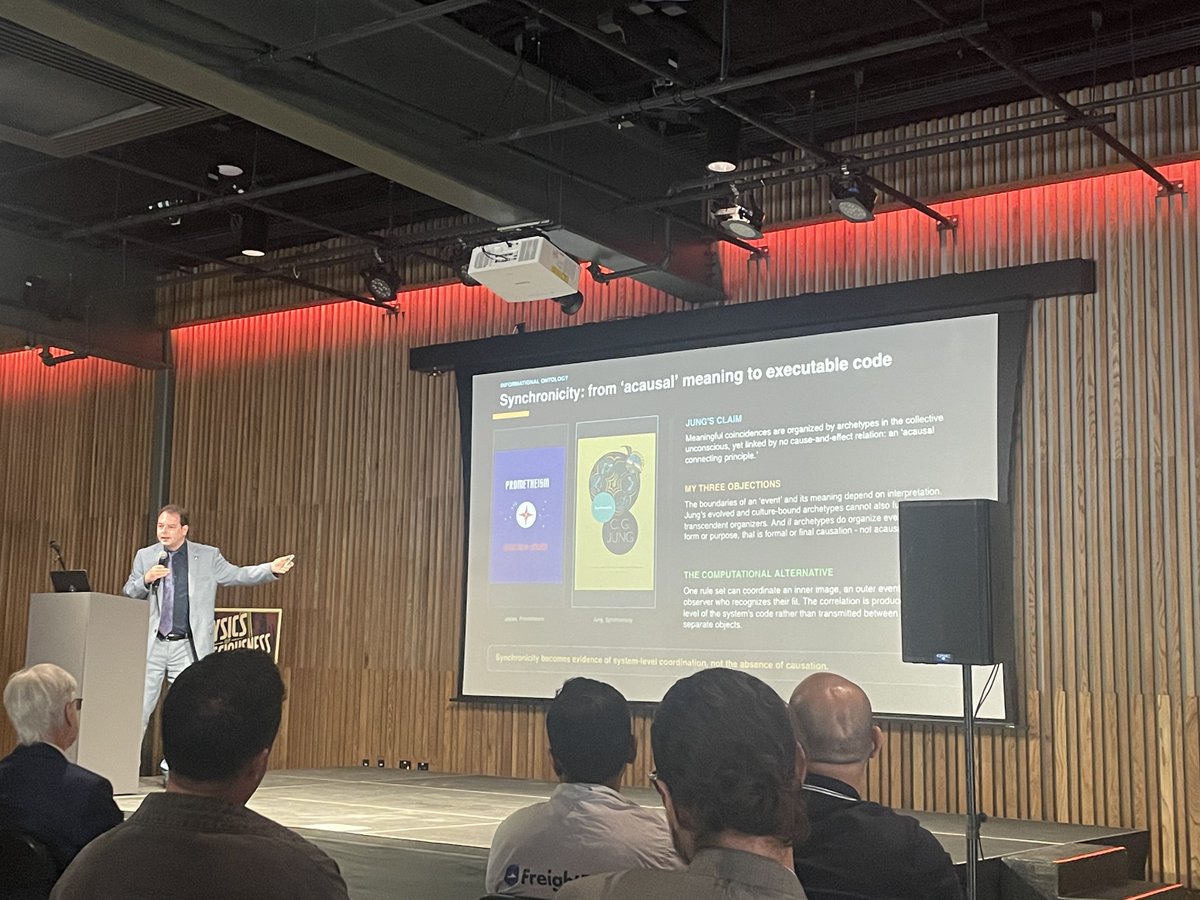
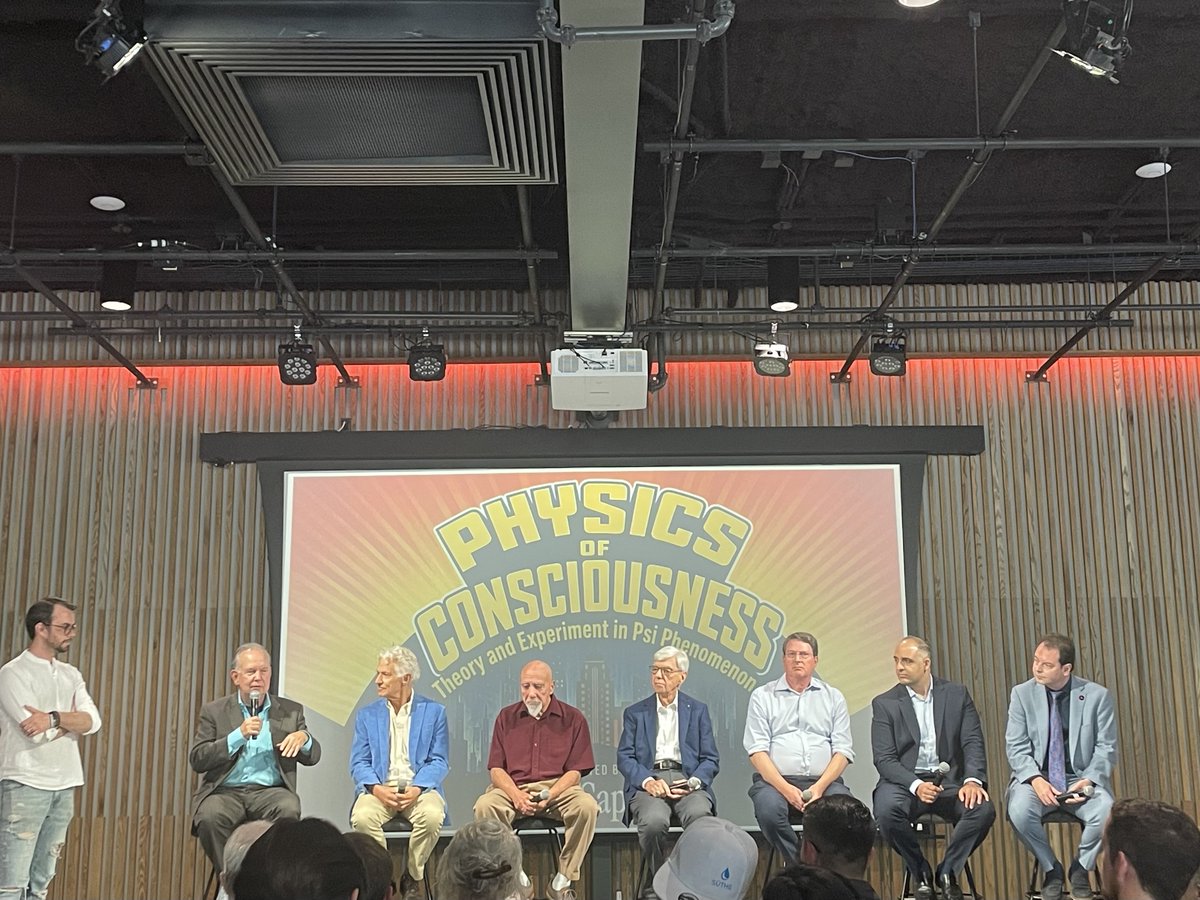
Last Saturday, July 11, I had the honor of presenting at APEC (the Alternative Propulsion Engineering Conference), representing @zpfTechnologies with our talk on Boundary-Conditioned Vacuum Interaction Systems (BCVIS).
APEC has platformed some of the most recognized names in advanced propulsion and vacuum physics: Dr. Harold "Sonny" White, Dr. Charles Buhler, Dr. Garrett Moddel, Dr. Mike McCulloch, Dr. Daniel Sheehan, Dr. Tom Valone, and etc. — researchers spanning NASA, DARPA-funded programs, Lawrence Livermore, and major universities. Standing on that same stage at this point in my journey is something I'm still processing.
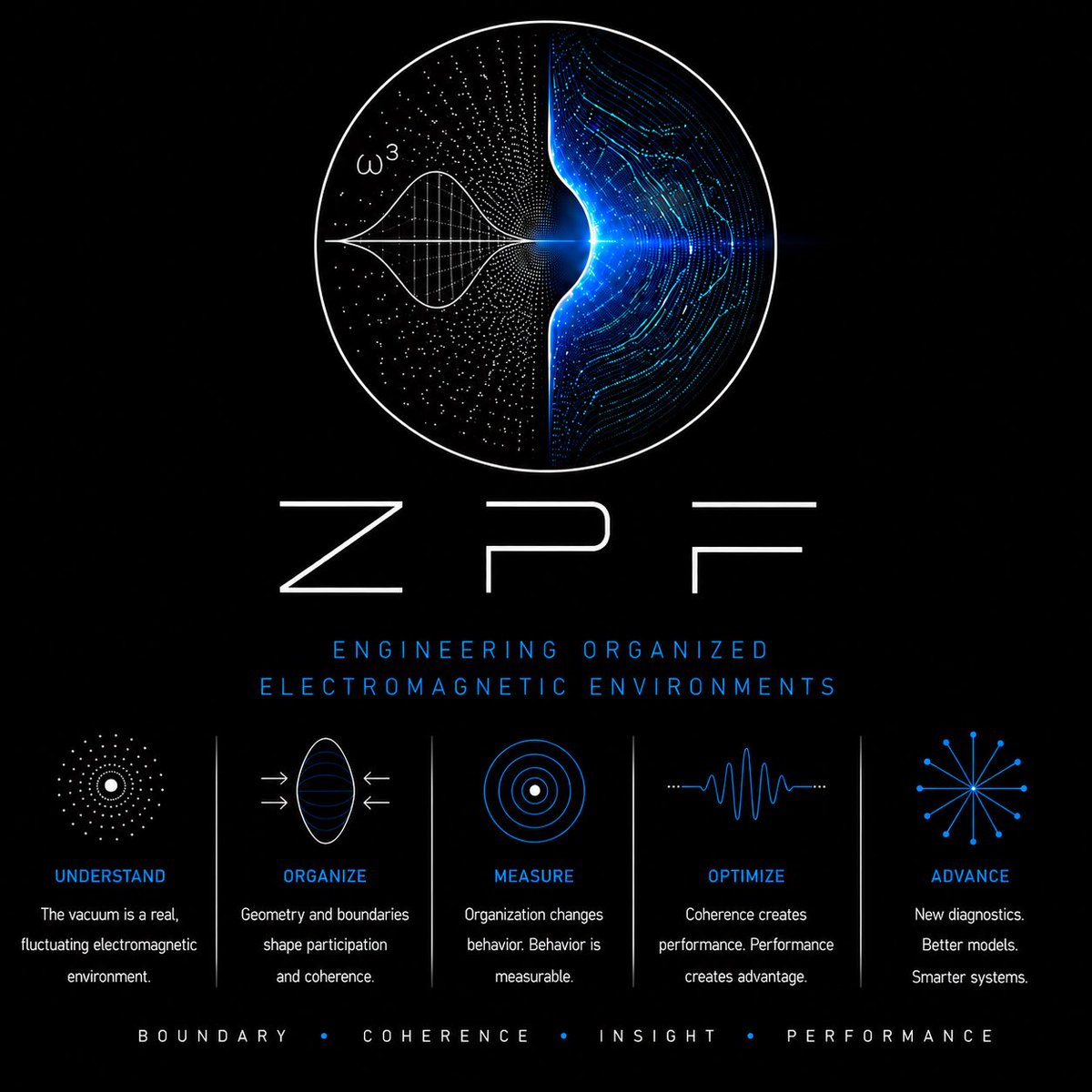
The talk itself: quantum physics says empty space isn't actually empty. It's filled with a background electromagnetic field, present everywhere, at every moment. At ZPF Technologies we're developing a nanoscale platform built to interact with that background in a measurable way, and I presented the diagnostics framework that keeps the whole program in check: the language, the variables, and the tests that tell competing explanations apart.
Long term, this research points toward two goals. The first is quantum vacuum propulsion: today, every rocket moves by throwing mass backward, which means carrying enormous amounts of fuel; most of a rocket's weight is the fuel needed to lift its own fuel. The long-term question is whether a spacecraft could instead exchange momentum directly with the vacuum field itself: no chemical fuel, no propellant, no mass expelled at all. The second is vacuum-catalyzed aneutronic fusion: exploring whether the vacuum field can assist fusion reactions at the nanoscale. Aneutronic means fusion routes that release little to no neutron radiation, which is what would make fusion power clean.
Huge thanks to @timventura and the whole APEC team for the warm reception and for building a place where frontier physics gets discussed openly and seriously, and to my fellow presenters for the sharp questions and great conversation. @QualiaQuanta
A special thank-you as well to @AshtonForbes for taking the time to walk his audience through our talk and the work we're doing at ZPF Technologies. The enthusiasm and the platform mean a lot.
And above all, thank you Douglas Miller, Founder and CEO, for trusting me to represent ZPF Technologies on that stage. Building this with you has been the opportunity of a lifetime. We're just getting started 🚀
https://t.co/QtQyyFu6As
https://t.co/40CIDm1Lb7
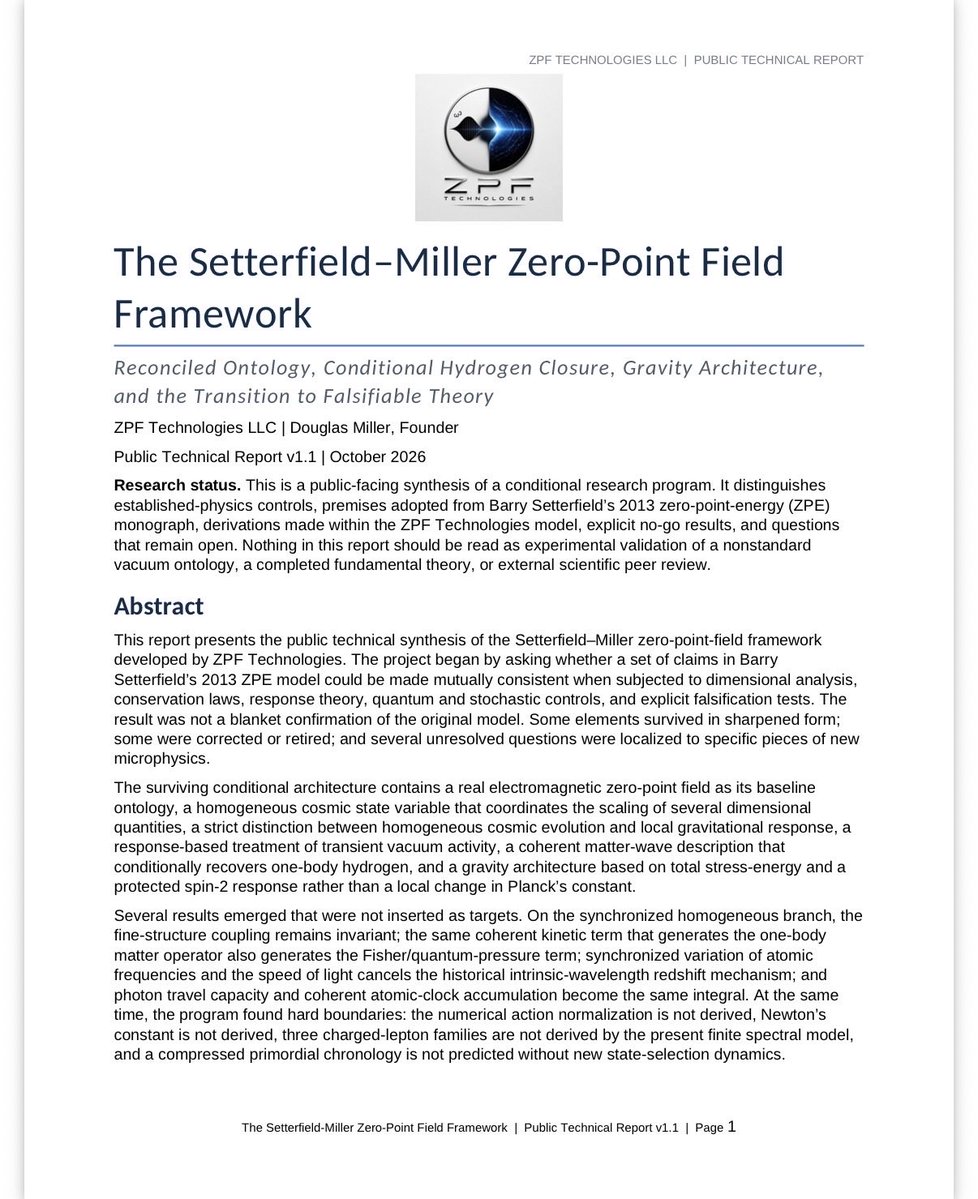
Quantum Electrodynamics and Quantum Field Theory are the best frameworks that we have to explain the physics of the universe. That said, it is still not a complete theory and has decades old unresolved issues. SED physics is unique becase it says that real zero point energy field fluctuations exist and that they are physical reason behind the quantum effects of QED/QFT. The problem is that plugging in a real ZPE does not magically fix everything. SED physics by itself is not the answer. Ontologicaly it is appealing becasue it offers a physical reason for quantum effects. The problem is that mathematics of SED doesn't fulfill that ontology. Something is still missing between QED/QFT and SED.
Barry Setterfield's life's work was to take SED and compare it to QED and and show how from an ontological perspective, real vacuum fluctions being responsible for quantum effects makes a lot of sense when you look at the cumulitive evidence. That being said Setterfield's work and his monograph "Cosmology and the Zero Point Energy" are not perfect.
The present work set out to reconcile Setterfield as well as conditionally reconcile the ground state of the hydrogen atom. I leave it up to public scrutiny as to if that has been accomplished in this present work. If it has, it is my belief that this work provides a crucial and imperitive path forward for physics.
https://t.co/pLr4IBw8F6
A scaled-up Casimir array would behave a bit like a one-shot battery.
Prepare an enormous number of cavities with their plates held apart, and you have a higher-energy configuration. Release them, and the ZPE pressure imbalance—greater outside the plates than inside—pushes the plates together and does mechanical work.
For our deliberately absurd example of 10⁶³ idealized cavities, that one-time interaction-energy change is ~4.3 × 10⁴⁹ J.
That doesn’t make the energy “free.�� The array had to be built and prepared, just as a battery has to be manufactured and charged.
But it makes the point: the Casimir effect isn’t incapable of doing work. A prepared Casimir system can discharge once, converting its available energy into real mechanical work—very much like a one-shot battery.
The Casimir effect does not show that the vacuum is a free, cyclic energy source. It does show that a boundary-conditioned vacuum can leave greater ZPE pressure outside the plates than inside. That pressure imbalance pushes the plates together and does mechanical work. Scale the number of cavities high enough, and the one-time work can become enormous. That does not mean the work is free—the cavities still have to be built and prepared. But that is beside the point of the thought experiment. The point is simply that ZPE fluctuations can exert a real force on matter and do real physical work.
In 1952, Louis de Broglie publicly returned to his original ideas because he believed physics had indeed taken a wrong turn by abandoning determinism and objective reality. This shift was directly catalyzed by American physicist David Bohm, who independently rediscovered and extended de Broglie’s abandoned 1927 Pilot Wave Theory.
When de Broglie saw Bohm’s 1952 papers, he realized the orthodox "Copenhagen interpretation" was not the only mathematically viable way to explain the subatomic world.
When David Bohm published a refined, working version of the pilot wave concept in 1952 (now called De Broglie–Bohm theory or Bohmian mechanics), it proved that a deterministic, realist quantum mechanics was entirely possible.
This prompted de Broglie to declare that physics had made a philosophical mistake. He spent the rest of his life arguing that:
•Particles are always real: An electron has a precise location and a definite trajectory at all times, whether we look at it or not.
•The "wave function" is a real physical field (The ZPE): Rather than just a mathematical tool for calculating probabilities, it acts as a literal pilot wave guiding the particle through space.
•Statistical probability is an illusion: The randomness of quantum physics isn't inherent to nature (the ZPE); it's simply a result of our ignorance of the precise initial positions of the particles (hidden variables) (due to the ZPE).
But the mainstream physics community didn't turn back. While brilliant minds like Albert Einstein and later John Stewart Bell championed the logic of de Broglie and Bohm's alternative, mainstream physics did not reverse course.
The primary drawback of the de Broglie–Bohm theory is its explicit nonlocality. To make the math work, a change to a particle in one part of the universe must instantly alter the pilot wave guiding a twin particle elsewhere, seemingly violating the spirit of Einstein's theory of relativity. Additionally, because standard quantum mechanics worked perfectly for calculating practical engineering problems, most physicists ignored the philosophical debate altogether.
This ignorance has persisted like a pestilence in the physics community to this day. BUT…it’s time for change
Had a very productive 2hr FaceTime conversation with the one and only ZPE AllStar Gabriel Dias tonight. We talked about his experiences at Deep Tech Week Austin including meeting:
• Hal Puthoff
• Garret Moddel
• Andrew Coté
• “Max” Derakhshani
And others. In attendance was Eric W Davis and C.J. Wilson of C.J. Wilson Racing
Pretty wild timing.
Today @DeptofWar released its newest UAP/UFO file batch under PURSUE. Included are the 37 AAWSAP Defense Intelligence Reference Documents (DIRDs) covering topics from air-breathing MHD and aneutronic fusion to advanced propulsion, vacuum-energy concepts, warp drives, wormholes, and more.
Back on August 12, @AshtonForbes and I were discussing these exact papers on Hard Truths Podcast — including air-breathing magnetohydrodynamics, aneutronic fusion, Hal Puthoff, Eric Davis, and the broader DIRD program.
At @zpfTechnologies, we’ve been working through a number of these papers from a physics and engineering standpoint: separating established physics from interpretation, comparing competing mechanisms, and asking what can actually be calculated, tested, or falsified.
If you’re studying physics or electrical engineering, read the DIRDs yourself. They’re a window into the advanced aerospace, field-physics, and propulsion questions that were serious enough for DIA to commission technical studies on.
If UFOs are real, what is their propulsion mechanism like? What’s the science behind it all?
Funny watching this conversation come full circle a month later.
Clip from our discussion below.
A bonus surprise speaker has joined the lineup, none other than Hal Puthoff
Hal joins @Jason_Jorjani , @StuartHameroff , Thomas Brophy, James Tagg and @MaxDerakhshani
I think this is shaping up to be one of the most interesting and frontier events @deeptechweek has ever hosted
thanks again to @M31Capital for making it possible
Magnetohydrodynamic (MHD) Propulsion - What Is It?" by AsteronX
#ufotwitter
This video, titled "Magnetohydrodynamic (MHD) Propulsion - What Is It?" by AsteronX, explains the physics, operating principles, and potential applications of magnetohydrodynamic field propulsion for aerospace and spaceflight.
1. What is MHD Propulsion? [00:15]
Magnetohydrodynamics (MHD) is the study of electrically conductive fluids—such as ionized gases, plasmas, or saltwater—interacting with magnetic fields [01:04]. MHD propulsion uses electromagnetic forces to accelerate conductive fluids directly, producing thrust without moving mechanical parts like propellers, turbines, or airfoils [02:29].
2. Physical Mechanism: The Lorentz Force [02:47]
Working Principle: When an electric current passes through a conductive fluid perpendicular to an applied magnetic field, it generates a perpendicular Lorentz Force [02:47].
Pressure & Acceleration: This magnetic force directly accelerates or decelerates the fluid particles, driving fluid flow and creating thrust or pressure gradients [08:30].
3. Atmospheric Flight Mechanics [10:03]
Air Ionization: Since neutral atmospheric air is non-conductive, the aircraft must ionize incoming air into a conductive sheath, often using high-frequency (radio/microwave) pulse discharges [10:19].
Aerodynamic Integration: The accelerated ionized air can be directed over specialized airfoils—such as saucer-shaped Coandă effect structures—to generate lift dynamically across the body [11:27].
4. Space Application Concepts [12:20]
Plasma Rocket Engines: Utilizing magnetic fields and Lorentz forces to accelerate cold or superheated plasma out of a nozzle without physical grid erosion [12:31].
Quantum Vacuum Thrusters (Theoretical): The video discusses futuristic concepts using ultra-short, intense electromagnetic pulses to interact directly with quantum vacuum virtual electron-positron fluctuations [13:35].
The core concept in the presenter's design is hull-integrated disc vehicle geometry, rather than an internal thruster, linear duct, or traditional rocket nozzle.
In the video, AsteronX emphasizes that for magnetohydrodynamics (MHD) to be practical in atmospheric flight, the vehicle's physical shape and propulsion system must be unified into a single structure.
Key Architectural Features of the Disc/Saucer Design
360° Coandă Effect Airfoil: Instead of pushing air through an internal engine tube, the saucer geometry acts as a continuous "wing wrapped around the vehicle". Plasma or ionized air accelerated across the curved upper skin adheres to the surface via the Coandă effect, generating low pressure and continuous lift across the entire hull.
Surface Boundary Layer Sheath: High-frequency pulse discharge electrodes embedded along the outer skin ionize ambient air into a conductive plasma sheath surrounding the disc. The Lorentz force directly manipulates this sheath, eliminating aerodynamic drag, shockwaves, and thermal heating during flight.
Field Drive vs. Mechanical Thruster: Rather than using discrete thruster pods or jet exhausts, magnetic and electric field arrays distributed across the disc's surface manipulate the fluid directly in 360 degrees, allowing omnidirectional maneuvering without moving parts or control surfaces.
(This geometry directly builds on historical field-acceleration concepts, such as Jean-Pierre Petit’s MHD aerodyne and saucer research cited in the video description).
Enough to power the Sun for 3.6 Quadrillion Years! The point is that physics allows for it. And people refuse to accept it because people can not think in terms of scale very easily. Elon Musk is changing that. Accept the premise first. Then let imagination be our only limitation. This is Kardashev scale engineering and energy output.
.@AaloAtomics designed its nuclear reactor to fit on a truck. That constraint shapes the vessel, the machines that build it, and the supply chain behind it.
Chapter 2 of my visit to @AaloAtomics' Austin pilot factory.
0:00 A reactor that fits on a truck
0:24 Water jets and vessel size
0:55 Designing around existing machines
1:22 Rolling and welding the vessel
1:49 CNC machining
2:03 Thin steel and shorter lead times
2:45 Inside the pilot factory
3:10 Supply chains and "no unobtainium"
3:59 Designing for manufacturing
4:10 Next: liquid sodium
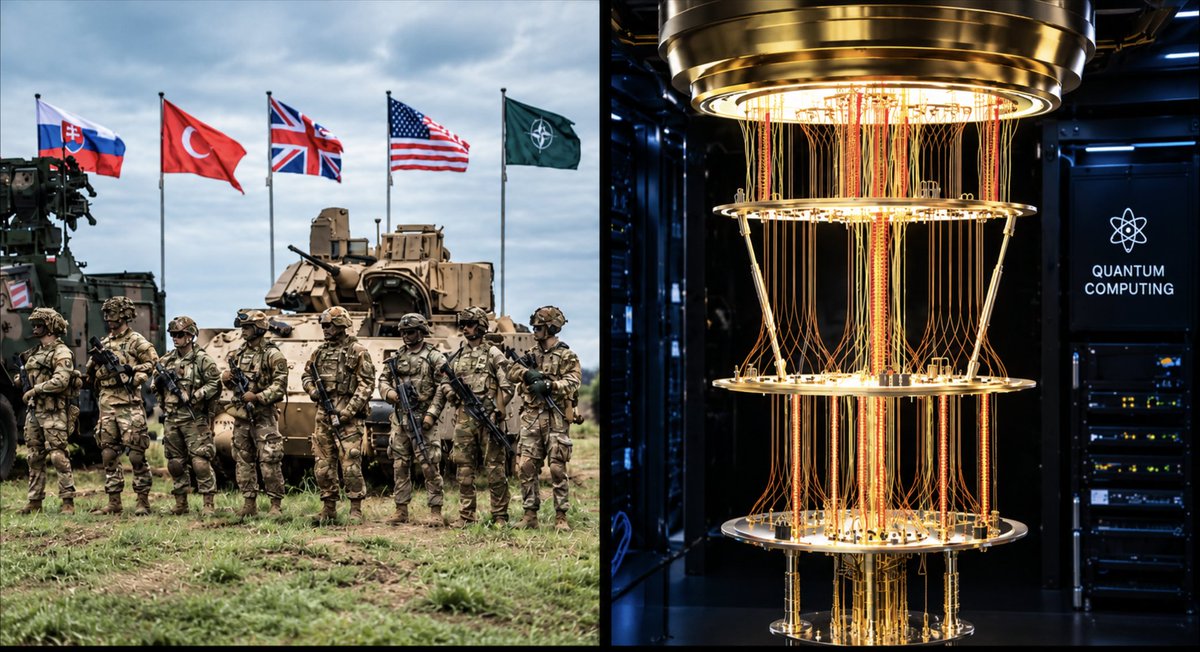
NATO JUST PUT QUANTUM ON A MILITARY SCHEDULE.
NATO has published its Quantum Technology Roadmap, approved by all Allies on July 30th, public as of yesterday.
Quantum navigation at sea first: NATO's maritime research center ran its first round of sea trials, Questor 26, in La Spezia, Italy earlier this month, testing quantum sensors for positioning and navigation where GPS is unavailable with more trials run through 2027.
First military pilot report, Q1 2027. Initial comparative assessments of quantum applications by the end of that year.
A quantum-resilient communications link between NATO headquarters in Brussels and its military command in Mons, Belgium, by the end of 2027.
And a design concept for an allied quantum computing access network, also in late 2027, so members can share machines instead of each building their own.
Underneath that, the roadmap orders a post-quantum cryptography migration across the alliance and an industry readiness study on quantum-safe suppliers next spring.
Put it next to this month's news with the Pentagon flying a jet for four hours over the Pacific on quantum navigation. A ship crossed the Coral Sea on a quantum gravimeter. The Pentagon is spending $200M to field quantum sensors. Now thirty-two countries have agreed on when to test the same thing.
No budget in the public summary, and no promise of deployment by a date. What NATO committed to is the trials, those are what decide which companies' sensors end up in allied militaries.
$INFQ $IONQ $LMT
Didn’t really talk about the physics so much In this interview. But my big take-away was the recovering 95% of the electricity they put in and an ultimate goal of making electricity available at 1 cent per kilowatt hour. The thing he didn’t touch on is probably the most interesting part– how much electricity are they recovering from the fusion.
So not only are they recovering 95% or more of the electricity they are putting in to do the fusion, they are recovering enough electricity from the fusion to power x,y,z. And that’s pretty cool.