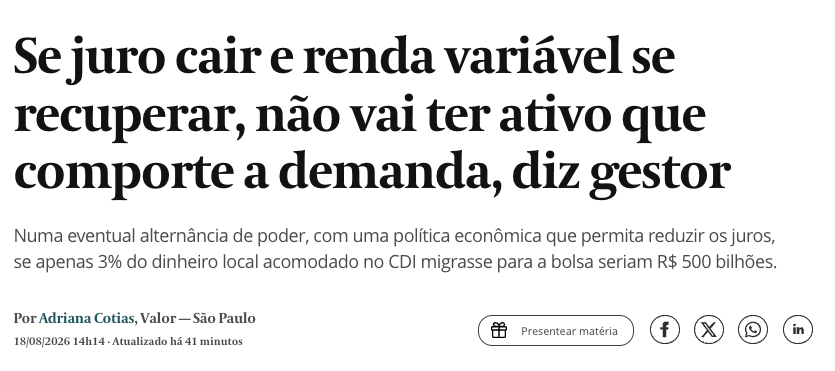
Pesquisas Datafolha de agosto vs o resultado em outubro de 2002 até 2022.
O Lula é o candidato do PT em 6 delas, as outras duas são a Dilma.
Nas duas primeiras eleições, Datafolha subestimava o PT. A partir da Dilma, isso mudou, mas de forma irrelevante. Quando o Bolsonaro apareceu, as variações foram bem significativas.
Se acontecer a variação média das 6 ocorrências, o Flávio vence por 52x48.
Datafolha de hoje, projeção para segundo turno:
Descondenado 47%, Flávio Bolsonaro 43%.
Diferença de 4%.
Datafolha de 18 de agosto de 2022:
Descondenado 54%, Jair Bolsonaro 37%.
Diferença de 17%.
Resultado das urnas: Descondenado 50,9%, Jair Bolsonaro 49,10%.
O gestor da AlphaKey fez a conta que o mercado evita fazer: R$ 15 trilhões dormem no CDI enquanto a bolsa inteira tem R$ 2,5 trilhões de free float. Se 3% desse dinheiro migrasse pra renda variável, seriam R$ 500 bilhões de fluxo — pra um mercado onde só 100 ações têm liquidez real.
Referência: o gringo colocou R$ 60 bi em três meses e o Ibov subiu de 140 mil pra quase 200 mil. Imagina R$ 500 bi.
O problema é a oferta. Não tem IPO desde 2022. Empresas boas recompraram ações. Estrangeiras saíram (Carrefour, Mills). Metade do capital das listadas está travado no controlador.
A tese dele: se o próximo governo fizer ajuste e o juro cair pra 10%, o capital não encontra ação suficiente pra comprar. A questão não é se, é quando.
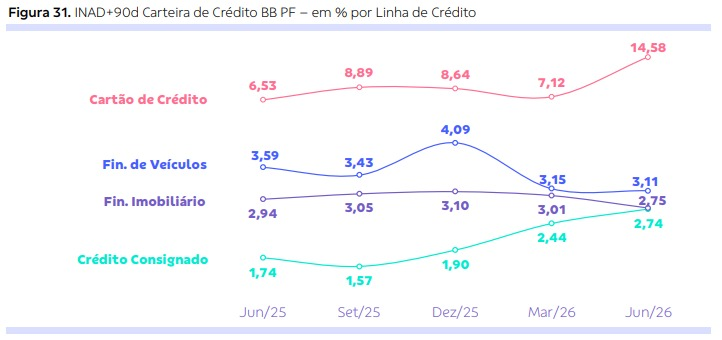
BBAS3, chamando atencao para a evolucao mto rapida da inadimplencia de 90 dias no cartao de credito de um tri para o outro.....
Nos outros bancos essa linha foi relativamente comportada, ponto de atencao grande aqui, 15% e relevante....
Tom Lee @fundstrat: Cisco corrected 40%+ twice, in 1997 and 1998, years before its real top.
This AI selloff looks like 1997, not 2000.
Cisco's actual top didn't come until 2000, at 200x earnings backing fantasy fiber-buildout assumptions, when the whole trade detached from reality. Lee's read on today: hyperscalers are real, revenue-generating buyers actually deploying racks, not speculative resellers, and AI usage, while still small, is already productive. That's mid-cycle pullback behavior, not blow-off-top behavior.
Ray Dalio @RayDalio isn't buying the mid-cycle framing. His bubble gauge, built off more than a century of data, currently reads about 75% of the way to the 2000 and 1929 extremes. Wealth has outrun money by his measure, and he says that gap eventually forces a painful correction regardless of whether the underlying technology thesis is right.
Lee's framing says there's years of AI infrastructure upside left before a real top. Dalio's gauge says the setup is already three-quarters of the way to historic bubble territory. The disagreement isn't about whether AI works, it's about how much of the good news is already priced.
Full walk-through of the Cisco analog, year by year, and what it implies for the AI trade from here: https://t.co/6SWmAQFUoq
Source: Global Money Talk - https://t.co/sMSDGQUa2M
>Be Leopold Aschenbrenner
>24 years old
>Born ~2001/2002 in Germany
>Son of two doctors
>Attend the John F. Kennedy School in Berlin
>Convince your parents to let you fly alone to the U.S. and enroll at Columbia University at age 15
>Graduate valedictorian in 2021 at age 19 with a B.A. in economics and mathematics-statistics
>Co-found Columbia’s effective altruism chapter
>Do research at Oxford’s Global Priorities Institute and co-author papers on long-term risks
>Join the FTX Future Fund in 2022, then resign before the collapse
>Land on OpenAI’s Superalignment team in 2023 under Ilya Sutskever and Jan Leike
>Write an internal security memo warning about industrial espionage and China risks
>Get fired in April 2024 over an alleged information leak (which you dispute)
>Two months later drop a 165-page manifesto titled Situational Awareness: The Decade Ahead predicting AGI around 2027 and runaway superintelligence
>Watch it go wildly viral (even Ivanka Trump praises it)
>Found Situational Awareness LP in late 2024 with ~$225 million, backed by the Collison brothers, Nat Friedman, Daniel Gross and others
Bet heavily on AI infrastructure—power, memory chips, data-center proxies, Bitcoin miners, CoreWeave, Nebius, Bloom Energy, Micron, Sandisk and more—while running high leverage
>Compound the fund to an estimated $20–24 billion AUM by mid-2026 with ~439% net gains since inception
>Get engaged to Avital Balwit (chief of staff to Anthropic’s CEO) and live in San Francisco
>Then, in late July 2026, after a brutal AI stock rout (many positions down >35%), shorts moving against you, and margin pressure from up to 4x leverage, liquidate the entire public equity book—longs and shorts—in one massive block trade to a single buyer
And he did it all by writing a prophetic essay, going all-in on the power-and-compute bottleneck, and riding the AI wave harder and faster than almost anyone.
Leopold Aschenbrenner is absolutely insane
JPMorgan says the forced selling in Korea is largely finished.
Its latest Korea Equity Strategy note estimates de-leveraging is now about 90% complete. The KOSPI has fallen nearly 40% from the June 22 peak.
Early fundamental worries and sector rotation were heavily amplified by leveraged ETFs, then accelerated by hedge-fund unwinds.
Two charts make the shift clear. Leveraged ETF assets under management rose from around $10 billion earlier this year to a peak near $50–52 billion in early July.
They have since dropped sharply to $16–18 billion. JPMorgan calls the current level no longer problematic.
Cumulative inflows into broad-market, offshore, and single-stock leveraged products have also stalled or begun to reverse.
Tighter rules, including higher cash requirements, have slowed the rush of new money.
Forced-selling pressure has eased. Positioning looks cleaner and valuations more attractive against still-supportive earnings.
From Samsung Electronics Q2 Earnings Call
Q: Do you expect the current memory shortage to persist into next year? If possible, could you also share your medium- to long-term outlook for memory demand?
A: The rapid acceleration of agentic AI is driving an explosive increase in token consumption. This is fueling unprecedented demand not only for AI servers but also for general-purpose computing servers.
In practice, AI frontier model developers that have been unable to secure sufficient cloud capacity from hyperscalers are now requesting allocations from neocloud providers as well. This has translated into large-scale memory procurement by server OEMs that primarily serve those neocloud customers.
Even so, memory shortages mean that many frontier AI companies are still unable to secure the infrastructure they need. To address this, they have begun sharing their medium- to long-term demand forecasts directly with us and expressing their intention to purchase memory from Samsung. We are also seeing the start of requests for long-term supply agreements (LTAs) to secure additional volume.
As the adoption of agentic AI continues to accelerate, memory demand is expanding at an exceptionally rapid pace. Industry supply remains well below demand. Even with increased industry-wide capex, it takes more than three and a half years from the construction of a new fab to wafer production. As a result, meaningful supply expansion through new capacity additions will take considerable time. We therefore believe a significant increase in industry supply before 2028 is unlikely.
Based on the demand visibility we currently have from customers, a substantial amount of unmet demand will roll over into next year, creating additional supply pressure. We expect the memory shortage in 2027 to be even more severe than it is this year, with tight supply conditions likely to persist into 2028.
Looking beyond 2029, it is still too early to make definitive projections. However, as AI token demand continues to surge, large customers building long-term AI infrastructure are expected to continue requesting multi-year supply agreements.
These long-term agreements are well aligned with our objective of hedging future business risks. We intend to prioritize contracts with customers that can provide firm, long-term demand commitments.
Over time, this should allow us to transition away from the historically cyclical nature of the memory industry toward a more stable and predictable business model.
With improved long-term demand visibility through LTAs, we will be in a better position to execute a more flexible supply strategy. Following our existing approach of securing cleanroom infrastructure in advance and installing production equipment in line with demand, we expect to further strengthen this disciplined and flexible capacity expansion strategy.
- Bolsa da Coreia cai -40%
- 360 mil contas liquidadas
- 60% abaixo dos 35 anos
Não brinquem com alavancagem. Cemitério de malandro.
🇺🇸 1929 chegou em -89%. Imagina estar usando dinheiro emprestado da corretora?
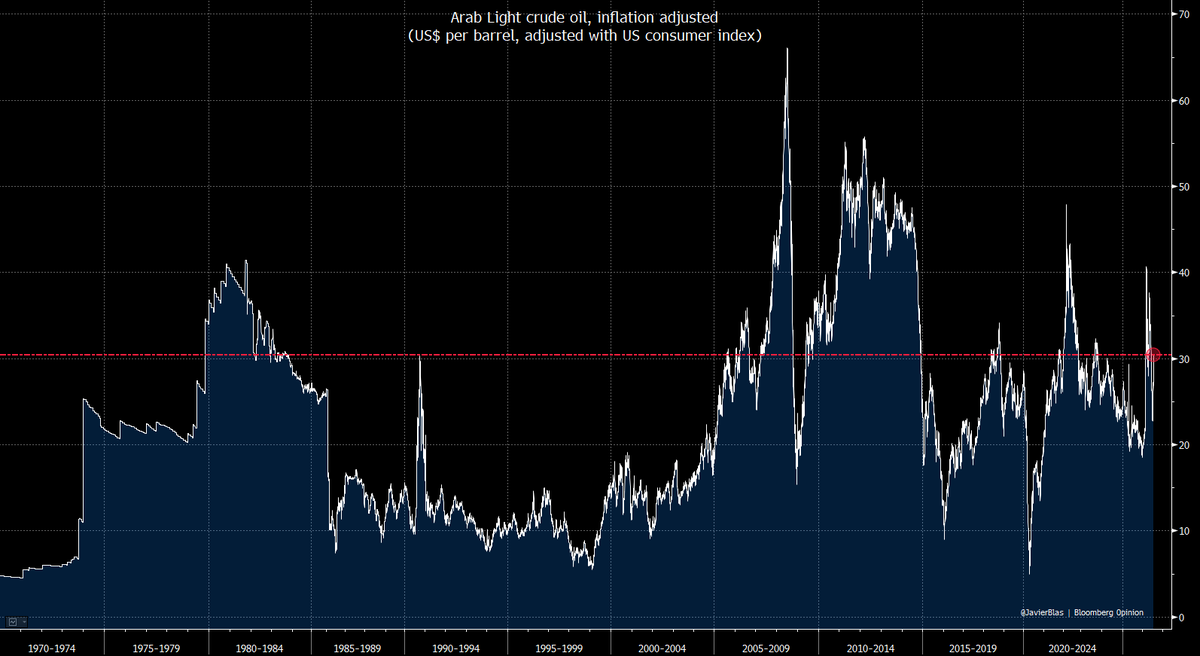
CHART OF THE DAY: Iran is trying to impose an intolerable economic cost on Trump via oil prices. by shutting Hormuz.
For now, not only oil prices haven't risen enough in nominal terms to do so, but adjusted by inflation remain at levels that can only be described as moderate.
@bz_equities valuations de algumas cias abaixo dos vistos naquele final pavoroso de 2024... ninguém mais faz conta e valuation parece não importar. depois vai ter papel duplicando ou triplicando e parecer obvio em retrospectiva, igual foi em 24
🤣 For those who think Michael Burry is a genius right now because he shorted $MU and $NVDA, based on a few days of market downturn, you might want to consider this:
Esse excesso de comunicação das companhias brasileiras com o mercado é extremamente prejudicial ao acionista e pra elas também.
Só no Brasil que o dia do resultado é o menos relevante pq a empresa já fez um zilhão de prévias, alinhou com sellside etc.
Local/hora de comunicação é no conference call pós resultados. Fim.
Os ETFs no Brasil bateram recorde e ultrapassaram R$ 110 bilhões sob gestão, alta de 40% só em 2026.
Em 2018 a classe mal passava de R$ 10 bilhões.
A curva é de adoção estrutural, não de moda.
Custo baixo, liquidez em bolsa e acesso a temas globais em uma única cota explicam a migração.
O mercado brasileiro amadureceu.
Deixou de ser nicho e virou instrumento central de alocação, e a discussão agora é sobre qualidade e teses do produto, não sobre se vale a pena usar.
$MU $SKHY $ASML
Idiot Type 8 has arrived sooner than expected.
Chinese DUV headlines drop and everyone pretends like US, Korean and European companies are going out of business.
Immersion DUV is a mid 2000s platform. ASML has spent twenty years refining it since. China didn't reach 2026 DUV. They reached the starting line. And DUV still requires multipatterning during production, which adds cost, cycle time and complexity on every layer.
The volume: five machines in 2026, about 20 in 2027. ASML ships around 130 immersion systems a year and is raising immersion capacity 30% for 2027.
The same reporting says the tool still lags on performance and reliability and needs more testing before real mass production. Moving a new litho platform into high volume production is a multi year yield and uptime problem, not a shipping problem.
And none of this touches HBM. HBM is TSV, advanced packaging, stack yield and per customer qualification. A domestic immersion tool does not give CXMT an HBM qualification.
One more thing nobody is saying out loud: this is a single Information report citing two unnamed people. Reuters and everyone else are reporting the report. ASML declined to comment. The manufacturer was never officially named.