The car industry had a century to build an electric car people actually wanted. It didn’t.
The aerospace industry had sixty years to make a rocket reusable. It didn’t.
The telecom industry had decades to connect the billions it couldn’t profit from. It didn’t.
One person looked at all three and started crossing them off.
Reusable rockets that land themselves. Electric cars that outsell their gas-powered rivals. A satellite network that beams internet from orbit to any point on the planet. A platform where speech is no longer filtered through a handful of editors. A chip inside a human brain that lets a paralyzed person control a computer with their thoughts.
And now a car that flies.
Six companies. Six industries. Each one operating at the frontier of its field while feeding engineering, data, and capability back into the others.
The rockets fund the satellites. The satellites fund the rockets. The cars train the robots. The AI runs them. The platform keeps the conversation free. The energy powers all of it.
People keep waiting for him to fail. They have been waiting for twenty years.
The rockets were supposed to explode. They land on boats. The cars were supposed to be toys. They outsell everyone. The satellites were supposed to be impossible. They connect six continents.
The brain chip was supposed to be science fiction. It is inside a human skull right now.
At some point the pattern stops being luck and starts being something the critics are not equipped to recognize.
Not because they lack intelligence. Because the framework they use to judge what is possible was built inside the institutions that couldn’t do what he does.
The conversation about Elon Musk has never been about Elon Musk.
It has been about how uncomfortable it makes people to watch one person accomplish what entire industries organized themselves to attempt and never finished.
History does not produce this combination often. The drive. The technical depth. The pain tolerance. The willingness to let the mission burn through everything else. And the insane ambition to attempt all of it at once.
Every one of these technologies would have arrived eventually. Reusable rockets. Electric vehicles. Global connectivity. Brain interfaces. None of them violated the laws of physics.
But eventually can mean fifty years. And fifty years is the difference between your grandchildren seeing it and you seeing it.
The most overlooked thing Musk has done is not any single invention.
It is how much of the future he pulled into the lifetimes of people who would have died before it arrived.
Earth does not get many of these.
And the people still betting against him are making the same mistake every industry made before he walked in and did the thing they said couldn’t be done.
We need to mine as much copper in the next 18 years as we have mined in the past 10,000 years, which is 700-800 million tonnes... and that's without the AI demand.
Including AI demand, @BMO estimates we need ~35,000 tonnes of copper per gigawatt of installed data centre capacity... And according to S&P, by 2030, installed data centre capacity in the US is expected to reach 152 GW (~62 GW today).
What has @elonmusk added to the world?
Every child that witnessed this event was thinking 'oh maybe my crazy idea is possible'.
This is the kind of thinking we want to instill in future engineers.
Of course the flying Tesla Roadster is a gimmick but that sort of misses the point, the tech flex behind it isn't.
Tesla's bulk business is about advanced technology from EV to self drive, but decided to create the most ridiculous manual drive supercar. Supercars are a gimmick,almost by definition, based on how wild can you make them.
The gimmick that can make the car literally fly, briefly, can make it corner like no other supercar and accelerate, literally like a dragster on a test track. It's got nothing to do with flying continuously, but having a car that will outperform every Lambo, Ferrari or McLaren with technology that they cannot replicate because it requires experience from space launches and computation that they don't have now nor will in future.
So Porsche, Bugatti, Aston Martin just became legacy prestige brands, like Rolex, Richard Mille or Patek Philippe. These cars celebrate the bygone age and the baroque, physical complexity of the internal combustion engine just as mechanical watches do for non digital, complex time-keeping mechanisms. But hey won't be faster anymore than a mechanical watch keeps better time than a Casio. They are now, de facto, mobile jewelry and no longer supercars with superlative performance. And this affects their ability to market the bulk business of mainstream European internal combustion engine cars. It's the end of an era of industrial era manufacturing.
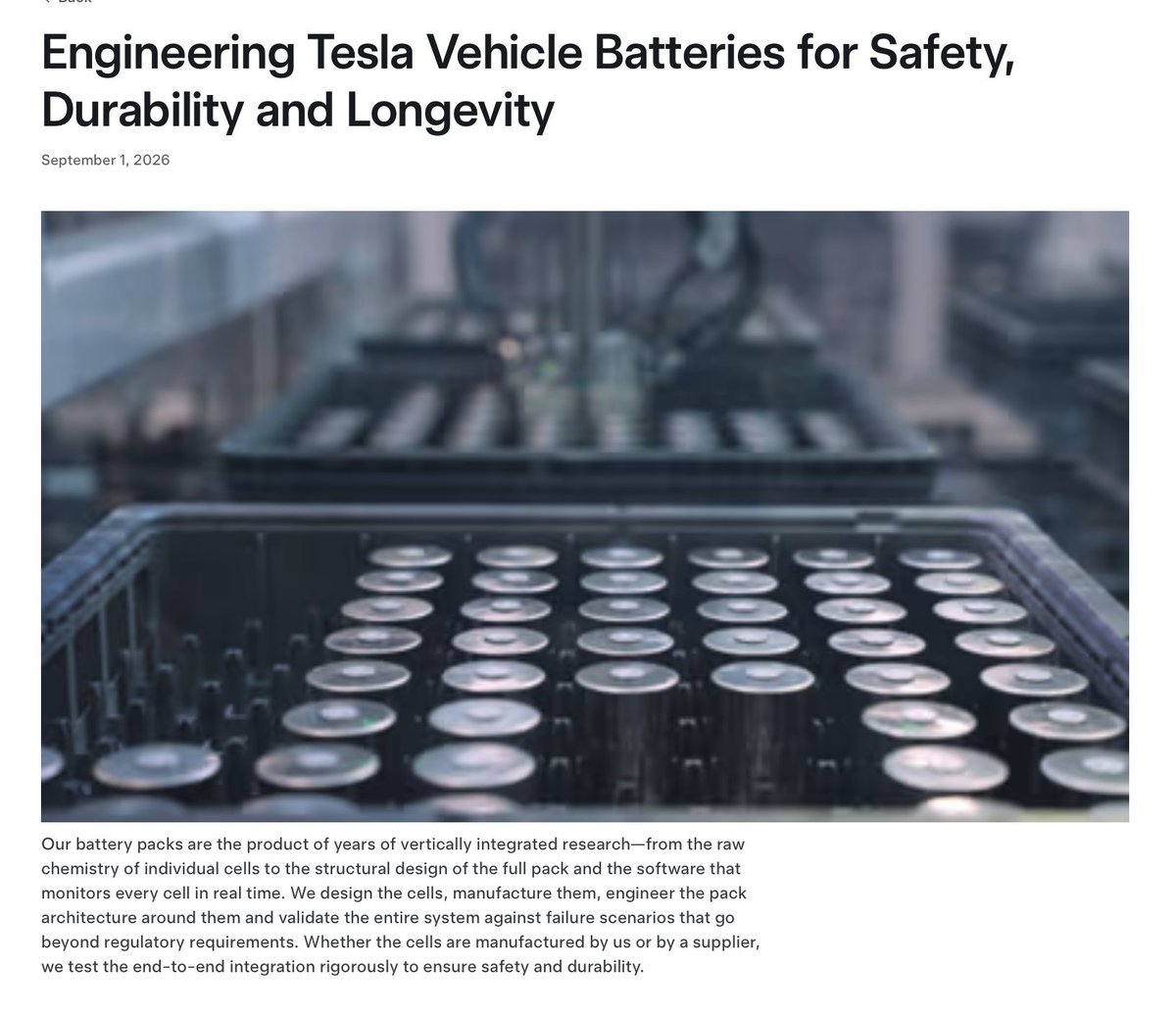
Tesla has released a new blog post about how they design vehicle battery packs around safety, durability, and longevity.
"Tesla takes a layered approach to battery safety. The design objective is that even if an issue occurs in a single cell and results in a thermal reaction, the problem is contained within the battery pack. This principle is called passive propagation resistance, or PPR.
In a Tesla battery pack, cells are surrounded by thermal barriers, structurally isolated and cooled so that failure in one cell does not spread to neighboring cells. The goal is simple: one cell failure should never become a catastrophic battery pack failure.
We ensure safe performance at three levels:
• Cell level: How does a single cell behave when it fails? Does it vent safely, or does it rupture unpredictably? We study many types of cell failures at high speed to understand exactly how they break in various conditions. Then our engineers adjust the cell design so that if it fails, it releases energy in a controlled manner rather than unpredictably.
• Module level: If one cell enters a self-sustaining thermal reaction (thermal runaway), can neighboring cells withstand the heat and pressure without joining in? Thermal isolation materials, deliberate spacing and liquid-filled cooling channels are all engineered to absorb and redirect the thermal energy to prevent propagation.
• Vehicle level: How does one cell’s thermal runaway interact with the rest of the vehicle? We test PPR under harsh conditions—high temperatures, full state of charge, loss of coolant flow and others—and validate that the system remains self-contained.
Car manufacturers are not typically required to perform PPR testing. It has always been a core requirement for our products, and we test voluntarily across many failure modes and environmental conditions before releasing a product. In addition to this passively safe design, we leverage our anonymized vehicle data to learn about rare issues and to develop active diagnostics with over-the-air software updates that make our products safer over time. Our layered approach to safety has demonstrated results: Our latest data shows that vehicle fires are significantly less likely to occur with Tesla vehicles than the average U.S. vehicle. In addition to having a lower rate of vehicle fires from all causes, our vehicles have shown an extremely low risk of battery fires. From over 265 billion miles of operation as of the end of 2025, we have no evidence of even a single case of a spontaneous battery failure leading to a vehicle fire in a Model 3, Model Y, Cybertruck or Semi.
Thermal Management for Every Cell
Batteries perform best and last longest within a specific temperature range. If they’re too hot, they degrade more quickly. If they’re too cold, they temporarily lose charge capacity. Our thermal management system is designed to keep every cell at the optimal temperature.
Liquid cooling and heating channels run through the battery pack, actively managing cell temperatures during charging, discharging and while the car is parked. It is not purely reactive—the system anticipates conditions as well. For example, if you set your destination as a Supercharger stop, the pack will pre-condition itself to the ideal temperature for faster charging before you arrive.
Why this matters for longevity:
• Cells that spend less time at extreme temperatures degrade more slowly. Our thermal management system directly extends the life of the battery.
• Effective temperature control ensures both safety and longevity. A well-managed cell is less likely to enter an unstable state and has less chemical degradation over time.
• Consistent temperatures across the pack increase longevity. Since all cells will age at roughly the same rate, this prevents weak links that could limit total pack capacity.
Inside Our 4680 Cell
In addition to the cells that we purchase from third-party vendors, we also manufacture our own 4680 cells for use in vehicles like Cybertruck and our Berlin-manufactured Model Y. This vertical integration means we control the entire supply chain, from materials selection to cell chemistry, manufacturing process and quality inspection.
Materials and Chemistry
A battery cell has two major components: the mechanical exterior structure (the can, lid and housing) and the internal electrochemistry. The electrochemistry is what determines how fast the cell charges, how much energy it stores and how long it lasts.
Three pieces of this chemistry matter most:
• Cathode: This is where the lithium lives when the cell is discharged. We engineer high-nickel layered oxide cathodes (like NMC [nickel, manganese and cobalt]) for high energy density in 4680, and lithium iron phosphate (LFP) cathodes in standard-range vehicles for durability and cost in non-4680 cells. The cathode can be coated in protective layers to help resist cracking during charge cycles, like how a protective clear coat on paint helps prevent chipping.
• Anode: This is where the lithium goes during charging. The anode's material properties determine how fast the cell can accept a charge and how well it holds a charge over thousands of charge cycles.
• Electrolyte: This is the liquid medium that lithium ions travel through between cathode and anode. We directly formulate our own electrolyte recipes, tuning the mix of lithium salts, solvents and additives to balance charging speed, energy capacity and lifespan.
A critical factor in cell longevity is the solid electrolyte interphase, or SEI, which is a thin layer that forms on the anode surface. Think of it as the patina that develops on copper: it is a natural byproduct of use, and its quality determines whether the underlying material is protected or slowly consumed. We engineer the electrolyte chemistry and anode material specifically to enable a stable, resilient SEI, which directly extends the cell's useful life and supports fast charging without excessive degradation.
Dry Electrode Manufacturing
We are the only battery manufacturer using dry electrode technology at scale. Traditional electrode manufacturing uses liquid solvents that must be evaporated and captured in energy-intensive ovens. Dry electrode processing skips this step, making the process cleaner and less energy intensive. It is a meaningful environmental improvement in how the cell itself is made before it ever goes into a car.
Inspecting Every Cell for Quality
At the scale we manufacture our vehicles, cell defects are statistically inevitable. The goal is not to pretend defects do not exist—it is to catch every single one before it leaves the factory, and to design the battery pack so that even if a defect slips through, it cannot cause harm.
Our quality inspection regimen includes:
• 100% inspection: Every cell is tested.
• Vision systems: Automated cameras inspect cells for visual defects on the production line.
• X-ray and CT scanning: X-ray scans are performed on 100% of cells, and CT scanning is performed on a significant fraction of cells to catch internal defects that are invisible from the outside.
• AI-based detection: AI-powered vision and anomaly detection systems are being developed to identify subtle patterns that human inspectors and traditional algorithms could miss. These systems allow for the inspection of much larger sets of data and volumes of cells compared to what would be possible with more traditional methods.
There is also a deliberate engineering tradeoff in cell size. Larger cells are more efficient to manufacture and pack, but smaller cells reduce the energy released if a single cell fails. Our 4680-cell format strikes a balance—it’s large enough for manufacturing and energy efficiency, but small enough that the safety systems can comfortably handle a single-cell event.
Rigorous, Fundamental and Continuous Testing
Our testing program for battery materials and cells is built on two principles:
• Vertical integration drives testing design. Because we build our own cells for our own packs, we design testing protocols that reflect real-world usage in Tesla vehicles—not generic industry benchmarks. The test regimen is tailored to the actual product.
• Testing is rooted in fundamentals. Rather than simply cycling cells until they fail and noting the number, our materials scientists investigate why degradation occurs at the component and material level. When a cathode cracks or an SEI layer grows too thick, we trace it to the root cause and have the expertise to modify the chemistry or redesign it accordingly.
This means we run thousands of cycling tests under varied protocols—different charge rates, temperatures and depth-of-discharge patterns—and use the results to forecast long-term performance. It also means that every material change, however small (down to trace-level chemical dopants that prevent cathode cracking), is validated against real degradation data before it enters production.
Learning From Every Mile Driven
We have a unique advantage that no other startup or traditional automaker can easily replicate: vehicle data telemetry from millions of vehicles on the road. Every Tesla vehicle transmits anonymized, real-time data on battery health, temperature, charge cycles and performance. This data feeds directly back into engineering.
When a rare cell anomaly occurs in the field, we can study exactly what happened, correlate it with manufacturing data and refine our designs and quality checks. This closed loop between the road and the factory is one of the most significant advantages we have in battery development.
Our batteries last because they are engineered to—from the molecular composition of the electrolyte to the structural design of the pack and the software that manages temperature in real time. They are safe because safety is not an afterthought—it is the foundation the entire system is built on, validated layer by layer, cell by cell, and tested against scenarios that go beyond what regulation demands.
We also offer a Battery and Drive Unit Warranty on all new Tesla vehicles for 8 years or 100,000 miles (minimum based on vehicle) with a minimum of 70% battery capacity retention over the warranty period."
https://t.co/D3D4dddSV0
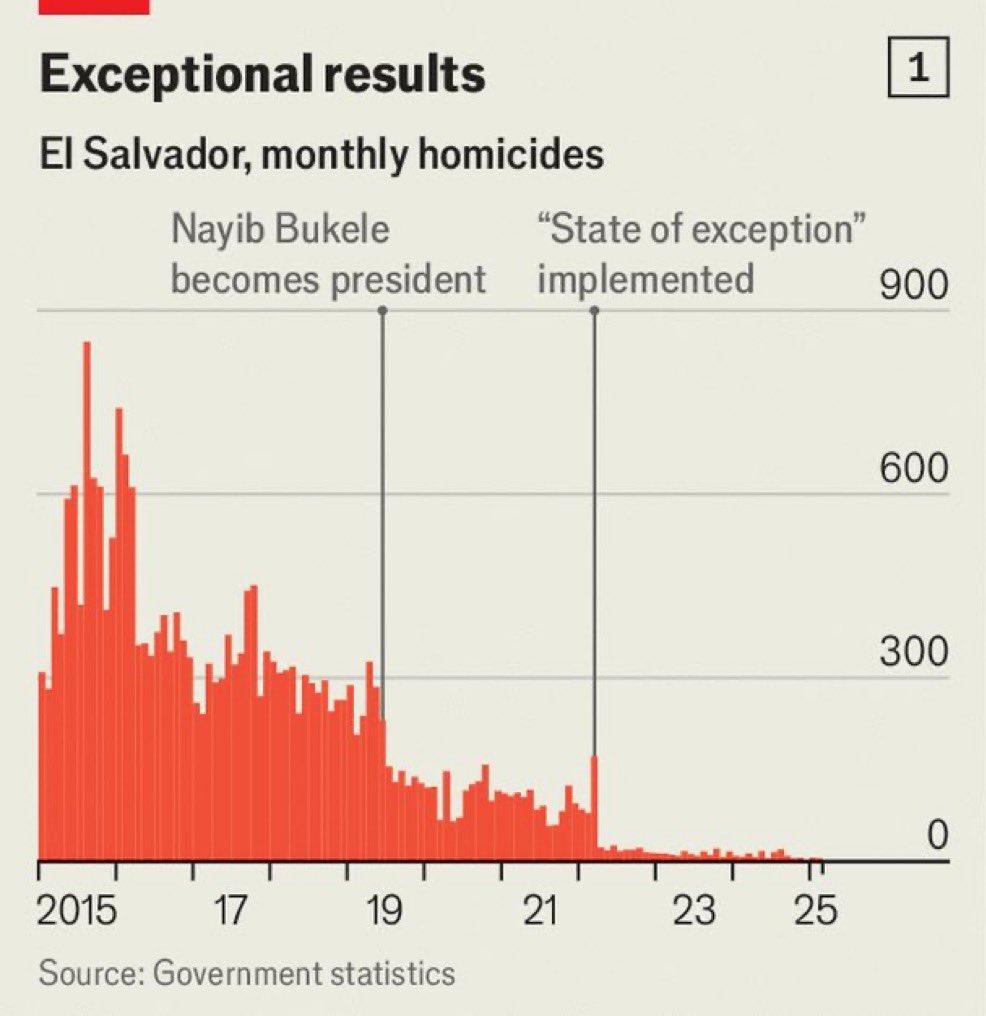
The fix everything button is literally just to arrest criminals and keep them in jail
Bukele was able to do this in a matter of months
When you see the crime and rot in western cities and feel unsafe letting your wife walk around, know that it is a choice.
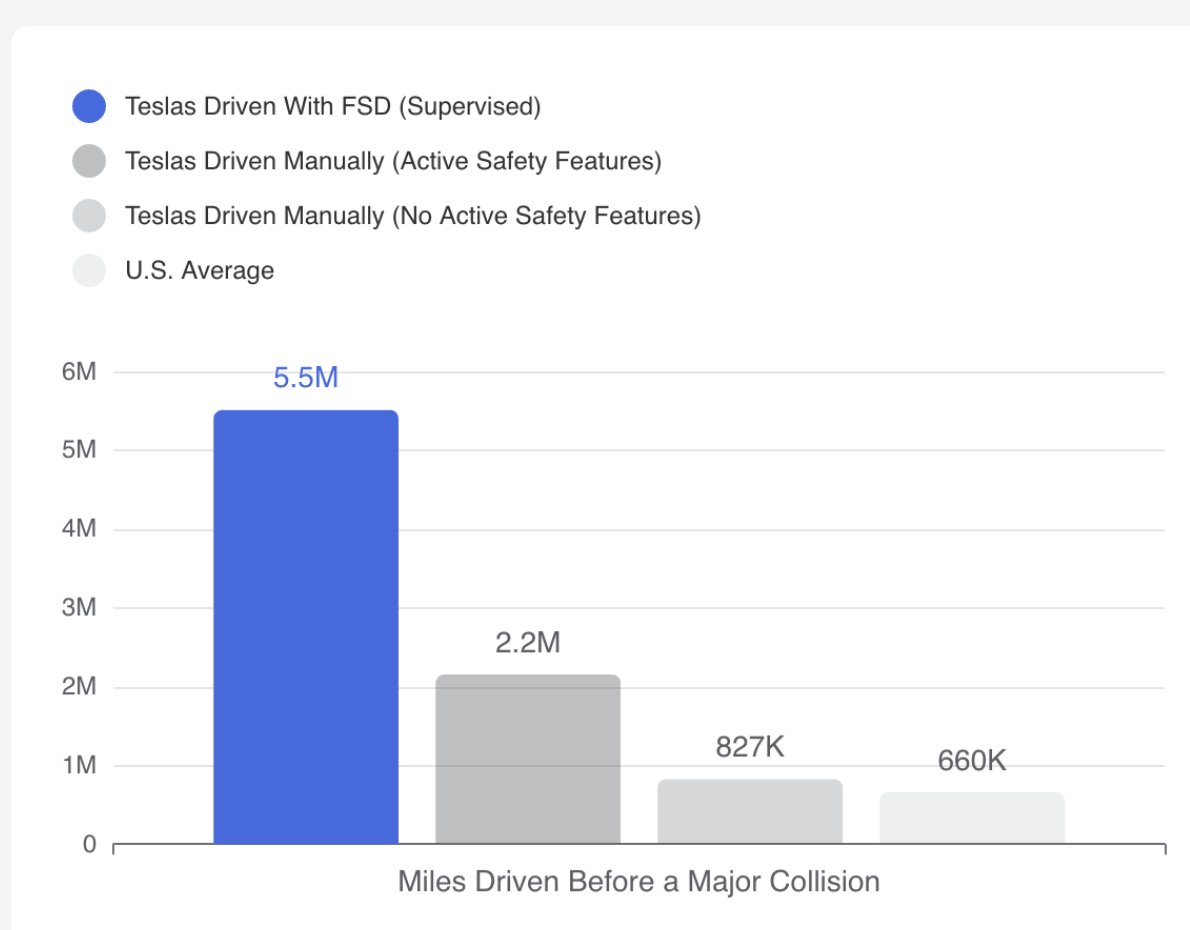
People completely miss the most important thing about Tesla FSD
It’s not just about convenience. It’s not a "cool self-parking trick."
It’s about the fact that car crashes are the #1 killer of healthy people aged 5-29 globally and one company has gathered over 10 billion miles of real-world data to actually solve it
Look at the recent data: Tesla just became the FIRST vehicle to pass NHTSA's new ADAS safety tests. Not the first EV. The first vehicle. Period.
The reality is harsh but simple. Countries that approve FSD get safer roads overnight. Countries that delay will literally watch their citizens die in preventable crashes while bureaucrats sit in meeting rooms debating "safety."
The "safety" argument against FSD is officially dead
Activist: "Your cows are putting carbon into the atmosphere."
Farmer: "Where did they get it?"
Activist: "What?"
Farmer: "The carbon. Where did the cow get it before it put it anywhere."
Activist: "From... eating?"
Farmer: "From eating grass. And where did the grass get it."
Activist: "The soil?"
Farmer: "The air. The grass pulled it out of the air last spring. The cow ate the grass. The cow breathed some of it back out. It went back into the air it came from."
Activist: "But it's still going into the atmosphere."
Farmer: "It's going back. There's a difference between a thing going somewhere and a thing going back. You've described a circle and you're frightened of it."
Activist: "Then just don't have the cow."
Farmer: "The grass still dies in autumn. It rots where it falls. The carbon goes back into the air either way, just without anyone getting fed in the middle."
Activist: "It's not that simple."
Farmer: "It's grass, cow, breath, grass. Or it's grass, rot, air, grass. Same circle, fewer dinners. If that's complicated for you I'd stay away from the water cycle. That one's got clouds in it."
As you go to work today and settle into the week, please study the form below. You will soon need to fill this out EVERY year and tell the government what you own and then allow them to tell you how much its worth.
That is the framework that is enabled by the Trojan Horse "Billionaire Tax" that is trying to get passed.
Give them credit: they cleverly use Billionaires as the hook, but build in the language and the framework that will allow the Legislature to simply extend the tax to everyone and make it yearly.
And this is where the form below comes in...
In this case, ask yourself, will it be you or the Billionaires that will be able to fill this out properly and avoid penalties.
As much as Billionaires can be pushed to do more for society, we all know that they have the infrastructure to manage these kinds of disclosures...middle class Californians do not and they will be the ones that get penalized in the end.
Thoughts on $TSLA
$TSLA is clearly no longer just a car company and this report makes that obvious. Musk is basically walking on water right now. The fact that he’s building autos, energy, AI, robotics, and a Robotaxi network all at once while still producing serious free cash flow is something you almost never see in business. And yeah, people are going to point to the PE and say it’s expensive, but that completely misses what’s actually going on here. Quite frankly, that argument is moronic and shows a lack of understanding of what’s being built.
Most companies struggle to do one thing well. $TSLA is trying to solve manufacturing, energy, autonomy, AI infrastructure, robotics, and fleet economics all at once. And somehow it’s still generating billions in free cash flow. That’s not normal, it’s not even comparable.
They’re scaling the core auto business, building energy, and at the same time pouring capital into AI and autonomy. This is an entirely different economic model. The bet is simple, give up near term margins to build something that looks more like software later.
Revenue was $22b, up 16%. That came from more deliveries, services up 42%, better pricing, and more FSD revenue. But not all of it was perfect. Energy was down and regulatory credits fell, so the growth was still good, but mixed.
Profitability improved, but let’s not pretend this looks like a software company yet. Operating income was about $900m with a 4.2% margin and $500m in net income. Margins are moving up, but they’re still low relative to what this business could become.
The reason is obvious. They’re spending heavily on AI, R&D, and infrastructure, and SBC is still elevated. That’s their strategy, and they’re deliberately compressing margins today to build something much bigger over time.
Cash flow is what matters most because they generated roughly $4b in operating cash flow and $1.4b in free cash flow. That’s very impressive, but they’re also spending $2.5b on capex and invested $2b into SpaceX. This is still a capital heavy business today, even if the long term goal is to become asset light.
The balance sheet is what makes all of this possible. Around $45b in cash and a massive asset base. That gives them time, and time is everything when you’re trying to build something this ambitious.
Every dollar $TSLA generates isn’t being returned, it’s being redeployed into AI compute, factories, and vertical integration. This isn���t a company optimizing earnings, it’s a company allocating capital into optionality. The question isn’t margins today, it’s what those dollars earn over the next decade.
This quarter, operations were a bit more mixed. Deliveries were 358k, up 6%, while production was 408k, up 13%. Inventory moved up to 27 days. That’s not alarming, but it tells you demand isn’t running away from them anymore. They are no longer supply constrained.
FSD is my favorite part of the report. Subscriptions hit 1.28m, up 51%. That’s a huge deal because it is an early signal of the shift from selling a car once to monetizing it over time. If that works, the entire model changes drastically.
At 1.28m subscribers, even modest pricing starts to matter big time. At $100 a month, that’s roughly $1.5b a year. Scale that across tens of millions of vehicles and the numbers start to get enormous. This is how a car company slowly becomes a software company.
Energy had a weak quarter with storage down 15%, but I wouldn’t overreact. This business is lumpy and new capacity is coming online. Longer term, it’s still a meaningful growth driver.
Meanwhile, the infrastructure keeps getting stronger. The Supercharger network is growing close to 20% with over 8,400 stations and roughly 80,000 connectors. People don’t talk about this enough, but it’s a huge advantage.
1/2 👇
Nicolai Tangen manages Norway’s $2 trillion sovereign wealth fund, the largest in the world.
They own shares in 9,000 companies and the fund is 25% of Norway’s national budget.
When asked about the difference between American and European ambition, his answer was surprising: