Our investigators are among the most #HighlyCited2026 globally. This year, seven #GeneLayInstitute faculty have been recognized for their research cracking the code on cross-system immunology that shapes the development of immune-based therapies.
🔗https://t.co/SXcDEbubMw
🚨 Why Is Colon Cancer Striking Younger Adults?
Colorectal cancer is now the leading cause of cancer death among Americans under 50, and diagnoses in younger adults continue to rise.
But WHY is this happening? And could the answers be hiding in the biology of the tumors themselves?
On this episode of @ProgressPotent1, I am joined by Dr. Ana C. Anderson, PhD - @AnaAndersonlab - Albert H. Coons Professor of Neurology at @HarvardMed and core faculty member of the @GeneLayInst at @MassGenBrigham.
Dr. Anderson is a co-senior author of a fascinating new study published in @NatureMedicine, conducted in collaboration with researchers at @DanaFarber and the @broadinstitute.
🔬 By examining 189 colorectal tumors and more than 850,000 cell nuclei from patients spanning over six decades of life, the research team uncovered intriguing differences in the biology of tumors affecting younger versus older patients.
Among the discoveries:
🧬 A different tumor environment - Younger patients' tumors contained higher proportions of connective and supporting cells, potentially relevant to how cancers grow and respond to treatment;
🔬 Hidden molecular signals - Researchers identified age-associated patterns of cellular communication linked to processes involved in cancer invasion;
🧪 The mysterious world of RNA - Distinct activity patterns emerged among long non-coding RNAs, including poorly understood molecules that may offer new directions for cancer research;
💡 A new way of thinking about cancer - Rather than simply dividing patients into those younger or older than 50, the team examined tumor biology across the entire lifespan, uncovering patterns that traditional approaches may have missed.
We explore the alarming rise of early-onset colorectal cancer, the tumor microenvironment, cancer immunology, single-cell genomics, the potential roles of the microbiome and environmental exposures, and what these discoveries might eventually mean for prevention, diagnosis, and treatment.
Importantly, this research provides an exciting new scientific roadmap for investigating the disease.
Could the key to understanding cancer lie not just in malignant cells, but in the entire biological ecosystem surrounding them?
Join us for a fascinating conversation at the intersection of cancer biology, immunology, and precision medicine!
Watch now - https://t.co/ohxHDVkyiY
#ColorectalCancer #CancerResearch #EarlyOnsetColorectalCancer #CancerBiology #PrecisionMedicine #CancerImmunology #NatureMedicine #HarvardMedicalSchool #MassGeneralBrigham #DanaFarber #BroadInstitute #ProgressPotentialAndPossibilities @BrighamWomens@MassGeneralNews@TierOnePR
What can gut microbial genetic variation reveal about human health?
Out now in @Nature: our work with @jingyuan_fu on a phenome-wide association study linking microbial SNVs to human phenotypes and creating an online resource for researchers.
https://t.co/QTqO055R70
We were pleased to host Naomi Habib, PhD, of the Hebrew University of Jerusalem, for a special seminar on microglia, Alzheimer’s disease, and resilience in the aging brain. Thank you, Dr. Habib, for an insightful discussion!
"My hope is that if our follow up studies confirm these differences, that could lead to tailored and precision treatments for our younger patients" said @KimmieNgMD on @WCVB news on the new discovery of the differences in colorectal tumors in younger patients.
https://t.co/Jwfu0ztsdB
Excited to share this study in @CellCellPress with @mathildpoyet, @mgroussi and @ejalm, exploring how industrialization shapes host-microbiome interactions using multivariate data from the Global Microbiome Conservancy cohort!
https://t.co/GdK7nov5En
Researchers analyzed 189 tumors across eight decades of life to uncover biological clues as to why colorectal cancer might behave differently in younger patients.
Here’s what they found. https://t.co/YmwLAfS3hZ
Research Briefing by @AnaAndersonlab & @KimmieNgMD highlights genetic deep-dive comparing colorectal cancer in young & older adults: “the culmination of a large commitment & investment by the @GeneLayInst & @DFarberYoungCRC”
Read it in @NatureMedicine ⬇️
https://t.co/f1P5qP6PDX
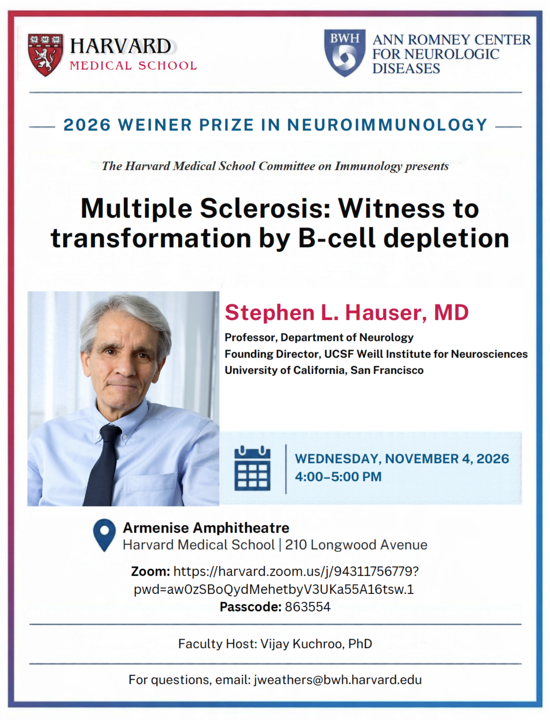
Dr. Stephen L. Hauser received the 2026 Weiner Prize in Neuroimmunology, delivering his lecture: “Multiple Sclerosis: Witness to Transformation by B-cell Depletion.” The event honored Institute member Dr. Howard Weiner and was hosted by Gene Lay Director Dr. Vijay Kuchroo.
These findings offer important insights into early-onset colorectal cancer and future directions for research and treatment.
Read more: https://t.co/L713OdRwm0
In a recent @businessinsider feature, Dr. Ana Anderson of the Gene Lay Institute of Immunology and Inflammation discusses new research uncovering age-associated differences in tumor composition and gene activity.
Microbiome-reactive T cells in inflamed gut are highly plastic with diverse functions. Team co-led by #DanielGraham & GLI Vice Director, #RamnikXavier, also found expanded TMIGD2-hi Th17 cell pool in the guts of patients with inflammatory bowel disease.
https://t.co/zKc33zSl0j
These findings offer a broader view of how colorectal tumor biology varies across age.
Co-directed by GLI core faculty member Ana Anderson, PhD, the study was conducted in collaboration with researchers at @MGBResearchNews , @DanaFarber, and @broadinstitute
Researchers analyzed 189 tumors across eight decades of life to uncover biological clues as to why colorectal cancer might behave differently in younger patients.
Here’s what they found. https://t.co/YmwLAfS3hZ
Three differences stood out in younger patients' tumors:
1. A higher proportion of supporting cells.
2. Increased activity of long non-coding RNAs.
3. Gene activity patterns suggesting stronger cell-to-cell signaling.