Applications are open for the Klarman Fellowship at @broadinstitute! We are looking for postdoctoral researchers to join the GaMBiT Initiative to develop innovative technologies that translate human genetic discoveries into disease mechanisms, biomarkers, and therapeutic leads.
New work with @CarolineUhler is out in @NatureComms! We developed StriMap, a deep learning model to predict TCR–peptide–HLA interactions, and used it to uncover bacterial peptides that activate an ankylosing spondylitis-associated TCR.
https://t.co/WhkhS37hmB
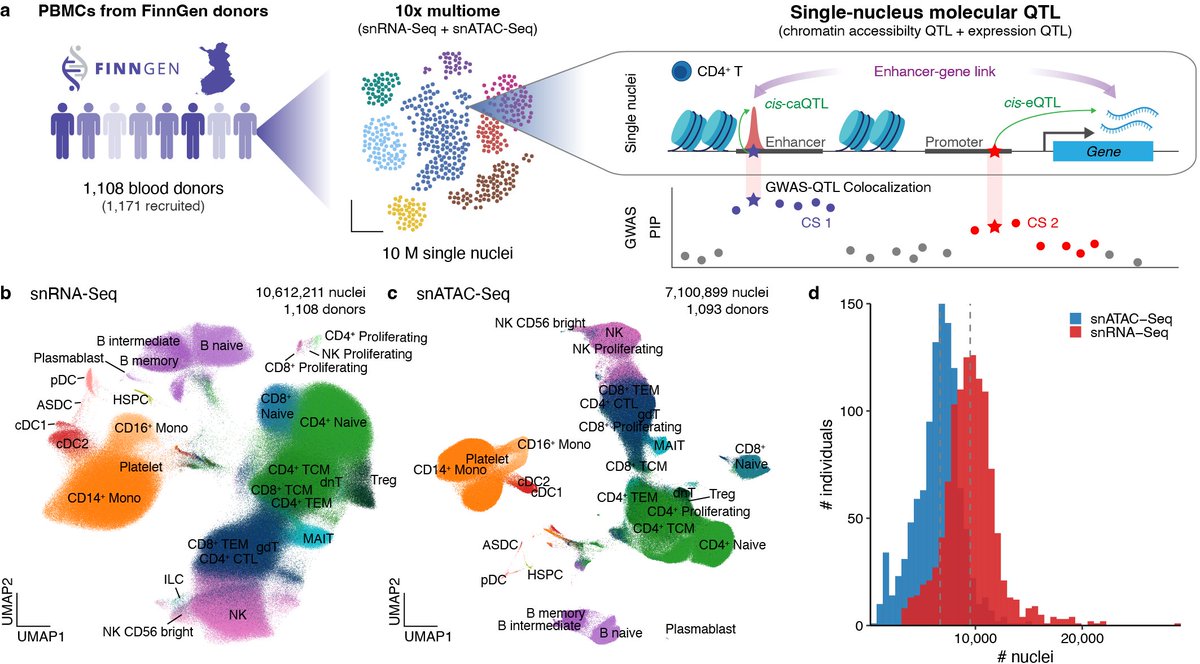
Our single-nucleus immune multiome atlas is now out in @Nature! 🧬
10M PBMCs from 1,108 @FinnGen_FI donors recruited by @FRCBSresearch, profiled at @broadinstitute KCO with chromatin accessibility and gene expression in the same nuclei, to trace how disease variants act 🧵👇
New work in @Nature with @dalygene led by @masakanai! We used population-scale chromatin and transcriptomic profiling of immune cells from FinnGen participants to connect disease-associated variants to gene regulation and disease risk.
https://t.co/DbgbzqAlZg
We teamed up with @HLahdesmaki to develop and validate PepGen, the first fully generative model capable of synthesizing MHCII peptide binders conditioned on allele, partial sequences, and continuous affinity
Read the results here: https://t.co/XnQaufD2lI
@broadinstitute
New preprint from our collaboration with @CarolineUhler at @broadinstitute on TissueFormer, a new tool for predicting spatial gene expression from histology images at cellular resolution
https://t.co/46D2T8YvKN
Out now in @NatureMicrobiol: Marie Pust and colleagues developed metastrand, a tool to quantify
strand-specific transcription in microbiomes at gene-level resolution, and used it to reveal
microbial adaptations associated with IBD.
https://t.co/wUY8I1dTu4
#metastrand#IBD
Building on our previous lung atlas, which identified pathogenic CTHRC1-high #fibroblasts enriched within fibrotic niches, this study further defines the molecular mechanisms that drive IPF.
https://t.co/8US6PY1gMD
@MGBResearchNews@MGHMolBio@broadinstitute
New work with @LabMedoff online now!
ADAMTS14 regulates YAP-driven fibroblast activation in IPF. We define an ADAMTS14–collagen V–focal adhesion pathway that contributes to #fibrosis, highlighting ADAMTS14 as a potential therapeutic target.
https://t.co/3TXkezIskX
Check out this @NatureMedicine Comment about the importance of studying heritage diets and the World Diet Initiative’s efforts to translate dietary diversity into health benefits for the global community:
https://t.co/2bor4AkOzC
It's that time of year again--we are saying goodbye to more of our youngest and brightest lab members as they transition to the next steps of their careers, either in grad school or in other institutions. This week, we are saying goodbye to Anna, Regan, and Tanvi.
New website launch for the World Diet Initiative—an international effort to map global dietary patterns and their impacts on human health.
The site is now accepting heritage diet submissions to build the open-access World Diet Atlas.
https://t.co/GGGfCiev0w
What the nose knows of cystic fibrosis microbes and hypertonic saline
Bouzek Previews work by @TheXavierLab presenting microbial gene atlas of nasopharyngeal swabs in infants w/cystic fibrosis & healthy controls & IDing impacts of clinical interventions
https://t.co/PeaLxgM4db