Introducing TimesFM-3, a state-of-the-art time series foundation model that enables accurate multivariate time series forecasting in a single forward pass, significantly outperforming other forecasting models across major benchmarks.
More on the blog →https://t.co/uSlnIdUJ4Q
Spent years building creator monetization at TikTok and YouTube. Now I'm on the other side.
First @studiojadu YouTube plaque just arrived in honor of 100k subscribers…
And we're already at 570k.
Onward. 💪
Unboxing video drop 🍿
Watch as @masoudl unwraps our 100k subscribers Silver Play Button…and we’re already halfway to 1 million! Thanks, and we’ll be hearing from you again soon, YouTube!
On maximizing Claude Code.
Early on, I spent time building reusable workflows/patterns.
Tedious to build, but this had a wild compounding effect as models and agent harnesses improved.
I think these effects will continue to compound exponentially.
No point in starting fresh every time you start a new project/feature.
Invest time building subagents, skills, commands, planning, MCP tools, context engineering patterns,...
Believe me when I tell you that they make a huge difference in how effective and productive you can be with Claude Code.
The best part is that all these workflows are transferable to other agents like Codex.
These days, I am mostly focusing on orchestration and automating code review. The workflows help a lot already, but I sometimes feel constrained by the current tools and environment. I like sandboxes and think they are going to enable a lot of the next wave of functionalities with these coding agents. I also think we are just touching the surface of context engineering and orchestrating agents. Git worktrees are great, but I am sure we can do better for scaling the work with coding agents.
It's exciting to see all the progress on long-context understanding and multimodality. Both are critical to unlock even more insane capabilities with these coding agents. The former is important to enable uninterrupted longer sessions, and the latter unlocks all sorts of visual cues and grounding that will help to build more creative and unique experiences.
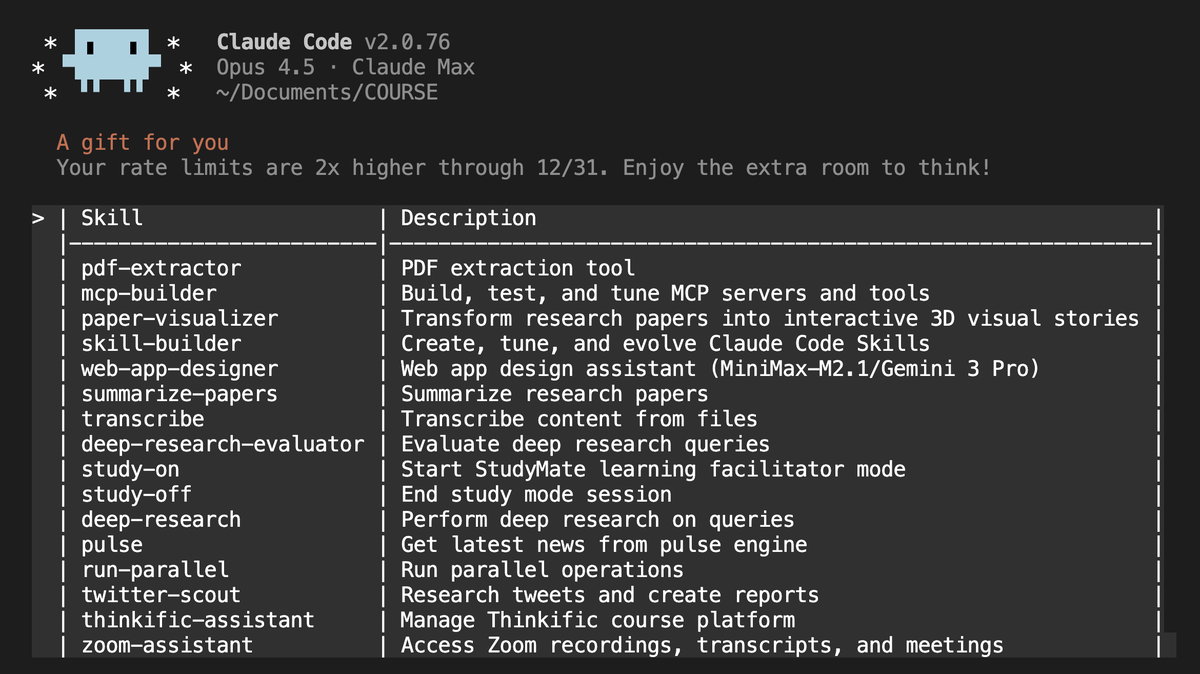
Below is a small snapshot of a few skills I have optimized and regularly use in Claude Code. All of these leverage different models and capabilities, which will only improve as capabilities are extended and models get better.
Excited for 2026 and hope to keep sharing more of my journey and keep learning from this awesome community.
New 3h31m video on YouTube:
"Deep Dive into LLMs like ChatGPT"
This is a general audience deep dive into the Large Language Model (LLM) AI technology that powers ChatGPT and related products. It is covers the full training stack of how the models are developed, along with mental models of how to think about their "psychology", and how to get the best use them in practical applications.
We cover all the major stages:
1. pretraining: data, tokenization, Transformer neural network I/O and internals, inference, GPT-2 training example, Llama 3.1 base inference examples
2. supervised finetuning: conversations data, "LLM Psychology": hallucinations, tool use, knowledge/working memory, knowledge of self, models need tokens to think, spelling, jagged intelligence
3. reinforcement learning: practice makes perfect, DeepSeek-R1, AlphaGo, RLHF.
I designed this video for the "general audience" track of my videos, which I believe are accessible to most people, even without technical background. It should give you an intuitive understanding of the full training pipeline of LLMs like ChatGPT, with many examples along the way, and maybe some ways of thinking around current capabilities, where we are, and what's coming.
(Also, I have one "Intro to LLMs" video already from ~year ago, but that is just a re-recording of a random talk, so I wanted to loop around and do a lot more comprehensive version of this topic. They can still be combined, as the talk goes a lot deeper into other topics, e.g. LLM OS and LLM Security)
Hope it's fun & useful!
https://t.co/75mXcUBI8L
@jordimash Hola Jordi. Seguidor/fan de la teva feina, tinc curiositat per saber el motiu d’imprimir-ho? Quin valor afegit té en comparació a mirar-ho a la pantalla. Gràcies
If you need to share an #ML model for web app development, create an #API instead of saving it to a file. This avoids environment and security issues, allows access from various languages and platforms, and simplifies integration. Here's how to make an ML API with FastAPI.
If you're looking for a Streamlit-style pattern in FastHTML, then this is the full code for a basic example with a form on the left and some results updated in real time on the right (just the form vals in this case):
https://t.co/6BtvKGTfUo