We have 3 new updates to Hivemind that are in service of our mission: making organizational agents more cost efficient and effective.
1. Proactive search experience for Claude Code + Cursor. After each user prompt, Hivemind automatically searches for relevant stored traces from the past and passes them to the agent as additional context. This improves reasoning and output.
2. Ability to share skills across teams and devices. Skill sharing is a simpler feature: it syncs the skills a user already has in their system through Deeplake, so everyone on the team can access them. Previously, we were more focused on generating and improving skills. This is about sharing existing skills across the team.
3. Ability to create and assign goals. Any teammate can create and assign goals to another that can persist across sessions until marked completed. Agents can automatically reason when the goal has been reached, and will notify the creator of the goal automatically.
All of these new features work to level up your team, reduce errors and redundant work and lower AI token spend.
Get set up with one command line install.
today, we're going beyond memory.
your org's agents shouldn't just remember what happened. they should learn from their experience.
Hivemind takes agent traces and codifies them into skills every agent on your team can use.
> no more explanations
> no more duplicate work
> no more repeat bugs
we make your intelligence compound.
here's how 👇
Engineering managers shouldn’t have to play detective every morning.
But too often, that’s the job:
standups get skipped
tickets stay stale
and status updates become a scavenger hunt.
What if your tools just told you what changed?
An AI layer across Claude Code, Codex, and OpenClaw could surface progress, blockers, and momentum automatically.
No nagging required.
You get your mornings back.
Engineers feel less monitored.
Everyone stays in sync.
Jack's right: "Companies move fast or slow based on information flow." But framing it as a worker hierarchy problem is losing the plot.
Look at where the actual work is moving: agents.
Quick history:
Email got messy. Slack fixed it.
Then humans kept dropping balls anyway. Someone's offline, a thread dies, marketing has no idea what eng shipped, the handoff never happens.
And now Slack itself is the slog. What if you could spend a fraction of the time in it?
Meanwhile, your agents are in the pre-Slack era:
• Your Claude Code agent has no clue what your coworker's OpenClaw agent decided yesterday.
• Marketing's agent can't see what sales's agent promised the customer.
• Product's agent has no idea what engineering's agent already shipped.
Same company, same project, totally separate brains. The fastest workers on your team are stuck on the slowest part of your stack.
Deeplake Hivemind fixes it. One install and your agents share memory across sessions, across teammates, across tools: Claude Code, OpenClaw, Codex, whatever.
When one agent learns something, every agent on your team knows.
No Slack pings. No status updates. No "wait, did you tell the VP?"
Just shared context, flowing automatically.
Slack was for humans. Hivemind is for the things actually doing the work now.
Comment HIVEMIND and we'll DM you $100 in free credits. Run the experiment with your crew.
@garrytan@garrytan you should give a try to https://t.co/dpCnPcgJOq
We made serverless postgres that scales with your agents. Would be awesome to make it part of gstack :)
you can get started with the deeplake skill
https://t.co/Dse2U44cME
Here is a banger article on how to make Postgres serverless for AI Agents.
The rules:
- spin up per request
- scale reads and writes
- drop to zero when idle
- no state tied to machines
- keep Postgres, rethink storage engine
What we got:
~14s cold start → ~1s
Databases in ~200ms
Stateless pods,
infinite horizontal scale
Postgres is the interface.
Deeplake is storage.
DuckDB is execution.
The system looks simple in hindsight.
But every piece breaks a default assumption.
This might be the simplest way to run databases for agents:
Make compute ephemeral. Make storage immutable. Let scaling be automatic.
Here’s how we built it. Link below
Jensen just announced the start of the GPU-accelerated database era at #GTC26.
AI runs on GPUs. But your data still runs on CPUs.
That mismatch is breaking the AI stack.
For the last two months, we’ve been busy solving this problem.
Excited to announce Deeplake becoming the GPU Database.
Deeplake brings your database directly onto the GPU, eliminating the CPU <-> GPU bottleneck for AI workloads.
The pendulum has switched.
GPU-native queries are now 10× faster and an order of magnitude cheaper to run.
Last week we even put up a 101 banner in San Francisco.
And this is just the beginning.
We’re planning a huge set of announcements starting this week. Stay tuned.
Flash Attention 4 moved to a Python DSL to make life easier. Last night, I rewrote it back into raw C++ CUTE just to get it running on my DGX Spark.
Here’s the 5x optimization arc from an sm_121 CUDA mismatch to matching PyTorch's speed from scratch.
How it started? Tried to load flash-attn-4 to play around, but there was CUDA mismatch. Obviously V4 is optimized for B200, so bunch of assert arch // 10 in [9, 10, 11] checks blocking sm_121.
Patched those. Then hit tcgen05 MMA ops - tensor core instructions that only exist on data center Blackwell (sm_100–sm_110).
Data center Blackwell (B200) has slightly different instruction paths/silicon than desktop Blackwell (GB10). Dead end.
But C++ CUTLASS works on sm_121. Confirmed with a GEMM smoke test 31.5 TFLOPS with NVFP4. Game on.
So I said screw it, let's rewrite Flash Attention from scratch using CuTe MMA primitives in raw CUDA C++.
v1 The naive version:
- SM80 MMA atoms (SM80_16x8x16_F32F16F16F32_TN)
- Softmax via shared memory (2 full smem round-trips, ~90 KB/iter)
- Scalar loads, no async
- Result: 9.6 TFLOPS non-causal, 12.8 TFLOPS causal
- Non-causal passed vs PyTorch immediately. Causal had a nasty bug. CuTe's MMA fragment N-repetition ordering doesn't match sequential column indices. Took a while to crack that one. Fixed with make_identity_tensor + partition_C for correct coordinate mapping.
v2 Register GEMM2 + smaller smem footprint: - P stays in registers, converted fp32→fp16 with CuTe layout reinterpretation - Shared memory: 48KB → 32KB (sQ + sK only, no sP/sVtmp)
- Enables 3 blocks/SM occupancy (up from 2) - Result: 11.9 TFLOPS non-causal (+24%), causal regressed slightly (lost async V pipeline overlap)
v3 The real deal (swizzle + ldmatrix + register pipeline):
- Swizzled smem layouts bank-conflict-free
- LdMatrix for smem -> reg (including transposed V)
- cp.async for gmem -> smem
- Register pipeline overlapping smem copies with MMA
- Online softmax with exp2 and scale_log2
v3 matches or beats PyTorch SDPA. 5.35x faster than v1. Both causal and non-causal pass correctness.
Even tried v4 with TMA (tensor memory accelerator) to match the FA4 paper's approach. Turns out TMA on GB10 has higher latency for small tiles vs cp.async with 128 threads doing parallel 16B copies. cp.async won. Not every technique transfers to every chip.
The whole journey: CUDA mismatch -> dead end -> "let me just write it from scratch" -> 5x optimization arc -> matching PyTorch in few hours.
SM121 has everything you need if you go C++ CUTLASS instead of the Python DSL.
Of course, those are modest results compared to B200 ~1,600 TFLOPS. Impressive work by Ted Zadouri @tedzadouri, Markus Hoehnerbach, Jay Shah(@ultraproduct), Timmy Liu, Vijay Thakkar (@__tensorcore__), Tri Dao (@tri_dao)
here is their paper https://t.co/Xedl4P8lVD
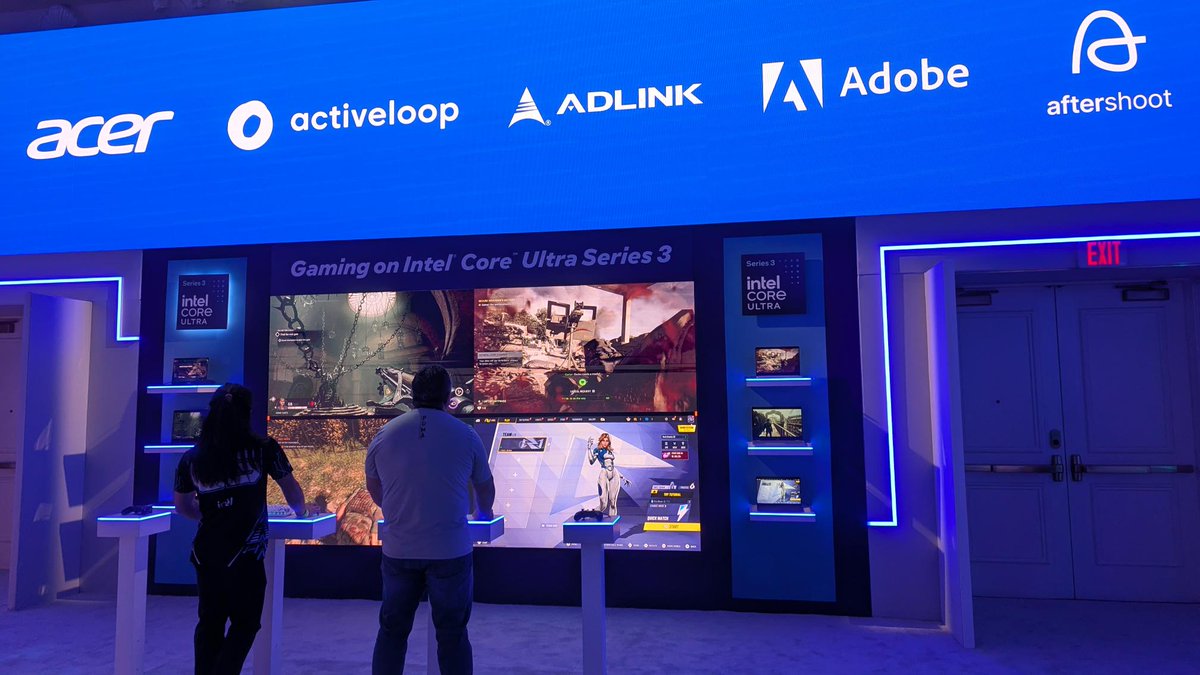
@activeloop and Pinkbot achieved 9× faster VLM reasoning throughput with @intel newest chips, unveiled at #CES2026.
As Physical AI takes on increasingly complex tasks, vision-language models enable robots not just to see, but to perceive and reason.
While perception now runs in near real time, VLM reasoning operates on a longer horizon, giving delivery robots the context needed for higher-stakes decisions such as when to cross the street.
At @activeloop we were among the first partners to run on Intel Corporation Panther Lake.
Intel's Panther Lake combined with Activeloop's Deep Lake multimodal storage enables fast perception with deep reasoning, making VLM-driven intelligence practical for last-mile robots.
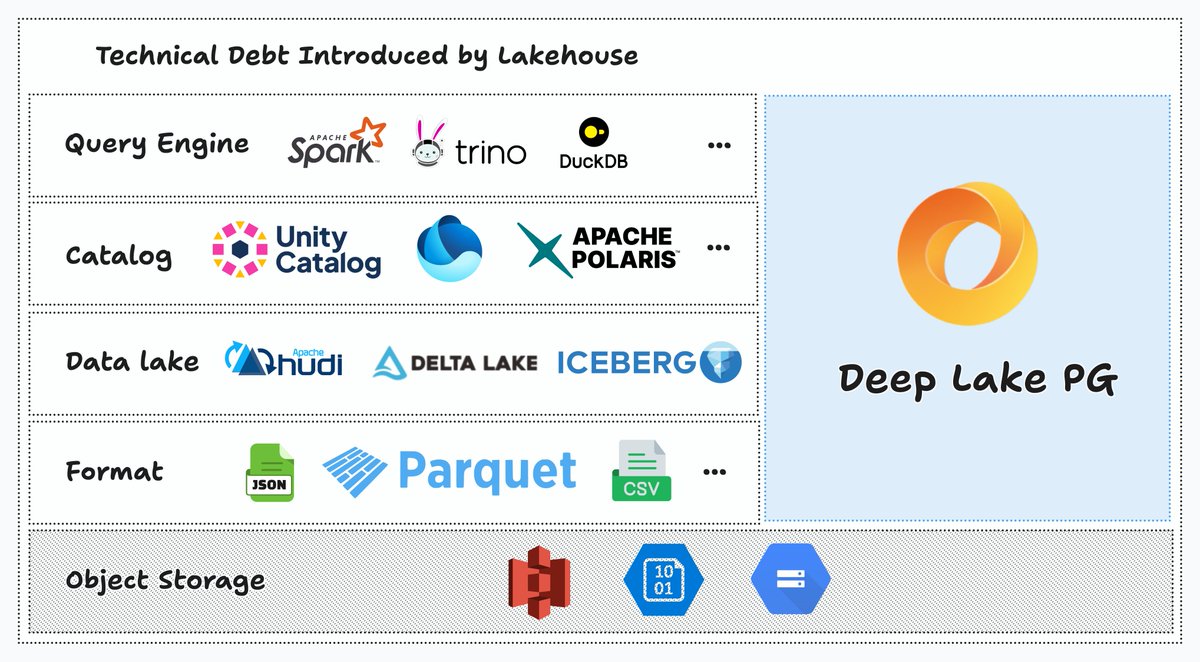
Today excited to open-source Deep Lake PG = Postgres + Deep Lake
Biggest bottleneck of AI having impact on GDP is unlocking data in Enterprises.
Every AI team I know is stitching Postgres → Vector DB → Warehouse → Lakehouse → Catalog.
All to give their agents basic memory and reasoning.
We replaced the entire data ecosystem with one database.
Deep Lake PG is now open source.
Stateless + multimodal knowledge + SQL queries + vectors in a single place.
Build on top of the database that powers our own Scientific Agent, a trove of 175TB+ of multimodal data.
The Genesis Mission calls for new ways to accelerate scientific discovery.
This is our contribution
Multimodal search across 25M papers is a step toward science discovery that moves at the speed of curiosity.
Releasing,
- Visually indexed scientific paper dataset with open access 25M papers, 450M+ visually indexed pages. Total 175TB+. All on Deep Lake
- Open-source scientific data agent that achieves 48% SOTA on Humanity's Last Exam with tools including the indexed scientific research dataset.
Excited to see what discoveries you all uncover with this.
Try it and share your most interesting findings.
Your GTM ops team wastes 70% of its time on manual data prep. It’s time to fix it. The endless cycle of manual data preparation, integration, and reconciliation.
We’re introducing Activeloop to unlock AI Data Analysis for GTM Operations.
Happy to share that AI Analyst is now available! It pulls together data from CRMs, ERPs, Slack threads and call transcripts into one unified view of your business.
Spoke to dozens of GTM leaders at large enterprises. All are frustrated by the same thing: their data is everywhere, but insights are nowhere.
At Activeloop today, we are unlocking AI Data Analysis form data silos towards Vibing intelligence.
I vibe animated a Pixar-quality @activeloop-L0 release video for Launch @ycombinator over weekend. Here is how,
AI has shifted the challenge entirely to taste.
Normally, professional animations cost 5-6 figures and take months — requiring teams of writers, animators, editors, and audio engineers.
With AI tools, I did it alone in just one day:
1. Script: @openai GPT-4.5 (Canvas mode)
2. Voice-over: @elevenlabs
3. Music: @aivatechnology Lyra
4. Images: @midjourney 6.1
5. Animation: @runwayml Gen 4
6. Editing: iMovie (lol)
What previously required massive budgets and large teams is now achievable solo, under $30. Particularly amazed on Aiva's music generation capabilities.
One missing piece: a true "Cursor for Video" offering total creative control. Can't wait to see that.





![DBuniatyan's tweet photo. Flash Attention 4 moved to a Python DSL to make life easier. Last night, I rewrote it back into raw C++ CUTE just to get it running on my DGX Spark.
Here’s the 5x optimization arc from an sm_121 CUDA mismatch to matching PyTorch's speed from scratch.
How it started? Tried to load flash-attn-4 to play around, but there was CUDA mismatch. Obviously V4 is optimized for B200, so bunch of assert arch // 10 in [9, 10, 11] checks blocking sm_121.
Patched those. Then hit tcgen05 MMA ops - tensor core instructions that only exist on data center Blackwell (sm_100–sm_110).
Data center Blackwell (B200) has slightly different instruction paths/silicon than desktop Blackwell (GB10). Dead end.
But C++ CUTLASS works on sm_121. Confirmed with a GEMM smoke test 31.5 TFLOPS with NVFP4. Game on.
So I said screw it, let's rewrite Flash Attention from scratch using CuTe MMA primitives in raw CUDA C++.
v1 The naive version:
- SM80 MMA atoms (SM80_16x8x16_F32F16F16F32_TN)
- Softmax via shared memory (2 full smem round-trips, ~90 KB/iter)
- Scalar loads, no async
- Result: 9.6 TFLOPS non-causal, 12.8 TFLOPS causal
- Non-causal passed vs PyTorch immediately. Causal had a nasty bug. CuTe's MMA fragment N-repetition ordering doesn't match sequential column indices. Took a while to crack that one. Fixed with make_identity_tensor + partition_C for correct coordinate mapping.
v2 Register GEMM2 + smaller smem footprint: - P stays in registers, converted fp32→fp16 with CuTe layout reinterpretation - Shared memory: 48KB → 32KB (sQ + sK only, no sP/sVtmp)
- Enables 3 blocks/SM occupancy (up from 2) - Result: 11.9 TFLOPS non-causal (+24%), causal regressed slightly (lost async V pipeline overlap)
v3 The real deal (swizzle + ldmatrix + register pipeline):
- Swizzled smem layouts bank-conflict-free
- LdMatrix for smem -> reg (including transposed V)
- cp.async for gmem -> smem
- Register pipeline overlapping smem copies with MMA
- Online softmax with exp2 and scale_log2
v3 matches or beats PyTorch SDPA. 5.35x faster than v1. Both causal and non-causal pass correctness.
Even tried v4 with TMA (tensor memory accelerator) to match the FA4 paper's approach. Turns out TMA on GB10 has higher latency for small tiles vs cp.async with 128 threads doing parallel 16B copies. cp.async won. Not every technique transfers to every chip.
The whole journey: CUDA mismatch -> dead end -> "let me just write it from scratch" -> 5x optimization arc -> matching PyTorch in few hours.
SM121 has everything you need if you go C++ CUTLASS instead of the Python DSL.
Of course, those are modest results compared to B200 ~1,600 TFLOPS. Impressive work by Ted Zadouri @tedzadouri, Markus Hoehnerbach, Jay Shah(@ultraproduct), Timmy Liu, Vijay Thakkar (@__tensorcore__), Tri Dao (@tri_dao)
here is their paper https://t.co/Xedl4P8lVD](https://pbs.twimg.com/media/HCwtDKzaQAAKatF.png)